Indian Plum (Oemleria cerasiformis)
Oemleria cerasiformis, commonly known as Indian Plum, is a remarkable native shrub that heralds the arrival of spring in the Pacific Northwest. As one of the earliest plants to bloom and leaf out each year, this member of the rose family (Rosaceae) provides critical early-season resources for pollinators and wildlife when few other food sources are available. Its cascading clusters of small white flowers and distinctive cucumber-scented leaves make it both ecologically valuable and aesthetically appealing in native landscape designs.
Indian Plum occupies a unique ecological niche as a “spring ephemeral” woody plant—it completes much of its reproductive cycle before the forest canopy fully leafs out and blocks available sunlight. This fascinating adaptation allows it to thrive as an understory species while maximizing its access to early-season light. The shrub’s dioecious nature (separate male and female plants) adds another layer of ecological complexity, with only female plants producing the bitter-sweet fruits that give the species its common name.
Quick Facts
| Scientific Name | Oemleria cerasiformis |
| Family | Rosaceae (Rose) |
| Plant Type | Deciduous Shrub |
| Mature Height | 16 ft |
| Spread | 6–12 ft |
| Growth Rate | Moderate to Fast |
| Sun Exposure | Full Sun to Part Shade |
| Water Needs | Low to Moderate |
| Soil Type | Well-drained, adaptable |
| Soil pH | 5.5–7.5 (adaptable) |
| Bloom Time | February – April |
| Flower Color | White |
| Fruit | Blue-black drupes (female plants only) |
| Fall Color | Yellow to orange |
| Deer Resistant | Moderately (deer may browse) |
| USDA Hardiness Zones | 6–9 |
Identification
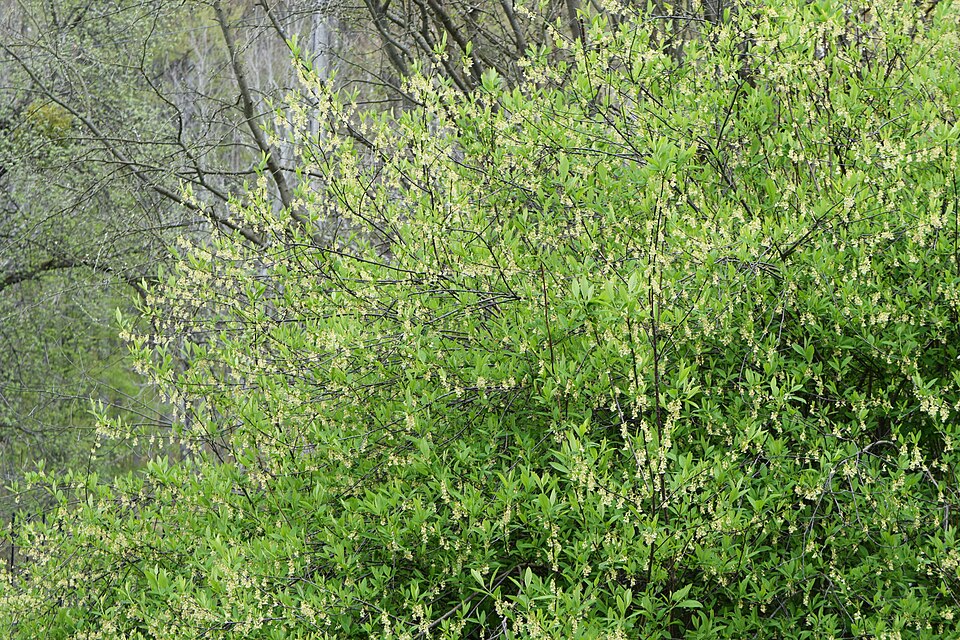
Indian Plum typically grows as a multi-stemmed deciduous shrub reaching 8 to 15 feet in height, though exceptional specimens can reach 25 feet. The plant often forms colonies through root sprouting, creating natural thickets that provide excellent wildlife habitat. The bark is smooth and dark gray to reddish-brown on older stems, while younger twigs display a characteristic greenish to reddish-brown coloration with prominent orange lenticels (breathing pores) that can be up to ½ inch long.
Leaves
The leaves are one of Indian Plum’s most distinctive features. They are simple, alternate, and oblong to elliptic, measuring 2 to 5 inches long and 1 to 2 inches wide. What makes them truly memorable is their distinctive cucumber-like fragrance when crushed—a reliable identification feature throughout the growing season. The leaves emerge early, often in late February or March, well before most other deciduous plants begin leafing out. Fall color is typically yellow to orange, providing moderate autumn interest.
Flowers
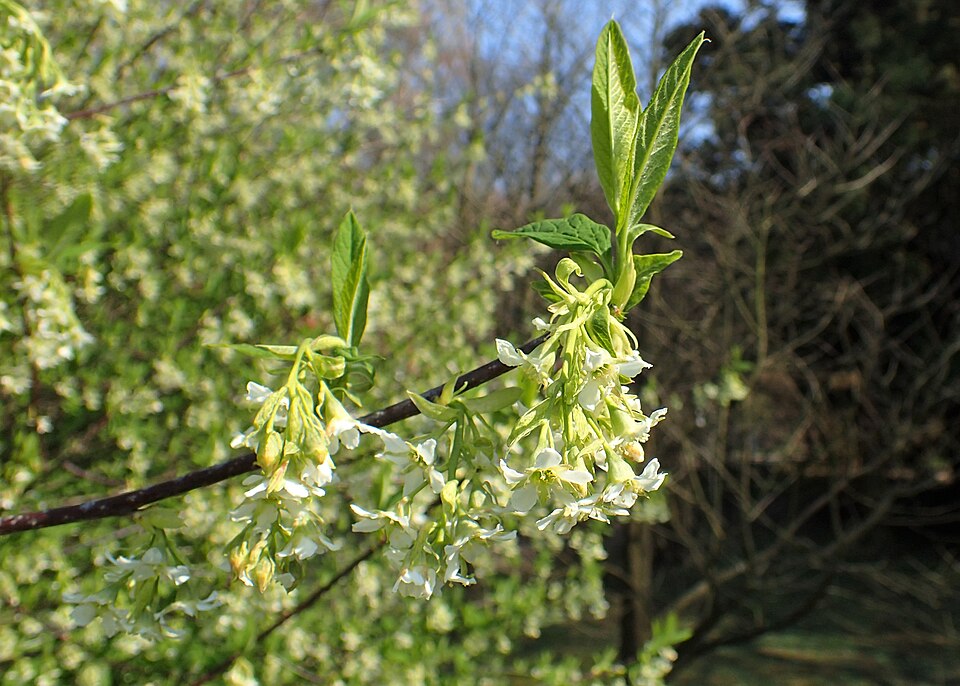
Indian Plum produces some of the earliest flowers of any Pacific Northwest native plant, blooming from February through April. The small white flowers are arranged in drooping racemes of 5 to 10 blooms each, hanging gracefully from the branches like delicate chandeliers. Individual flowers are about ¼ to ½ inch across with 5 white petals and prominent stamens. Because Indian Plum is dioecious, male and female flowers occur on separate plants, with male flowers typically being more numerous and showy due to their prominent stamens.
Fruit
Only female plants produce fruit, which develops from July through September. The small drupes (stone fruits) start reddish-pink and mature to dark blue or blue-black, each containing a single seed. The fruits are initially quite bitter due to compounds similar to those found in bitter almonds, but they become sweeter as they fully ripen. Indigenous peoples traditionally harvested and used these fruits, often after processing to reduce bitterness.
Native Range
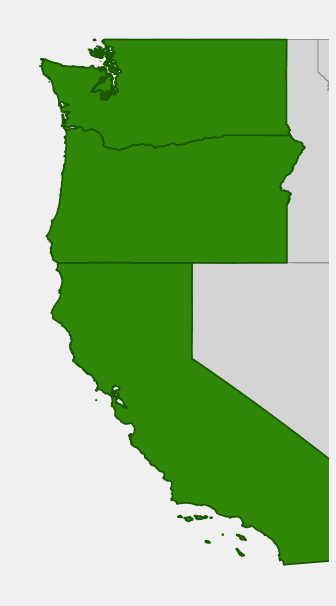
Native range of Indian Plum. USDA (County-Level Data)
Indian Plum has an extensive Pacific Coast distribution, ranging from southwestern British Columbia south through Washington, Oregon, and into northern California, reaching as far south as Santa Barbara County. It primarily occurs west of the Cascade Range crest but extends eastward along major river valleys, particularly the Columbia River Gorge. The species typically grows at elevations from sea level to about 5,000 feet, with optimal habitat between 1,000 and 3,000 feet elevation.
This wide latitudinal distribution reflects the species’ remarkable adaptability to varying climate conditions while maintaining its preference for the temperate maritime climate of the Pacific Coast. Fossil evidence suggests that Indian Plum has maintained a similar range since the Eocene epoch, making it one of the oldest continuously present native plants in the Pacific Northwest.
📋 Regional plant lists featuring Indian Plum: Western Oregon & Western Washington
Growing & Care Guide
Indian Plum is among the most adaptable and low-maintenance native shrubs for Pacific Northwest gardens. Its natural resilience and early-season interest make it an excellent choice for naturalistic landscapes, wildlife gardens, and restoration projects.
Site Selection
Choose a location that receives full sun to partial shade. Indian Plum performs best with morning sun and some afternoon protection in hotter climates, but adapts well to a variety of light conditions. The plant naturally occurs in forest edges, clearings, and along stream terraces, suggesting it appreciates some protection from the hottest afternoon sun while still receiving adequate light for flowering.
Soil Requirements
This species is remarkably adaptable to different soil types, growing successfully in sandy, loamy, or clay soils as long as drainage is adequate. While it prefers slightly acidic to neutral pH (5.5-7.5), it tolerates a wider range than many natives. Good drainage is more important than specific soil composition—avoid planting in areas that stay waterlogged during winter months.
Water Needs
Once established, Indian Plum is quite drought tolerant, reflecting its adaptation to Pacific Northwest summers with their characteristic dry period. During the first year, provide regular water to encourage establishment, then gradually reduce watering frequency. Mature plants typically require no summer irrigation in most Pacific Northwest locations, though they may benefit from occasional deep watering during extended dry periods.
Planting & Establishment
Plant in fall or early spring. Dig a hole twice as wide as the root ball but no deeper, as shallow planting promotes better root establishment. Indian Plum has fibrous roots that spread relatively close to the surface, making it excellent for erosion control on slopes. Space plants 8-12 feet apart if creating a naturalized grouping.
Pruning & Maintenance
Minimal pruning is required. If desired, light pruning can be done immediately after flowering to maintain shape or control size. Because the plant blooms on old wood, avoid late-season pruning that would remove next year’s flower buds. Indian Plum has a tendency to form colonies through root sprouting—this can be encouraged for naturalized plantings or controlled by removing unwanted shoots.
Landscape Uses
- Wildlife gardens – exceptional early nectar source
- Erosion control – fibrous root system stabilizes slopes
- Naturalized areas – forms attractive thickets over time
- Seasonal interest – early spring flowers, fall fruit
- Restoration projects – pioneer species for disturbed sites
- Rain gardens – tolerates periodic wet conditions
Wildlife & Ecological Value
Indian Plum’s greatest ecological contribution lies in its role as an early-season resource provider. When most plants are still dormant, Indian Plum offers crucial nectar and pollen to emerging pollinators and nesting materials to early-breeding birds.
For Pollinators
The early flowers provide essential nectar and pollen for native bees, including mason bees, mining bees, and early bumble bee queens establishing new colonies. Honeybees also visit extensively when weather permits. The abundance of male flowers produces copious pollen, while both male and female flowers provide nectar. This early-season bounty can literally mean the difference between survival and starvation for overwintering pollinators.
For Birds
The fruits are consumed by numerous bird species, including American robins, cedar waxwings, Steller’s jays, and various thrush species. More importantly, the early leaf-out provides some of the first insect habitat of the season, supporting the aphids, caterpillars, and other small arthropods that feed early-nesting birds. The dense branching structure also provides excellent nesting sites for small songbirds.
For Mammals
Black bears, coyotes, and foxes consume the fruits when available. Deer and elk browse the foliage, particularly in winter and early spring when other food sources are scarce. Small mammals including squirrels and chipmunks also harvest and cache the fruits.
Ecological Succession Role
Indian Plum functions as a pioneer species, quickly colonizing disturbed sites and helping prepare them for later successional species. Its ability to form colonies through root sprouting helps stabilize soil and create favorable microclimates for tree seedlings. In forest restoration, Indian Plum often serves as a “nurse plant” that shelters and facilitates the establishment of longer-lived species.
Cultural & Historical Uses
Pacific Northwest Indigenous peoples have utilized Indian Plum for thousands of years. The fruits were harvested in summer and used fresh or dried for winter storage. Traditional preparation methods often involved mixing the bitter fruits with sweeter foods or processing them to reduce astringency. The inner bark was used medicinally to treat various ailments, and the straight shoots were valued for making arrows and other tools.
The wood is exceptionally dense and strong despite the small diameter of most stems. While limited to small-scale applications by the shrub’s size, Indian Plum wood was prized for items requiring strength and durability, such as digging sticks, arrow shafts, and small carved implements.
Today, Indian Plum is increasingly valued in restoration ecology and sustainable landscaping. Its ability to rapidly colonize disturbed sites makes it valuable for erosion control and habitat restoration, while its early-season flowers make it essential for supporting native pollinator populations.
Frequently Asked Questions
How fast does Indian Plum grow?
Indian Plum has a moderate growth rate under optimal conditions. Growth varies depending on soil moisture, light levels, and climate conditions. In favorable sites with adequate water and appropriate light, you can expect steady annual growth that will establish a mature specimen within several years.
Is Indian Plum deer resistant?
Like most native plants, Indian Plum may be browsed by deer, especially during winter months when other food sources are scarce. However, established plants are generally resilient to occasional browsing. Consider using physical barriers for young plants in areas with heavy deer pressure.
When is the best time to plant Indian Plum?
Fall planting is ideal for Indian Plum, as it allows the root system to establish during the cool, moist winter months before the stress of summer heat. Early spring planting is also successful if you can provide consistent watering through the first growing season.
Does Indian Plum need special soil conditions?
Indian Plum performs best in conditions that mimic its natural habitat. While adaptable to various soil types, it thrives in well-drained soil with adequate organic matter. Match the moisture and pH conditions of its native range for optimal health and growth.
Can Indian Plum be grown in containers?
Young Indian Plum plants can be successfully grown in containers for a time, making them suitable for patios, decks, or as temporary plantings. However, for long-term health and full development, transplanting to the ground is recommended once the plant reaches maturity.

Looking for a nursery that carries Indian Plum?
Browse our native plant nursery directory: Oregon · Washington