Shagbark Hickory (Carya ovata)
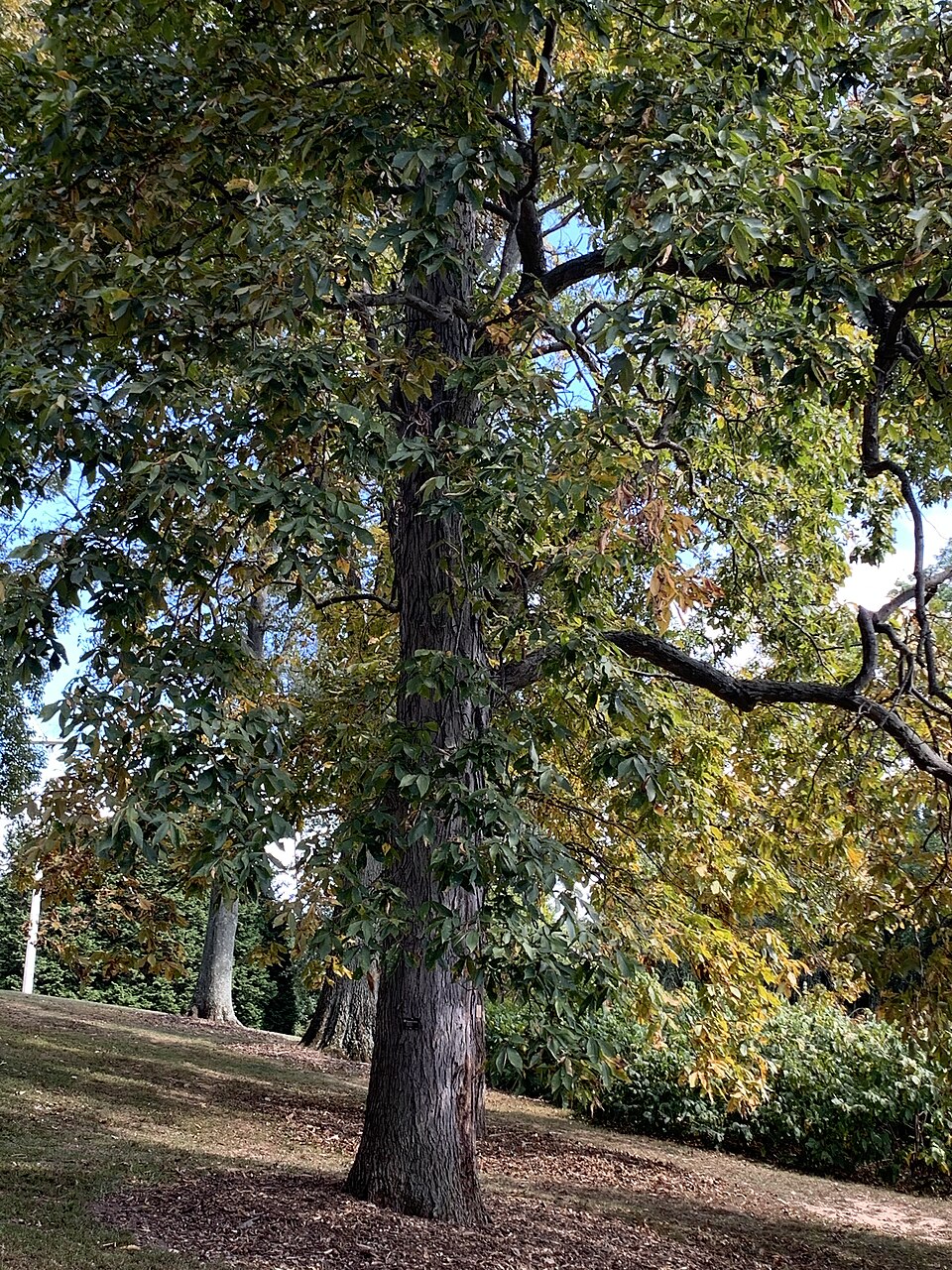
Carya ovata, the Shagbark Hickory, is one of eastern North America’s most striking and ecologically important native trees, instantly recognizable by its spectacular bark — long, curved, loose-hanging plates of gray bark that peel away from the trunk in shaggy strips, giving the tree a distinctive “shaggy” appearance unlike any other native tree. This large, majestic deciduous tree grows 75 to 100 feet tall and provides an exceptional combination of wildlife value, autumn color, edible nuts, and landscape character that has made it a beloved species throughout its range from the Great Plains to New England.
The nuts of Shagbark Hickory are among the most flavorful of any native North American tree — sweet, rich, and highly nutritious. They are eaten eagerly by squirrels, chipmunks, Wild Turkeys, Wood Ducks, and dozens of other wildlife species. The nuts also have a long history of human use by Indigenous peoples and early colonists, who made hickory nut oil for cooking and pressed the ground nuts into a rich, calorie-dense food called “pawcohiccora” — the likely origin of the word “hickory.” The wood of Shagbark Hickory is exceptionally tough, flexible, and shock-resistant, and was the material of choice for tool handles, wagon wheels, and early baseball bats.
Despite being a slow-growing species that requires patience in the landscape, Shagbark Hickory delivers long-term value that few other trees can match. Its vibrant yellow to golden-brown autumn color, unique architectural bark, significant wildlife value, and ability to anchor multi-generational landscapes make it a premier choice for large properties, parks, woodland gardens, and any native landscape with room for a canopy-scale tree.
Identification
Shagbark Hickory is a large deciduous tree typically reaching 75 to 100 feet (23–30 m) in height, with exceptional specimens approaching 120 feet. The crown is narrow and somewhat open in youth, developing a broader, irregular, somewhat open canopy with age. The trunk is straight and often quite large in diameter — old trees can have trunks 3 to 4 feet in diameter. The overall form is tall, stately, and impressive.
Bark
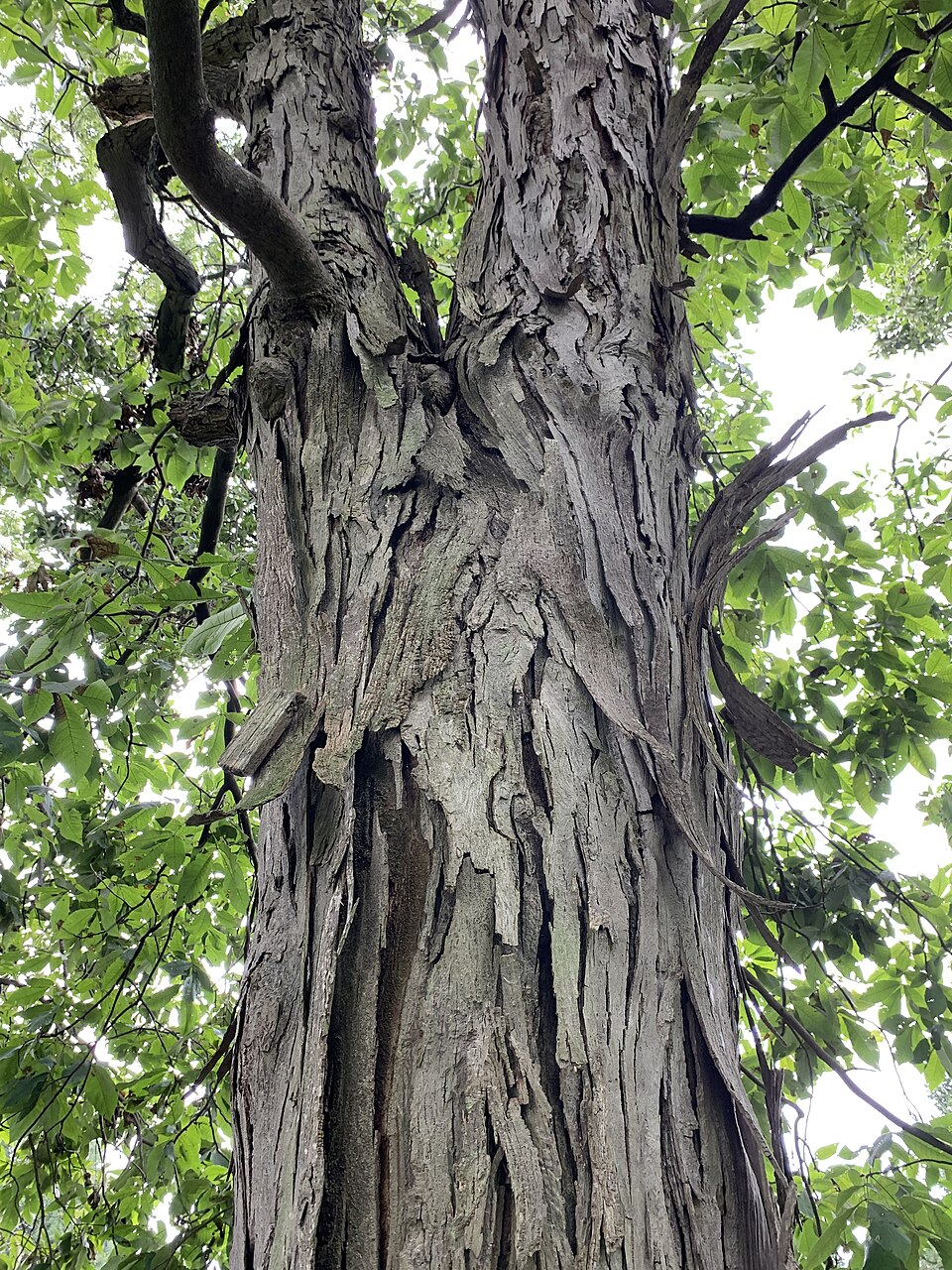
The bark is Shagbark Hickory’s signature feature and is unlike any other native tree. On young trees (under about 25–30 years), the bark is relatively smooth and grayish-brown. As the tree matures, the outer bark separates into long, thick, curved plates (called “scales” or “shags”) that lift away from the trunk at both ends while remaining attached in the middle, creating the characteristic shaggy, plated appearance that gives the species its name. These loose bark plates can be 6 to 12 inches long and create an immediately recognizable silhouette. The shaggy bark provides important roosting habitat for several species of bats.
Leaves
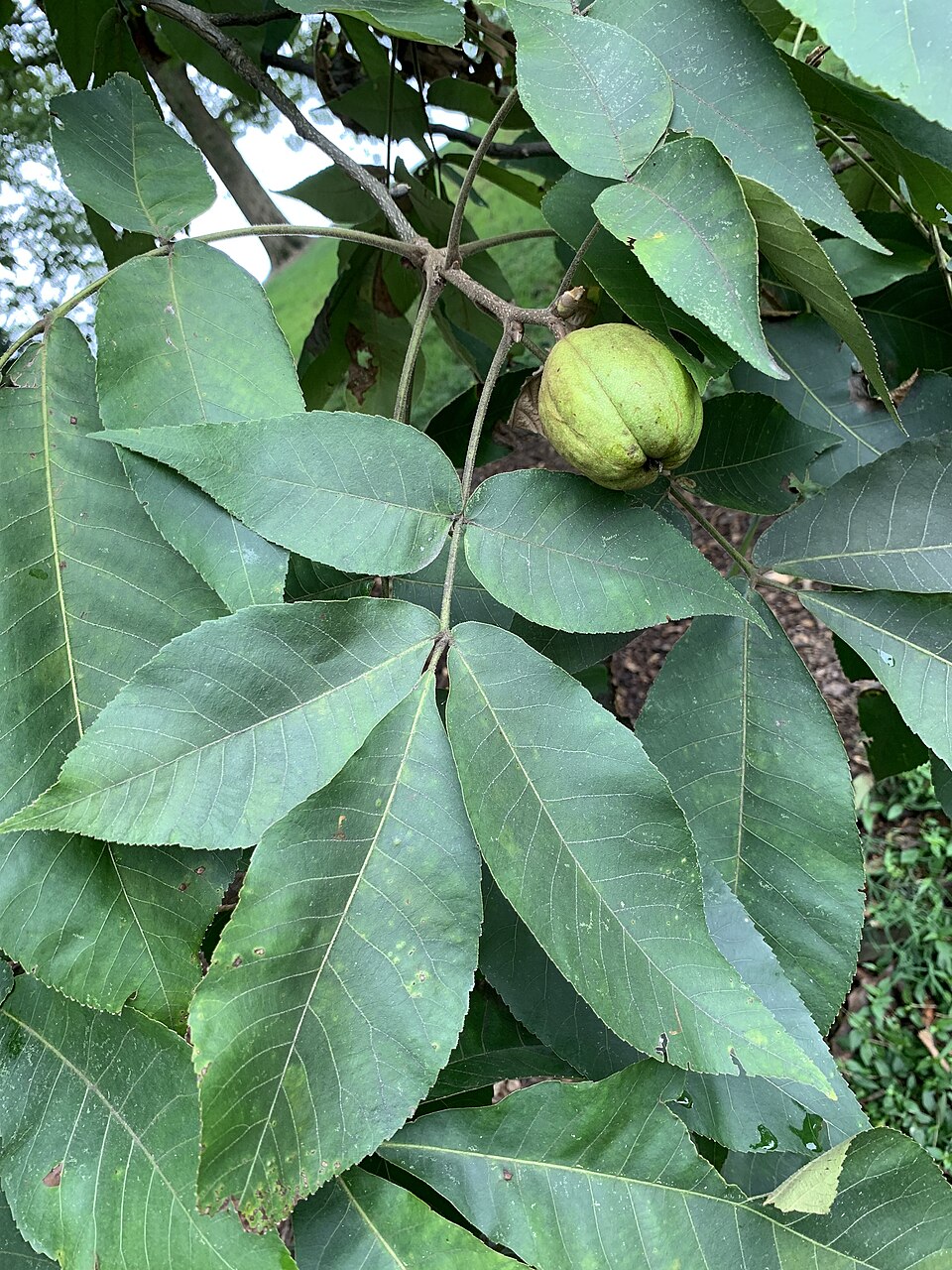
The leaves are large, pinnately compound, typically 8 to 14 inches (20–35 cm) long, composed of 5 leaflets (occasionally 7). The terminal leaflet is the largest, often 4 to 7 inches long. Leaflets are oval to lance-shaped with finely toothed margins, dark green on top and paler below, and covered with tufts of hair along the midrib and margins (particularly the terminal leaflet). In autumn, the foliage turns a brilliant yellow to golden-brown — one of the most striking fall color displays of any native tree. The leaves have a spicy, distinctive fragrance when crushed.
Nuts & Husks
The nuts are enclosed in a distinctive 4-valved husk that splits cleanly from top to bottom at maturity in September–October. The husk is thick (¼ inch or more), round to slightly flattened, and splits into 4 sections that release the nut cleanly. The nut itself is rounded to oval, 1 to 1½ inches long, with a pale tan to grayish shell and sweet, edible kernel. Shagbark Hickory produces the best-flavored nut of any native hickory — significantly sweeter than Bitternut, Pignut, or Mockernut hickory — and is the species most commonly harvested for human consumption.
Quick Facts
| Scientific Name | Carya ovata |
| Family | Juglandaceae (Walnut) |
| Plant Type | Deciduous Tree |
| Mature Height | 75–100 ft |
| Sun Exposure | Full Sun to Part Shade |
| Water Needs | Moderate |
| Bloom Time | April – May (catkins) |
| Fall Color | Yellow to golden-brown |
| Fruit | Sweet, edible nut; ripens Sept–Oct |
| Growth Rate | Slow (6–12 in/year) |
| USDA Hardiness Zones | 4–8 |
Native Range
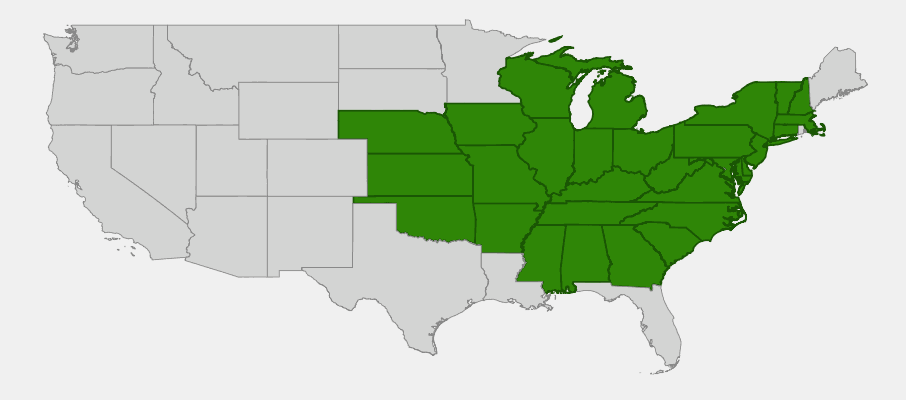
Shagbark Hickory is native to a broad swath of eastern and central North America, from southern New England south through the Appalachians to Georgia and Alabama, and west through the Midwest to Kansas, Nebraska, and the eastern Dakotas. Its range centers on the eastern deciduous forest biome, where it is most abundant in the central Appalachians, the Ohio River valley, and the upper Midwest. It is most common on well-drained upland soils — ridgetops, slopes, and upland flats — where it is a characteristic component of oak-hickory and mixed mesophytic forest communities.
In the Great Lakes region, Shagbark Hickory is a common component of upland oak-hickory woodlands, growing alongside White Oak (Quercus alba), Bur Oak (Quercus macrocarpa), and other hickory species. In Michigan, Wisconsin, and Minnesota, it occurs primarily in the southern portions of these states where upland deciduous forests predominate. The tree is notably absent from the cooler boreal forest zones of northern Minnesota and the Upper Peninsula of Michigan, where the climate is too cold for productive nut development.
Shagbark Hickory is a long-lived species — trees of 200 to 300 years are documented, and the species is considered a climax forest species in oak-hickory communities. Its large, heavy nuts are dispersed primarily by squirrels and other rodents through caching behavior, which has shaped the tree’s evolutionary ecology and its relationship with forest animal communities across its range.
📋 Regional plant lists featuring Shagbark Hickory: Michigan, Minnesota & Wisconsin
Growing & Care Guide
Shagbark Hickory is a long-term investment — slow-growing but exceptionally rewarding. Plant it knowing that future generations will benefit from the magnificent tree you establish today. Once sited correctly, it is a remarkably tough, low-maintenance, long-lived landscape tree.
Light
Shagbark Hickory grows best in full sun to part shade. In full sun, it develops the most robust crown and produces the heaviest nut crops. It tolerates moderate shade as an understory tree in youth (as it naturally does in forest settings), but reaches its full potential in open or partially open conditions. Avoid deep shade planting if nut production is a goal.
Soil & Water
This species is well-adapted to a wide range of upland soil conditions — loamy, sandy, or clay soils with moderate fertility and average moisture. It prefers well-drained soils and is not tolerant of prolonged waterlogging. Deep, well-drained loam supports the fastest growth, while rocky or clay soils may slow growth but are tolerated. Established trees are quite drought-tolerant. Soil pH of 6.0–7.5 (slightly acidic to neutral) is preferred. Avoid poorly drained soils where prolonged wet conditions may cause root rot.
Planting Tips
Plant balled-and-burlapped or container-grown stock in spring or early fall. Hickories have a deep taproot that makes transplanting difficult — planting young (1–2 gallon) nursery stock is generally more successful than moving larger trees. Choose your planting site carefully, as the tree does not transplant well once established. Allow at least 30–40 feet from structures and other trees for its eventual crown spread. Direct seeding in fall (stratified nuts) is very effective if you have patience for the multi-year establishment period.
Pruning & Maintenance
Young Shagbark Hickories may need structural pruning to encourage a single dominant leader — in nursery conditions they sometimes develop competing codominant stems. Remove competing leaders and low, crossing branches in the first decade to establish good structure. Beyond that, established trees require minimal pruning. The species is resistant to most serious pests and diseases, though Hickory Bark Beetles, Hickory Shuckworm, and Pecan Weevil can occasionally cause damage to nuts. Generally, no routine pest control is needed.
Landscape Uses
- Canopy shade tree — magnificent large specimen for parks and large properties
- Wildlife habitat — unmatched nut production for squirrels, turkeys, and other wildlife
- Woodland restoration — cornerstone species of oak-hickory communities
- Autumn color — brilliant yellow to golden-brown fall foliage
- Edible landscape — sweet, flavorful nuts for human harvest
- Bat roosting — shaggy bark provides critical bat habitat
- Windbreaks and property lines — large, long-lived screening tree
Wildlife & Ecological Value
Shagbark Hickory is one of the most wildlife-valuable native trees in eastern North America, supporting a remarkable community of birds, mammals, and insects.
For Birds
Wild Turkeys, Wood Ducks, Red-headed Woodpeckers, and many other birds consume hickory nuts directly or feed on the insects associated with hickory trees. Northern Bobwhite consume small nuts and seeds. Red-bellied Woodpeckers and Nuthatches cache nuts in bark crevices. The shaggy bark itself provides exceptional habitat — several species of bats, including the Endangered Indiana Bat (Myotis sodalis) and the Little Brown Bat (Myotis lucifugus), roost under the loose bark plates of Shagbark Hickory. This bat association makes mature Shagbark Hickory trees particularly valuable in the landscape — a single large tree can provide roosting habitat for dozens of bats, each of which consumes thousands of insects per night.
For Mammals
Gray Squirrels, Fox Squirrels, Red Squirrels, and Chipmunks are major consumers of hickory nuts, and their caching behavior — burying nuts in the ground for winter retrieval — distributes seeds throughout the landscape and aids in forest regeneration. White-tailed Deer, Black Bears, and Wild Boars also consume fallen nuts. The dense, leafy canopy provides thermal cover for deer and other mammals.
For Insects & Pollinators
Hickory trees support a rich insect community. The catkins produce abundant pollen in spring, providing an important early-season resource for native bees. The foliage supports over 200 species of Lepidoptera caterpillars (moths and butterflies), making hickory one of the most important host plants for caterpillars in eastern North America. The hickory-dependent insect community in turn supports nesting birds and other insectivorous wildlife throughout the food chain.
Ecosystem Role
Shagbark Hickory is a cornerstone species of eastern deciduous forest ecosystems. Its large annual nut crop represents a massive energy subsidy to the forest animal community. The shaggy bark creates microhabitat that is used by bats, insects, spiders, and lichens. Its leaf litter decomposes slowly and contributes to the distinctive soil chemistry of hickory-oak woodlands. As a long-lived species, it provides multi-generational habitat continuity that supports specialist wildlife adapted to mature forest conditions.
Cultural & Historical Uses
Few native trees have been more important to the human cultures of eastern North America than Shagbark Hickory. Indigenous peoples throughout its range had developed sophisticated uses for the tree long before European contact. The most significant was food — the sweet, rich nuts were a critical calorie source. Many nations ground the nutmeats with water to make “pawcohiccora,” a rich, oily, protein-rich food preparation that was consumed directly, used in cooking, or stored for winter. It was from this Algonquian word that English speakers derived the word “hickory.”
The wood of Shagbark Hickory is the toughest, most shock-resistant of any native North American hardwood — it combines high density, flexibility, and tensile strength in a way that no other species matches. Indigenous peoples used hickory wood for bows, tool handles, war clubs, and structural elements of their buildings. European colonists quickly recognized these properties and used hickory for wagon wheel spokes, axe handles, plow handles, and later for baseball bats and skis. Andrew Jackson earned the nickname “Old Hickory” for his tough, resilient character — a direct cultural reference to the wood’s legendary properties.
Hickory smoked barbecue is among the most distinctive culinary traditions of the American South and Midwest — Shagbark Hickory wood produces an intensely flavored smoke that has been used for centuries to cure meats and add flavor to cooking. Today, hickory nut syrup and hickory nut oil are experiencing a revival in artisan food production, and there is renewed interest in developing improved selections for nut production in agroforestry systems. The species continues to be valued for its wood in tool handles, furniture, and flooring where high shock resistance is required.
Frequently Asked Questions
How long does it take Shagbark Hickory to produce nuts?
Shagbark Hickory typically begins producing nuts at 10–15 years of age under good growing conditions, with significant nut production beginning at 25–30 years. Nut production peaks in mature trees 60–100+ years old. This long juvenile period is why hickory is considered a long-term investment — patience is required, but the payoff in wildlife habitat and nut production is exceptional.
Are Shagbark Hickory nuts edible for people?
Yes — Shagbark Hickory produces the sweetest, most flavorful nut of any native hickory, and they are excellent for human consumption. They can be eaten raw, used in baking and cooking (hickory nut pie, cookies, ice cream), or pressed for oil. They are nutritious, rich in fat and protein. The only downside is that the shells are thick and very hard, making hand-cracking laborious — specialized nut crackers or commercial crackers work best.
Can Shagbark Hickory be planted near a house?
Because of its large mature size (75–100+ ft) and deep taproot, Shagbark Hickory should be planted at least 30–40 feet from structures, driveways, and underground utilities. The falling nuts can be messy on paved surfaces. It is best suited to large properties, parks, and natural areas where its full potential can be realized. It is not appropriate for small urban lots.
Why does Shagbark Hickory have shaggy bark?
The loose, plated bark of mature Shagbark Hickory is a structural adaptation whose exact evolutionary function is debated. One prominent theory is that the bark texture helps the tree shed ice and snow, preventing mechanical damage from ice storms in its native range. Another function — discovered more recently — is providing critical roosting habitat for several bat species that shelter under the loose bark plates. Bats, in turn, consume vast quantities of insects that might otherwise damage the tree’s leaves and seeds.
Is Shagbark Hickory the same as Bitternut Hickory?
No. Shagbark Hickory (Carya ovata) and Bitternut Hickory (Carya cordiformis) are different species, easily distinguished by their bark, buds, and nut flavor. Shagbark has the signature shaggy, plating bark; Bitternut has relatively smooth, interlaced bark. Bitternut has distinctive bright yellow buds and produces a very bitter, inedible nut. Shagbark’s nuts are sweet and edible. Both are native to the Midwest and East, often growing together in the same woodland.