Evergreen Wood Fern (Dryopteris intermedia)
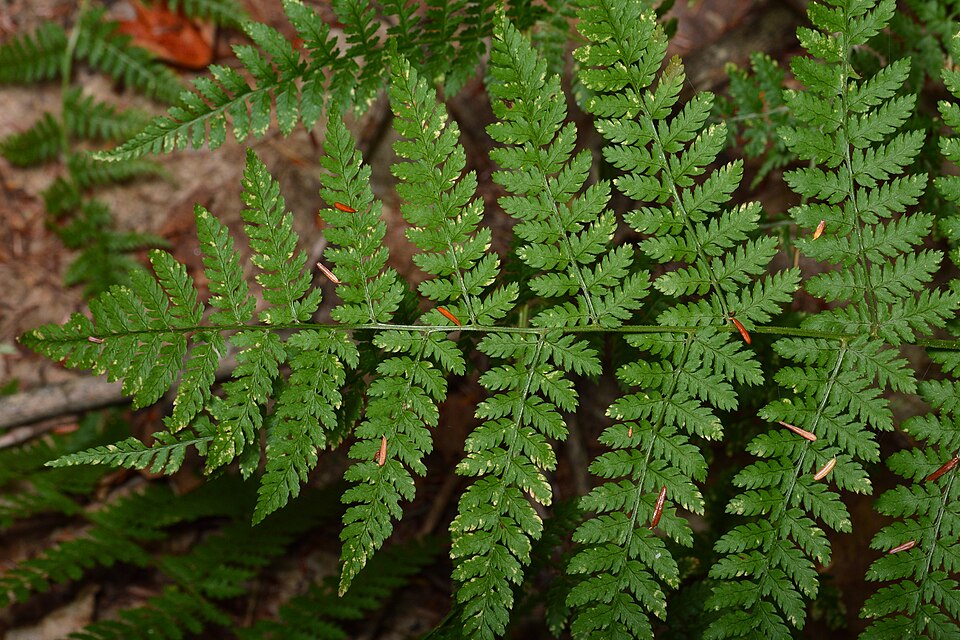
Dryopteris intermedia, commonly known as Evergreen Wood Fern, Intermediate Wood Fern, or Fancy Fern, is one of the most beautiful and versatile native ferns for shaded woodland gardens in the eastern United States. This elegant species forms neat, vase-shaped clumps of lacy, dark green fronds that remain evergreen — or nearly so — through the winter in much of its range, providing year-round structure and interest in the shade garden. The species name intermedius reflects its intermediate characteristics between two parent species — it is one of many allopolyploid ferns in the genus Dryopteris, derived from ancient hybridization events.
Evergreen Wood Fern is widely distributed across the eastern United States and Canada, growing in moist, shaded woodlands, stream banks, and rocky ravines. Unlike many moisture-loving ferns, it is remarkably tolerant of drier conditions as long as it never completely dries out — making it more adaptable in the garden than species like Royal Fern or Ostrich Fern. The finely cut, bi- to tripinnate fronds create an exceptionally lacy texture that garden designers prize as a backdrop or companion to other shade plants.
In the Delaware, New Jersey, and New York region, Evergreen Wood Fern is one of the most commonly encountered ferns in moist deciduous woodlands, particularly on north-facing slopes, in ravines, and along stream corridors where its preference for consistent moisture and shade can be met. It is an excellent garden plant for challenging shady, moist sites where many plants struggle, and it contributes importantly to forest floor biodiversity as a structural component of the native understory layer.
Identification
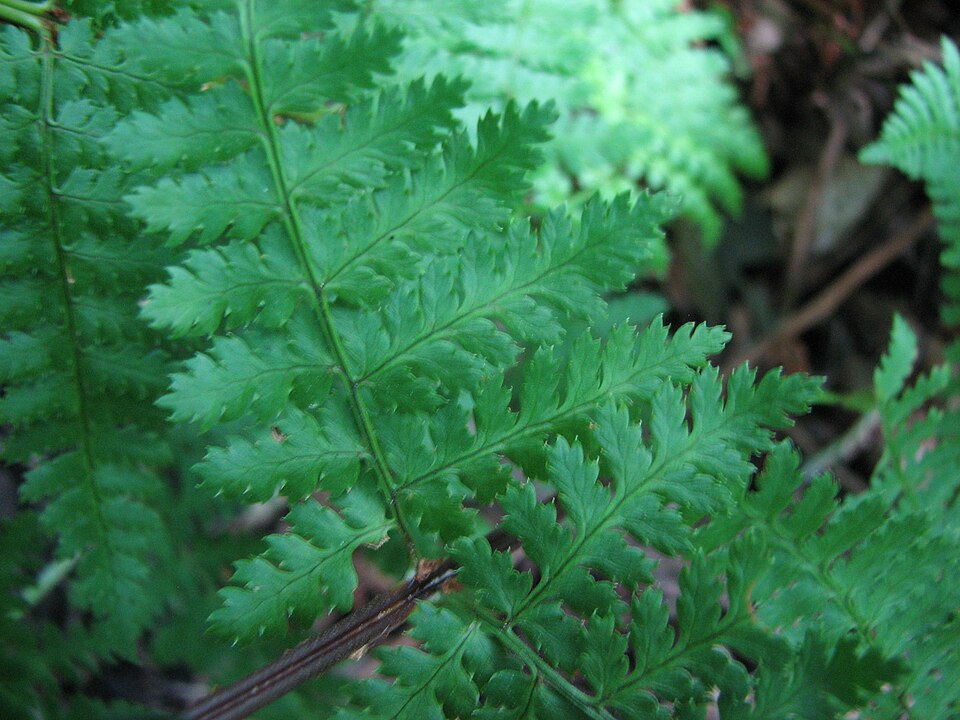
Evergreen Wood Fern forms a graceful vase-shaped clump typically 1.5 to 2.5 feet tall (to 3 feet in ideal conditions), with fronds arching outward from a central crown. It is an evergreen to semi-evergreen fern — fronds remain green through winter but may be somewhat flattened by snow and ice, regrowing from the crown in spring. The key identification feature is the exceptionally fine cutting of the frond: the fronds are bi- to tripinnate with the lobes themselves further toothed — creating an extraordinarily lacy appearance that distinguishes it from the similar Marginal Wood Fern (D. marginalis).
Fronds
The fronds are narrowly lance-shaped to broadly lance-shaped, typically 1 to 2.5 feet long and 6 to 12 inches wide at the widest point. They are bi- to tripinnate — each frond is divided into pinnae (primary divisions), which are divided into pinnules (secondary divisions), which are themselves lobed or cut — creating the highly dissected, delicate appearance. The upper surface is dark, lustrous green; the underside is slightly paler. The stipe (stalk) is covered with attractive chestnut-brown scales, particularly near the base. Fronds overwinter but typically flatten under snow load.
Sori (Spore Cases)
The sori (clusters of spore-producing structures) are kidney-shaped with a prominent kidney-shaped indusium (covering membrane), located near the midrib of each pinnule — not at the margins. This is a key distinguishing feature from Marginal Wood Fern, where the sori are located at or very near the pinnule margins. The sori mature in mid to late summer. Each kidney-shaped sorus is about 1/16 inch across and turns dark brown when mature.
Crown
The crown (base of the plant from which fronds arise) is covered with attractive, dense, shiny brown scales that are visible at the base of each stipe. These scales are one of the most reliable identification characters for wood ferns in general. The rhizome is stout, upright, and slowly creeping, forming a tight clump rather than a spreading colony — making Evergreen Wood Fern a well-behaved garden plant that does not spread aggressively.
Quick Facts
| Scientific Name | Dryopteris intermedia |
| Family | Dryopteridaceae (Wood Fern) |
| Plant Type | Evergreen Fern (clump-forming) |
| Mature Height | 2–3 ft |
| Sun Exposure | Full Shade |
| Water Needs | Moderate |
| Bloom Time | Non-flowering (reproduces by spores) |
| Spore Season | Mid to late summer |
| Winter Interest | Evergreen to semi-evergreen |
| USDA Hardiness Zones | 3–8 |
Native Range
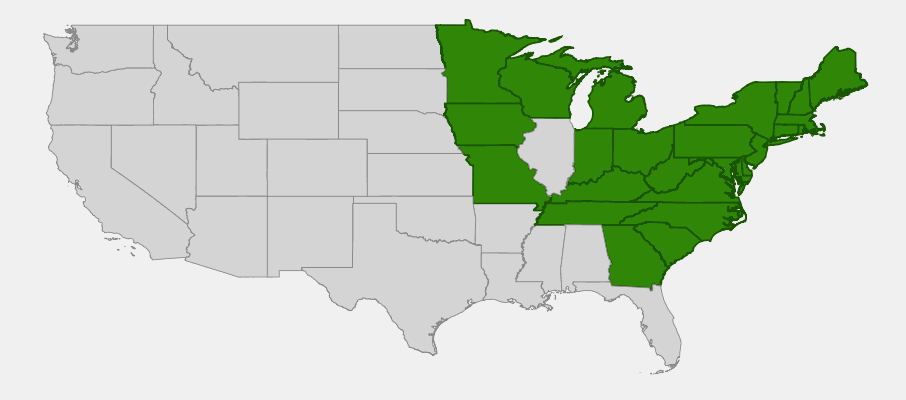
Evergreen Wood Fern is native to much of the eastern and central United States and Canada, ranging from Newfoundland and Labrador west to Manitoba and Minnesota, and south through the Appalachian Mountains to Georgia, Alabama, and Tennessee. In the lowlands, it ranges south to Virginia, Maryland, and the northern portions of the coastal plain states. The species is most abundant in the northeastern United States and the southern Appalachians, where moist, shaded woodland conditions are widespread.
In Delaware, New Jersey, and New York, Evergreen Wood Fern is found in moist deciduous forests, particularly on north-facing slopes, in ravines, and along stream corridors from sea level to the highest elevations in the Catskills and Adirondacks. It is one of the most common ferns in the diverse mesic hardwood forests of the region, growing alongside Wild Ginger, Trout Lily, Trillium, and other spring ephemerals on rich, moist forest floors. It also occurs in rocky, hemlock-dominated ravines where it contributes to the distinctive dark green, moss-and-fern carpet of these special habitats.
Evergreen Wood Fern reaches its southern limits in the mountains of Georgia and Alabama, where it occurs at higher elevations in cool, moist coves. The southern Appalachian populations tend to be larger and more robust than northern specimens, benefiting from the long growing season. As a polyploid species, Evergreen Wood Fern is genetically diverse across its range and shows considerable morphological variation — some populations appear to be relics of past hybridization with related species.
📋 Regional plant lists featuring Evergreen Wood Fern: Delaware, New Jersey & New York
Growing & Care Guide
Evergreen Wood Fern is one of the most reliable and attractive ferns for shaded woodland gardens. Its combination of fine texture, dark evergreen color, vase-shaped habit, and moderate adaptability makes it an excellent plant for a wide range of shady garden conditions — from the edge of a naturalized woodland to a formal shaded border.
Light
Evergreen Wood Fern is best suited to partial to full shade. It performs beautifully in the dappled light beneath deciduous trees, where it receives filtered sun throughout the day, and also thrives in deeper shade beneath evergreens. Unlike many ferns, it is reasonably tolerant of moderately dry conditions in shade — but not in full sun, which quickly causes frond scorch and decline. A north or east-facing site with good moisture retention is ideal.
Soil & Water
Prefers moist, humus-rich, well-drained soil with a slightly acidic pH (5.0–6.5). Amend heavy clay soils with generous quantities of compost or leaf mold to improve drainage while retaining moisture. The critical rule — from the batch notes — is that this fern must not dry out: even brief periods of drought stress cause frond browning and decline. Mulch with 2–3 inches of shredded leaves or bark chips to maintain soil moisture and mimic the natural forest floor. In dry summers, water deeply every 7–10 days.
Planting Tips
Plant in spring or fall. Set the crown at soil level — do not bury it. Space plants 18–24 inches apart for individual specimens; 12–18 inches for a ground cover effect. Evergreen Wood Fern is an excellent companion to spring-blooming woodland wildflowers such as Trillium, Wild Ginger, and Bloodroot — the ferns’ emergence coincides with the wildflowers’ decline, maintaining year-round interest. It combines beautifully with Hostas, Astilbes, and other shade perennials in designed shade gardens.
Pruning & Maintenance
Cut back old fronds in late winter or early spring before new growth emerges to reveal the fresh, bright green new fronds unfurling from the crown. This is the most significant maintenance task. Otherwise, the fern requires little attention beyond consistent watering during dry periods and annual mulching to maintain soil moisture. The plant is disease-resistant and not significantly bothered by pests. Deer do not preferentially browse it, though they may nibble in high-deer-pressure areas.
Landscape Uses
- Shade garden groundcover and border plant
- Woodland garden companion to spring wildflowers
- Stream bank and rain garden planting in shaded locations
- Foundation planting on north-facing walls
- Winter interest — evergreen fronds provide structure when most perennials are dormant
- Texture contrast with broad-leaved shade plants like Hostas and Hellebores
Wildlife & Ecological Value
Evergreen Wood Fern is an important structural component of the forest understory, contributing to the biodiversity and habitat quality of eastern woodland ecosystems in ways that go far beyond its visual appeal.
For Birds
The dense, evergreen clumps of Evergreen Wood Fern provide important cover and nesting habitat for ground-associated birds including Hermit Thrush, Veery, Wood Thrush, and Ovenbird. The fronds create insulated microsites that protect nesting birds from predators and weather. The moist soil beneath fern clumps supports the earthworm and invertebrate communities that ground-feeding birds forage on throughout the year.
For Mammals
White-tailed Deer, Eastern Cottontail, and various rodents use fern clumps as resting and refuge sites. The accumulated leaf litter and decaying organic matter beneath established fern clumps supports rich communities of invertebrates that small mammals — shrews, voles, salamanders — forage on intensively. The plant is rarely browsed by deer.
For Pollinators
As a non-flowering fern, Evergreen Wood Fern does not directly support pollinators. However, it contributes to the moist, shaded microhabitats that many beneficial insects require for shelter, thermoregulation, and moisture during hot, dry periods. Some moth species use ferns as shelter for overwintering eggs.
Ecosystem Role
Evergreen Wood Fern plays an important role in forest floor ecology by maintaining soil moisture, contributing organic matter through frond decomposition, and providing structural habitat for soil invertebrates. The dense frond canopy shades the soil surface, reducing evaporation and maintaining the cool, moist conditions required by many forest floor organisms including salamanders, ground beetles, millipedes, and the mycorrhizal fungi that underpin forest nutrient cycling.
Cultural & Historical Uses
Wood ferns in the genus Dryopteris have a long history of use by Indigenous peoples of eastern North America. The Cherokee used related wood ferns medicinally for rheumatism, snake bites, and as a general tonic. The Iroquois used various Dryopteris species as a wash to prevent hair loss and as a component in medicinal steam baths. The fiddleheads (young, unfurling fronds) of some Dryopteris species were occasionally eaten as spring greens, though they are less palatable and potentially less safe than the widely consumed Ostrich Fern fiddleheads.
The ornamental qualities of wood ferns were recognized early by American horticulturists, and Dryopteris intermedia has been cultivated in shade gardens since the Victorian era, when fern cultivation (pteridomania — “fern fever”) was at its peak. The fine texture, dark glossy color, and neat clumping habit made it a favorite of Victorian fernery designers. Today it remains one of the most popular native ferns in the nursery trade, widely available as a well-behaved, reliable shade garden plant.
From an ecological restoration perspective, Evergreen Wood Fern is one of the most valuable species for restoring native woodland understory communities. Its use in restoration plantings, combined with native wildflowers and woody shrubs, helps reconstruct the layered structure of eastern deciduous forests that has been lost through development, invasive species, and deer overbrowsing. The species’s adaptability, availability in the nursery trade, and reliable performance make it a cornerstone of woodland restoration projects throughout the northeast.
Frequently Asked Questions
Is Evergreen Wood Fern truly evergreen?
It is evergreen to semi-evergreen, depending on winter severity. In mild winters (USDA Zones 6–7), the fronds remain green and upright through winter. In harsh winters (Zone 4–5), fronds may flatten and brown significantly under snow and ice but the crown remains alive and produces fresh fronds in spring. Cutting back winterburned fronds in late February reveals the new growth more clearly.
How does Evergreen Wood Fern differ from Marginal Wood Fern?
The key difference is sorus position: Evergreen Wood Fern has kidney-shaped sori near the midrib of pinnules; Marginal Wood Fern has sori at or near the pinnule margins. Evergreen Wood Fern is also more finely cut (tripinnate vs. bipinnate), giving it a lacier appearance. Marginal Wood Fern tends to be more drought-tolerant and grows in rockier, drier habitats.
Can I grow Evergreen Wood Fern in a container?
Yes, in a large (12–16 inch) container with excellent drainage and consistent moisture. Use a potting mix of equal parts peat, perlite, and compost. Container plants may need more frequent watering and should be protected from extreme summer heat. Overwinter containers in a sheltered, cool location in Zone 5 and colder.
What are good companion plants for Evergreen Wood Fern?
Excellent companions include Wild Ginger (Asarum canadense), Trillium, Jack-in-the-Pulpit (Arisaema triphyllum), Bloodroot (Sanguinaria canadensis), Hostas, Hellebores, and other shade perennials. In woodland settings, it pairs well with native shrubs like Spicebush, American Hazelnut, and Witch Hazel.
Is Evergreen Wood Fern deer-resistant?
It is generally not preferred by deer and is considered moderately deer-resistant. In high-deer-pressure areas it may be browsed, particularly when other forage is scarce in winter. Surrounding it with more strongly deer-resistant plants can reduce pressure on individual ferns.

Looking for a nursery that carries Evergreen Wood Fern?
Browse our native plant nursery directory: Delaware · New Jersey