Glaucous-leaf Greenbriar (Smilax glauca)
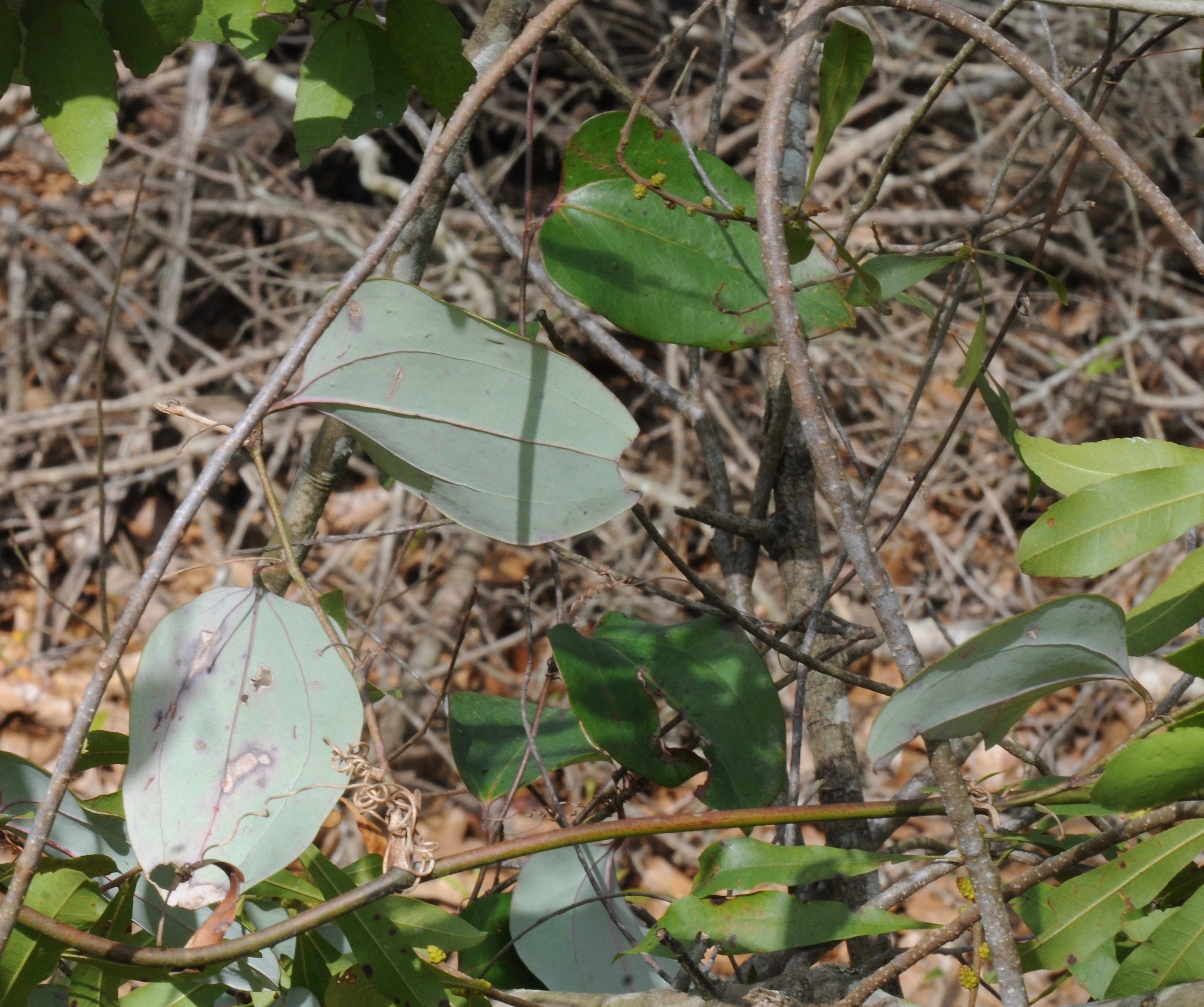
Smilax glauca, commonly known as Glaucous-leaf Greenbriar, Cat Briar, or Saw Briar, is a thorny native deciduous to semi-evergreen vine of the eastern United States — one of approximately 20 native Smilax species in North America. The species name glauca (Latin: “bluish-gray” or “sea-green”) refers to the distinctive whitish or powdery bloom on the undersides of the leaves that immediately distinguishes this species from other greenbriars. A member of the Smilacaceae family, the greenbriars represent some of the most ancient flowering plants, belonging to the monocot lineage, more closely related to lilies and orchids than to typical woody shrubs or vines.
Glaucous-leaf Greenbriar is a woody vine with tough, thorny stems that twine and scramble through other vegetation using paired tendrils arising from the petioles — the climbing mechanism is highly effective, allowing the plant to reach heights of 10–20 feet or more in the canopy. The vine produces small, fragrant, greenish-yellow to yellowish flowers in spring, followed by clusters of dark blue to black berries that are critically important food for dozens of bird species through fall and winter. The plant’s formidable thorns, dense scrambling habit, and evergreen to semi-evergreen foliage create thickets that serve as some of the most secure bird nesting and hiding habitat in the eastern woodland understory.
While greenbriars are sometimes viewed as weedy or undesirable because of their thorny aggressiveness, their ecological value is genuinely exceptional — few native plants provide the combination of wildlife food (fruits), nesting security (dense thorny thickets), thermal cover (semi-evergreen foliage), browse (young shoots and leaves), and structural diversity that Smilax species contribute to eastern woodland edges. For naturalistic plantings, wildlife gardens, and habitat restoration in Delaware, New Jersey, and New York, Glaucous-leaf Greenbriar deserves consideration as a key structural component.
Identification
Glaucous-leaf Greenbriar is a woody vine with green, slightly angled stems armed with stout, straight thorns. The stems are climbing to scrambling, reaching 10–20 feet in length as they clamber through shrubs and trees. The plant spreads both by seed and by underground rhizomes, forming dense colonies in favorable conditions.
Stems and Thorns
The stems are rounded to slightly angled, green to greenish-brown, and armed with stout, straight, sharp thorns that are green at the base and brown to black at the tip. The thorns arise from the stem tissue itself (not from modified leaves or stipules) and are extremely effective at deterring large mammal browsing and providing secure nesting habitat. Young stems are green and flexible; older stems become woody and gray-brown but remain armed. Paired tendrils, arising from the leaf petioles, allow the vine to cling to and climb supporting vegetation.
Leaves
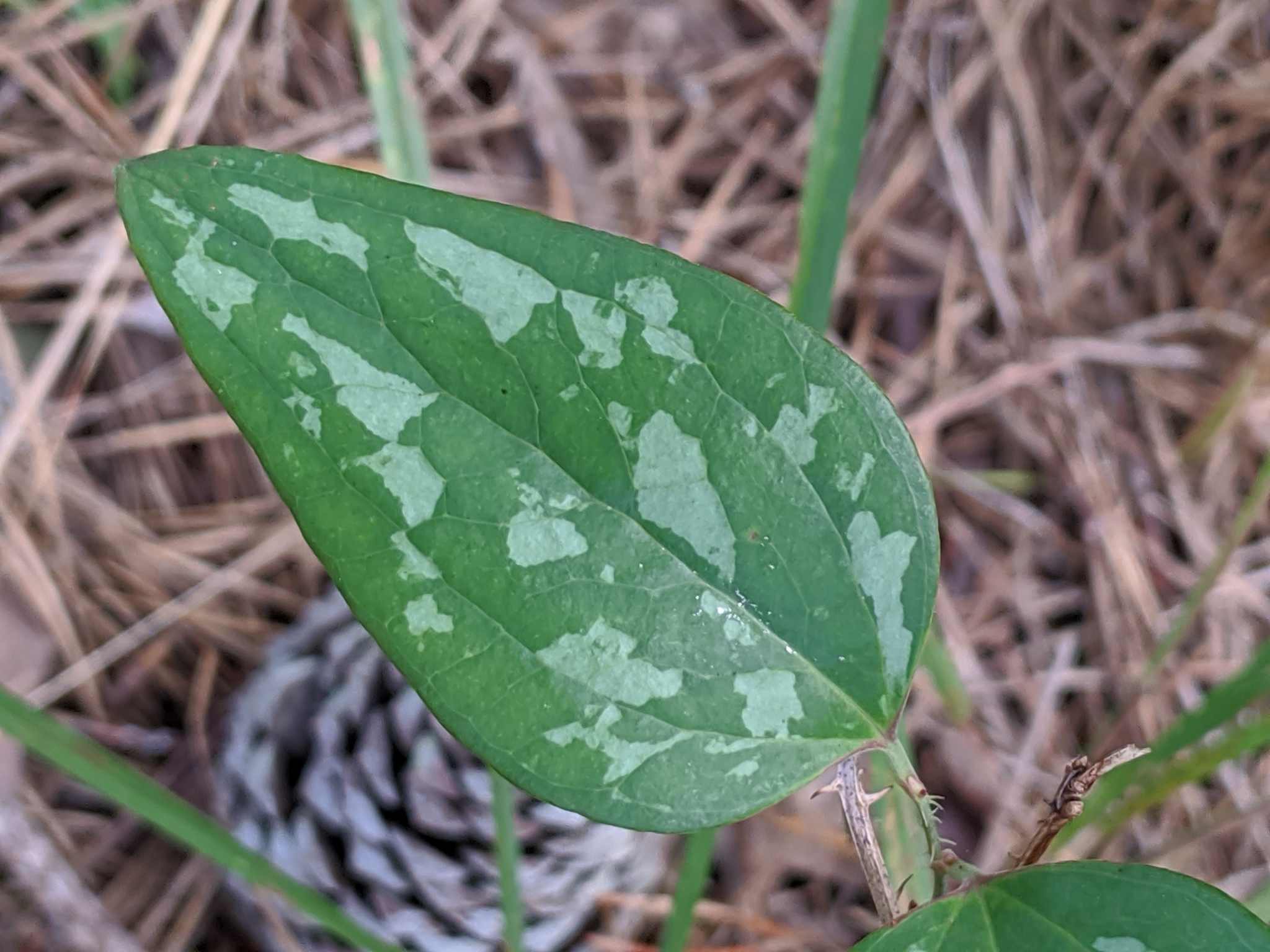
The leaves are the most diagnostic feature of this species. They are alternate, simple, broadly ovate to orbicular (somewhat heart-shaped), 2–4 inches (5–10 cm) long and nearly as wide, with a smooth to slightly wavy margin. The upper surface is dark to medium green and somewhat glossy; the underside is distinctly whitened or glaucous — covered with a powdery, waxy bloom that gives the leaf a pale bluish-white or silvery-white color. This glaucous underside is immediately diagnostic when leaves are turned over. The leaves are leathery and can persist through mild winters, making the plant semi-evergreen in the mid-Atlantic.
Flowers
Flowers bloom April–June in small, round umbels (ball-like clusters) arising from the leaf axils on slender stalks. Individual flowers are very small, about ⅛ inch across, with six yellowish-green to greenish-white tepals. The flowers are fragrant and attract a variety of small insects. Male and female flowers occur on separate plants (the species is dioecious) — so both a male and female plant are needed for fruit production.
Fruit
The berries are small, round, about ¼ inch (6–7 mm) in diameter, maturing from green to dark blue-black with a glaucous coating in late summer to fall. They are borne in compact clusters at the ends of slender stalks and are an extremely important wildlife food source. Each berry contains 1–3 seeds. The berries persist on the vine well into winter after the leaves have dropped, providing crucial food during the lean winter months for many birds.
Quick Facts
| Scientific Name | Smilax glauca |
| Family | Smilacaceae (Greenbrier family) |
| Plant Type | Deciduous to Semi-Evergreen Thorny Vine |
| Mature Height | 10–20 ft |
| Sun Exposure | Part Shade to Full Sun |
| Water Needs | Low to Moderate |
| Bloom Time | April – June |
| Flower Color | Greenish-yellow to yellowish-white (small, fragrant) |
| Fruit | Dark blue-black berries (fall–winter) |
| Thorns | Yes — stout, sharp; use gloves when handling |
| USDA Hardiness Zones | 5–9 |
Native Range
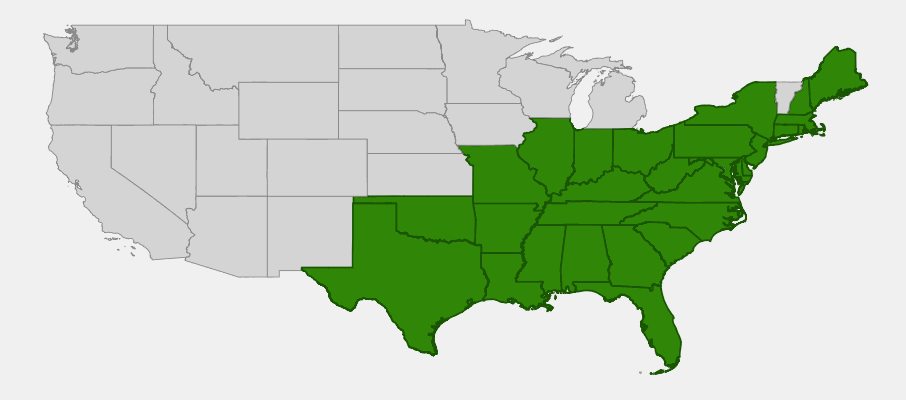
Glaucous-leaf Greenbriar is native to a broad swath of eastern North America, ranging from coastal Maine south through the entire eastern seaboard to Florida, west to eastern Texas and Oklahoma, and north through the Mississippi Valley into southern Illinois and Indiana. It is most abundant in the coastal plain and Piedmont regions of the southeastern United States, where it is a ubiquitous component of forest edges, old fields, and woodland understories.
Throughout its range, Glaucous-leaf Greenbriar occupies the full diversity of mid-Atlantic habitats — from the sandy coastal plain pine-oak forests of New Jersey and Long Island to the upland hardwood forests of the Piedmont and Appalachian foothills, from dry ridge-top woodlands to moist bottomland margins. It is especially common along forest edges, roadsides, old field margins, and disturbed areas where shrubby vegetation establishes. Its ability to grow in dry, sandy, nutrient-poor soils as well as moderately moist conditions reflects its broad ecological amplitude.
In Delaware, New Jersey, and New York, Glaucous-leaf Greenbriar is a native and ecologically important component of the coastal plain and Piedmont landscapes. In New Jersey’s Pine Barrens, it is a characteristic vine species along forest margins and in shrubby oak openings. On Long Island’s south shore and in the Delaware coastal plain, it forms important thicket habitat where dense, thorny cover provides secure nesting habitat for numerous songbirds. Fire-adapted, it re-sprouts readily from rootstocks after disturbance.
📋 Regional plant lists featuring Glaucous-leaf Greenbriar: Delaware, New Jersey & New York
Growing & Care Guide
Glaucous-leaf Greenbriar is a tough, adaptable native vine that establishes readily in a wide range of conditions. Its greatest assets are drought tolerance, wildlife value, and the ability to grow in poor soils where many other plants fail. Its greatest challenge in the garden is containment — it can spread aggressively and the thorns make handling difficult.
Light
Highly adaptable for light: grows in part shade to full sun, making it suitable for planting at woodland edges, in open shrubby areas, or at the margins of more densely shaded sites. In full sun, it produces more fruits and denser growth; in part shade, growth is more open and climbing behavior is more pronounced as the plant reaches for light.
Soil & Water
Excellent drought tolerance once established — one of the most drought-tolerant native vines in the eastern United States. Grows in dry, sandy, acidic to neutral soils (pH 5.0–7.0), rocky soils, and loamy uplands. It also tolerates moderately moist conditions. Avoid waterlogged soils. No soil amendment is typically needed — the plant performs well in lean, native soils without fertilization. Heavy fertilization encourages excessive vegetative growth at the expense of fruit production.
Planting Tips
Plant Glaucous-leaf Greenbriar in areas where its spreading habit and thorns will not be a management problem — ideally at the back of a property, along a fence line, at a woodland edge, or in a naturalistic area. Plan for the plant to spread by rhizomes; install a root barrier if containment is needed. Provide a support structure (fence, trellis, existing shrubs) for the vine to climb. Plant in spring or fall; water during establishment, then leave it alone. Use heavy gloves when handling — the thorns are sharp and persistent.
Pruning & Maintenance
Prune in late winter to control spread and shape. Cut unwanted stems to the ground — the plant will resprout from the rhizome. To remove unwanted colonies, repeated cutting in combination with rhizome excavation is most effective; herbicide application is needed for stubborn infestations if removal is desired. No significant pest or disease problems in native soil conditions.
Landscape Uses
- Wildlife habitat creation — few plants provide better bird nesting and roosting cover
- Fence and barrier planting — impenetrable thorny hedge when established
- Woodland edge naturalization
- Erosion control on dry, sandy slopes
- Restoration planting in coastal plain and pine barren habitats
- Deer-resistant plantings (thorns deter deer browsing on established plants)
Wildlife & Ecological Value
Glaucous-leaf Greenbriar is one of the most ecologically valuable native vines in the eastern United States. Its importance to wildlife is difficult to overstate.
For Birds
The dark blue-black berries are a crucial food source for dozens of bird species, especially during fall and winter when other fruits are scarce. Species regularly consuming Smilax berries include Northern Mockingbird, Brown Thrasher, Gray Catbird, American Robin, Hermit Thrush, Eastern Bluebird, Cedar Waxwing, Wild Turkey, Ruffed Grouse, Northern Cardinal, and many others. Migrating songbirds including thrushes and warblers rely heavily on Smilax berries. The dense, thorny thickets are premier nesting habitat for many songbirds — catbirds, thrashers, mockingbirds, and yellow warblers all favor thorny vine thickets for the security they provide. The thick tangles also serve as excellent roosting cover through the winter months.
For Mammals
White-tailed deer browse Smilax foliage and stems intensively — it is one of the most important deer browse plants in the eastern United States. The thorny growth habit limits browsing by adult deer but not by fawns or rodents. Black bears, raccoons, opossums, and foxes consume the berries. Cottontail rabbits use Smilax thickets as escape cover. The deep rhizomes provide food for voles and wild pigs in some areas.
For Pollinators
The small, fragrant spring flowers attract various generalist pollinators including native bees, small wasps, flies, and beetles. While not a major nectar plant, it provides early-season resources in the woodland understory where few other plants are blooming. The regional plant data notes “small fragrant flowers” as a feature — these are particularly noted by native bee specialists as useful pollen sources in the early-season landscape.
Ecosystem Role
Smilax species, including Glaucous-leaf Greenbriar, play an important structural role in eastern woodland edge communities. Their thorny thickets create zones of impenetrable cover that persist through disturbance, providing refuge and nesting habitat that more palatable shrubs cannot provide because of deer pressure. In areas with heavy deer browsing, Smilax thickets often become islands of biodiversity in otherwise overly browsed understories. The rhizome network stabilizes soil on slopes and in disturbed areas.
Cultural & Historical Uses
The greenbriars (Smilax species) have a long history of human use throughout eastern North America. Indigenous peoples used numerous parts of the plant. The young shoots and leaves of Glaucous-leaf Greenbriar and related species were eaten as cooked greens in spring, when the tender new growth is still flexible and before the thorns harden. The Cherokee, Seminole, Choctaw, Creek, and many other southeastern nations used Smilax shoots as a vegetable and the rhizomes as a starch source. The starchy rhizomes were dried, ground into flour, and used to make a type of jelly-bread or used as a thickener in soups and stews.
The rhizome starch of Smilax species is the original source of the flavoring and food ingredient known as “sarsaparilla” — the same name applied to the commercial root beer flavoring originally derived from various Smilax species of tropical America. North American species including Smilax glauca were used similarly. The roots and rhizomes were also used medicinally by Indigenous peoples as a treatment for skin diseases, rheumatism, and as a blood purifier. European herbalists adopted similar uses, and Smilax root was an important ingredient in “sarsaparilla tonics” sold throughout the 19th century as cure-alls for various ailments.
The extremely tough, flexible stems of Smilax vines were used by Indigenous peoples to make baskets and as binding cord. The stems’ combination of flexibility and strength made them useful for binding bundles, securing shelters, and making coarse basketry. In the South, the semi-evergreen greenbriars provided important winter forage for livestock — their persistence through winter made them valuable when other forage was scarce. Today, Smilax species are primarily valued for their ecological contributions rather than human use, though foragers continue to harvest young shoots as wild greens and the rhizomes as a traditional food.
Frequently Asked Questions
Is Glaucous-leaf Greenbriar invasive?
No — it is native to the eastern United States, not invasive. It can spread aggressively by rhizomes and can be difficult to remove once established, but it is an ecologically appropriate native plant throughout its natural range. Confusion arises because several exotic Smilax species have been introduced to North America, and because native greenbriars can be persistent in garden situations where they’re not wanted.
Are Smilax berries edible for humans?
The berries are not considered edible for humans — they are somewhat bitter and contain compounds that can cause digestive upset in quantity. Leave them for the wildlife that depends on them. The young spring shoots, however, are edible when cooked.
How do I get rid of Glaucous-leaf Greenbriar?
Removal requires persistent effort because the deep rhizomes resprout readily. Cut all stems to the ground and excavate as much rhizome as possible. Repeat cutting of any new sprouts throughout the growing season to exhaust the rhizome’s energy reserves. For large infestations, targeted herbicide application to freshly cut stem stubs is most effective. Wear heavy gloves throughout — the thorns are sharp and persistent.
How do I identify Glaucous-leaf Greenbriar vs. other greenbriars?
The key diagnostic feature is the whitened (glaucous) underside of the leaf, which gives the species its name. Turn over a leaf — if the underside is distinctly pale, whitish, or silvery-blue, it’s Smilax glauca. Common Greenbriar (S. rotundifolia) has green leaf undersides. Laurel-leaf Greenbriar (S. laurifolia) has very thick, leathery, evergreen leaves.
Will Glaucous-leaf Greenbriar grow on a trellis?
Yes — like all Smilax species, it climbs by coiling tendrils and can be trained on a sturdy wire fence, chain-link fence, or trellis. Be aware that it will thoroughly colonize whatever support you provide and that the thorns make subsequent management difficult. It is best suited to naturalistic settings rather than formal garden structures.

Looking for a nursery that carries Glaucous-leaf Greenbriar?
Browse our native plant nursery directory: Delaware · New Jersey