Interrupted Fern (Osmunda claytonia)
Osmunda claytonia (syn. Osmundastrum claytoniana), commonly known as Interrupted Fern or Clayton’s Fern, is one of the most distinctive and charming native ferns in eastern North America. Its common name is immediately explained upon seeing it: in fertile fronds, two to five pairs of specialized, spore-bearing pinnae (leaf divisions) appear in the middle of the frond, interrupting the otherwise continuous blade of green, sterile pinnae above and below. These fertile pinnae are markedly smaller, covered with dark green spore cases, and wither away after spore dispersal — leaving characteristic gaps in the frond and giving each plant a uniquely sculptural appearance during and after spore season.
Interrupted Fern is a member of the ancient fern family Osmundaceae, which has an exceptionally long fossil record dating back some 220 million years to the Triassic period. The genus Osmunda contains some of the most “primitive” ferns — plants that retain characteristics seen in fossil species hundreds of millions of years old. The stout, fibrous rootstocks of Osmunda ferns were historically used as “osmunda fiber” — a potting medium prized by orchid growers — though commercial harvesting has largely been replaced by synthetic alternatives.
In the Delaware, New Jersey, and New York region, Interrupted Fern is a characteristic species of moist to moderately dry deciduous woodlands, forest edges, and roadside banks. It is more tolerant of drier conditions than its close relative the Cinnamon Fern, making it adaptable to a broader range of garden settings. The large, pale green fronds — typically 2 to 4 feet tall — create a bold, tropical texture that adds drama to the woodland garden from spring emergence through fall.
Identification
Interrupted Fern forms large, vase-shaped clumps of broadly lance-shaped fronds, typically 2 to 4 feet tall and 8 to 14 inches wide. The fronds are light to medium green, erect to slightly arching, and arranged in a circular crown. The critical identification feature is the “interrupted” fertile frond: in fertile plants, 2 to 5 pairs of pinnae in the middle section of the frond are replaced by smaller, dense, dark brown-green spore-bearing pinnae that shrivel after spore release, leaving distinctive gaps.
Fronds
Fronds are bipinnate — each frond is divided into pinnae (primary divisions), which are divided into pinnules (secondary divisions). The pinnules are oblong, smooth-edged to slightly toothed, and rounded at the tip. The upper frond surface is medium green and somewhat glossy; the underside is pale green. Sterile fronds have uniform pinnae throughout. Fertile fronds are otherwise identical but have 2–5 pairs of specialized middle pinnae that bear sporangia (spore cases) rather than green photosynthetic tissue. This “interrupted” pattern is unique among eastern ferns and makes identification straightforward even at a distance.
Stipe (Stalk)
The stipe is green to yellowish-green, smooth, and covered with a few wispy hairs when young, particularly at the base. Unlike Cinnamon Fern and Royal Fern, the stipe base does not have the dense tuft of reddish-brown “cinnamon” hairs characteristic of those species. The stipes are deeply grooved on the upper surface. The crown (base of the plant) is covered with stout, fibrous roots that form the characteristic “osmunda fiber” material prized as an orchid-growing medium.
Seasonal Appearance
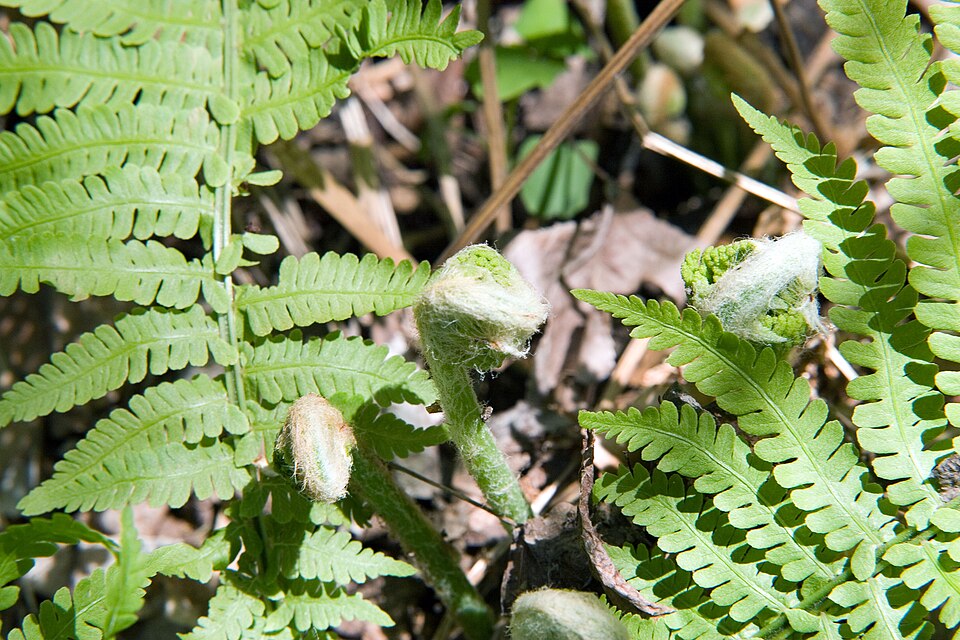
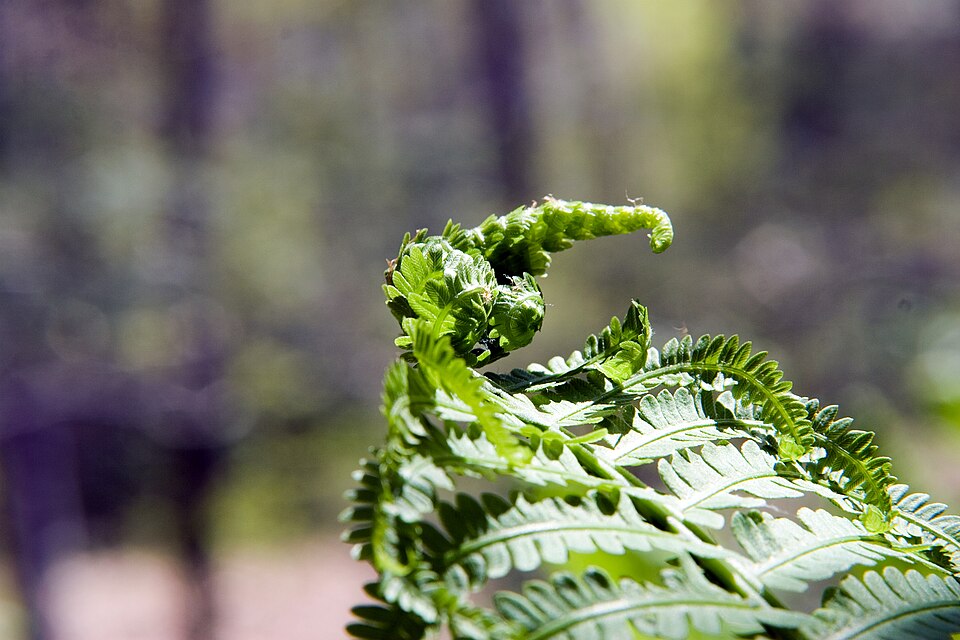
New fronds emerge in spring as tightly coiled croziers (fiddleheads) covered with white woolly hairs that quickly fall away as the fronds expand. Fertile pinnae release spores in late spring (May–June), after which they shrivel and drop, leaving the characteristic gaps in the frond. By late summer, only the sterile pinnae remain. Fronds turn a warm yellow to golden-brown in autumn before dying back to the crown with the first hard frosts.
Quick Facts
| Scientific Name | Osmunda claytonia |
| Family | Osmundaceae (Royal Fern) |
| Plant Type | Deciduous Fern (clump-forming) |
| Mature Height | 3–4 ft |
| Sun Exposure | Full Shade |
| Water Needs | Low (Drought Tolerant) |
| Bloom Time | Non-flowering (reproduces by spores) |
| Spore Season | May – June |
| Fall Color | Golden yellow to warm brown |
| USDA Hardiness Zones | 3–8 |
Native Range
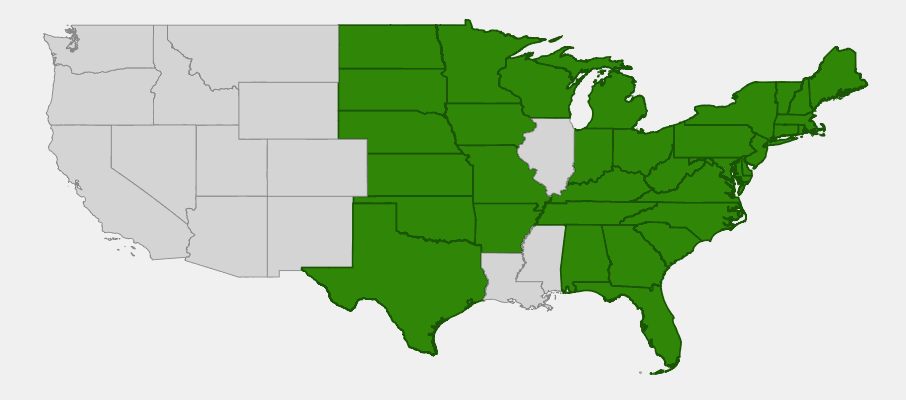
Interrupted Fern is native to a wide range of eastern and central North America, from Newfoundland and Nova Scotia west through Manitoba and North Dakota, and south through the eastern United States to northern Georgia, Alabama, and Tennessee. It is one of the most wide-ranging Osmunda ferns in North America, and is particularly common in the northeastern United States and the Great Lakes region. The species also has a remarkable disjunct distribution in Asia — it occurs in parts of eastern Asia including China, Korea, Japan, and the Himalayas — making it one of the few fern species with a classic “eastern North America/eastern Asia” distribution pattern.
In Delaware, New Jersey, and New York, Interrupted Fern is found throughout in moist to moderately dry deciduous woodlands, forest edges, roadside banks, and shaded slopes. It is notably more drought-tolerant than Cinnamon Fern (Osmunda cinnamomea), growing successfully on slopes and higher ground where Cinnamon Fern would struggle without additional moisture. The two species often grow near each other in transitional habitats, with Cinnamon Fern occupying the lower, wetter ground and Interrupted Fern on higher, slightly drier sites.
Unlike its relatives the Cinnamon Fern and Royal Fern, Interrupted Fern is not restricted to wetland or wetland-margin habitats — it commonly occurs in typical upland mesic woodlands throughout its range. This makes it one of the most widely usable of the large Osmunda ferns for general landscape applications. Its adaptability to drier conditions relative to other Osmundas makes it the best choice for woodland garden settings that cannot be consistently kept moist.
📋 Regional plant lists featuring Interrupted Fern: Delaware, New Jersey & New York
Growing & Care Guide
Interrupted Fern is one of the easiest and most striking large native ferns to grow in woodland garden settings. Its adaptability to a range of moisture conditions — greater than that of Cinnamon Fern or Royal Fern — makes it accessible to a wider range of gardeners, and its bold, dramatic fronds create impressive textural interest throughout the growing season.
Light
Interrupted Fern grows best in partial to full shade. It tolerates more sun than many large ferns if moisture is adequate, but the best results in typical garden settings are in dappled to moderate shade beneath deciduous trees. Avoid full sun in dry conditions, which causes frond scorch. In cooler, moister climates (northern New England, higher elevations), it tolerates more sun than in the warmer, drier mid-Atlantic lowlands.
Soil & Water
Prefers moist, humus-rich, slightly acidic soil (pH 5.0–6.5). While more drought-tolerant than Cinnamon Fern once established, Interrupted Fern should not be allowed to experience prolonged drought — especially during the establishment period. Consistent moisture produces the most vigorous, upright fronds. Incorporate generous amounts of compost or leaf mold before planting. Mulch with 2–3 inches of shredded leaves annually. Once established (2–3 growing seasons), the stout rootstock provides some drought buffer.
Planting Tips
Plant divisions or container plants in spring or fall. Space 2–3 feet apart for a naturalized effect, or 3–4 feet apart to allow individual specimens to develop their full vase shape. The stout, fibrous rootstock can be divided in spring before new fronds emerge. Each division should include several growing points (crowns). Plant the rootstock at or just below soil level. For large-scale planting, Interrupted Fern creates a dramatic understory mass beneath high-canopied deciduous trees.
Pruning & Maintenance
Cut back old fronds to the ground in late fall after they die back or in late winter before new fronds emerge. Remove the dead fronds to expose the attractive fibrous crown and allow easy inspection for new crozier growth. Interrupted Fern requires no other routine maintenance once established. The dead fronds decompose slowly and can be left in place in naturalized settings to provide mulch and organic matter. The plant is essentially pest- and disease-free.
Landscape Uses
- Woodland garden specimen or mass planting beneath deciduous trees
- Shade border bold textural element in shaded perennial gardens
- Stream banks and pond edges in partially shaded situations
- Naturalizing slopes and forest edges with dappled light
- Companion planting with spring-blooming woodland wildflowers
- Architectural accent — the large, vase-shaped clumps create focal points in the garden
Wildlife & Ecological Value
Interrupted Fern, like other large Osmunda species, contributes substantially to the biodiversity and ecological function of moist woodland habitats, providing cover, habitat structure, and direct resources for a variety of wildlife.
For Birds
The dense clumps of Interrupted Fern provide nesting habitat and cover for ground-nesting birds including Ovenbird, Hermit Thrush, and Veery. The moist soil beneath fern clumps supports populations of earthworms and insects that ground-foraging birds — thrushes, robins, and sparrows — exploit throughout the breeding season. The decaying frond material harbors invertebrates that many small birds glean from the forest floor during migration.
For Mammals
The stout fibrous rootstocks of Osmunda ferns provide nesting material and insulation for small mammals including voles, shrews, and chipmunks. White-tailed Deer occasionally browse the young fiddleheads in spring, though the preference is not strong. The dense clumps provide important thermal cover and escape habitat for small mammals year-round.
For Pollinators
As a spore-producing plant, Interrupted Fern does not offer nectar or pollen. However, the moist, shaded conditions it creates and maintains beneath its canopy support diverse communities of moisture-dependent insects including crane flies, midges, and various beetles that contribute to forest food webs.
Ecosystem Role
Interrupted Fern plays a significant role in forest hydrology by reducing surface runoff, maintaining soil moisture, and building organic matter through frond decomposition. The fibrous rootstocks of large Osmunda colonies literally hold stream banks and slope soils in place, functioning as significant erosion-control structures. In succession dynamics, Interrupted Fern is among the first large ferns to colonize disturbed moist-to-mesic woodland sites, stabilizing soil and creating microhabitat that facilitates the establishment of woody plants.
Cultural & Historical Uses
Interrupted Fern carries the species name claytonia in honor of John Clayton (1685–1773), a Virginia-born colonial botanist who spent decades collecting and cataloguing the plants of Virginia and the mid-Atlantic region. His collections, shared with the Dutch botanist Jan Gronovius, formed the basis for Flora Virginica (1739, 1743) — one of the earliest systematic flora of North America. The naming of this distinctive fern after Clayton was a fitting tribute to a naturalist who devoted his life to documenting the botanical riches of the region where this fern is so characteristic.
Indigenous peoples across the range of Interrupted Fern used the stout, fibrous rootstocks of Osmunda ferns in various ways. The Iroquois used the roots of related Osmunda species as packing and binding material, and the woolly hairs from the young fiddleheads were incorporated into crafts and preparations. The Algonquian peoples of the northeast were familiar with the fern as a component of the woodland landscape, and some traditional ecological knowledge suggests uses of the fiddleheads as a minor food source in spring, though they require thorough cooking.
The most commercially significant use of Osmunda ferns was the harvest of rootstocks for “osmunda fiber” — the dense, wiry root mass that was the gold standard potting medium for orchid growing from the late 19th century through much of the 20th century. Osmunda fiber held moisture while providing excellent aeration, and orchid growers prized it above all other growing media. Wild harvesting of osmunda rootstocks in the northeastern United States significantly reduced populations in accessible areas. Today, synthetic growing media have largely replaced osmunda fiber, reducing pressure on wild populations and allowing recovery.
Frequently Asked Questions
What is the “interruption” in Interrupted Fern?
In fertile fronds, 2 to 5 pairs of middle pinnae are replaced by smaller, specialized pinnae bearing dark sporangia (spore cases). These fertile pinnae interrupt the continuous green blade of sterile pinnae above and below them in the frond. After spore dispersal in late spring, the fertile pinnae shrivel and drop, leaving gaps — the “interruptions” — in the frond, which is how the species gets its common name.
How does Interrupted Fern differ from Cinnamon Fern?
Cinnamon Fern produces separate, entirely fertile fronds (covered with cinnamon-brown sporangia) and separate entirely sterile fronds — unlike the “interrupted” fertile fronds of Interrupted Fern. Cinnamon Fern also has a tuft of cinnamon-brown hairs at the base of each pinna, which Interrupted Fern lacks. Interrupted Fern is also more drought-tolerant and grows in drier woodland habitats than the moisture-loving Cinnamon Fern.
Can Interrupted Fern grow in full sun?
In cool, consistently moist conditions, Interrupted Fern can tolerate considerable sun. But in the mid-Atlantic region, it is best given partial to full shade to prevent frond scorch. If you want a large fern for a sunnier spot with good moisture, Cinnamon Fern may be more tolerant in wet conditions, or consider ostrich fern for consistently moist, partly sunny sites.
Is Interrupted Fern the same as Clayton’s Fern?
Yes — “Clayton’s Fern” is an alternate common name referring to the species epithet claytonia, which honors colonial botanist John Clayton. “Interrupted Fern” is the most widely used common name and is the standard name in most field guides and botanical literature.
How long does Interrupted Fern live?
The individual rootstock (crown) of an Osmunda fern is extremely long-lived — some colonies are estimated to be hundreds of years old. The shallow, fibrous rootstock grows slowly upward as old material dies below, eventually forming a raised mound several inches above the soil surface in very old specimens. Individual fronds live for one growing season, but the crown they arise from can survive for many decades or centuries in undisturbed conditions.

Looking for a nursery that carries Interrupted Fern?
Browse our native plant nursery directory: Delaware · New Jersey