Red Mulberry (Morus rubra)
Morus rubra, commonly known as Red Mulberry, is a native deciduous tree of the eastern and central United States prized for its exceptionally sweet and juicy edible fruits and its extraordinary value for wildlife. This member of the Moraceae (mulberry) family is the only mulberry species native to eastern North America — the White Mulberry (Morus alba) and Black Mulberry (M. nigra) that are commonly encountered in the region are both Old World species that have naturalized here, often hybridizing with the native Red Mulberry and threatening its genetic integrity. The species name rubra means “red,” referring to the color of the ripe fruit, which transitions from green to red to deep purple-black at full maturity.
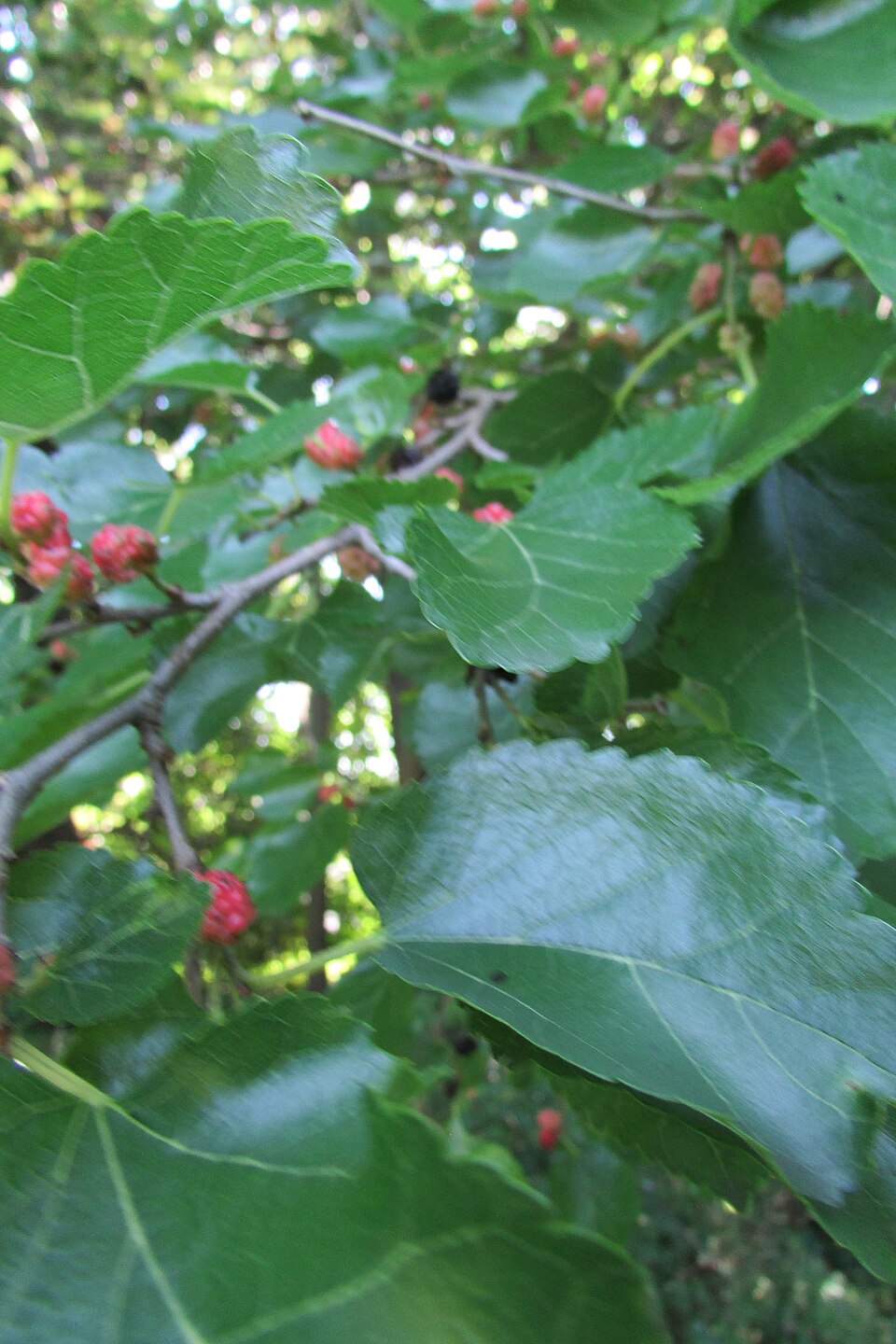
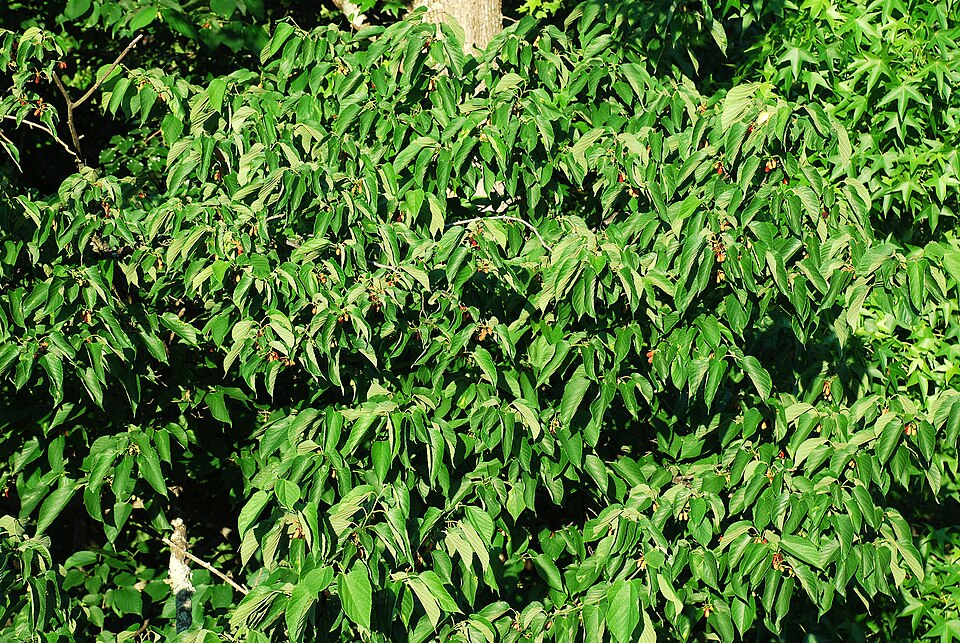
Red Mulberry is a fast-growing, medium to large deciduous tree, typically reaching 35 to 70 feet in height, with a broad, rounded crown and attractive large leaves that vary considerably in shape — from simple, unlobed ovals to deeply mitten-shaped or three-lobed forms — sometimes on the same tree. This variability in leaf shape is characteristic of the species and distinguishes it from the smooth-leaved White Mulberry. The fruit — technically a syncarp or aggregate fruit composed of many small drupelets — ripens in June and July and is consumed by a remarkable diversity of wildlife, making Red Mulberry one of the most ecologically important fruiting trees in the eastern United States.
In the Delaware, New Jersey, and New York region, Red Mulberry grows naturally in moist, fertile woodlands along river floodplains, forest edges, and disturbed habitats. It is increasingly threatened by hybridization with the invasive White Mulberry, which makes pure-species Red Mulberry trees progressively rarer across much of its range. Planting nursery-sourced, locally provenant Red Mulberry helps maintain the genetic integrity of this native species and provides exceptional food and habitat value for wildlife.
Identification
Red Mulberry is a medium to large tree, typically 35 to 70 feet tall with a trunk diameter of 1 to 2 feet and a broad, rounded crown. One of the most distinctive features is the highly variable leaf shape: leaves may be unlobed, mitten-shaped (one or two lobes), or three-lobed, often with multiple forms present on the same individual tree. This variability is characteristic of mulberries generally and should not cause confusion once the other traits are recognized.
Bark
Young bark is brown to orange-brown, smooth to slightly furrowed, becoming gray-brown and deeply furrowed with age, developing broad, flat-topped ridges separated by long furrows. The inner bark produces a milky sap when cut — a useful field character shared with all mulberries. The bark is often covered with lichens and mosses on older specimens. Broken twigs exude a milky latex sap that is a reliable identification feature for the genus.
Leaves
Leaves are alternate, simple, and highly variable in shape — this variability is one of the most reliable identification hints for mulberry. On a single tree, leaves may be unlobed ovate (2–9 inches long), mitten-shaped with a single lobe, or deeply three-lobed. The key identification characters distinguishing Red from White Mulberry are: the upper leaf surface is dull green and noticeably rough (sandpapery) to the touch (glabrous and shiny in White Mulberry); the underside is hairy, particularly along the veins. Leaf margins are sharply serrate (toothed). The upper surface roughness is the single most useful field character for distinguishing our native Red Mulberry from the non-native White Mulberry.
Flowers & Fruit
Flowers are small and inconspicuous, appearing in catkin-like spikes in April–May as the leaves emerge. Plants are typically dioecious (separate male and female trees), though occasionally monoecious. The fruit is a cylindrical aggregate of small drupelets (technically a syncarp), 1 to 1.5 inches long, ripening from green to red to deep purple-black in late June through July. The flavor is sweet and rich, with complex fruity notes — commonly described as the sweetest and most flavorful of the mulberries. Fruit production can be enormous on mature trees, creating a carpet of fallen fruit beneath the canopy — a feast for wildlife.
Quick Facts
| Scientific Name | Morus rubra |
| Family | Moraceae (Mulberry) |
| Plant Type | Deciduous Tree |
| Mature Height | 50–70 ft |
| Sun Exposure | Full Sun to Part Shade |
| Water Needs | Moderate |
| Bloom Time | April – May |
| Fruit Ripening | Late June – July |
| Fruit Color | Red to dark purple-black |
| USDA Hardiness Zones | 4–9 |
Native Range
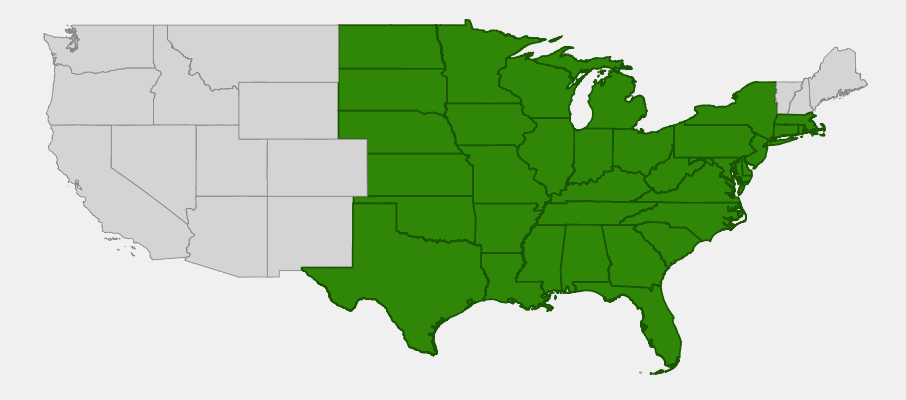
Red Mulberry is native to a broad swath of the eastern and central United States, from southern New England and southern Ontario west to Nebraska and Kansas, and south through the entire southeastern states to Florida, Texas, and northeastern Mexico. It is most abundant in the fertile bottomland forests of the Mississippi Valley and the mid-Atlantic states, where the moist, deep soils of river floodplains and valley bottoms provide ideal growing conditions. The species is found from sea level to about 3,000 feet in the Appalachian Mountains.
In Delaware, New Jersey, and New York, Red Mulberry is found primarily along river floodplains, rich bottomland forests, and forest edges with fertile, moist soils. The Delaware River valley, the Hudson Valley, and the various tributaries draining the Coastal Plain all support populations of Red Mulberry in appropriate riparian and bottomland habitats. The species is increasingly rare as a pure-species tree in much of the northeast due to hybridization pressure from the ubiquitous non-native White Mulberry (Morus alba), which was introduced to North America in the colonial era for silkworm cultivation and has since spread widely throughout the region.
The conservation concern surrounding Red Mulberry in the northeastern United States centers on the extensive hybridization with White Mulberry. Hybrid swarms intermediate in character between the two species are now more common in many areas than pure Red Mulberry. Planting genetically verified, nursery-sourced Red Mulberry helps maintain the native gene pool and supports the full ecological community associated with this species, including specialist insects and wildlife that evolved with it.
📋 Regional plant lists featuring Red Mulberry: Delaware, New Jersey & New York
Growing & Care Guide
Red Mulberry is a fast-growing, adaptable, and long-lived tree that thrives with minimal care once established. Its main requirements are adequate sun, moderate moisture, and fertile soil — conditions it naturally occupies in bottomland forests and river floodplains. It is an excellent choice for large properties, wildlife gardens, edible landscapes, and naturalized riparian plantings.
Light
Red Mulberry grows best in full sun to part shade. In full sun with good moisture, it grows rapidly and produces abundant fruit. In part shade, growth is somewhat slower and fruit production reduced but still substantial. Avoid deep shade, where the tree becomes weak and sparsely productive. Site in the sunniest available spot for maximum wildlife benefit from fruit production.
Soil & Water
Prefers deep, moist, fertile, well-drained to somewhat moist soils — similar to the bottomland forest conditions of its native habitat. Best in loamy or silty soils with good organic matter content. Tolerates periodic flooding but not standing water. pH range of 5.5 to 7.0 is acceptable. Once established, Red Mulberry is moderately drought-tolerant, though consistent moisture produces the best fruit and fastest growth. Mulch the root zone to maintain soil moisture and moderate temperature.
Planting Tips
Plant in spring or fall in a location with adequate space for the tree’s mature 35–70 foot height and broad crown. Allow at least 20–30 feet from structures and pavement — the ripening fruit stains walkways, pavement, and outdoor surfaces a deep purple, so avoid planting directly adjacent to patios, driveways, or areas where the staining would be problematic. The fruit is a wonderful asset for wildlife but a nuisance near high-use human areas. Ensure the planting site has adequate moisture, especially in the first two growing seasons.
Pruning & Maintenance
Red Mulberry requires minimal pruning. Remove dead or damaged branches in late winter. Avoid heavy pruning in summer when sap flow is active, as the milky latex can be slow to heal. The tree is fast-growing and generally self-shaping without intervention. It is relatively free of serious disease and pest problems in its native range, though it is susceptible to Mulberry Leaf Spot and canker diseases in wet years. Encourage good air circulation by pruning crossing branches.
Landscape Uses
- Wildlife garden anchor — one of the highest-value fruit trees for birds and mammals
- Edible landscape — the fruit is delicious for human consumption as well
- Shade tree for large properties with open space
- Riparian planting along stream banks and river corridors
- Naturalized bottomland and floodplain restoration
- Urban tree (away from pavement) — tolerates urban air pollution
Wildlife & Ecological Value
Red Mulberry produces the most wildlife-consumed fruit of any native tree in the eastern United States. The abundance and timing of fruit production — late June through July — provides a critical food source during a period when many other native fruits have not yet ripened.
For Birds
Red Mulberry fruit is consumed by over 50 bird species, making it one of the top wildlife trees in eastern North America. American Robin, Wood Thrush, Hermit Thrush, Veery, Eastern Bluebird, Cedar Waxwing, Rose-breasted Grosbeak, Baltimore Oriole, Gray Catbird, Brown Thrasher, and dozens of other species gorge on the fruit during the ripening period. The abundance of fruit during breeding season provides critical nutrition for parent birds feeding nestlings. The tree is also a larval host for the Cecropia Moth, one of the largest and most spectacular native moths in North America.
For Mammals
Raccoons, opossums, foxes, White-tailed Deer, Black Bears, Wild Turkey, and Eastern Box Turtles all consume Red Mulberry fruit extensively. Squirrels — both Gray and Fox Squirrels — are major consumers, both eating fruit directly and caching seeds. The fruit-drop period creates a feeding frenzy beneath mature mulberry trees, concentrating wildlife in ways that make Red Mulberry planting spots among the best wildlife observation points in the native landscape.
For Pollinators
While the flowers are wind-pollinated and produce little nectar, the tree supports pollinators indirectly by hosting dozens of moth and butterfly larvae. The Cecropia Moth, Polyphemus Moth, and various other large Saturniid moths use Red Mulberry as a larval host plant. Numerous smaller moth species also complete their larval development on mulberry foliage, contributing to the diverse moth communities that in turn support insectivorous birds and bats.
Ecosystem Role
Red Mulberry is a keystone species in eastern bottomland forest food webs. The sheer volume of fruit produced by a mature tree — which can ripen thousands of drupes over a 4–6 week period — provides a pulse of food energy that benefits the entire food web, from fruit-eating birds and mammals to the hawks and foxes that prey on them during the concentrated feeding activity. The tree’s broad crown also provides important shade over streams and wetland edges, moderating water temperature and supporting aquatic ecosystems.
Cultural & Historical Uses
Red Mulberry was one of the most widely used native trees among Indigenous peoples of eastern North America. The fruit was eaten fresh, dried for winter storage, and incorporated into pemmican and other preserved foods across dozens of cultural groups from the Great Plains to the Atlantic Coast. Cherokee, Iroquois, Delaware, Choctaw, and many other nations harvested the fruit extensively during the brief but abundant ripening season. The sweet-sour flavor and nutritional richness of the fruit made it highly valued, and seasonal mulberry harvests were often communal events. Some cultures fermented the fruit into alcoholic beverages.
Beyond the fruit, Red Mulberry provided important material resources. The inner bark was used to make flexible fiber for twine, rope, baskets, and cloth — a use shared with the related Paper Mulberry of Asia. The Cherokee wove garments from the strong, flexible inner bark fibers. The wood is extremely durable and rot-resistant, valued for fence posts, barrels, furniture, and boat parts by both Indigenous peoples and European settlers. Early American settlers frequently preserved Red Mulberry trees on their properties specifically for their fruit value for both humans and animals.
The arrival of White Mulberry (Morus alba) with European colonists — brought for silk production using the silkworm (Bombyx mori, which feeds on White Mulberry leaves) — significantly disrupted the genetic integrity of native Red Mulberry through widespread hybridization. Today, conservation efforts focus on identifying and propagating genetically pure Red Mulberry from populations away from White Mulberry contamination. For the native plant gardener, choosing locally sourced, genetically verified Red Mulberry is an important contribution to the conservation of this culturally and ecologically significant species.
Frequently Asked Questions
How do I tell Red Mulberry from White Mulberry?
The single most reliable field character: rub the upper leaf surface with your fingertip. Red Mulberry leaves feel rough and sandpapery (like fine sandpaper); White Mulberry leaves feel smooth or only slightly rough. Also, Red Mulberry has a dull, matte upper leaf surface while White Mulberry leaves are glossy. Petiole (leaf stalk) sap: both produce milky latex when broken, so this doesn’t distinguish them.
Is Red Mulberry fruit safe to eat?
Yes — Red Mulberry fruit is safe, delicious, and nutritious when fully ripe (deep red to purple-black). Unripe fruit (green or white) and the milky sap of stems and leaves can cause nausea and hallucinations. Only harvest and eat fully ripe fruit. The fruit is excellent fresh, in jams, pies, smoothies, and wine.
Does Red Mulberry stain everything purple?
Yes. The ripe fruit produces intense purple-red stains on clothing, concrete, pavement, and anything it falls on. This is the primary reason to avoid planting near patios, driveways, or walkways. In a wildlife garden or lawn area where staining is acceptable, the fruit production is a massive ecological benefit that far outweighs the mess.
Is Red Mulberry a good street tree?
The fruit drop and staining make it a poor street tree for most urban situations. For street and sidewalk plantings, consider other native trees. Red Mulberry is best in open areas of parks, wildlife gardens, and naturalized landscapes where the fruit can benefit wildlife without creating maintenance problems.
How do I attract birds with Red Mulberry?
Plant one or more trees in a sunny location with clear sight lines from surrounding shrubs and trees, so birds can observe the tree and access it safely. A mature Red Mulberry in fruit is a guaranteed magnet for dozens of bird species during the 4–6 week ripening window. Position a bench or blind nearby for exceptional wildlife viewing during this period.

Looking for a nursery that carries Red Mulberry?
Browse our native plant nursery directory: Delaware · New Jersey