Trumpet Creeper (Campsis radicans)
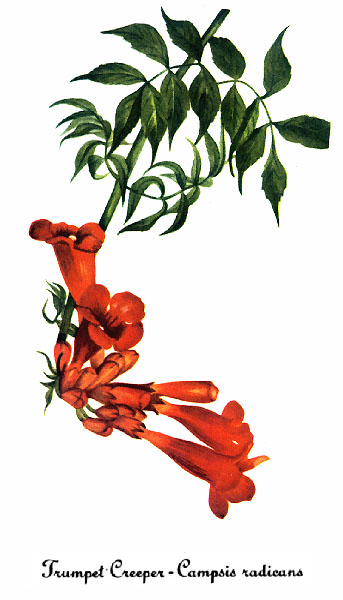
Campsis radicans, commonly known as Trumpet Creeper, Trumpet Vine, or Hummingbird Vine, is one of the most spectacular native flowering vines of eastern North America. This robust, woody deciduous vine produces an extraordinary summer-long display of large, vivid orange to red trumpet-shaped flowers that are absolutely irresistible to Ruby-throated Hummingbirds — earning it the nickname “hummingbird vine” in many parts of its range. The flowers are designed for hummingbird pollination: deep, narrow tubes that exclude most insects while perfectly accommodating the hovering, long-billed hummingbird.
A member of the trumpet vine family (Bignoniaceae), Trumpet Creeper grows vigorously by aerial rootlets that cling to any rough surface — bark, masonry, wood, or stone — climbing to 20–40 feet or more on suitable support. Pinnate compound leaves give it a lush, tropical appearance throughout the growing season. The large, showy flowers — 2½ to 3 inches long — bloom from June through August (or even into September), providing a sustained source of nectar for hummingbirds throughout the summer. In full sun, the flowering is especially abundant and the vine is at its most spectacular.
Trumpet Creeper grows naturally in moist to moderately dry woodland edges, thickets, and disturbed areas throughout much of the eastern and central United States. It is adaptable, vigorous, and virtually indestructible once established — characteristics that make it both an excellent garden plant and a potentially aggressive one. In the right setting, it is unmatched for hummingbird attraction and bold visual impact. For gardeners in Delaware, New Jersey, and New York who want to attract Ruby-throated Hummingbirds and add dramatic summer color to fences, walls, and arbors, Trumpet Creeper is a first-rate native choice.
Identification
Trumpet Creeper is a vigorous, woody, deciduous vine climbing to 20–40 feet by aerial rootlets (adhesive disks and short roots along the stem). The overall appearance is bold and lush — large pinnate leaves and massive clusters of brilliant orange-red flowers make this one of the most visually striking native vines.
Stems & Bark
Mature stems are woody, brown, and develop shaggy, fibrous bark with age. Young stems are green to brownish, producing aerial rootlets at intervals that allow the vine to cling firmly to rough surfaces without additional support. The roots are aggressive and the stem base can become very large over time — old vines with trunks several inches in diameter are not uncommon. The vine can also spread by underground runners, which emerge as new shoots well away from the main plant.
Leaves
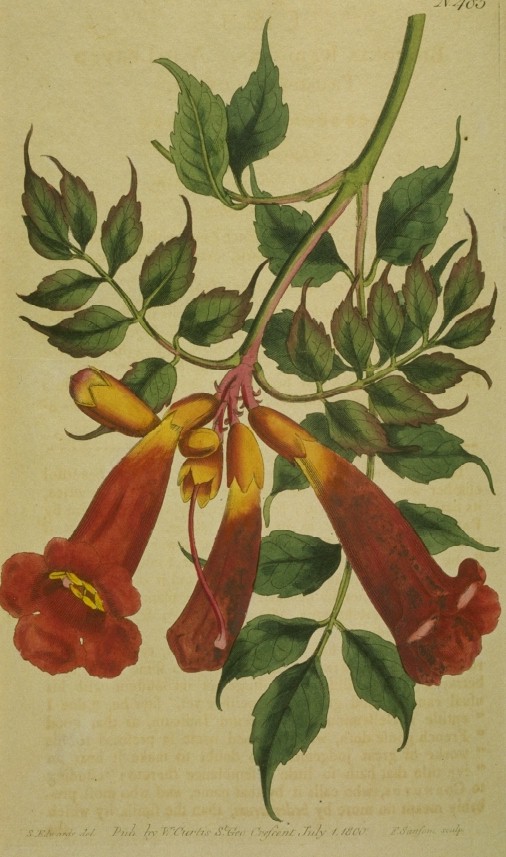
The leaves are pinnately compound, typically 7–11 leaflets per leaf, each leaflet 1½ to 3 inches long, elliptic to ovate, with coarsely toothed margins and a pointed tip. The leaflets are bright green above, paler below, and give the vine a lush, tropical appearance. Leaves emerge relatively late in spring and drop early in fall with little ornamental fall color.
Flowers & Fruit
The flowers are the defining feature of Trumpet Creeper. Borne in terminal clusters of 4–12, the blooms are large (2½–3 inches long), tubular to trumpet-shaped, and vivid orange-red to scarlet outside, with a yellow-orange interior. The tube is slightly curved, with 5 shallow, reflexed petal lobes at the mouth. Blooming from June through August, each cluster produces flowers sequentially over several weeks, extending the show. After flowering, the plant produces long, bean-like seed pods 4–6 inches long that split open in fall to release numerous flat, winged seeds.
Quick Facts
| Scientific Name | Campsis radicans |
| Family | Bignoniaceae (Trumpet Vine) |
| Plant Type | Deciduous Woody Vine |
| Mature Height | 20–40 ft |
| Sun Exposure | Full Sun to Part Shade |
| Water Needs | Low to Moderate |
| Bloom Time | June – August |
| Flower Color | Orange to orange-red / scarlet |
| USDA Hardiness Zones | 4–9 |
Native Range
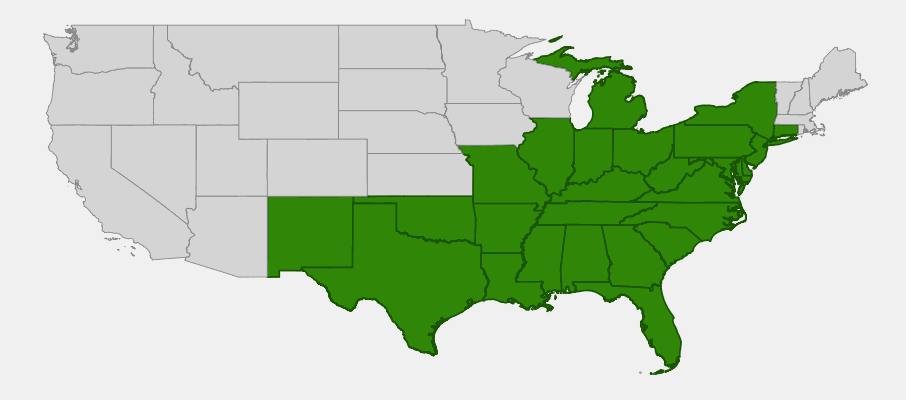
Trumpet Creeper is native to the eastern and central United States, ranging from New Jersey south to Florida and west to Texas, Nebraska, Iowa, and Kansas. It is most common in the mid-Atlantic, Southeast, and Midwest, where it grows in woodland edges, thickets, roadsides, and riverbanks. The species has naturalized well beyond its native range — it is widely planted and has escaped cultivation in parts of the Northeast, Midwest, and Pacific Coast.
In Delaware, New Jersey, and New York, Trumpet Creeper is native primarily in the coastal plain and piedmont regions — Delaware and southern New Jersey represent the core of its native range in the tri-state area. In northern New Jersey and New York, it occurs mainly as an escape from cultivation, though there are natural populations in suitable habitats in the lower Hudson Valley and Long Island.
In its natural habitat, Trumpet Creeper grows in moist to moderately dry forest edges, thickets, floodplains, and disturbed areas. It is a pioneer species that quickly colonizes forest margins and disturbed ground. It associates with Black Locust, Wild Grape, Virginia Creeper, Poison Ivy, and other vigorous, light-demanding vines and shrubs in successional habitats.
📋 Regional plant lists featuring Trumpet Creeper: Delaware, New Jersey & New York
Growing & Care Guide
Trumpet Creeper is one of the most vigorous and adaptable native vines — easy to grow, spectacular in bloom, and virtually indestructible once established. The main challenge is managing its vigor.
Light
Trumpet Creeper flowers most abundantly in full sun. As the batch notes indicate, it “flowers in full sun” — in shade, it grows vigorously but produces few or no flowers. Choose a full sun location for maximum blooming and hummingbird attraction. Part shade is acceptable but will significantly reduce flowering.
Soil & Water
Trumpet Creeper is extremely adaptable. It grows in virtually any well-drained soil — sandy, clay, rocky, poor or fertile — and tolerates moderate drought once established. It actually performs better in less fertile soils; rich soils and high fertility promote vigorous vegetative growth at the expense of flowering. Water regularly in the first year to establish roots, then largely ignore it.
Planting Tips
Plant on a very strong support — a large arbor, stout fence, sturdy trellis, or mature tree. The mature vine can weigh hundreds of pounds and will overwhelm weak structures. Keep it away from house siding, gutters, and wood trim, as the aerial rootlets can damage painted and wood surfaces. Allow 10–15 feet of horizontal space. Site it thoughtfully — once established, it is difficult to remove completely.
Pruning & Maintenance
Regular pruning is necessary to manage Trumpet Creeper’s vigor. Prune hard in late winter, cutting back to 2–3 buds from main framework branches. Remove suckers and root sprouts that emerge from the base regularly — these can colonize considerable distances from the main plant. New plants that sprout in unwanted locations should be dug out promptly. The vine flowers on new wood, so hard annual pruning actually promotes better flowering.
Landscape Uses
- Hummingbird garden — the finest native vine for Ruby-throated Hummingbirds
- Arbor or pergola cover — spectacular summer display
- Fence or wall cover — excellent on sturdy masonry or wood fences
- Wildlife habitat — birds nest in the dense foliage, hummingbirds feed on flowers
- Bank stabilization — roots bind steep slopes
- Naturalizing — beautiful in large, informal, naturalistic areas
Wildlife & Ecological Value
Trumpet Creeper’s primary ecological role is as a hummingbird forage plant, but it supports a much wider range of wildlife than many people realize.
For Birds
Ruby-throated Hummingbirds are the primary pollinators and the most visible wildlife beneficiaries of Trumpet Creeper flowers. A single large vine in full bloom can attract multiple hummingbirds that hover and feed throughout the day. House Finches, American Goldfinches, and other birds nest in the dense vine tangles. The persistent seed pods provide food for seed-eating birds in fall.
For Mammals
Squirrels and chipmunks occasionally consume Trumpet Creeper seeds. The dense tangles of stems provide shelter for small mammals. In the South, hummingbird feeders near trumpet creeper plantings attract broad-tailed and rufous hummingbirds in migration as well as resident Ruby-throateds.
For Pollinators
While primarily hummingbird-pollinated, Trumpet Creeper flowers are also visited by large carpenter bees that are strong enough to enter the flower tubes. Hummingbird Clearwing Moths also visit the flowers. The vine serves as a host plant for the Pandorus Sphinx Moth (Eumorpha pandorus) and Plebeian Sphinx Moth (Paratraea plebeja), whose large caterpillars feed on the leaves.
Ecosystem Role
As a vigorous, pioneer vine species, Trumpet Creeper plays a role in forest succession and habitat creation. Its dense tangles provide important cover in woodland edges and disturbed areas. The deep, spreading root system helps bind unstable slopes and eroded banks. The flowers are among the most important nectar sources for migrating Ruby-throated Hummingbirds, who build fat reserves for their trans-Gulf migration to Central America in late summer.
Cultural & Historical Uses
Trumpet Creeper was well known to Indigenous peoples throughout its range. The Cherokee, Creek, and other southeastern nations used the plant medicinally in preparations made from the leaves, bark, and roots. One notable use was as a treatment for athlete’s foot and fungal skin infections — the plant has demonstrated antifungal properties that may validate this traditional use. Roots were also used in preparations for treating rheumatism, muscle pain, and as a general tonic.
An important caution: the plant contains iridoid glycosides and other compounds that can cause contact dermatitis in sensitive individuals. The sap can cause skin reddening, itching, and blistering in susceptible people — a reaction sometimes called “cow itch” in southern folk names for the plant. Gloves should be worn when pruning or handling the plant if you have sensitive skin.
European settlers and later American gardeners recognized Trumpet Creeper as an ornamental plant of extraordinary beauty and began cultivating it widely. It was among the first North American plants introduced to European gardens in the 17th century, where it became a beloved ornamental. The cultivar ‘Flava’ (yellow-flowered) and the hybrid Campsis x tagliabuana ‘Madame Galen’ (orange-red, larger flowers) are popular in European and American gardens, though the straight native species offers the greatest value for wildlife.
Frequently Asked Questions
Is Trumpet Creeper invasive?
Trumpet Creeper is a native species in the eastern United States and is not classified as invasive in its native range. However, it is vigorous and can spread aggressively by underground runners and seedlings if not managed. In areas outside its native range where it has naturalized (Pacific Northwest, parts of Europe), it can behave invasively. In its native range, the key is site selection and regular pruning to keep it in bounds.
Can Trumpet Creeper damage my house or fence?
Yes — the aerial rootlets can damage painted surfaces, wood trim, mortar in older brick walls, and gutters. Do not plant Trumpet Creeper directly on house siding or near gutters and downspouts. It is best on heavy-duty pergolas, masonry walls, chain-link fences, large trees, or purpose-built sturdy trellises well away from structures.
How do I stop Trumpet Creeper from spreading?
Dig out root sprouts and suckers promptly before they become established. Regular, hard pruning in late winter reduces seed production and controls spread. Installing a root barrier at planting helps contain underground spread.
Will Trumpet Creeper bloom in shade?
Rarely, if at all. Trumpet Creeper is a sun-lover that produces its best flowering — and hummingbird attraction — in full sun. In shade, it grows vigorously but remains largely flowerless. The batch data specifically notes “flowers in full sun.”
Does Trumpet Creeper cause a rash?
Some people — particularly those with sensitive skin — experience contact dermatitis from Trumpet Creeper sap and plant parts. The reaction ranges from mild reddening to blistering in highly sensitive individuals. The southern folk name “cow itch” references this property. Wear gloves when pruning and wash hands and arms after contact.

Looking for a nursery that carries Trumpet Creeper?
Browse our native plant nursery directory: Delaware · New Jersey