Top 5 Best Succulent Pots and Small Ceramic Planters with Drainage in 2026
We independently select all products and services. If you click through links we provide, Plant Native may earn a commission with no extra cost to you.
Last updated: November 20, 2026
Finding the right pot for your succulents isn’t just about aesthetics — it’s about survival. Drainage holes are the single most important feature in any succulent planter, and without them, even the hardiest jade or echeveria will eventually succumb to root rot. After researching dozens of ceramic succulent pots and testing the top contenders for build quality, drainage design, and overall value, we’ve narrowed the field to five standout options.
Whether you’re looking for a matching windowsill set, a quirky owl planter for your desk, or a minimalist white ceramic that disappears into your decor, every pick on this list includes proper drainage and a tray or saucer to protect your surfaces. All prices reflect current Amazon listings and include our affiliate links.
Our picks range from colorful crackle-glazed sets to budget-friendly 12-packs, so there’s something here for every succulent collector — from the person with one desk cactus to the plant parent with an entire shelf of propagations.
Our top pick
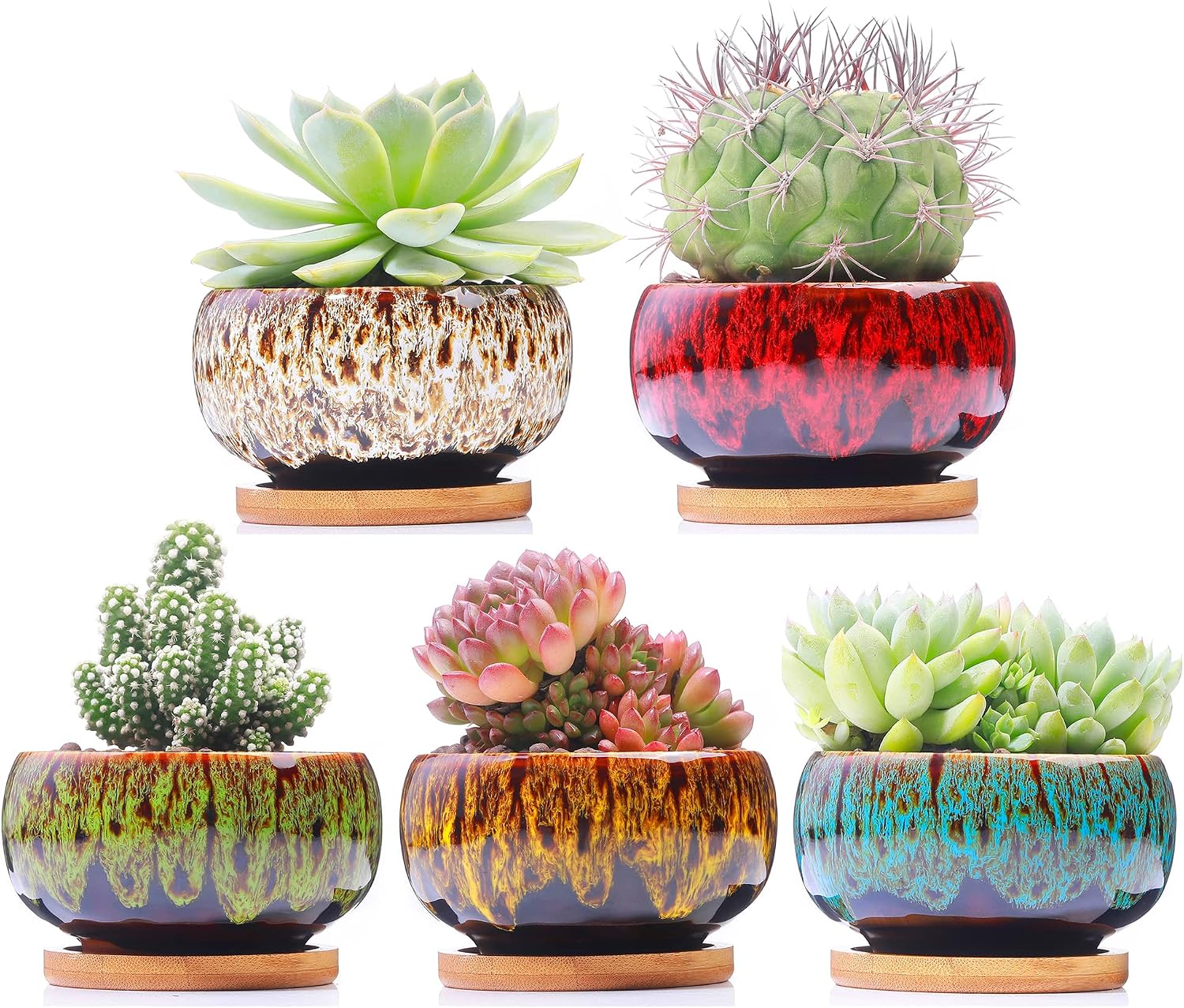
- Attached saucer means no separate tray to slide around or collect grime
- Five different vivid crackle glazes, glazed inside and out
- About 4 inches wide and 2 inches tall — sized for rosette succulents and small cacti
- Drainage hole in every pot, with mesh included for the bottom
Cons
- Attached saucer holds only a little water — empty it after heavy watering
- Shallow 2-inch depth is too small for larger succulents or trailing varieties
The LamDawn set is our top pick because it solves the most annoying problem with small succulent pots: the separate saucer that slides around, collects dust, and grows mildew underneath. Each pot has a saucer built into its base that catches drainage water neatly while keeping a slim profile on your windowsill or desk, and mesh is included to keep soil from washing out of the drainage holes.
Each of the five pots has a different crackle glaze, from deep red to teal and amber, which gives the set a collected-over-time look rather than mass-produced uniformity. The pots are glazed inside and out and measure about 4 inches across by 2 inches tall, a good fit for echeveria, haworthia, lithops, and small cacti. If you need pots for larger succulents like aloe or snake plants, look at the STHIE set below instead.
Best value

- Good value — six pots with individual bamboo trays
- Clean bright-white finish matches any decor style from modern to farmhouse
- Each pot has a drainage hole, and the removable tray stops soil loss and overflow
Cons
- Bamboo trays can develop water stains over time if not dried regularly
- At about 2 inches tall, the pots suit only small succulents and cuttings
ZOUTOG delivers a lot for the money in the small ceramic planter market. This 6-pack comes with an individual bamboo tray for every pot — a feature that many pricier sets skip — and the white ceramic is fired at high temperature for a clean, durable finish.
Each pot measures about 3.1 inches across and 2 inches tall, a sweet spot for most common succulents, and every pot has a drainage hole while its tray catches runoff to stop soil loss and overflow. These are ideal if you’re potting up propagations or gifting succulents to friends. The main trade-off is size: at about 2 inches deep, they are best for small plants. Like any ceramic, they can chip if dropped, but at this price point, replacing one isn’t a major concern.
Best decorative pick

- Six owl designs with different flowing glaze colors — handmade, so colors vary
- Bottom drainage hole keeps succulents healthy despite the decorative shape
- Compact size (about 2.2 x 2.2 x 2.4 inches) suits desks, shelves, and windowsills
Cons
- No included saucer or tray — you’ll need to buy or improvise something to catch drainage
- Small interior is tight for anything larger than a single small succulent
- Owl theme isn’t for everyone — these commit you to a specific aesthetic
If you want succulent pots that spark conversation, the Sun-E owl set delivers. Each of the six pots features a different flowing glaze — shades of green, brown, blue, and cream — over a detailed owl form. Because the pots are handmade and the glaze varies, a lined-up set looks curated rather than cookie-cutter.
Functionally, each pot has a drainage hole, and the ceramic is made from clay baked at high temperature. The biggest drawback is the lack of an included saucer. You can pair them with small cork coasters or buy a set of bamboo trays separately. These make excellent gifts for plant lovers, teachers, or anyone who appreciates a desk that looks like a tiny ceramic zoo. Just keep in mind the roughly 2.5-inch size — these are strictly for small succulents, baby cacti, or air plants.
Best minimalist design
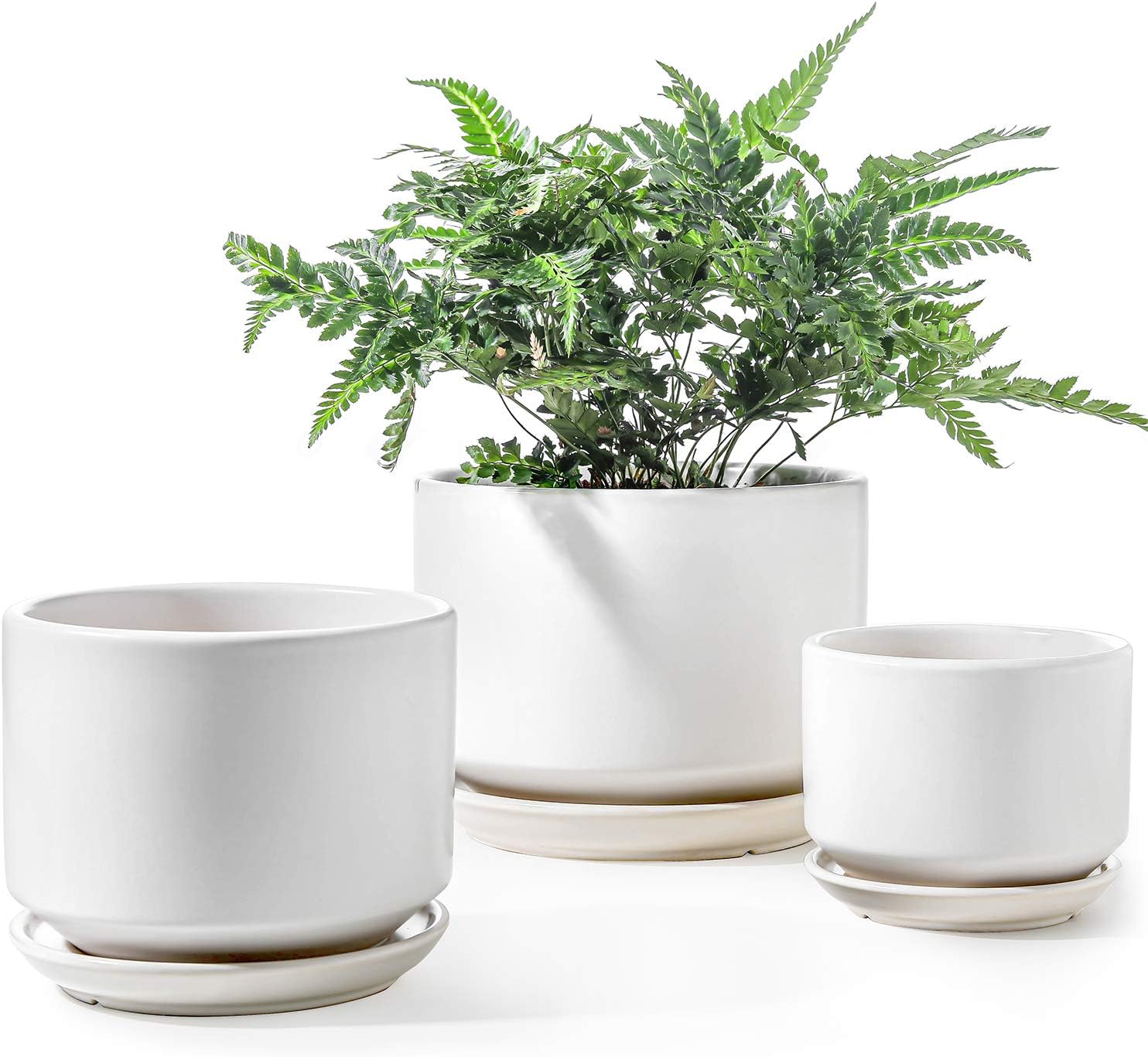
- Clean straight-cylinder shape with a smooth soft-white glaze that wipes clean
- Permanently attached saucers catch drips, and mesh pads are included
- Three sizes (4.3, 5.3 and 6.8 inches across) for small to medium plants
Cons
- Only 3 pots per set — not ideal if you need many identical pots for a shelf display
- White glaze shows soil and mineral marks more readily than darker glazes
LE TAUCI is a favorite among minimalism-loving plant parents, and this 3-pack shows why. The high-fired stoneware has a smooth soft-white glaze on a simple straight cylinder, so the pots blend into modern, boho, farmhouse, or minimalist rooms and let green foliage stand out. The straight sides also give roots more room than tapered pots of the same width.
Each pot has a drainage hole with a permanently attached saucer, so excess water drains away from roots while the built-in tray catches drips, and three mesh pads keep soil from washing out. The sizes run from 4.3 x 3.5 inches up to 6.8 x 5.3 inches (diameter x height), so the small pot suits a single succulent while the large one fits a jade, small snake plant, or pothos.
Best saucer set

- Three graduated widths (3.4″, 4.4″, 5.5″) let you size up as succulents grow without switching brands
- Matching glazed saucers look more polished than mismatched bamboo trays
- Blue glaze with gold dots adds color without overwhelming a space
Cons
- Only 3 pots per set — not ideal if you need many identical pots for a shelf display
- The 5.5″ pot is larger than what most small succulents need, though it works well for aloe or haworthia clusters
- Ceramic saucers can scratch wooden surfaces — use felt pads underneath
The STHIE graduated set solves a common problem: what do you do when your 2-inch succulent outgrows its pot? With three sizes in matching ceramic, you can pot up without breaking your aesthetic. The blue glaze with scattered gold dots has depth and variation that photographs well and looks expensive on a shelf.
The matching saucers are the real selling point here. While bamboo trays work fine functionally, ceramic-on-ceramic looks intentional and coordinated, and every pot has a drainage hole to protect plants from overwatering. This set is best for someone who wants a few statement pots rather than a large collection of identical ones. If you’re displaying succulents on a coffee table or entryway console where the pots themselves are part of the decor, STHIE delivers a premium look without a premium price tag.
How We Chose These Pots
We evaluated over 30 ceramic succulent planters available on Amazon, prioritizing drainage design, ceramic quality, included accessories (saucers and trays), aesthetic appeal, and value per pot. Every pick on this list has a properly sized drainage hole — the non-negotiable feature for succulent health.
Why Drainage Holes Matter for Succulents
Succulents store water in their leaves and stems, making them exceptionally prone to root rot when soil stays wet. A drainage hole allows excess water to escape after watering, letting the soil dry out completely between sessions. Pots without drainage are the number one killer of indoor succulents — even more than underwatering or insufficient light.
Ceramic vs. Plastic vs. Terracotta
Ceramic pots strike the best balance between aesthetics and function. They’re heavier than plastic (so they won’t tip over), more attractive than terracotta (which stains and effloresces), and better insulators than either. The main downside is fragility — ceramic chips if dropped. For succulents specifically, ceramic’s moderate porosity is ideal: it allows some air exchange through the walls without drying out as aggressively as unglazed terracotta.
What Size Pot Does Your Succulent Need?
Choose a pot that’s about 1 inch wider in diameter than your succulent’s rosette or canopy. Too large and the excess soil retains moisture that roots can’t absorb; too small and the plant becomes rootbound and stressed. For most common succulents — echeveria, sempervivum, haworthia — a 2.5 to 3.5 inch pot is ideal. Larger varieties like aloe, jade plants, or mature agave need 4 to 6 inches.
Tips for Using Small Planters with Drainage
Always use a fast-draining succulent soil mix (or add perlite to standard potting soil). Water thoroughly until water runs out the drainage hole, then empty the saucer after 15 minutes. Never let pots sit in standing water. In winter, reduce watering frequency to once every 2-3 weeks for most species. Place a small piece of mesh or a coffee filter over the drainage hole to prevent soil loss without blocking water flow.
We independently select all products and services. If you click through links we provide, Plant Native may earn a commission with no extra cost to you. As an Amazon Associate I earn from qualifying purchases.