San Bernardino Larkspur (Delphinium parryi)
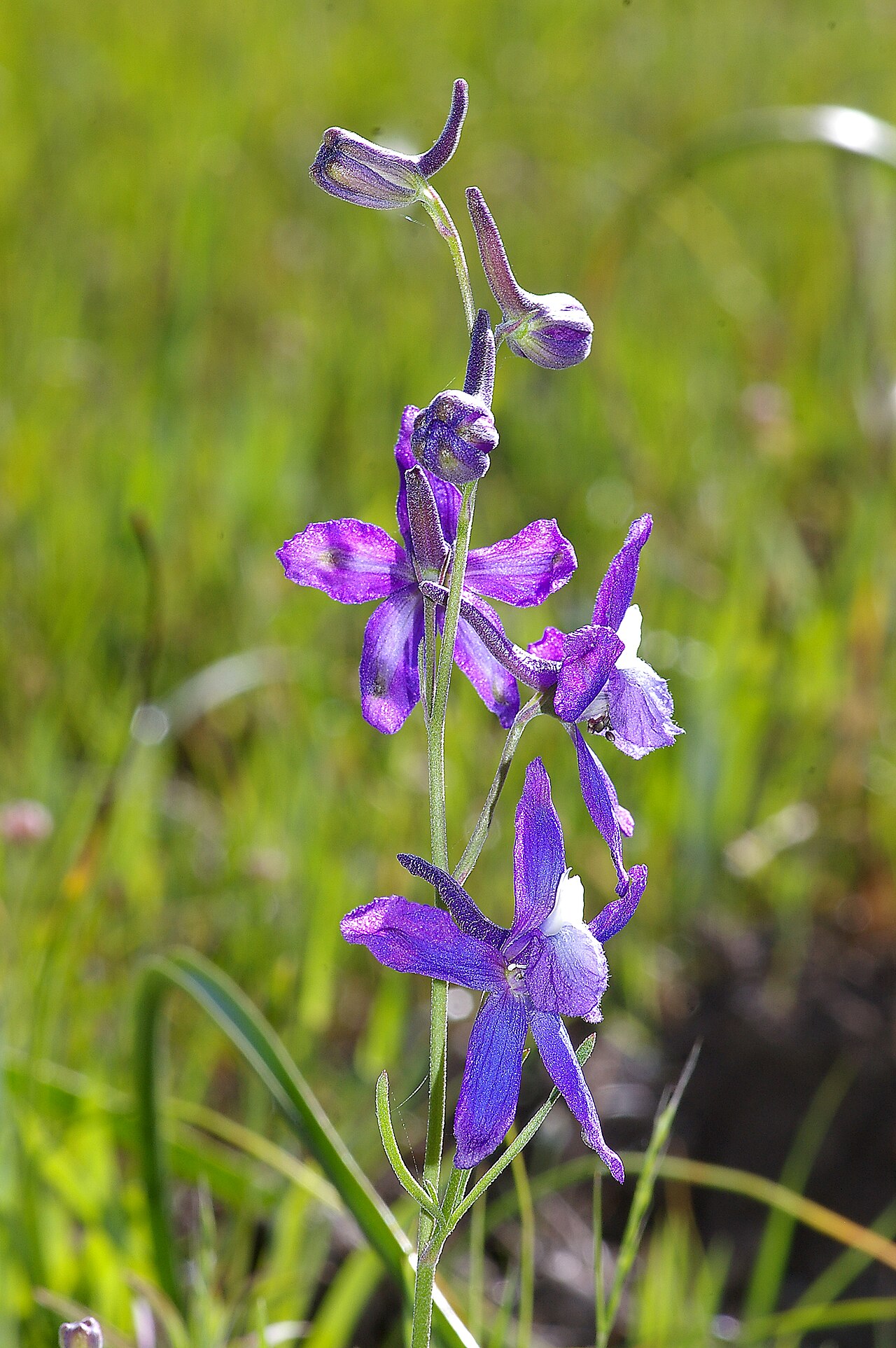
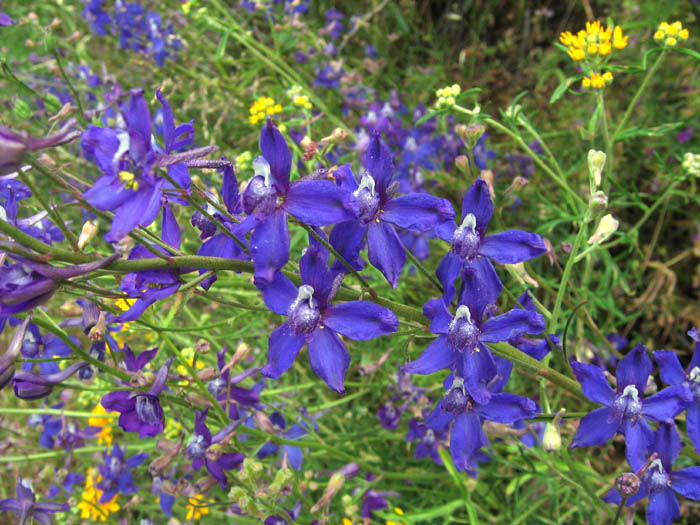
Delphinium parryi, commonly called San Bernardino larkspur or Parry’s larkspur, is a striking spring wildflower of California’s grasslands, chaparral, and oak woodlands. From a cluster of deeply lobed, fuzzy basal leaves, it sends up slender flowering stalks topped with loose spires of deep violet-blue flowers, each with a long backward-pointing spur and a tuft of pale, almost white petals tucked at the center. It is endemic to California (with a small range extending into Baja California), occurring from the San Francisco Bay Area south through the Coast Ranges, the Transverse and Peninsular Ranges, and into San Diego County.
Despite the common name pointing to the San Bernardino Mountains, this larkspur is a lowland and foothill plant of open grassy slopes, coastal sage scrub, and chaparral openings rather than a true mountain species — it typically grows below about 5,000 feet, often in the same dry, grassy hillsides that turn gold with wild oats and lupine each spring. Like most larkspurs, every part of the plant is toxic if eaten, a trait it shares with its relatives across the genus and one worth knowing before planting it where livestock or curious pets graze.
For California native plant gardeners, San Bernardino larkspur is a classic component of a dry spring wildflower display, prized for its rich violet-blue color — a shade uncommon among California’s typically gold, orange and pink spring bloomers — and for the ease with which it reseeds in the right conditions.
Identification
San Bernardino larkspur is a perennial herb growing from a cluster of fibrous, somewhat fleshy roots, with flowering stems reaching 1 to 3 feet tall, occasionally approaching 3.3 feet in favorable sites. The stems are finely hairy and usually unbranched or sparingly branched below the flower spike.
Leaves
Leaves are mostly basal, rounded in outline but deeply cut into narrow, finger-like lobes, giving them a distinctly dissected, almost fern-like look. Both stems and leaves are covered in fine hairs, giving the foliage a soft, slightly grayish cast. Leaves wither as the plant moves into summer dormancy, in keeping with the species’ adaptation to California’s dry-summer climate.
Flowers
The flowering stalk carries an open, elongated cluster of a few to as many as 60 flowers on slender pedicels. Each flower has five petal-like sepals in deep purple to light blue, with a long nectar spur extending more than ¾ inch behind the flower. Two true upper petals are typically white or pale, forming a pale “eye” at the flower’s center that contrasts with the surrounding blue-violet sepals. Bloom occurs from March through June depending on elevation and rainfall.
Fruit & Seeds
Like other larkspurs, the flowers give way to a cluster of three dry, beaked follicles (pod-like fruits) that split open to release numerous small seeds. All plant parts, including seeds, contain toxic diterpenoid alkaloids.
Quick Facts
| Scientific Name | Delphinium parryi |
| Family | Ranunculaceae (Buttercup) |
| Plant Type | Perennial Wildflower |
| Mature Height | 1–3 ft |
| Mature Spread | 1–1.5 ft |
| Growth Rate | Moderate |
| Sun Exposure | Full Sun to Part Shade |
| Water Needs | Low |
| Soil Type | Well-drained clay, loam, or gravelly soils |
| Soil pH | Neutral to slightly alkaline |
| Bloom Time | March – June |
| Flower Color | Deep purple-blue with white center |
| Fall Color | None (summer dormant) |
| Fruit | Dry beaked follicles (pods) |
| Deer Resistant | Yes (toxic foliage) |
| USDA Hardiness Zones | 8–10 |
Native Range
San Bernardino larkspur is endemic to California, found from the San Francisco Bay Area south through the Central Coast and Coast Ranges, into the Transverse and Peninsular Ranges of Southern California, and south to San Diego County, with its range continuing a short distance into northern Baja California, Mexico. Despite its common name, it is not confined to the San Bernardino Mountains but occurs broadly across coastal and inland Southern California foothills and valleys.
Within this range it favors open grasslands, coastal sage scrub, chaparral openings, and oak woodland edges, typically on clay or heavier soils that hold enough moisture through the winter rainy season to support its spring growth cycle. It is most common below about 5,000 feet elevation, in the same Mediterranean-climate belt that supports much of California’s iconic spring wildflower displays.
Because it depends on winter and spring rainfall followed by summer dormancy, San Bernardino larkspur is a true dry-summer specialist and is not found in the wetter, forested parts of northern California or at the higher, snow-dominated elevations of the Sierra Nevada.
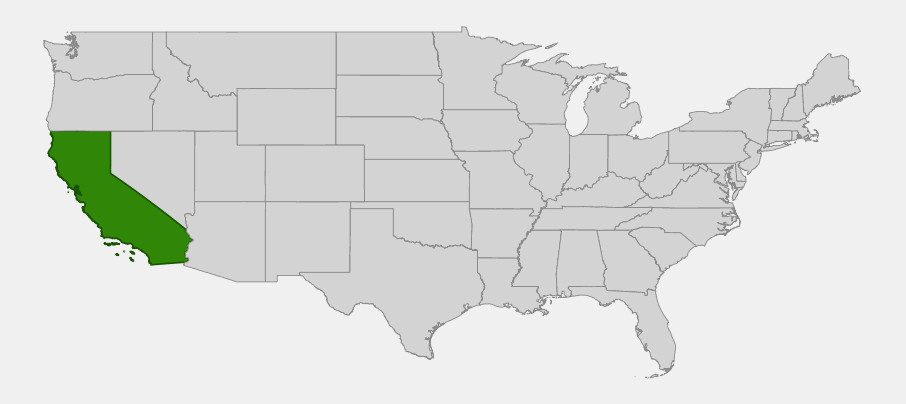
📋 Regional plant lists featuring San Bernardino Larkspur: California & Nevada
Growing & Care Guide
San Bernardino larkspur rewards gardeners who can replicate its native cycle of wet winters and dry summers, going dormant and disappearing from view for much of the year before returning reliably each spring.
Light
Full sun to light part shade suits this species well, matching the open grassland and chaparral-edge conditions where it grows wild. In hotter inland gardens, a bit of afternoon shade can help extend the bloom period.
Soil & Water
This larkspur tolerates a range of soils, including heavier clay, as long as drainage is adequate during the brief but important winter growing season. Water during fall and winter establishment and through spring bloom; once foliage begins to yellow and the plant enters summer dormancy, withhold water entirely — like many California natives, San Bernardino larkspur’s fleshy roots are prone to rot if kept moist through the dry season.
Planting Tips
Sow seed in fall to take advantage of natural winter rains and cold stratification, or plant container stock in fall as well so roots can establish before the spring growth flush. Choose a site where summer irrigation can be kept away from the dormant root zone, such as among other summer-dry California natives rather than in a regularly watered bed.
Pruning & Maintenance
Allow foliage to die back naturally after bloom and seed set; this is the plant’s normal dormancy cycle, not a sign of trouble. Deadhead spent flower stalks if seed is not wanted, or leave them to self-sow. Because all parts are toxic, wear gloves when handling and cutting back the plant, and keep it away from areas where children, pets, or livestock might browse it.
Landscape Uses
San Bernardino larkspur is well suited to several California native garden styles:
- Dry spring wildflower meadows with other summer-dormant natives
- Oak woodland understory plantings
- Chaparral and coastal sage scrub gardens
- Pollinator gardens seeking blue-violet spring color
- Habitat restoration on dry grassy slopes
Wildlife & Ecological Value
San Bernardino larkspur plays a modest but valuable role in California’s spring wildflower ecosystems, particularly for pollinators adapted to its deep, spurred flowers.
For Pollinators
The long nectar spurs are especially suited to bumblebees and other long-tongued bees, as well as hummingbirds, which can reach nectar that is inaccessible to many shorter-tongued insects. The violet-blue flower color is also particularly attractive to bees, which see blue and ultraviolet wavelengths well.
For Birds & Mammals
Hummingbirds visit the flowers for nectar during the spring bloom period. Because the entire plant is toxic, it is generally avoided by deer, rabbits, and livestock, which makes it a reliably browse-resistant choice in gardens where herbivory is a concern — though this same toxicity means it should be kept away from grazing animals and curious pets.
Ecosystem Role
As a summer-dormant perennial, San Bernardino larkspur is well adapted to California’s Mediterranean climate cycle, completing its growth, flowering, and seed set during the wet season and retreating underground during the dry months alongside many of its grassland and chaparral-edge neighbors, contributing to the layered diversity of spring bloom that characterizes healthy California grassland and oak woodland communities.
Cultural & Historical Uses
Larkspurs as a genus, including Delphinium parryi, have a documented history of caution rather than use among both Indigenous peoples and early ranchers in California: the plants were recognized as toxic to livestock, particularly cattle, and were avoided or managed around rather than cultivated or consumed. Some historical accounts describe limited, carefully prepared external uses of larkspur plant material by Indigenous communities in parts of the West, though specific documented use of Delphinium parryi itself is limited.
The species was named for Dr. Charles Christopher Parry, a 19th-century botanist and plant collector who made significant contributions to the documentation of California and Rocky Mountain flora. The genus name Delphinium comes from the Greek word for dolphin, referencing the dolphin-like shape of the unopened flower bud.
Today, the plant’s significance is primarily horticultural and ecological, valued by California native plant gardeners for its distinctive blue-violet color in the spring wildflower palette and recognized by land managers as a characteristic component of healthy coastal sage scrub and grassland plant communities.
Frequently Asked Questions
Is San Bernardino larkspur poisonous?
Yes. Like all larkspurs, every part of the plant contains toxic diterpenoid alkaloids and should never be eaten. Keep it away from livestock, pets, and young children, and wear gloves when handling or cutting the plant back.
Why does San Bernardino larkspur disappear in summer?
It is a summer-dormant perennial adapted to California’s dry-summer climate. After flowering and setting seed in spring, the foliage naturally yellows and dies back, with the plant surviving underground until the following winter’s rains trigger new growth. This is normal, not a sign of a dying plant.
Can I grow San Bernardino larkspur outside California?
It can be grown wherever a true Mediterranean climate with wet winters and dry summers can be replicated, but it struggles in regions with summer rainfall or humid summers, where the dormant roots are prone to rot.
Does San Bernardino larkspur attract hummingbirds?
Yes. Its long-spurred, nectar-rich flowers are well suited to hummingbird pollination, and hummingbirds are regular visitors during the spring bloom period, along with bumblebees and other long-tongued bees.
Is San Bernardino larkspur the same as the larkspur found in the San Bernardino Mountains?
The common name references the species’ description rather than an exclusive mountain habitat. San Bernardino larkspur actually grows mainly in lowland and foothill grasslands and chaparral across much of coastal and inland Southern California, not only in the San Bernardino Mountains themselves.

Looking for a nursery that carries San Bernardino Larkspur?
Browse our native plant nursery directory: California