
Beach Naupaka (Scaevola sericea)
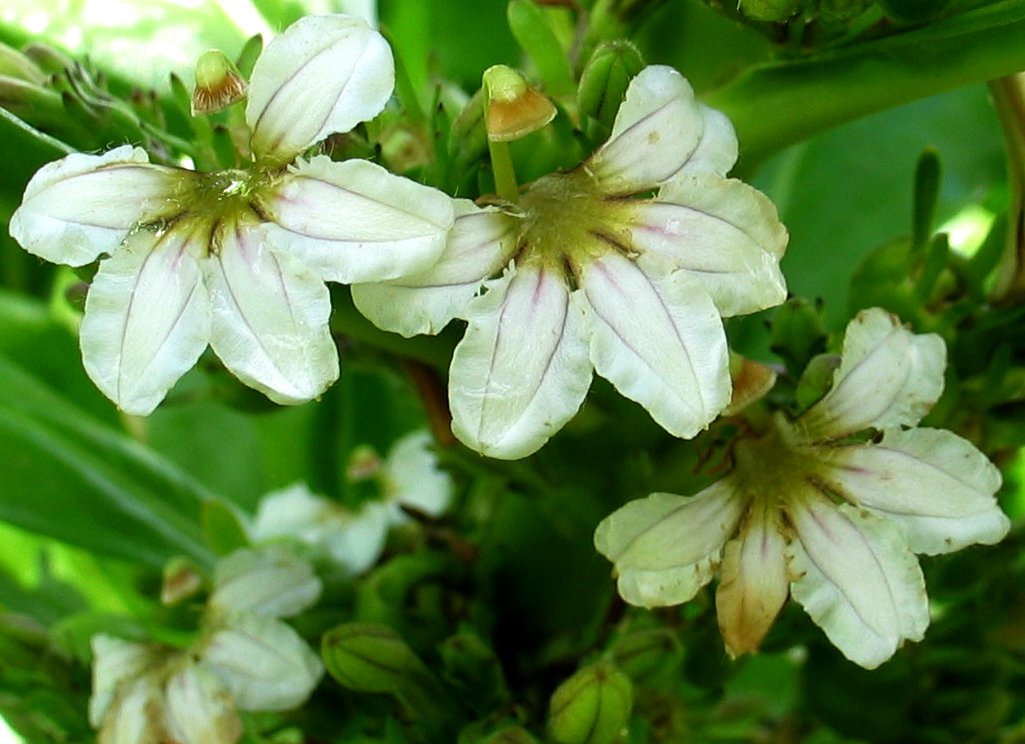
Scaevola sericea (syn. Scaevola taccada), known in Hawaiian as Naupaka Kahakai or Beach Naupaka, is one of the most iconic coastal plants of Hawaiʻi and the broader Indo-Pacific region. A member of the Goodeniaceae family, Beach Naupaka forms dense, spreading mounds 3 to 10 feet tall along sandy beaches, rocky shores, and coastal bluffs throughout the Hawaiian Islands. Its most immediately recognizable feature is its uniquely shaped flowers — each bloom appears as if it were cut in half, with all five petals arranged on one side of the flower in a fan shape.
This distinctive half-flower has inspired one of Hawaiʻi’s most beloved legends. In the Hawaiian tradition, the naupaka flower was once whole, but was torn in two when two lovers — one living on the beach and one in the mountains — were separated, never to be reunited. The mountain naupaka (Scaevola gaudichaudiana) and beach naupaka mirror each other’s half-flowers, representing the separated halves of a single bloom and the enduring hope of reunion. The legend is told in different versions across the islands, cementing naupaka’s place as one of Hawaiʻi’s most culturally resonant plants.
Beyond its cultural significance, Beach Naupaka is an extraordinarily valuable coastal plant. Its dense, sprawling growth stabilizes beach sand and dune systems, protecting shorelines from wave erosion. The fleshy white berries are dispersed by ocean currents — the seeds float and remain viable after seawater immersion — which explains the plant’s remarkable distribution across the tropical Pacific. Beach Naupaka is widely used in Hawaiian coastal restoration, landscaping, and erosion control, and is one of the most readily available native Hawaiian plants at nurseries across the state.
Identification
Beach Naupaka is a large, spreading shrub typically 3 to 10 feet (1–3 m) tall and often considerably wider, forming dense, rounded mounds that can sprawl across beach margins and coastal slopes. Stems are thick, succulent, and woody at the base, with a soft, slightly fleshy quality throughout. The plant’s overall appearance is robust and salt-spray-tolerant, with a somewhat tropical, lush quality even in harsh coastal conditions.
Leaves
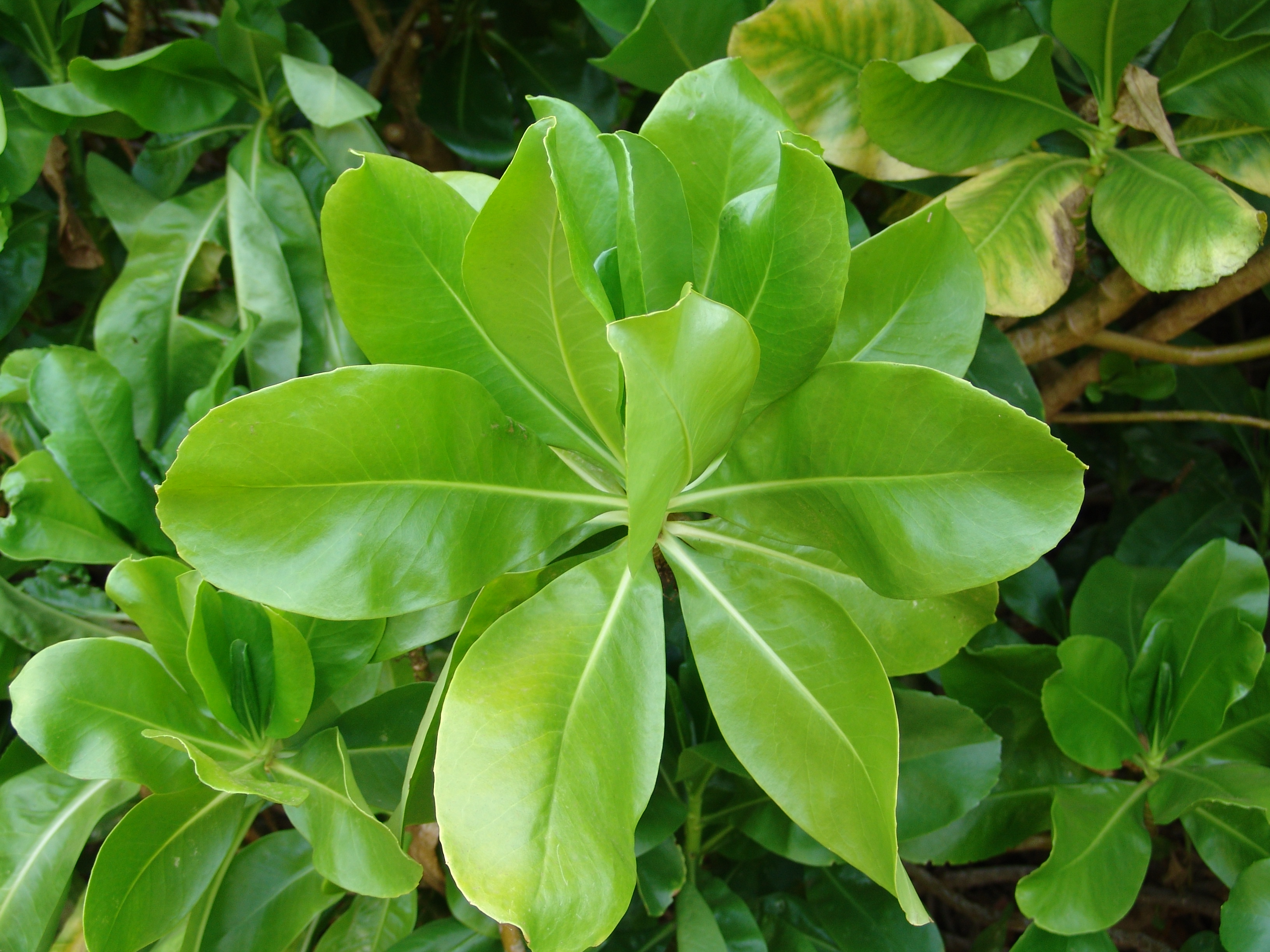
The leaves are simple, alternate, and clustered toward the ends of branches. Each leaf is obovate to spatula-shaped, 3 to 6 inches (8–15 cm) long and 1½ to 3 inches (4–8 cm) wide, with a thick, somewhat succulent texture that stores water in the dry coastal environment. Leaf surfaces are bright glossy green above, paler below, with slightly revolute (rolled under) margins. Leaves are arranged in rosette-like clusters at stem tips, creating a distinctive layered appearance.
Flowers
The flowers are the most distinctive feature of Beach Naupaka — each bloom appears as if split in half, with five white to cream-colored petals all arranged in a fan on one side. This unusual “half-flower” form is characteristic of the entire genus Scaevola and gives naupaka its immediate recognizability. Flowers are approximately 1 inch (2–3 cm) across, white or cream with purple veining at the base of the petals, and are delicately fragrant, especially in the morning. They are produced in small clusters from leaf axils throughout much of the year, with peak blooming varying by location and season.
Fruit
The fruit is a fleshy white drupe (berry) approximately ½ inch (1–1.5 cm) in diameter, with a spongy, corky texture that makes it buoyant in seawater. Inside are two hard seeds. The white berries ripen within weeks of flowering and are dispersed by ocean currents, birds, and small mammals. The buoyancy of the fruit is key to the plant’s wide Indo-Pacific distribution — seeds can float for months and remain viable after long ocean voyages.
Quick Facts
| Scientific Name | Scaevola sericea (syn. Scaevola taccada) |
| Family | Goodeniaceae |
| Plant Type | Evergreen Coastal Shrub |
| Mature Height | 3–10 ft |
| Sun Exposure | Full Sun to Part Shade |
| Water Needs | Low to Moderate (highly salt-tolerant) |
| Bloom Time | Year-round |
| Flower Color | White to cream (with purple veining) |
| Fragrance | Yes — delicate, sweet fragrance |
| USDA Hardiness Zones | 10–12 |
Native Range
Beach Naupaka (Scaevola sericea) has one of the widest distributions of any coastal plant in the world — ranging from East Africa and Madagascar across the Indian Ocean, through Southeast Asia and the Pacific Islands, to Hawaiʻi, and south to Australia and New Zealand. This extraordinary range reflects the plant’s remarkable seed dispersal mechanism: the buoyant, corky white berries float for months in seawater while remaining viable, allowing the plant to colonize beaches across the entire Indo-Pacific region.
In the United States, Beach Naupaka is native to Hawaiʻi, where it occurs on all of the main Hawaiian Islands and the Northwestern Hawaiian Islands (including Midway Atoll, Laysan Island, and French Frigate Shoals). Within Hawaiʻi, it is almost exclusively found in the coastal zone, typically within a few hundred feet of the ocean — in beach strand communities, rocky coastal bluffs, coral rubble areas, and coastal dune systems. It rarely extends more than a few hundred meters inland, marking a clear ecological boundary between the coastal zone and inland vegetation.
Because Beach Naupaka is found on both Hawaiian and many other Pacific island beaches, there is ongoing discussion among botanists about whether some Hawaiian populations should be considered native (indigenous) versus introduced by early Polynesian voyagers. The scientific consensus treats it as indigenous — having arrived in Hawaiʻi naturally via ocean dispersal prior to human contact — and it is listed as such by the USDA Plants Database. In conservation terms, Beach Naupaka is treated as a native species in Hawaiian coastal restoration efforts.
📋 Regional plant lists featuring Beach Naupaka: Hawaii
Growing & Care Guide
Beach Naupaka is one of the easiest and most rewarding native Hawaiian plants to grow in coastal and near-coastal landscapes. It is extremely salt-tolerant, drought-resistant, and fast-growing, making it ideal for shoreline stabilization, coastal garden design, and erosion control.
Light
Beach Naupaka thrives in full sun, which is where it grows naturally on exposed beaches and bluffs. It tolerates partial shade but may become more open and less floriferous under reduced light. For the best growth, dense form, and maximum flower and berry production, plant in full direct sunlight.
Soil & Water
Beach Naupaka is perfectly adapted to the poor, sandy, well-drained soils of Hawaiian beaches. It tolerates salt spray, brackish conditions, and periodic flooding by seawater — making it one of the most salt-tolerant shrubs available for Hawaiian coastal landscaping. It does not require fertilization and performs well in low-nutrient coastal soils. Once established, it is highly drought-tolerant and requires little to no supplemental irrigation in coastal Hawaii. In inland settings, moderate watering helps establish plants, but avoid overwatering or heavy soils.
Planting Tips
Plant Beach Naupaka from container nursery stock. It grows quickly — plants can reach 3–4 feet in the first year under good conditions. Space plants 4–6 feet apart for a continuous hedge or windbreak, or wider for individual specimens. In coastal erosion-control plantings, closer spacing of 2–3 feet accelerates soil binding. Beach Naupaka can also be propagated easily from stem cuttings — take 6–8 inch semi-hardwood cuttings and root in well-drained mix.
Pruning & Maintenance
Beach Naupaka requires minimal pruning. It can be lightly shaped after flowering to maintain a desired size or form. For naturalistic coastal plantings, simply allow it to spread and fill space naturally. Remove dead or storm-damaged branches as needed. The plant has excellent pest and disease resistance in coastal Hawaiian settings.
Landscape Uses
- Coastal erosion control — one of the best plants for stabilizing beach sand and dune edges
- Beach and shoreline landscaping — creates a natural coastal aesthetic
- Salt spray buffer — protects inland plantings from salt damage
- Wildlife habitat — berries attract birds; flowers attract pollinators
- Windbreak or screen — dense growth provides excellent wind protection
- Native coastal restoration — critical for revegetating degraded Hawaiian beach strand communities
Wildlife & Ecological Value
Beach Naupaka is ecologically foundational to Hawaiian coastal ecosystems, providing food, shelter, and structural habitat in a zone that is highly exposed and stressful for most plants.
For Birds
The white, fleshy berries of Beach Naupaka are eaten by many native and non-native Hawaiian birds, including the introduced zebra dove, spotted dove, and various shorebirds. The dense growth provides important nesting and roosting habitat for small birds in the otherwise exposed coastal zone. In areas with shearwater and petrel nesting colonies, Beach Naupaka thickets provide burrow-shading cover.
For Pollinators
The fragrant, half-flowers attract native Hawaiian bees, honeybees, and various butterflies. The near year-round blooming provides consistent nectar resources in the coastal zone, where few other native plants flower. Native yellow-faced bees (Hylaeus spp.) — many of which are endangered — have been documented visiting Beach Naupaka flowers.
For Marine Wildlife
Beach Naupaka’s overhanging branches above the high-tide line provide shade and cover for Hawaiian monk seals (Neomonachus schauinslandi) resting on beaches — an often-overlooked but important ecological service. The root systems of Beach Naupaka also help maintain beach berm stability that protects Hawaiian green sea turtle (Chelonia mydas) nesting habitat.
Ecosystem Role
In the coastal strand community — one of Hawaiʻi’s most threatened ecosystems — Beach Naupaka is the dominant native shrub, creating the structure and microclimate conditions that support the entire coastal plant community. Its deep roots stabilize sand and bind beach berm soils, while its dense canopy reduces wind erosion and creates shade that allows other coastal natives to establish beneath it. Restoration of Beach Naupaka along degraded Hawaiian coastlines is among the most impactful coastal conservation actions available.
Cultural & Historical Uses
Beach Naupaka is perhaps most famous as the subject of one of Hawaiʻi’s most beloved legends. In the most commonly told version, a Hawaiian chiefess named Naupaka fell in love with a commoner named Kaui. Their love was forbidden because of their different social classes, and despite seeking the blessing of a kahuna (priest) and even the gods, they were told their love could never be. In despair, Naupaka tore the flower from her hair and ripped it in half, giving one half to Kaui. He went to live on the mountain; she remained at the beach. Ever since, the naupaka of the beach and the naupaka of the mountains bear only half-flowers — each waiting for its other half.
Beyond legend, Beach Naupaka had practical uses in traditional Hawaiian life. The wood was used for kindling and small implements. The berries, while not particularly palatable raw, were occasionally used as a famine food or in traditional medicine. The leaves and bark were used in some traditional medicinal preparations for skin conditions and as a mild analgesic. Naupaka branches and leaves were also woven into temporary shelters and windbreaks in coastal settings.
In contemporary Hawaiian culture, Beach Naupaka has become a symbol of coastal stewardship and native plant restoration. Community beach planting events using Beach Naupaka are among the most popular native plant restoration activities on O’ahu and Maui, drawing volunteers who connect with both the ecological importance and the cultural legacy of this remarkable plant. The half-flower is widely recognized as a symbol of Hawaiian environmental identity.
Frequently Asked Questions
What is the legend of the naupaka flower?
The legend tells of two lovers — Naupaka (a chiefess) and Kaui (a commoner) — who were forbidden to be together. In sorrow, Naupaka tore a flower in half, giving one half to her love as they parted forever. The beach naupaka and mountain naupaka (Scaevola gaudichaudiana) each bear only half-flowers, symbolizing the separated lovers and the hope of eventual reunion.
Can Beach Naupaka berries be eaten?
The white berries are technically edible but are spongy, somewhat tasteless, and mildly astringent. They are not considered a desirable food for humans, though birds eat them readily. The berries are primarily notable for their buoyancy — they float for months in seawater, allowing the plant to disperse its seeds across the Pacific.
Is Beach Naupaka invasive outside Hawaii?
In some regions outside its native range — particularly in Florida and other parts of the Caribbean — Beach Naupaka has been introduced and can become invasive, spreading aggressively in coastal habitats and displacing native coastal vegetation. In Hawaiʻi it is native and should be planted freely for restoration; in other regions, use only native alternatives.
How fast does Beach Naupaka grow?
Beach Naupaka is a fast-growing native plant under good coastal conditions. New plants can establish quickly and begin spreading within the first year, adding 1–3 feet of growth annually. In ideal beach-front conditions with full sun and good drainage, it can form substantial mounds within 2–3 years of planting.
Does Beach Naupaka flower year-round?
Yes — in most Hawaiian coastal locations, Beach Naupaka produces flowers throughout the year, with no distinct dormant season. This makes it one of the most reliably blooming native coastal plants in Hawaiʻi, providing year-round nectar for pollinators and a constant supply of fragrant blossoms for those who enjoy the plant’s subtle sweet scent.

Looking for a nursery that carries Beach Naupaka?
Browse our native plant nursery directory: Hawaii