Pohinahina (Vitex rotundifolia)
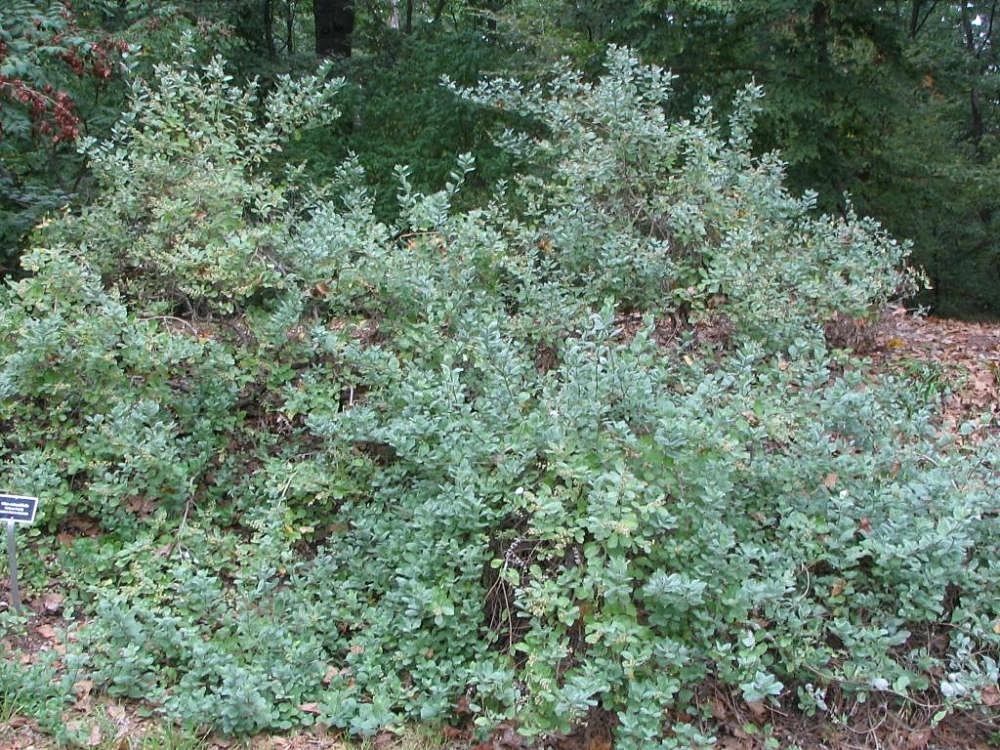
Vitex rotundifolia, known in Hawaiian as Pohinahina and broadly as Beach Vitex, is a low-growing, mat-forming native shrub of tropical and subtropical coastal beaches throughout the Indo-Pacific region, including Hawaii. A member of the Lamiaceae (mint family), Pohinahina is one of the most distinctive plants of Hawaii’s sandy coastal habitats — recognizable by its trailing ground-hugging stems, velvety silvery-green rounded leaves, and spikes of fragrant lavender-blue flowers produced through summer and fall.
Pohinahina is celebrated in traditional Hawaiian chant and hula as a plant of the seashore (kahakai), valued for its beauty and fragrance. It is a true native plant of Hawaii’s coastal strand communities and plays an important role in stabilizing sandy beach margins and providing ground-level habitat structure in coastal zones. The species’ distinctive silvery foliage — produced by dense, fine hairs that reflect intense tropical sunlight and reduce water loss — is one of the most striking features of Hawaii’s native coastal plant communities.
Pohinahina’s combination of drought tolerance, salt tolerance, and hardiness earned it a reputation as one of the toughest native Hawaiian coastal plants. Its ability to stabilize sandy soils, its year-round visual interest, and its modest water requirements make it an outstanding choice for Hawaiian coastal restoration, native beach plantings, and low-water garden designs. However, it should only be planted in Hawaii and similar native range areas — the same species has become an invasive plant along the US southeastern Atlantic coast, where it damages sea turtle nesting habitat and displaces native dune vegetation.
Identification
Pohinahina is a low-growing, spreading shrub that forms prostrate to semi-erect mats typically 1 to 2 feet tall but spreading 3 to 6 feet or more horizontally. Stems root where they contact soil, allowing the plant to spread across sandy substrates. The overall appearance is soft and silvery — the dense covering of fine hairs on leaves and young stems gives the plant a velvet-like texture and silvery-gray-green color. The species name “rotundifolia” means “round-leaved,” referring to the characteristically rounded leaf shape.
Leaves
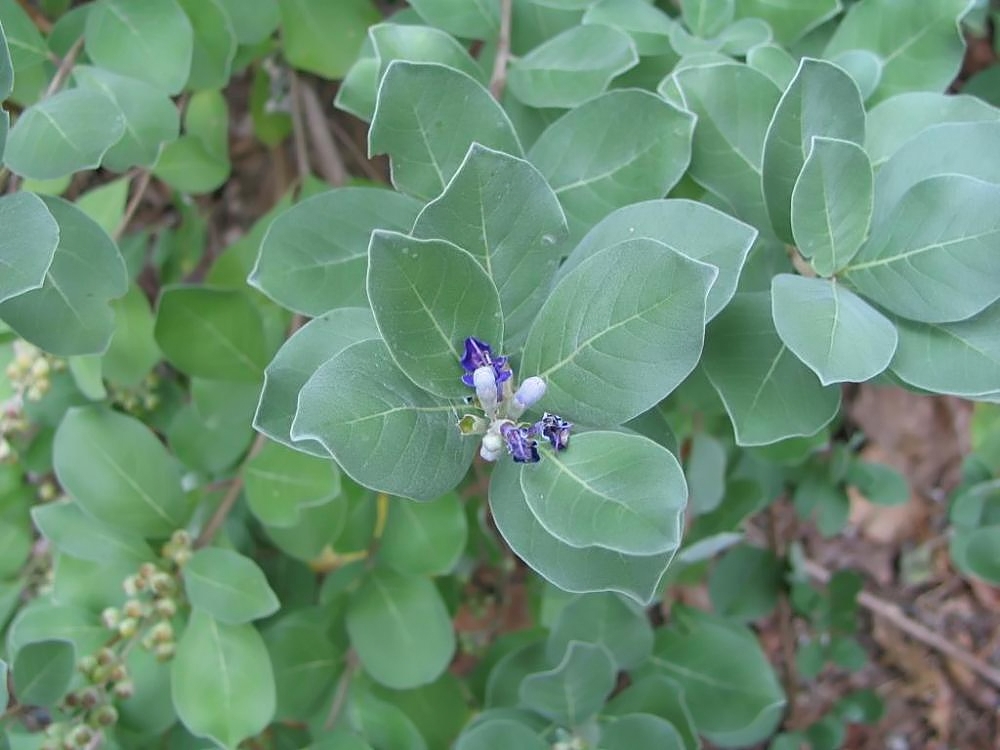
The leaves are the most immediately striking feature of Pohinahina: oval to nearly round, 1 to 2 inches (2.5–5 cm) long and nearly as wide, with a short petiole. Both surfaces are densely covered in fine, silvery-white hairs (tomentum) that give the leaf a velvety texture and distinctly silvery-green to gray-green color. The leaves are aromatic when crushed, with a pleasant, herbal scent reminiscent of other Lamiaceae members. Leaf margins are entire (smooth). The combination of rounded shape, silvery color, and velvety texture makes Pohinahina leaves unmistakable.
Flowers
Flowers are produced in terminal spikes or panicles above the foliage from summer through fall. Each flower is small — about ½ inch (12 mm) long — with two lips: the upper lip with 2 lobes and the lower lip with 3 lobes. Color is lavender-blue to violet-blue, sometimes pale lilac. The flowers are fragrant and produced abundantly. Individual flowers are short-lived but the extended flowering period and continuous production of new spikes means plants are rarely without flowers from summer through fall.
Stems & Roots
Stems are slender, reddish-brown, and flexible — trailing along the ground and rooting at nodes to form expanding mats. Young stems are covered in the same fine silvery hairs as the leaves. The root system is fibrous and extensive, penetrating deeply into sandy substrates and providing effective sand stabilization. Old stems become woody at the base, creating a somewhat shrubby central crown from which trailing stems radiate outward.
Quick Facts
| Scientific Name | Vitex rotundifolia |
| Family | Lamiaceae (Mint family) |
| Plant Type | Native Evergreen Spreading Shrub (Groundcover) |
| Mature Height | 1–2 ft tall; spreading 3–6+ ft wide (drought-tolerant; velvety, silvery leaves) |
| Sun Exposure | Full Sun |
| Water Needs | Low (Drought Tolerant) |
| Bloom Time | Summer – Fall |
| Flower Color | Lavender-blue to violet |
| Salt Tolerance | High — coastal beach and strand plant |
| USDA Hardiness Zones | 9–12 (Hawaii and Indo-Pacific; INVASIVE on US mainland East Coast — do NOT plant outside Hawaii) |
Native Range
Pohinahina (Vitex rotundifolia) has a native range spanning the tropical and subtropical coastal areas of the Indo-Pacific, from the eastern coast of Africa through South Asia, Southeast Asia, Japan, the Pacific Islands, and Hawaii. In the United States, Hawaii is the only state where this plant is native. It is found on the sandy beaches, coastal strands, and low coastal bluffs of all the main Hawaiian Islands, particularly on leeward (dry) shorelines with sandy or rocky substrates.
In Hawaii, Pohinahina is most commonly associated with the sandy beach strand community — the zone between the high tide line and the dune vegetation — where it grows alongside other native coastal plants such as Maʻo (Gossypium tomentosum), Naio (Myoporum sandwicense), ʻilima (Sida fallax), and native morning glories (Ipomoea spp.). The coastal strand community is one of Hawaii’s most threatened habitat types, with the vast majority of historic coastal strand vegetation having been lost to development, invasive species, and beach modification.
⚠️ Important Regional Note: While Pohinahina is a valued native plant in Hawaii, the same species was introduced as an ornamental to the southeastern United States beginning in the 1980s and has become a serious invasive plant along the Atlantic coast beaches of Virginia, the Carolinas, Georgia, and Florida. On these beaches, it outcompetes native dune plants, destabilizes beach profiles, and reduces the availability of suitable nesting habitat for sea turtles, including the loggerhead and leatherback sea turtles. Pohinahina should only be planted in Hawaii and its native Indo-Pacific range.
📋 Regional plant lists featuring Pohinahina: Hawaii
Growing & Care Guide
Pohinahina is an excellent and visually distinctive plant for Hawaiian coastal gardens. Hardy, drought-tolerant, and requiring minimal care once established, it is well-suited for full-sun, dry garden situations and coastal restoration work.
Light
Pohinahina requires full sun and performs best with intense, direct sunlight for most of the day. It is adapted to the extreme light conditions of open beach and coastal strand environments and will not thrive in shade. The silvery foliage acts as a natural reflective surface in intense sun — avoid shading plants with taller neighbors. In full sun with adequate drainage, it is at its most vigorous and floriferous.
Soil & Water
Pohinahina is highly drought tolerant and thrives in sandy, well-drained, and even nutrient-poor soils. It excels in the kind of coarse, free-draining coastal sands of beach environments where most plants struggle. Established plants require very little supplemental irrigation and are remarkably self-sufficient. During the establishment period (first 6–12 months after planting), water regularly to help the root system develop. Once established, reduce watering to occasional deep irrigation during extended dry periods. Avoid clay or poorly draining soils. Pohinahina has excellent salt tolerance and handles coastal salt spray without problems.
Planting Tips
Plant in spring or fall. Space plants 3–4 feet apart for a groundcover planting, allowing trailing stems to spread naturally and fill gaps over time. Pohinahina is an effective living mulch and groundcover on open sunny slopes and flat areas. It integrates beautifully with other native Hawaiian coastal plants — particularly alongside Maʻo and ʻilima for an authentic Hawaiian coastal planting design. It can also be used as a low edging plant along paths or garden borders in full-sun positions.
Pruning & Maintenance
Light pruning helps maintain a tidy appearance and encourages dense, compact growth. Trim back long trailing stems as needed to control spread. Remove old flower spikes after bloom to encourage new flowering growth. Pohinahina is a generally pest- and disease-free plant in Hawaii. Its primary challenge is ensuring adequate drainage — avoid any conditions that lead to waterlogging, particularly during establishment.
Landscape Uses
- Coastal restoration planting — one of the most effective native plants for Hawaiian beach strand restoration
- Sand stabilization — spreading mats bind sandy soil and prevent erosion
- Groundcover in full-sun, dry garden areas
- Native Hawaiian coastal garden specimen
- Drought-tolerant landscape — xeriscape applications
- Fragrant garden — aromatic foliage and flowers
- Low edging along paths and borders in full-sun positions
Wildlife & Ecological Value
Pohinahina contributes to coastal strand ecosystem function by providing food, shelter, and habitat structure in one of Hawaii’s most threatened coastal communities.
For Pollinators
The lavender-blue flowers of Pohinahina attract native Hawaiian yellow-faced bees (Hylaeus spp.) and other native pollinators. In coastal habitats where native plant diversity has been reduced by development and invasive plants, Pohinahina’s reliable summer-fall blooming provides a critical floral resource. Introduced honeybees and native carpenter bees also visit the flowers.
For Birds
The low, dense mats of Pohinahina provide shelter and nesting habitat for ground-nesting birds in coastal settings. The trailing stems and dense foliage create protected microhabitats at ground level. In Hawaii, shorebirds and migratory waterfowl that utilize coastal zones may benefit from the structural habitat Pohinahina provides.
For Insects
As a member of the aromatic Lamiaceae family, Pohinahina supports native Hawaiian insect communities that feed on the foliage and utilize the plant’s microhabitat. The aromatic compounds in the leaves may deter some herbivorous insects, while attracting specialized pollinators.
Ecosystem Role
In Hawaii’s coastal strand communities, Pohinahina plays a foundational role in sand stabilization and community structure. Its spreading, rooting stems bind loose sand, reducing erosion during storm events and wind. The mat-forming growth habit creates a microclimate at ground level that is cooler and more humid than the surrounding bare sand — conditions that favor germination of other native coastal plants. As one of the characteristic plants of the Hawaiian coastal strand, Pohinahina is a key component of the restoration palette for this critically threatened habitat type.
Cultural & Historical Uses
Pohinahina holds an important place in Hawaiian cultural traditions, particularly in the context of hula and traditional poetry (mele). In Hawaiian hula, Pohinahina is associated with the sea and the seashore — it is one of the characteristic plants of the kahakai (shoreline) that appears in chants describing the Hawaiian coastal landscape. The plant’s silvery beauty, pleasant fragrance, and connection to the beach made it a recognizable and beloved element of the Hawaiian natural world that practitioners of hula sought to celebrate and preserve through dance and song.
The aromatic leaves and flowers of Pohinahina were used in lei making and as a fragrant decorative element in traditional Hawaiian contexts. The velvety, silvery leaves have an attractive, distinctive feel and visual quality that made them desirable for use in garlands and body adornment. The pleasant herbal scent of the crushed foliage was also appreciated in aromatherapy-like applications within traditional Hawaiian wellness practices.
The wood and roots of Pohinahina were used medicinally in traditional Hawaiian practice (lāʻau lapaʻau). Preparations from various parts of the plant were used for fever, headache, and general debility in traditional Hawaiian medicine. Related species across the Pacific and Asia have well-documented medicinal histories as well, with Vitex species being used for fever, pain, and reproductive health in many traditional medicine systems from India to Japan. Contemporary research has confirmed the presence of bioactive iridoid compounds in the plant.
Frequently Asked Questions
Can I grow Pohinahina outside of Hawaii on the US mainland?
No — Pohinahina (Vitex rotundifolia) is an invasive species on the US mainland East Coast (Virginia through Florida), where it threatens native dune vegetation and sea turtle nesting habitat. It should NOT be planted outside of Hawaii and its native Indo-Pacific range. If you want to grow a native Vitex on the US mainland, consider the native American species such as Vitex agnus-castus (Chaste Tree) or native Lamiaceae alternatives for your region.
How do I control the spread of Pohinahina in my Hawaii garden?
Pohinahina spreads by rooting trailing stems that contact the soil. To control spread, simply trim back the trailing stems to the desired boundary. The plant does not have aggressive underground rhizomes, so physical pruning is very effective. Establishing a defined planting area with regular edge-trimming is the easiest management approach.
Is Pohinahina fragrant?
Yes — the leaves are mildly aromatic when crushed, with a pleasant herbal-minty scent typical of the Lamiaceae family. The lavender-blue flowers are also lightly fragrant. The plant is not intensely perfumed, but its scent is one of its traditional attractions in Hawaiian lei making and cultural practices.
How does Pohinahina survive such harsh coastal conditions?
Pohinahina’s adaptations to harsh coastal environments are remarkable. The dense covering of fine white hairs on leaves and stems (tomentum) reflects intense sunlight, reduces water loss through evaporation, and provides a degree of protection from salt spray. The trailing growth habit keeps the plant below the most intense coastal winds. The deep, fibrous root system accesses moisture from deeper in the sand profile. These combined adaptations allow it to thrive where most garden plants would struggle.
Can Pohinahina grow in containers?
Yes — Pohinahina grows well in large, well-draining containers in full sun. This can be a good approach for growing it on lanaʻi or in small garden spaces. Use a fast-draining sandy or cactus mix, ensure excellent drainage, and allow to dry between waterings. Container-grown plants will spread their stems over the edge of the pot, creating an attractive cascading effect.

Looking for a nursery that carries Pohinahina?
Browse our native plant nursery directory: Hawaii