
Plants in the Mojave Desert: A Guide to the Region’s Flora
Last updated: August 20, 2026
Mojave Desert Plants: Quick Reference
- Location: Parts of California, Nevada, Utah, and Arizona
- Size: ~47,877 sq mi (124,000 km²)
- Elevation: 2,000–5,000 ft (with extremes from -282 ft at Death Valley to 11,049 ft)
- Iconic plant: Joshua tree (Yucca brevifolia) — found only in the Mojave
- Plant species: 2,000+ vascular plant species, ~25% endemic
- Rainfall: 2–6 inches annually; summer temps exceed 120°F (49°C)
- Adaptations: Deep roots, waxy coatings, CAM photosynthesis, drought deciduousness
The Mojave Desert is one of North America’s four major deserts, sandwiched between the Great Basin Desert to the north and the Sonoran Desert to the south. Despite receiving as little as 2 inches of rain per year, the Mojave supports a remarkably diverse plant community — over 2,000 species of vascular plants, with roughly a quarter found nowhere else on Earth.
From the iconic Joshua tree standing sentinel against a desert sunset to tiny wildflowers that carpet the desert floor during rare “superblooms,” Mojave Desert plants have evolved extraordinary strategies to survive one of the harshest environments on the planet. This guide covers the major species, their survival adaptations, and how to incorporate desert-adapted plants into your own landscape.
Iconic Plants of the Mojave Desert
Joshua Tree (Yucca brevifolia)
The Joshua tree is the signature plant of the Mojave Desert — so closely associated with this ecosystem that scientists use its distribution to define the Mojave’s boundaries. These dramatic, tree-like yuccas can grow up to 40 feet tall and live for hundreds of years (some specimens are estimated at 1,000+ years old).
Joshua trees depend on a single pollinator — the yucca moth (Tegeticula synthetica) — in one of nature’s most remarkable mutualisms. The moth lays eggs in the flower while deliberately pollinating it; moth larvae eat some seeds, but enough survive to reproduce. Without the yucca moth, Joshua trees cannot set seed.
Conservation status: Joshua trees are threatened by climate change, which is shrinking their suitable habitat. In 2023, the western Joshua tree (Y. brevifolia) was listed as threatened under California’s Endangered Species Act.
Creosote Bush (Larrea tridentata)
If the Joshua tree is the Mojave’s icon, the creosote bush is its foundation. This unassuming shrub dominates vast stretches of the Mojave and is arguably the most successful desert plant in North America. Some creosote bush clonal colonies are among the oldest living organisms on Earth — the famous “King Clone” in the Mojave is estimated to be 11,700 years old.
After rain, creosote releases a distinctive, pungent aroma that many desert dwellers find deeply evocative — it’s the smell of the desert itself. The plant’s waxy, resinous leaves minimize water loss and contain compounds that inhibit the growth of competing plants (allelopathy), creating the characteristic even spacing seen in creosote flats.
Mojave Yucca (Yucca schidigera)
Not to be confused with the Joshua tree, the Mojave yucca has dense rosettes of sword-like leaves and produces tall stalks of white, bell-shaped flowers. Indigenous peoples used the tough leaf fibers for rope, sandals, and baskets. Today, Mojave yucca extract is used commercially as a natural foaming agent and animal feed supplement.
Desert Tortoise Host Plants
The threatened desert tortoise (Gopherus agassizii) depends on native Mojave plants for food and shelter. Key host plants include:
- Desert dandelion (Malacothrix glabrata)
- Indian ricegrass (Achnatherum hymenoides)
- Desert globemallow (Sphaeralcea ambigua)
- Galleta grass (Pleuraphis rigida)
Cacti of the Mojave Desert
While the neighboring Sonoran Desert has the famous saguaro, the Mojave has its own impressive collection of cacti:
Beavertail Cactus (Opuntia basilaris)
One of the most beautiful Mojave cacti, beavertail produces stunning magenta-pink flowers in spring. Its flat, paddle-shaped pads lack the large spines of other prickly pears but are covered in tiny, hair-like glochids that are notoriously irritating.
Silver Cholla (Cylindropuntia echinocarpa)
Named for the silvery sheen of its densely packed spines, silver cholla is common throughout the Mojave. Birds, including cactus wrens and thrashers, nest in its protective branches.
Barrel Cactus (Ferocactus cylindraceus)
California barrel cactus can grow up to 10 feet tall and stores significant water in its ribbed, cylindrical body. Bright yellow flowers appear at the crown in spring, followed by fruits that persist for months.
Cottontop Cactus (Echinocactus polycephalus)
This slow-growing cactus forms clusters of barrel-shaped stems topped with dense, cottony white spines. It’s exceptionally drought-tolerant and found on rocky slopes throughout the Mojave.
Mojave Mound Cactus (Echinocereus mojavensis)
A small, clustering cactus with brilliant red-orange flowers. It’s endemic to the Mojave and thrives at higher elevations (4,000-8,000 ft).
Desert Trees and Large Shrubs
Desert Willow (Chilopsis linearis)
Despite its name, desert willow is not a true willow — it’s in the Bignoniaceae family. It produces gorgeous orchid-like flowers in pink, purple, and white, and attracts hummingbirds. Excellent for drought-tolerant landscaping.
Smoke Tree (Psorothamnus spinosus)
Found in desert washes, smoke trees have a ghostly, smoke-like appearance due to their dense network of gray, leafless branches. They produce fragrant purple flowers in late spring.
Catclaw Acacia (Senegalia greggii)
Named for its hook-shaped thorns, catclaw acacia provides critical habitat for desert wildlife. Its seeds were ground into flour by Indigenous peoples.
Mesquite (Prosopis spp.)
Mesquite trees have some of the deepest root systems of any desert plant — taproots can reach 150+ feet to access groundwater. Their sweet seed pods are edible and were a staple food for Indigenous desert communities.
Wildflowers and the Mojave Superbloom
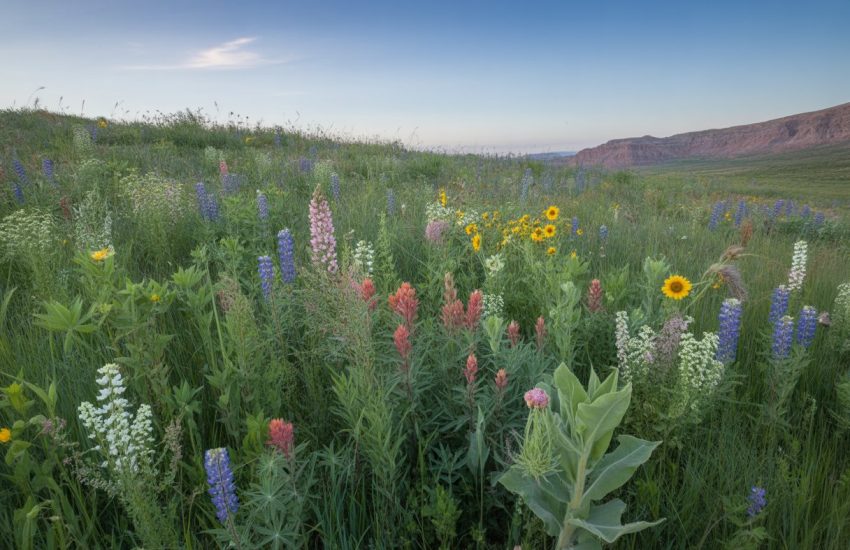
In years with above-average winter rainfall, the Mojave Desert erupts in one of nature’s most spectacular events: the desert superbloom. Millions of annual wildflowers germinate simultaneously, carpeting the desert floor in brilliant color. Key superbloom species include:
- Desert gold (Geraea canescens) — Bright yellow sunflower relative
- Desert five-spot (Eremalche rotundifolia) — Pink flowers with maroon spots
- Mojave aster (Xylorhiza tortifolia) — Lavender daisy-like flowers
- Desert marigold (Baileya multiradiata) — Cheerful yellow flowers that bloom nearly year-round
- Desert lupine (Lupinus sparsiflorus) — Purple-blue spikes
- Sand verbena (Abronia villosa) — Pink-purple clusters; sweet evening fragrance
- Desert paintbrush (Castilleja chromosa) — Brilliant orange-red bracts
These annual wildflowers are “drought evaders” — they spend most of their lives as seeds, waiting in the soil for the right combination of temperature and moisture to germinate, bloom, set seed, and die, all within a few weeks.
How Mojave Desert Plants Survive
Mojave plants have evolved remarkable adaptations to cope with extreme heat (120°F+), minimal rainfall (2-6 inches/year), intense UV radiation, and nutrient-poor soils:
Water Conservation Strategies
- Succulent water storage — Cacti and yuccas store water in specialized tissues
- CAM photosynthesis — Many desert plants open their stomata only at night to minimize water loss, fixing CO₂ into malic acid for daytime photosynthesis
- Waxy leaf coatings — Creosote bush and jojoba have resinous or waxy leaves that reduce evaporation
- Small or absent leaves — Many desert plants have tiny leaves or photosynthesize through green stems (like palo verde)
- Drought deciduousness — Ocotillo and some shrubs drop their leaves during dry periods and regrow them after rain
- Deep taproots — Mesquite roots can reach 150+ feet; creosote has both deep taproots and wide-spreading lateral roots
Heat and Sun Protection
- Reflective surfaces — Silver cholla’s pale spines reflect sunlight; brittlebush produces white hairs on leaves
- Vertical leaf orientation — Reduces exposure to midday sun
- Spines for shade — Dense cactus spines create a microclimate of shade around the plant
Reproduction Strategies
- Seed dormancy — Annual wildflower seeds can remain viable in soil for decades, waiting for optimal conditions
- Clonal reproduction — Creosote bush reproduces by sending up new stems from roots, creating rings of clones
- Specialized pollination — Joshua tree/yucca moth mutualism; cactus flowers attract specific native bees
Threats to Mojave Desert Plants
The Mojave’s plant communities face growing pressures:
- Climate change — Rising temperatures and shifting rainfall patterns threaten heat-sensitive species like Joshua trees; models predict 90% habitat loss by 2100
- Solar energy development — Large-scale solar farms displace native vegetation; careful siting is critical
- Invasive species — Non-native grasses (especially red brome and cheatgrass) create fire fuel in ecosystems not adapted to fire
- Off-road vehicles — Damage fragile desert soil crusts that take decades to recover
- Groundwater depletion — Threatens deep-rooted species that depend on water tables
Desert-Adapted Plants for Home Landscaping
Many Mojave plants (or their relatives) work beautifully in water-wise home landscapes. For Arizona, the Southwest, or any arid region, consider:
- Desert marigold — Nearly year-round yellow blooms; virtually zero supplemental water
- Desert willow — Stunning flowering tree; hummingbird magnet
- Beavertail cactus — Gorgeous spring flowers; architectural form
- Brittlebush (Encelia farinosa) — Gray-green mounds with yellow daisy flowers
- Red bird of paradise (Caesalpinia pulcherrima) — Tropical-looking blooms in a desert-tough package
- Penstemon — Many native species are adapted to desert conditions
For succulent care tips, see our watering guide. And if you’re interested in desert rose care, we’ve got you covered.
Frequently Asked Questions
What is the most common plant in the Mojave Desert?
The creosote bush (Larrea tridentata) is by far the most common and widespread plant in the Mojave Desert. It dominates vast stretches of desert flats and can live for thousands of years through clonal reproduction. The famous “King Clone” creosote colony is estimated to be 11,700 years old.
Are Joshua trees only found in the Mojave Desert?
Yes — Joshua trees (Yucca brevifolia) are essentially endemic to the Mojave Desert. Their distribution is so closely aligned with the Mojave’s boundaries that ecologists use their presence to help define the desert’s extent. They grow at elevations between 2,000 and 6,000 feet in the transition zones between desert and mountain habitats.
How do desert plants survive without water?
Mojave plants use multiple strategies: succulents store water in their tissues; plants with CAM photosynthesis only open stomata at night to reduce water loss; deep-rooted species like mesquite tap groundwater 100+ feet below; drought-deciduous plants shed leaves during dry periods; and annual wildflowers survive as dormant seeds, only growing during wet periods.
What causes a desert superbloom?
Superblooms require a specific combination of above-average winter rainfall, warm soil temperatures, and reduced wind. The moisture triggers germination of millions of dormant wildflower seeds. Superblooms don’t happen every year — they require approximately double the average rainfall spread over several months from October through February.
Can I grow Mojave Desert plants at home?
Yes! Many Mojave species thrive in home landscapes in USDA zones 7-10, as long as you provide excellent drainage and minimal supplemental water. Desert marigold, beavertail cactus, desert willow, and brittlebush are popular landscape plants. Even in humid climates, many can be grown in containers with fast-draining cactus mix.
Explore more: desert flora overview · desert biome animals · California native shrubs · browse all plants
joshua trees being found only in the mojave is a fact I didn’t know.
over 2,000 plant species with a quarter of them endemic is a lot for such a dry place.