Top 5 Picks: Reliable Precision Seed Drill for Professional Gardeners to Maximize Efficiency
We independently select all products and services. If you click through links we provide, Plant Native may earn a commission with no extra cost to you. As an Amazon Associate I earn from qualifying purchases.
Last updated: September 3, 2026
Precision seed drills matter a lot for professional gardeners who want uniform planting and optimal germination. These machines let you plant seeds at consistent depths and spacing, which boosts crop yields and cuts down on wasted seed.
You’ll find precision seed drills in commercial gardens and serious home plots. They save time and make planting way more accurate.
Unlike the old-school seeders, these drills use calibrated mechanisms to drop each seed right where it should go. That’s a big deal for crops that are picky about spacing or depth.
When you’re picking a seed drill, you have to think about what seeds you’ll use, how wide it drills, how many seeds it holds, and how easy it is to adjust. You’ll want something durable, too, since most pros need gear that lasts season after season.
Look for adjustable seed plates, tight depth control, and sturdy materials. If you can calibrate and clean it easily, you’ll move faster when planting season hits. We tried out a bunch of popular models to see which ones really deliver for professionals.
Top 5 Reliable Precision Seed Drills for Professional Gardeners
We pulled together the most reliable precision seed drills for professional gardeners. Our picks focus on accuracy, durability, and ease of use so you can keep your planting consistent.
Our top pick

- Keeps seed spacing and depth consistent
- Has several seed plates for various seeds
- Built tough with rust-resistant parts
Cons
- Sometimes drops two seeds or skips one
- Works best in well-prepared soil
- Switching plates and using the row marker takes some practice
When we tried the EarthWay, it stood out for precise planting in different garden beds. The seven seed plates made it easy to switch between crops like corn and peas, and our rows looked neat.
The build feels solid—no rattling or flimsy parts, and rust hasn’t shown up yet. The 30-inch row marker kept our lines straight, which honestly saved us a ton of time.
We did notice it sometimes picks up two seeds or misses one, depending on the plate and seed. It really shines on loose, tilled soil, not so much on hard-packed ground. If you’re willing to dial in your technique, this tool pays off.
Best runner-up

- Super easy to use—no tools needed
- Lets you adjust furrow depth for different seeds
- Lightweight, UV-resistant plastic
Cons
- Plastic feels fragile in tough conditions
- Short handle isn’t comfy for taller folks
- Seeds can jam up in the mechanism
Setting up the Bio Green Hand Seeder was a breeze. It glides along loose, prepped soil, and we managed pretty accurate planting with it. The variety of seed discs matched up well with different seed sizes.
But on hard or clay-heavy soil, the plastic opener just didn’t cut a clean furrow. We got a few seed jams, especially with weirdly shaped seeds, so we had to clear them out by hand sometimes.
The handle’s a bit short if you’re over 5’8″, which got uncomfortable after a while. Still, for a lightweight tool, it gets the job done in smaller or softer plots.
Best budget option

- Handles a wide range of veggies
- All-metal construction feels sturdy
- Lets you adjust depth and spacing easily
Cons
- Wheels can stick or not turn
- Handle connection breaks too easily
- Soil clumps and moisture mess with performance
We used the Varomorus seeder for everything from onions to carrots. The all-metal build feels reliable, and adjusting seed density with the rotating drum is pretty straightforward.
But the wheels gave us headaches. In damp or bumpy soil, they’d stick or just not turn, making it tough to push. Sometimes we had to stop and unjam seeds by hand.
Assembly wasn’t bad, but the handle connection is weak and broke on us sooner than we’d like. If the handle was included and beefed up, it would help a lot. The seeder can plant accurately, but the friction and sticking make it less reliable if you’re doing a ton of rows.
Best premium choice

- Durable materials and galvanized finish stand up to regular use
- Nozzles keep seed spacing consistent
- Large seed box means fewer refills
Cons
- Manual push gets tiring on big gardens
- Only works with seeds 3-15mm in size
- Seed visibility could be better in bright sun
The iron and plastic build feels strong, and the galvanized nozzles kept our seeds spaced just right. The brush mechanism usually dropped just one or two seeds at a time, which helped us avoid bare spots or clumps.
We liked the clear seed storage box—it’s easy to see when you need a refill. For medium-sized plots, the capacity was more than enough.
Pushing it around a huge garden does get tiring, but skipping steps like digging and covering saved us time overall. For professionals who care about precision, this one balances accuracy and efficiency nicely.
Also great
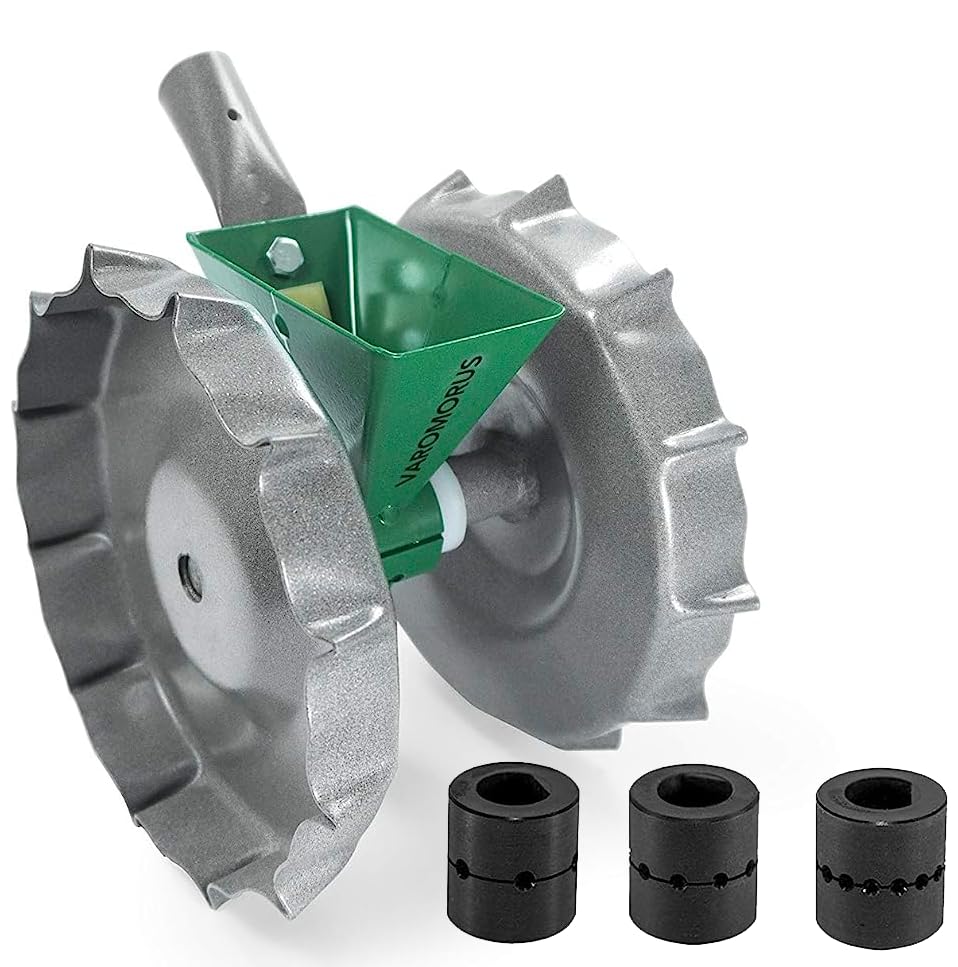
- Works with many seed types, from carrots to lettuce
- Metal construction feels built to last
- Easy to set up, comes mostly assembled
Cons
- Handle isn’t included, so you’ll need to buy or make one
- Can overseed small seeds if you’re not careful
- Some users have trouble with seed wheel threads
We liked the Varomorus Precision Seeder’s sturdy metal frame and practical design. The nozzle set makes it easy to switch between seed sizes, but getting the right spacing for tiny seeds took some trial and error.
The rotating sowing drum kept our seed depth nice and even, which really helps with uniform germination in raised beds or open ground. Not having a handle was annoying, but the rest of the build held up well.
We found it worked best if we slowed down and paid attention, especially with fine greens or brassicas. If you’re running a small or medium-sized garden or greenhouse and care more about precision than speed, this seeder fits the bill.
When you’re picking out a precision seed drill, accuracy and ease of use really top the list. Seed placement depth and spacing control—these two things can make or break your crop’s germination and yield.
Look for adjustable settings so you can tweak seed depth for your soil and whatever you’re planting. Uniform seed spacing helps avoid overcrowding and keeps plants from fighting over resources.
Durability? Absolutely matters. A tough, well-built seed drill with corrosion-resistant parts will hold up longer and take on rough field conditions.
Machine capacity and size come into play, too. The best size depends on your garden’s scale and what you’re willing to spend. Bigger drills work faster but might get clumsy in tight spaces.
Maintenance shouldn’t be a headache. Go for a model that’s easy to clean and has simple part replacements, so you spend less time fixing and more time planting.
Power source is another thing to think about. Manual drills give you control but take more effort, while powered ones handle bigger areas with less sweat.
It’s worth weighing these features so your seed drill actually fits your gardening style—and doesn’t let you down when it counts.
Buying Guide
When you’re picking out a precision seed drill, accuracy and ease of use really top the list. Seed placement depth and spacing control—these two things can make or break your crop’s germination and yield.
Look for adjustable settings so you can tweak seed depth for your soil and whatever you’re planting. Uniform seed spacing helps avoid overcrowding and keeps plants from fighting over resources.
Durability? Absolutely matters. A tough, well-built seed drill with corrosion-resistant parts will hold up longer and take on rough field conditions.
Machine capacity and size come into play, too. The best size depends on your garden’s scale and what you’re willing to spend. Bigger drills work faster but might get clumsy in tight spaces.
Maintenance shouldn’t be a headache. Go for a model that’s easy to clean and has simple part replacements, so you spend less time fixing and more time planting.
| Feature | Importance | What to Look For |
|---|---|---|
| Seed Depth Control | High | Adjustable depth settings |
| Seed Spacing Control | High | Consistent, uniform spacing |
| Durability | Medium to High | Sturdy, rust-resistant materials |
| Size & Capacity | Medium | Matches garden size and workload |
| Maintenance | Medium | Easy to clean and maintain |
Power source is another thing to think about. Manual drills give you control but take more effort, while powered ones handle bigger areas with less sweat.
It’s worth weighing these features so your seed drill actually fits your gardening style—and doesn’t let you down when it counts.