Staghorn Sumac (Rhus typhina)
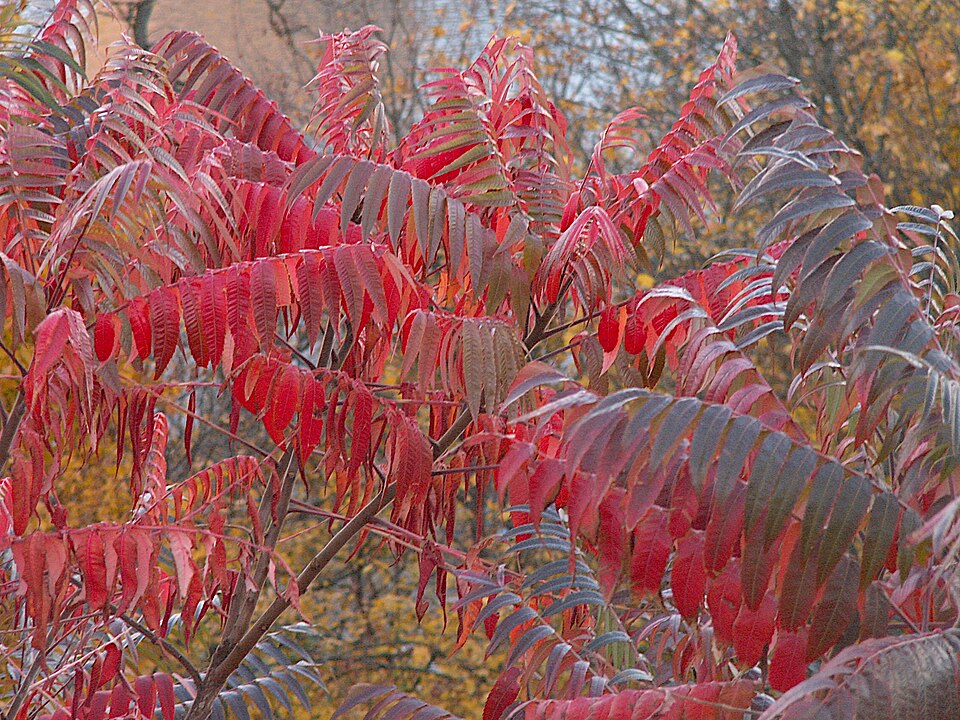
Rhus typhina, commonly known as Staghorn Sumac, is one of the most dramatically beautiful and ecologically productive native shrubs or small trees in the eastern United States and Canada. Its common name refers to the dense, velvety hairs that cover its young branches, resembling the soft velvet covering the antlers (staghorns) of a deer in summer. From its bold, tropical-looking compound leaves to its brilliant scarlet autumn color to its persistent, upright clusters of dark red fruit that feed birds through the winter — Staghorn Sumac delivers visual drama and ecological value across all four seasons.
Staghorn Sumac typically grows 10 to 20 feet tall with an open, flat-topped crown and a vase-shaped, spreading form — often forming large colonies through vigorous root suckering. The leaves are large and pinnately compound, with 11 to 31 leaflets, giving the plant a bold, almost tropical character in the summer landscape. In late June through August, greenish flower clusters appear at the branch tips, developing into the characteristic upright, cone-shaped fruit clusters (drupes) that ripen to dark red by late summer and persist through winter. These fruit clusters — attractive in their own right — serve as a critical food source for birds and small mammals during the lean winter months.
Despite its reputation as a “weedy” shrub (it spreads aggressively by suckers in favorable conditions), Staghorn Sumac is genuinely one of the most valuable native shrubs for dry, disturbed, and challenging sites. Its deep root system controls erosion on steep slopes, its nitrogen-fixing associates improve poor soils, its fall color rivals the best ornamental shrubs, and its ecological contributions — to birds, pollinators, and the food web — are outstanding. Thoughtfully planted and managed, it is a spectacular addition to any native plant garden.
Identification
Staghorn Sumac is a large, open shrub to small tree, typically 10 to 20 feet (3–6 m) tall with a spreading, flat-topped crown. Older plants develop a distinctly architectural, layered branching pattern. The plant spreads by root suckers, often forming large colonies with multiple stems of varying ages. Identification is straightforward: the combination of velvety hairy twigs, large pinnate leaves, and upright red fruit clusters is unique among eastern North American native shrubs.
Bark & Twigs
Young branches are covered with dense, soft, reddish-brown hairs — the “staghorn” character that gives the plant its name. This velvety coating makes the stems feel like the velvet-covered antlers of a young deer. As branches age, the hairs wear away and the bark becomes smooth and grayish-brown. The twigs are stout and contain a large, light-colored pith. The overall branching pattern becomes increasingly architectural with age, creating a distinctive tropical-looking silhouette even without leaves.
Leaves
The leaves are alternately arranged, large, and pinnately compound — 12 to 24 inches (30–60 cm) long — with 11 to 31 leaflets. Each leaflet is 2 to 5 inches long, lance-shaped, with serrate margins. The upper surface is medium to dark green; the underside is pale and slightly hairy. Leaf stems (rachis) are also hairy. In autumn, the leaves turn a brilliant scarlet to orange-red — among the most intense fall colors of any native plant, developing reliably and dramatically even in years when other plants disappoint. The fall color begins in late September and peaks in October.
Flowers & Fruit
Flowers appear in June and July at the branch tips, forming dense, upright, cone-shaped clusters (panicles) of tiny greenish-yellow flowers. Staghorn Sumac can be either dioecious or polygamo-dioecious — most plants are either predominantly male or female. Female plants produce the showy fruit clusters, while male clusters are slightly different in texture and color. The fruit clusters (drupes) are dense, upright, conical, covered in dark red, sticky hairs that persist on the plant through winter, often until February or March. These persistent fruit clusters are one of Staghorn Sumac’s most distinctive and valuable features.
Quick Facts
| Scientific Name | Rhus typhina |
| Family | Anacardiaceae (Cashew) |
| Plant Type | Deciduous Shrub to Small Tree |
| Mature Height | 20 ft |
| Sun Exposure | Full Sun to Part Shade |
| Water Needs | Low to Moderate |
| Bloom Time | June – August |
| Flower Color | Greenish-yellow (fruit clusters bright red) |
| Fall Color | Brilliant scarlet to orange-red |
| Fruit Season | August – March (persistent through winter) |
| Spreading Habit | Aggressive root suckering; forms large colonies |
| USDA Hardiness Zones | 3–8 |
Native Range
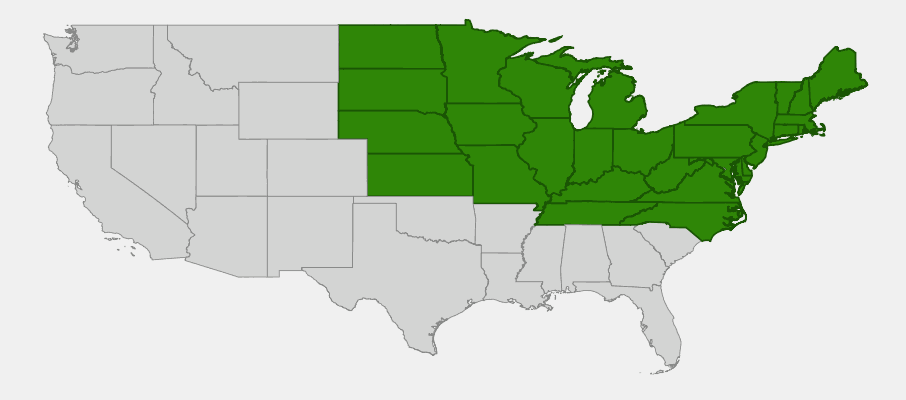
Staghorn Sumac is native to eastern North America from Nova Scotia and Ontario south through New England, the mid-Atlantic states, the Appalachian Mountains, and the Midwest to Kansas, Nebraska, and the Dakotas. It reaches its greatest abundance in the northeastern United States and southern Canada — the region from New England through New York, Pennsylvania, and the Great Lakes states — where it is among the most common and conspicuous native shrubs on disturbed sites, roadsides, forest edges, and open hillsides.
Within its natural range, Staghorn Sumac is an early-successional, disturbance-adapted species — it colonizes newly disturbed sites aggressively through both seed and root suckering, forming dense thickets on abandoned fields, roadsides, railroad rights-of-way, cleared forests, and rocky outcrops. It prefers dry to moderately moist, well-drained soils and is common on rocky or sandy slopes, old quarries, and sandy uplands. In the Appalachian region, it extends well up into the mountains, tolerating cold and rocky conditions that exclude most other shrubs.
As a pioneer species, Staghorn Sumac plays a critical role in ecological succession — stabilizing disturbed slopes, building organic matter, and gradually creating conditions that allow later-successional species to establish. In areas with a natural fire regime, it resprouts vigorously after fire, and its role in post-disturbance recovery is ecologically significant. The disjunct populations noted in the range data (Georgia, Alabama, Mississippi) likely represent populations in suitable upland sites at the southern edge of the species’ climatic tolerance.
📋 Regional plant lists featuring Staghorn Sumac: New York, Pennsylvania & New Jersey
Growing & Care Guide
Staghorn Sumac is one of the easiest native shrubs to grow — it thrives in poor, dry conditions where other plants fail, grows rapidly, and provides exceptional multi-season interest. The primary management challenge is controlling its vigorous suckering to keep it within its intended space.
Light
Full sun to part shade — Staghorn Sumac reaches its best fall color, densest growth, and most prolific fruiting in full sun. It tolerates part shade but becomes more open and produces less fruit in shadier conditions. In its natural habitat it colonizes open, sun-exposed slopes and edges rather than forest understory. For maximum ornamental and wildlife value, plant in a site with at least 6 hours of direct sun daily.
Soil & Water
Staghorn Sumac is one of the most drought-tolerant native shrubs in eastern North America, excelling in dry, rocky, sandy, and nutrient-poor soils. The batch data notes “Low to Moderate” moisture needs, reflecting its natural adaptation to dry upland and disturbed sites. It tolerates a wide range of soil types (sand, loam, clay, rocky) and pH levels, but performs best in well-drained to dry conditions. Avoid wet, poorly drained soils — Staghorn Sumac will not thrive in areas with standing water. No supplemental irrigation is needed once established.
Planting Tips
Plant in spring or fall. Container-grown plants establish readily. Allow ample space — at least 10 to 15 feet — for the plant’s natural suckering spread. Install a root barrier (heavy-gauge polyethylene, 18 inches deep) if you want to limit the colony to a defined area. Staghorn Sumac is an excellent choice for erosion control on dry, steep slopes where its aggressive suckering and deep root system are assets rather than liabilities. Interplant with Goldenrods, Wild Bergamot, or Little Bluestem grass for a naturalistic native meadow-edge composition.
Pruning & Maintenance
Remove unwanted suckers regularly to control spread — this is the primary maintenance task. For a more compact, densely branched form, cut the entire colony to ground level in late winter every 3 to 5 years — the plant regenerates vigorously from the root system. This “coppicing” approach also maximizes the vigor and size of the tropical-looking compound leaves. Avoid pruning individual branches heavily — sumac tends to develop an awkward form when individual branches are cut rather than the whole plant being cut to the ground.
Landscape Uses
- Mass planting on dry slopes for erosion control and fall color
- Wildlife habitat — winter food for birds, summer nectar for pollinators
- Meadow edge and hedgerow in naturalistic landscapes
- Screening on challenging dry sites where other shrubs fail
- Specimen plant for bold tropical-looking summer foliage
- Rain shadow sites — dry spots near buildings or pavement where water doesn’t reach
- Fall color anchor in native plant gardens
Wildlife & Ecological Value
Staghorn Sumac is one of the most ecologically productive native shrubs in eastern North America, providing food and habitat for an exceptional diversity of wildlife across multiple seasons.
For Birds
The persistent red fruit clusters of Staghorn Sumac are a critical winter food source for many birds. American Robins, Eastern Bluebirds, Northern Mockingbirds, Cedar Waxwings, Yellow-rumped Warblers, Downy Woodpeckers, Hairy Woodpeckers, Ruffed Grouse, Ring-necked Pheasants, and Wild Turkeys all consume sumac fruits. The fruit is typically not a first choice when other food is available, but becomes critically important in late winter when other food sources are exhausted — the “emergency ration” quality of sumac berries makes them an insurance policy for wildlife through hard winters. The dense, thicket-forming habit also provides excellent nesting cover for many species.
For Pollinators
Staghorn Sumac flowers in June through August — a valuable mid-summer nectar source when many earlier-blooming plants have finished. The flower clusters attract a wide array of native bees, honeybees, and beneficial insects. Staghorn Sumac is notably important for specialist native bees in the genus Andrena and Calliopsis that are closely associated with Rhus species. Various butterflies including Red-banded Hairstreaks — which use sumac as a larval host plant — Eastern Tiger Swallowtails, and various skippers visit the flowers for nectar.
For Mammals
White-tailed Deer browse Staghorn Sumac foliage and twigs — a significant use in winter when other food is scarce. Eastern Cottontails, various squirrels, and small rodents consume the seeds and bark. The thicket-forming colonies provide dense cover for rabbits, foxes, and small mammals year-round. Bears occasionally consume the fruit.
Ecosystem Role
As a pioneering species, Staghorn Sumac is a critical driver of ecological succession on disturbed lands. Its aggressive suckering stabilizes bare slopes and eroded areas faster than almost any other native woody plant, preventing soil loss and creating the structural complexity that allows other species to establish. Its dead wood supports woodpeckers and cavity-nesting birds, and its leaf litter — which decomposes relatively quickly — builds soil organic matter on poor sites. Over time, Staghorn Sumac thickets become nurseries for forest trees, gradually shading themselves out as succession advances.
Cultural & Historical Uses
Staghorn Sumac has a rich history of use by Indigenous peoples across eastern North America. The ripe fruit clusters — the dark red, hairy drupes — were used by many nations to make a tart, lemonade-like beverage sometimes called “sumac-ade” or “Indian lemonade.” The berries are soaked in cold water, the liquid strained to remove seeds and hairs, and the resulting bright-red, citrus-flavored drink is consumed fresh. This beverage is still made today by foragers and native plant enthusiasts. The berries contain malic acid, the same organic acid responsible for tartness in apples, giving sumac drinks their characteristic lemony flavor.
Beyond beverages, Indigenous peoples used sumac for a variety of purposes. The inner bark and roots were used medicinally — as astringents, antiseptics, and treatments for sore throats, mouth sores, and fever. The Iroquois used sumac bark and berries in preparations for many ailments. The leaves were dried and smoked, often mixed with tobacco (Nicotiana) and other plants in a ceremonial blend called “kinnikinnick” by various Algonquian nations — “kinnikinnick” is an Algonquian word meaning “mixture,” and sumac was a common component.
The tannin-rich bark and leaves of Staghorn Sumac were important in the leather-tanning industry — sumac tannin was used to process fine leather, particularly in southern Europe where related Mediterranean sumac species were used for the same purpose. American sumac bark was commercially harvested in the 19th century for tannin production. Today, Sumac is experiencing a culinary renaissance — ground dried sumac berries are a widely used Middle Eastern spice (primarily from the non-native Rhus coriaria), and North American foragers are discovering that our native Staghorn Sumac berries produce an excellent equivalent.
Frequently Asked Questions
Is Staghorn Sumac related to Poison Sumac?
They are in the same family but are quite different plants. Poison Sumac (Toxicodendron vernix) grows in swamps and bogs, has smooth white berries (not red hairy ones), and causes severe skin rashes. Staghorn Sumac grows in dry upland sites and has red, hairy fruit clusters. The two are easy to distinguish: if the berries are red and hairy and the plant is on dry ground, it’s safe Staghorn Sumac. Poison Sumac has white, waxy berries and grows only in wet habitats.
How do I make sumac lemonade?
Collect ripe, dark red fruit clusters in late summer before rain has washed away the malic acid. Soak the clusters in cold or room-temperature water (not hot, which releases tannins) for 20 to 30 minutes, crushing the berries slightly. Strain through a fine cloth or coffee filter to remove seeds, hairs, and debris. Add sweetener to taste. The result is a tart, pink-red beverage with a pleasant citrusy flavor. It’s best enjoyed fresh, though it can be refrigerated for a few days.
How do I control Staghorn Sumac from spreading?
Staghorn Sumac spreads vigorously by root suckers. To control spread: (1) Remove suckers promptly when they appear, cutting them at or just below soil level. (2) Install a deep root barrier (18 inches) around the planting area at installation. (3) Mow the surrounding area regularly — mowing eliminates suckers before they establish. (4) Plant in a site where spreading is acceptable (a dry slope, a meadow edge, a naturalized area) and allow the colony to expand naturally.
What is the best sumac for fall color?
Staghorn Sumac (Rhus typhina) and Smooth Sumac (Rhus glabra) are both outstanding for fall color, producing brilliant scarlet to orange-red tones. Staghorn Sumac has velvet-hairy stems and leaves while Smooth Sumac is hairless — both perform similarly in the landscape. The cut-leaf cultivar ‘Laciniata’ of Staghorn Sumac has deeply divided, fernlike leaflets that create an even more dramatic tropical effect in summer and an equally spectacular fall display.
Is Staghorn Sumac good for dry, poor soil?
Yes — it thrives in exactly those conditions. Staghorn Sumac naturally colonizes dry, rocky, sandy, and nutrient-poor soils that would prevent the establishment of most other shrubs. It is one of the best native plants for challenging sites: roadsides, steep dry slopes, abandoned lots, disturbed areas, and thin-soil sites near driveways and pavement. Once established, it requires no irrigation, fertilization, or other inputs.

Looking for a nursery that carries Staghorn Sumac?
Browse our native plant nursery directory: New York · Pennsylvania