Sweetgum (Liquidambar styraciflua)
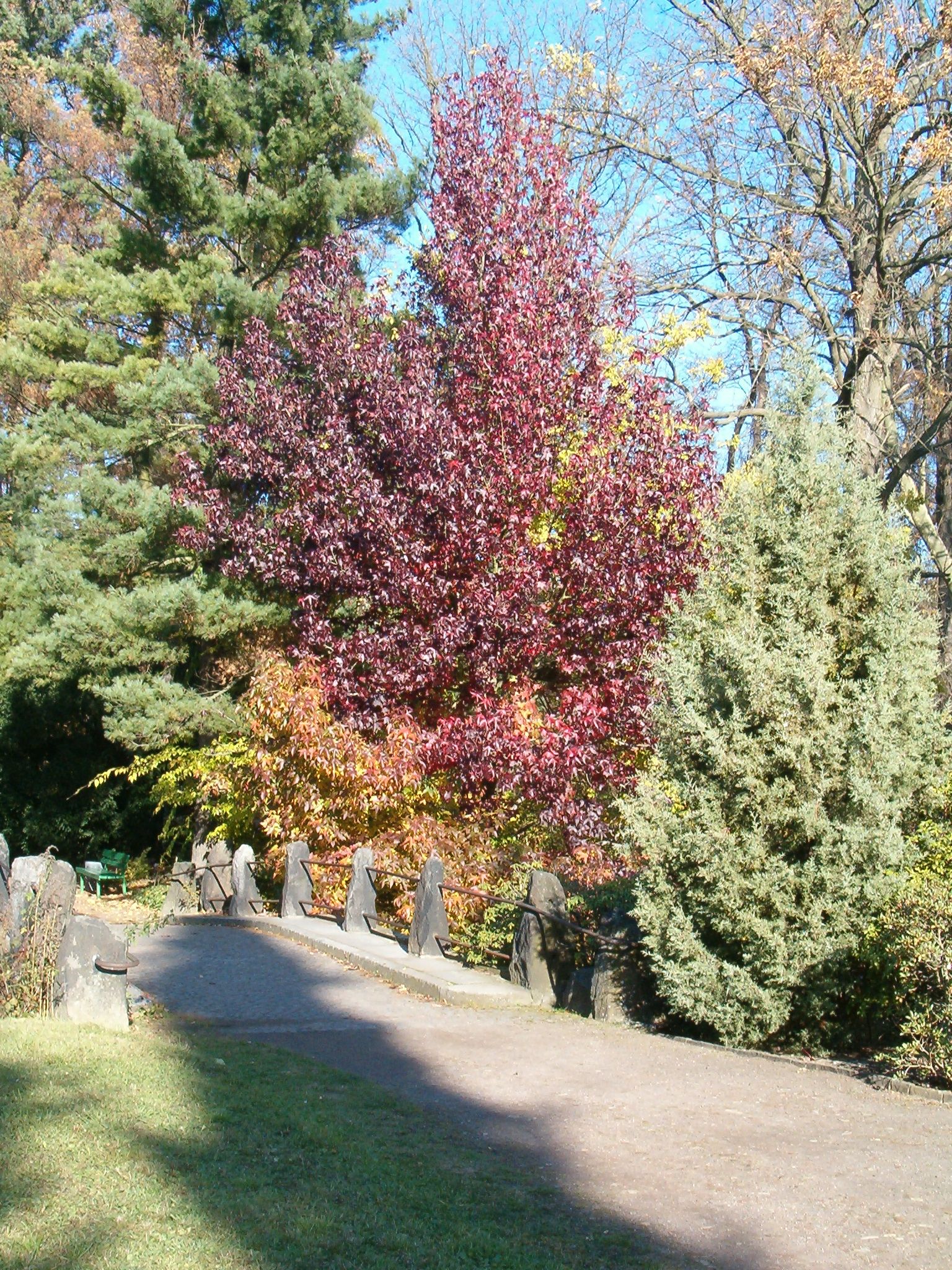
Liquidambar styraciflua, the Sweetgum, is one of the most visually spectacular native trees of eastern North America — a large, fast-growing deciduous tree celebrated for its extraordinary fall foliage, which displays a simultaneous kaleidoscope of brilliant scarlet-red, orange, yellow, and deep purple tones that can persist well into November. Growing 60–80 feet tall (and occasionally over 100 feet), with a distinctly pyramidal to broadly oval crown and the most uniquely star-shaped leaves of any common eastern tree, Sweetgum is both a landmark species of bottomland and moist upland forests from Connecticut to Florida and west to Texas and Oklahoma, and one of the most widely planted native shade trees in the eastern United States.
The genus name Liquidambar refers to the fragrant, balsamic resin (liquid amber) produced by the bark — a sticky, amber-colored sap that was historically used medicinally, as a chewing gum substitute, and as incense. The species epithet styraciflua means “flowing with storax” (a fragrant resin). The tree’s spiny, ball-shaped fruiting heads — which hang on the tree through winter and litter the ground in spring — are instantly recognizable, earning the tree unflattering nicknames like “gumball tree” or “gum balls” from homeowners who find the capsules painful underfoot. Despite this minor drawback, few native trees can match Sweetgum’s combination of size, rapid growth, wildlife value, and spectacular autumn color.
For ecological restoration, wildlife gardening, and large-property landscaping, Sweetgum is an outstanding native tree. It is a significant food tree for birds and small mammals, a host plant for hundreds of Lepidoptera species, and an important component of diverse bottomland and moist upland forest communities. Its rapid growth rate — one of the fastest among large native hardwoods — makes it valuable for quickly establishing canopy structure in restoration plantings. Sweetgum is a signature tree of the Mid-Atlantic region, and its brilliant autumn color is one of the quintessential visual experiences of fall in eastern forests.
Identification
Sweetgum is a large deciduous tree, typically 60–80 feet tall in landscape conditions, occasionally exceeding 100 feet in optimal bottomland forest sites. The young tree is distinctly pyramidal; as it matures the crown broadens and becomes more oval to rounded. The trunk is straight, often remarkably clean and columnar. Old trees may develop a broad, irregular crown. The tree has several highly distinctive identification features that make it one of the easiest eastern trees to identify at any season.
Bark & Twigs
The bark of mature Sweetgum is grayish-brown, deeply furrowed and ridged in a distinctive interlaced or corky pattern. Young bark is brownish-gray and develops its characteristic texture as the tree ages. One of the most notable features is the corky wings or ridges that develop on young stems and twigs — irregular corky projections extending from the stems give young branches a distinctly winged appearance in winter. This feature, combined with the star-shaped leaf scars, makes Sweetgum easy to identify in leafless winter condition.
Leaves
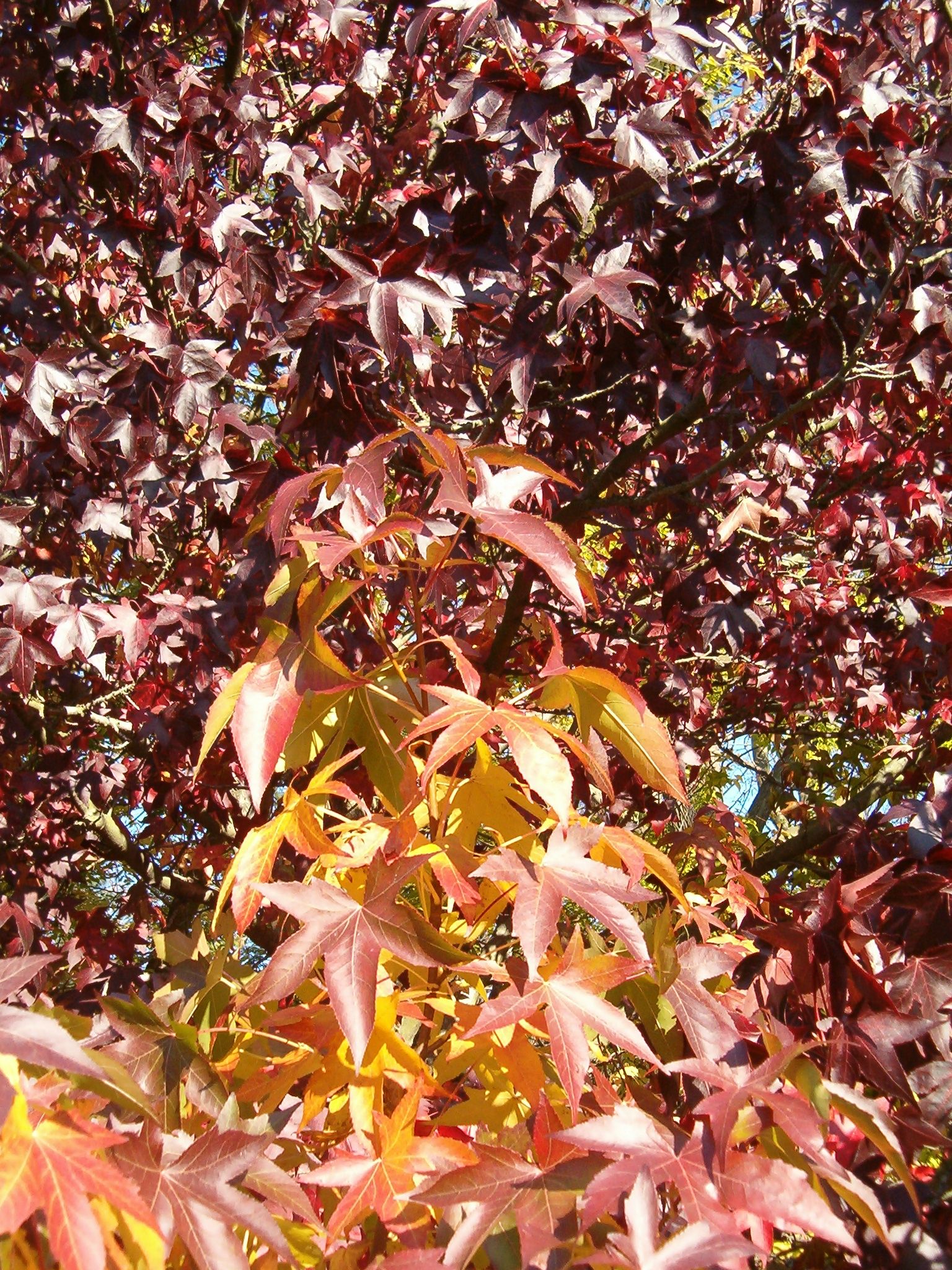
The leaves are the most immediately recognizable feature: star-shaped, palmate, with 5–7 pointed, finely-toothed lobes radiating symmetrically from a central point — resembling a maple leaf but larger and more deeply lobed, with a symmetry that is almost geometric. Leaves are 4–8 inches wide, dark lustrous green above, paler below, and aromatic when crushed (the fragrant resin is present throughout the plant). In autumn, leaves produce one of the most spectacular and variable color displays of any native tree: individual leaves may show red, orange, yellow, and purple simultaneously, and a single tree in fall can display this entire color spectrum at once.
Flowers & Fruit
Sweetgum flowers are modest and easily overlooked — the tree is wind-pollinated. Male flowers appear in upright, rounded heads arranged in a branched cluster, releasing pollen in April–May. Female flowers are in round, 1-inch hanging heads on separate, longer stalks. The resulting fruit is the tree’s most famous (and to some, notorious) feature: a spiny, spherical “gum ball” 1–1.5 inches in diameter, composed of 40–60 woody capsules each with a pair of sharp, curved beaks. These hang on the tree through winter in decorative clusters, then fall in spring to litter the ground.
Quick Facts
| Scientific Name | Liquidambar styraciflua |
| Family | Altingiaceae (Sweetgum) |
| Plant Type | Deciduous Tree |
| Mature Height | 60–85 ft |
| Sun Exposure | Full Sun |
| Water Needs | Moderate to High |
| Bloom Time | April – May |
| Flower Color | Greenish (inconspicuous) |
| Fall Color | Brilliant scarlet-red to red-purple; highly variable |
| USDA Hardiness Zones | 5–9 |
Native Range
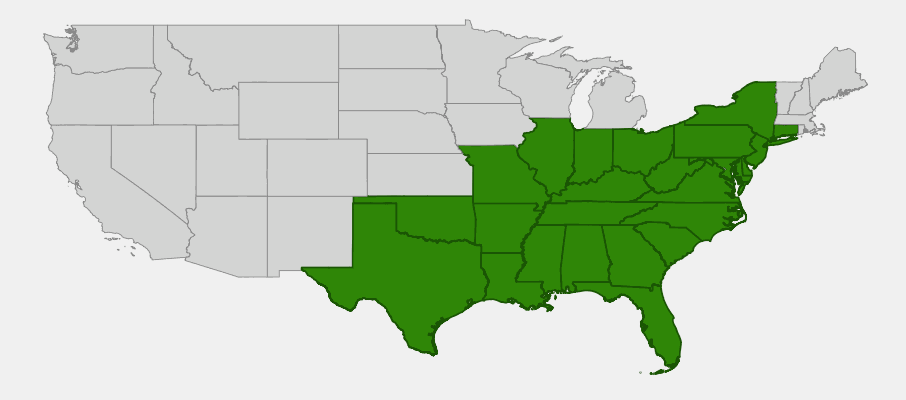
Sweetgum is native to a broad swath of the eastern United States, ranging from extreme southwestern Connecticut, New York (Long Island and the lower Hudson Valley), New Jersey, and southeastern Pennsylvania south through Delaware, Maryland, Virginia, West Virginia, North Carolina, South Carolina, Georgia, Florida, Alabama, Mississippi, Louisiana, and Arkansas, west to Texas and Oklahoma. It also occurs in isolated populations in southern Mexico and Central America, making it one of the few eastern North American trees with a disjunct Latin American range.
In the northeastern portion of its range — NY, NJ, PA — Sweetgum is largely restricted to the coastal plain and the warmer lowland areas. On Long Island and in southern New Jersey, it is common in moist, poorly drained soils of the Atlantic Coastal Plain, growing in bottomland forests, wet forest edges, and disturbed lowland areas. In Pennsylvania it is mainly found in the southeastern corner (Philadelphia region) and the Delaware Valley, where it reaches its northernmost extent in the region. It is not native to most of upstate New York or the higher elevations of Pennsylvania and New Jersey.
The tree reaches its greatest abundance and largest size in the bottomland and floodplain forests of the Southeast — along the Mississippi Alluvial Valley, the lower Coastal Plain, and the piedmont rivers of the Mid-Atlantic and Southeast. In these environments, Sweetgum is a dominant species, growing with Bald Cypress, Water Tupelo, River Birch, Sycamore, and various bottomland oaks. It is one of the most abundant hardwood species in the southeastern United States by timber volume.
📋 Regional plant lists featuring Sweetgum: New York, Pennsylvania & New Jersey
Growing & Care Guide
Sweetgum is a fast-growing, adaptable, and generally low-maintenance native tree once established. Its main requirements are full sun, adequate moisture, and enough space for its ultimate size — a full-grown Sweetgum needs at least a 30×30 foot area. Given proper siting, it is one of the most rewarding large native trees you can plant.
Light
Sweetgum is a full-sun tree that produces its best growth and most vivid fall color in sites with 6+ hours of direct sunlight daily. It tolerates light shade but becomes thin-crowned and produces less spectacular fall color in partial shade. For maximum fall color, choose a sunny, open site. Young trees are somewhat shade-tolerant in their first few years but should be given full sun for best long-term results.
Soil & Water
Sweetgum prefers moist, deep, well-drained to moderately wet soils — it is naturally a bottomland species adapted to sites with higher water availability than most upland trees. It grows best in deep, fertile, slightly acidic loam (pH 5.5–7.0) but tolerates a wide range of soil types including clay and sandy loam, provided moisture is adequate. It tolerates periodic flooding better than most upland trees. It does not tolerate prolonged drought once established without showing stress. Supplemental irrigation during summer dry spells is beneficial, especially for young trees. Avoid highly alkaline soils — Sweetgum is susceptible to chlorosis in high-pH conditions.
Planting Tips
Plant Sweetgum from container stock in spring or early fall. It transplants well when young but becomes harder to establish as container size increases. Plant at the same depth as in the container — avoid deep planting. Provide generous mulching (3–4 inch ring, 3 feet out from the trunk) to maintain soil moisture and moderate temperature. Water weekly the first two summers until the tree is fully established. Leave adequate space — plan for a tree 60–80 feet tall and 40–50 feet wide at maturity.
Pruning & Maintenance
Sweetgum requires minimal pruning. Remove dead or crossing branches in late winter. Young trees develop good natural structure with little intervention. One common maintenance consideration is the spiny gum balls — if fallen fruit is a concern (near pathways or play areas), consider planting the sterile cultivar ‘Rotundiloba’, which produces little or no fruit. Otherwise, the gum balls can be left as wildlife food or raked in spring. Sweetgum is generally pest- and disease-resistant, though it can be damaged by ice storms due to its somewhat brittle branch structure.
Landscape Uses
- Specimen shade tree — unmatched multi-color fall display
- Street tree (with adequate space) on moist, well-drained sites
- Riparian and bottomland restoration plantings
- Large-scale wildlife plantings — food and habitat for birds and mammals
- Naturalistic woodland garden anchor tree
- Wet site specialty tree — tolerates moist to periodically wet soils
Wildlife & Ecological Value
Sweetgum is an ecologically productive native tree that supports diverse wildlife through its seeds, structure, and Lepidoptera host plant value. Its spiny seed balls — often dismissed as a nuisance — are actually a significant winter and early spring food source for multiple bird species.
For Birds
The small, winged seeds within Sweetgum’s spiny gum balls are consumed by American Goldfinches, Purple Finches, Dark-eyed Juncos, Carolina Wrens, and several sparrow species that pick seeds from the dried capsules throughout winter and early spring. Yellow-bellied Sapsuckers drill sap wells in Sweetgum bark and feed on the flowing resin. The tree’s tall structure and dense canopy provide nesting sites for large raptors (Red-tailed Hawk, Great Horned Owl) as well as many songbirds. Wood Ducks nest in cavities in large, old Sweetgums in bottomland forests.
For Mammals
Eastern Gray Squirrels are the primary mammalian consumers of Sweetgum seeds, which they extract from the spiny capsules with impressive dexterity. White-tailed deer browse Sweetgum seedlings and sapling foliage but generally avoid established trees. The fragrant resin (liquidambar) produced by the bark was reportedly licked by deer and horses attracted by its sweet aroma — which may have influenced Indigenous and early settler observations about the “sweetness” of the gum.
For Pollinators
Sweetgum is wind-pollinated and not a significant nectar source for bees or butterflies. However, its foliage hosts over 325 species of moth and butterfly caterpillars, including the Promethea Silkmoth (Callosamia promethea), Luna Moth (Actias luna), and Imperial Moth (Eacles imperialis) — some of the most spectacular large silk moths of eastern North America. These caterpillars are essential food for breeding birds and the ecosystem services they provide cascade far beyond the Sweetgum itself.
Ecosystem Role
In bottomland and floodplain forests, Sweetgum is a dominant canopy species that provides structural complexity, organic matter input (massive leaf litter), and the root architecture that stabilizes streambanks and floodplain soils. Its rapid growth allows it to quickly recolonize disturbed bottomland sites. The gum balls persist on the forest floor for years, creating microhabitat for insects and small mammals. As a fast-growing, long-lived native tree that reaches large size, Sweetgum sequesters substantial quantities of carbon over its lifetime, making it valuable in reforestation programs targeting carbon sequestration goals.
Cultural & Historical Uses
Sweetgum has an extraordinarily rich history of use by both Indigenous peoples and European settlers. The fragrant, balsamic resin (storax or liquidambar) that oozes from the bark when cut or wounded has been used medicinally, ritually, and commercially for centuries. Various southeastern Indigenous nations, including the Cherokee, Choctaw, Chickasaw, and Natchez, used Sweetgum resin as a topical antiseptic, wound treatment, and treatment for skin conditions. The resin was mixed with bear grease as a salve for skin ailments and applied to cuts and sores. The inner bark was used in preparations for treating fevers and dysentery.
Spanish and French explorers in the 16th and 17th centuries noted the Sweetgum resin as a potential commercial product — Spanish botanist Francisco Hernández described its medicinal uses in his comprehensive survey of Mexican plants in the 1570s. The resin was briefly traded to Europe as a substitute for Oriental Storax (Styrax officinalis), used in perfumery and pharmacy. William Bartram, the great 18th-century naturalist, described “liquid amber” as one of the most remarkable products of the southeastern American forests. Sweetgum resin continued to be used in folk medicine well into the 20th century as a treatment for wounds, skin diseases, and respiratory conditions.
The wood of Sweetgum is commercially important and widely used in the furniture and cabinetry industries. It is moderately hard, fine-grained, and takes stains and finishes exceptionally well. Quarter-sawn Sweetgum displays a distinctive “ribbon-stripe” figure in the interlocked grain. It is sold as “red gum” (heartwood) or “sap gum” (sapwood) in the lumber trade. Sweetgum is one of the most important commercial hardwoods of the southeastern United States, used in furniture components, veneer, plywood, interior millwork, and pulpwood. The dried seed capsules (gum balls) have been used in crafts and holiday decorations for generations.
Frequently Asked Questions
How do I deal with Sweetgum gum balls?
The spiny seed balls are the tree’s most frequent complaint. Options: (1) Plant the fruitless cultivar ‘Rotundiloba’ which produces minimal fruit. (2) Rake or blow them up in spring after they fall and compost them. (3) Use them as a garden mulch in areas you don’t walk on. (4) Leave them — they’re wildlife food and decompose slowly. In areas where they fall on paths or lawns, regular cleanup is the most practical solution.
Is Sweetgum the same as American Sweetgum?
Yes — “American Sweetgum,” “Sweetgum,” “Red Gum,” “Bilsted,” and “Alligatorwood” are all common names for the same species, Liquidambar styraciflua. “American Sweetgum” is used to distinguish it from the Oriental Sweetgum (L. orientalis) of the eastern Mediterranean.
How fast does Sweetgum grow?
Sweetgum is one of the faster-growing large native hardwoods — expect 18–25 inches per year under good conditions. It can reach 25–30 feet in just 10 years from planting, making it relatively fast for a major shade tree. Growth slows as the tree matures but continues throughout its long life.
Can Sweetgum grow in wet soil?
Yes — Sweetgum is one of the few large hardwoods that tolerates periodically wet soil and even brief flooding. It naturally grows in bottomland forests that are seasonally flooded. It performs well in moist to moderately wet sites. However, it does not thrive in permanently waterlogged soil — it needs periods of soil aeration.
Why is Sweetgum not native to my area even though I see it everywhere?
Sweetgum is widely planted outside its native range — it grows well in zones 5–9 and is used extensively as a street and park tree. In areas of New York, New England, and the Midwest outside its natural range, the trees you see are planted, not native. Within its native range in the NY-NJ-PA region (primarily coastal plain of NY and NJ, and southeastern PA), it is a true native. Check USDA county-level maps to determine if Sweetgum is native to your specific county.

Looking for a nursery that carries Sweetgum?
Browse our native plant nursery directory: New York · Pennsylvania