Witch Hazel (Hamamelis virginiana)
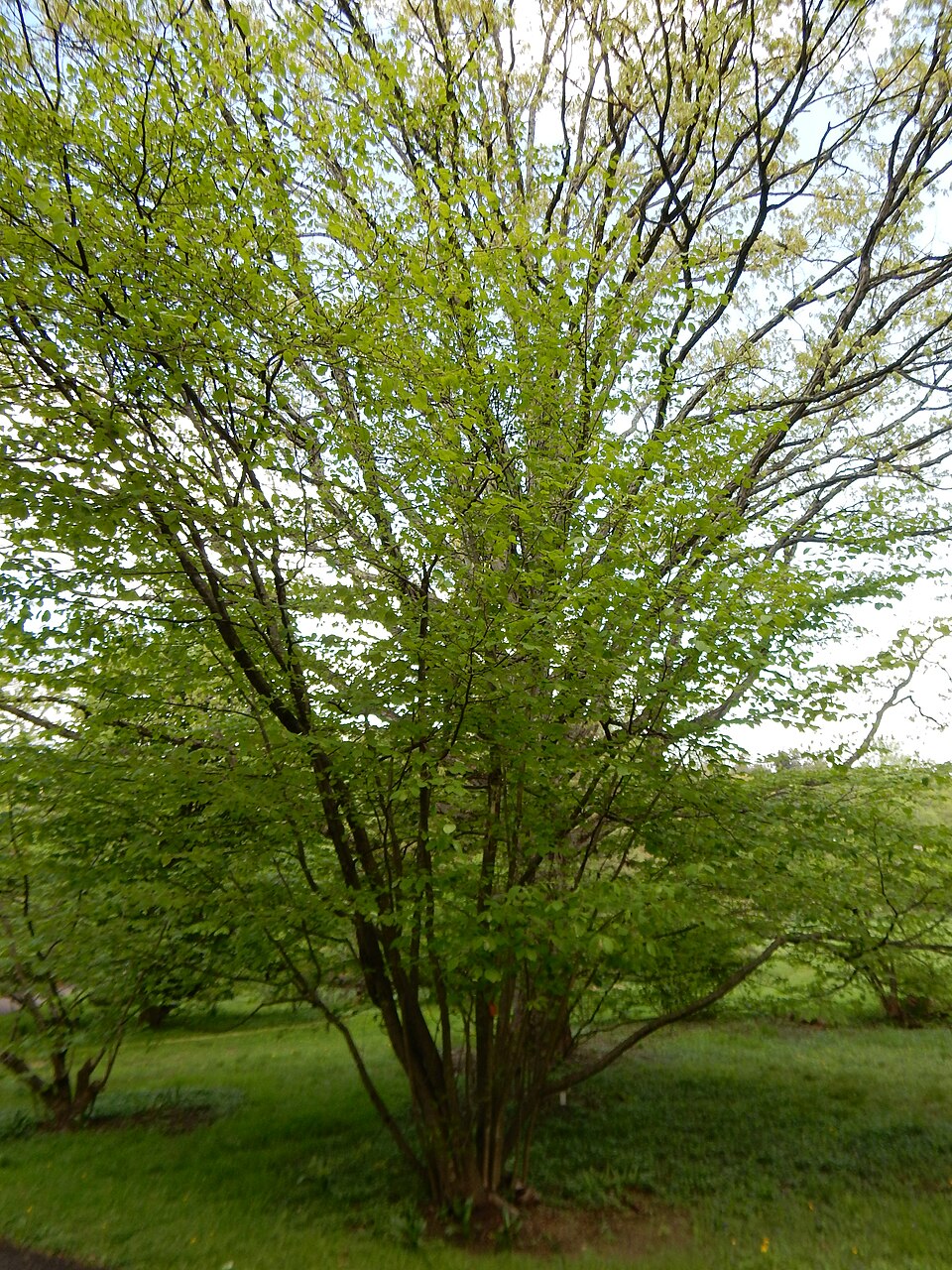
Hamamelis virginiana, commonly known as Witch Hazel, American Witch Hazel, or Common Witch Hazel, is one of the most extraordinary and beloved native shrubs of eastern North America. It holds a singular distinction among all native woody plants: it blooms in late fall — October through December — when every other tree and shrub has long since dropped its leaves and retreated into winter dormancy. The flowers, borne on bare or nearly bare branches, consist of four crinkled, bright golden-yellow ribbon-like petals that unfurl in the cold autumn air, filling the landscape with a cheerful warmth that seems almost miraculous in the fading days of the year.
Witch Hazel is a large, multi-stemmed deciduous shrub or small tree reaching 8 to 20 feet tall, with an open, spreading, somewhat irregular form. Its autumn display is doubly spectacular — the golden yellow flowers appear just as or just after the leaves turn brilliant yellow, creating a stunning combination that makes Witch Hazel one of the most outstanding four-season native plants in the eastern landscape. The fruit capsules — which mature slowly over a full year following pollination — open explosively in autumn with an audible pop, ejecting the shiny black seeds up to 30 feet from the parent plant.
Beyond its unique ornamental appeal, Witch Hazel has extraordinary historical importance — it is the source of one of the most widely used botanical medicines in the world. Witch hazel extract, distilled from the bark and twigs, is found in hundreds of personal care products and is sold as a topical astringent in virtually every pharmacy in North America. Its long history of use by Indigenous peoples, followed by its adoption into mainstream medicine and the cosmetics industry, makes it one of the most economically and culturally significant native plants in the United States.
Identification
Witch Hazel grows as a large, multi-stemmed shrub or occasionally a small tree, reaching 8 to 20 feet tall and often equally wide, with an open, irregular, spreading crown. The bark is smooth, light brownish-gray, and sometimes scaly on older stems. One of the most unusual features of the plant is its simultaneous production of flowers, ripening fruits from the previous year, and new leaf buds — all occurring on the branches at the same time in autumn, a botanical phenomenon that is rare among temperate woody plants.
Bark
The bark of young stems is light gray to brownish, smooth or slightly scaly. Inner bark is light yellow. The branches are distinctive — somewhat zigzagging from node to node, with the buds naked (without scales), consisting instead of exposed, fuzzy leaf rudiments. This “naked bud” feature is a reliable winter identification characteristic. The wood is hard, dense, and flexible — properties that contributed to its many historical uses as a divining rod and tool handle material.
Leaves
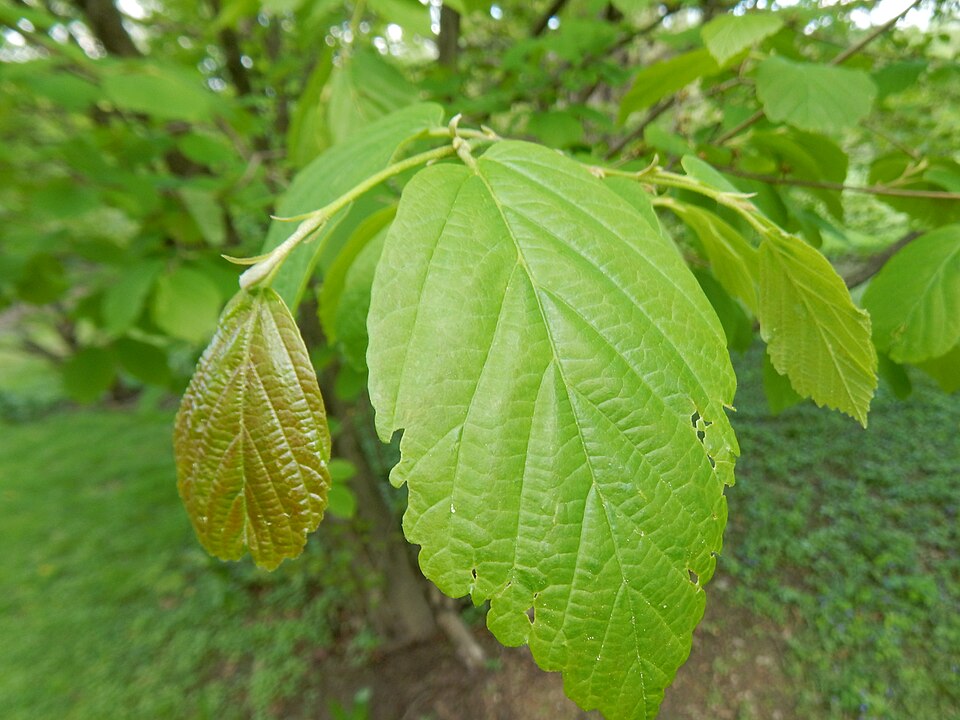
The leaves are alternate, broadly oval to obovate, 3 to 5 inches long, with scalloped or wavy-toothed margins and an asymmetrical base — one side of the leaf base is notably larger than the other, giving the leaf a characteristic lopsided appearance. This asymmetrical leaf base is a key identification feature that distinguishes Witch Hazel from other fall-leafing shrubs. The upper surface is dark green and smooth to slightly hairy; the underside is paler with star-shaped (stellate) hairs visible under magnification. Fall color is spectacular — clear, deep yellow that turns warm amber before dropping, often lingering on the branches alongside the flowers.
Flowers & Fruit
The flowers are uniquely beautiful — each consisting of four strap-shaped, crinkled, bright golden-yellow petals ½ to ¾ inch long, along with four small, yellow-green sepals and four stamens. They are produced in small, axillary clusters of 3 to 5 flowers, emerging from the leaf axils or bare branch tips from October through December. In the Mid-Atlantic states, peak bloom is typically in October–November, often coinciding with or following leaf drop. The flowers are fragrant, with a delicate, somewhat spicy honey scent, and are an important late-season nectar source for insects. The fruit is a hard, woody capsule that develops slowly over the following year, ripening in the following autumn when it splits open explosively, ejecting two glossy black seeds with remarkable force.
Quick Facts
| Scientific Name | Hamamelis virginiana |
| Family | Hamamelidaceae (Witch Hazel) |
| Plant Type | Deciduous Shrub / Small Tree |
| Mature Height | 8–20 ft |
| Sun Exposure | Full Sun to Full Shade |
| Water Needs | Low to Moderate |
| Bloom Time | October – December |
| Flower Color | Golden yellow |
| USDA Hardiness Zones | 3–8 |
Native Range
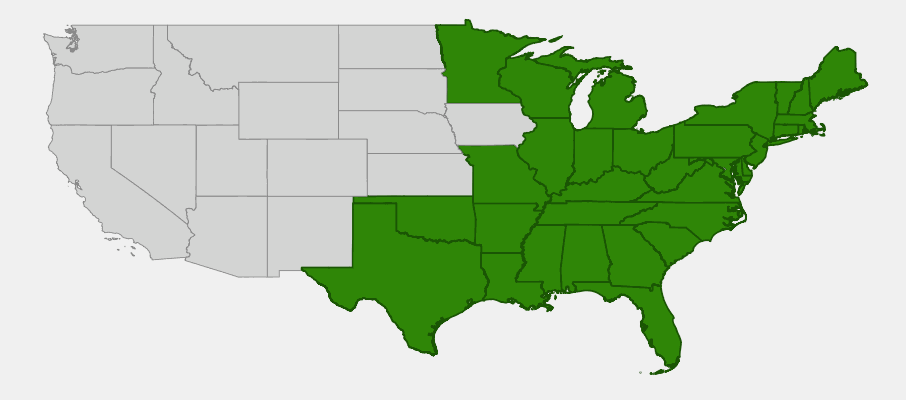
Witch Hazel is native to eastern North America, from Nova Scotia and New Brunswick south to Florida and west to Nebraska and Texas. It is one of the most widely distributed native woody plants in the eastern United States, occurring in virtually every state east of the Great Plains. Its range includes Maine, New Hampshire, Vermont, New York, Pennsylvania, New Jersey, and all the Mid-Atlantic and southeastern states, westward through the Ohio Valley and Great Lakes region to Wisconsin, Minnesota, Iowa, Missouri, Arkansas, and Oklahoma.
In its natural habitat, Witch Hazel grows in a remarkable variety of conditions — from moist streamside bottomlands to dry rocky upland slopes, in deep forest understory and at open forest edges. It is one of the most shade-tolerant native shrubs in the eastern forest, capable of growing and blooming in the deep shade beneath mature forest canopies. This extreme shade tolerance is unusual among flowering shrubs and makes Witch Hazel particularly valuable for garden situations beneath existing trees where most other flowering shrubs fail.
Witch Hazel’s late-fall bloom timing is an adaptation to a specific ecological niche. By blooming after most leaves have fallen, the flowers are more visible to pollinators from a distance, and the bare-branch bloom occurs when insect competition from other flowers is zero. In its natural habitat, Witch Hazel is pollinated primarily by nocturnal moths (Eupithecea and related species) and occasionally by late-flying native bees that remain active on warm autumn days. The seeds, ejected explosively by the dried capsule, are cached by white-footed mice, which sometimes fail to recover all their caches — inadvertently planting new Witch Hazel seedlings across the forest floor.
📋 Regional plant lists featuring Witch Hazel: New York, Pennsylvania & New Jersey
Growing & Care Guide
Witch Hazel is one of the most rewarding and adaptable native shrubs for the eastern garden. Its unique late-fall bloom, spectacular fall foliage color, shade tolerance, and ease of care make it an outstanding four-season plant that deserves far wider use in gardens throughout the northeastern United States.
Light
One of Witch Hazel’s greatest assets is its remarkable adaptability to light conditions — it grows and flowers in everything from full sun to full shade, making it one of the most versatile native shrubs available. In full sun it develops a denser, more compact form with the most prolific flowering. In shade — even the deep shade beneath mature oaks and maples — it grows more openly but continues to bloom reliably, making it invaluable for shaded garden situations where most flowering shrubs fail. The fall color is most vivid in full to partial sun.
Soil & Water
Witch Hazel is adaptable to a wide range of soil conditions — from moist streamside soils to moderately dry rocky slopes. It performs best in moist, well-drained soils with slightly acidic pH (5.5–6.5), but tolerates both somewhat wet and somewhat dry conditions once established. It is moderately drought tolerant after 2–3 years of establishment and requires no supplemental irrigation in most of the northeastern states. Avoid poorly drained, waterlogged soils where the roots may rot. Mulching with 2–3 inches of organic material helps maintain soil moisture and mimics the leaf litter of its natural forest habitat.
Planting Tips
Plant Witch Hazel in spring or fall. It transplants well from container stock and establishes relatively quickly. Space plants 10 to 15 feet apart to allow for mature spread — this is a large shrub that needs room. Choose your site based on the full-grown size (up to 20 feet tall and wide) rather than the initial plant size. Witch Hazel makes an outstanding specimen plant, woodland garden anchor, or naturalistic screen. In the garden, it pairs beautifully with other native woodland shrubs including Spicebush, Buttonbush, native viburnums, and Mountain Laurel.
Pruning & Maintenance
Witch Hazel requires minimal pruning. Remove dead or crossing branches in early spring after flowering. If needed for space management, prune lightly immediately after bloom — cutting now will remove some flower buds for the following season, but fall pruning would remove all flower buds. Avoid heavy pruning; the plant has a naturally attractive, irregular form that should be preserved. Witch Hazel is largely pest- and disease-free, though it can occasionally develop leaf spot fungus (not serious), aphid infestations (controlled by natural predators), and witch hazel leaf gall aphid — which causes distinctive cone-like galls on the leaves but does not seriously harm the plant.
Landscape Uses
- Four-season specimen shrub — outstanding spring buds, summer foliage, fall color, and winter/late-fall flowers
- Woodland garden anchor — thrives in the shade of large deciduous trees
- Late-fall/early winter bloom — the only native shrub providing flowers after hard frost
- Naturalistic screening — large, informal habit creates effective screens
- Understory planting — one of few flowering shrubs tolerating deep shade
- Rain garden edges — tolerates periodic wetness
- Wildlife habitat planting — exceptional for late-season pollinators and year-round bird habitat
Wildlife & Ecological Value
Witch Hazel provides unique wildlife value through its late-fall bloom timing, offering food and habitat when virtually no other native plants are active.
For Birds
The dense, multi-stemmed structure of Witch Hazel provides excellent nesting habitat for a variety of songbirds — American Robins, Gray Catbirds, Northern Cardinals, and various thrushes are known to nest in large Witch Hazel shrubs. The seeds, while small, are consumed by Ruffed Grouse, Wild Turkeys, and various small birds. The insect diversity associated with the fall flowers — including moths that pollinate the flowers — provides food for late-season insectivorous birds. The year-round cover provided by the large, multi-stemmed shrub is used by overwinting birds including American Tree Sparrows and Dark-eyed Juncos.
For Mammals
White-tailed deer browse Witch Hazel foliage, and the seeds are cached by white-footed mice and other small rodents, which sometimes forget their caches — inadvertently planting new seedlings. Rabbits may gnaw bark in winter. The explosively discharged seeds — shot up to 30 feet from the plant — land in the leaf litter where they are found and cached by rodents, contributing to seed dispersal across the forest floor. Beaver occasionally harvest the stems for dam construction along streamside populations.
For Pollinators
Witch Hazel occupies a unique ecological niche as one of the very last native plants to provide nectar and pollen before winter. Its primary pollinators are nocturnal moths — particularly owlet moths and geometrid moths — that remain active on mild autumn nights when temperatures stay above freezing. These moths are uniquely adapted to function at low temperatures, and Witch Hazel flowers provide their last opportunity to feed before winter dormancy. On warm autumn days, late-flying native bees including bumblebee queens also visit the flowers for the final nectar of the season. This relationship between Witch Hazel and its late-season pollinator community is one of the most specialized and ecologically fascinating in the eastern forest.
Ecosystem Role
As one of the most widely distributed native understory shrubs in the eastern forest, Witch Hazel plays an important structural role in forest ecosystems. Its dense branching provides habitat structure at the shrub layer for birds, small mammals, and insects. Its late-fall bloom closes the nectar gap at the end of the growing season, supporting the final activities of overwintering insects. Its seeds, dispersed by explosive ballistics and rodent caching, help maintain forest understory diversity. The tannin-rich bark and leaves decompose slowly, contributing to the forest floor’s organic layer and providing a substrate for fungal networks and invertebrate communities.
Cultural & Historical Uses
Witch Hazel has one of the most extensive histories of human use of any native North American plant. Indigenous peoples throughout the eastern United States used it as one of their most important medicinal plants. The Mohegan, Potawatomi, Ojibwe, Delaware, Cherokee, and many other nations used preparations of the bark, leaves, and twigs for a wide range of applications: as a poultice for swellings, sore muscles, and bruises; as a steam treatment for aching limbs; in eye washes; for treatment of hemorrhoids; and as a general astringent for skin conditions. The plant’s astringent properties come from its high content of tannins, particularly hamamelitannin, which cause protein coagulation and tissue tightening.
European settlers quickly adopted Witch Hazel from Indigenous healers, and by the 19th century it had become one of the most commercially important medicinal plants in North America. In 1866, Theron T. Pond — a pharmacist in Utica, New York — began producing and selling “Pond’s Extract,” a distillation of Witch Hazel bark, which became one of the most successful patent medicines of the era. The Dickinson Company, founded in 1866, remains the largest producer of witch hazel products today, with its distillery in Essex, Connecticut, processing millions of pounds of Witch Hazel bark and twigs annually.
Witch hazel extract is used in hundreds of consumer products worldwide — astringents, toners, hemorrhoid preparations (including Tucks pads), eye drops, insect bite treatments, shaving products, and cosmetics. The USDA estimates annual witch hazel production in the United States at approximately 2.5 million pounds of bark and twigs. Despite this massive commercial harvest — conducted primarily in Connecticut, using branches carefully cut to allow regrowth — wild populations remain abundant throughout the eastern forest, a testament to the plant’s resilience and the sustainability of properly managed harvest. The common name “Witch Hazel” derives from the Old English “wych” (flexible/pliable) referring to the flexible branches, and from the plant’s resemblance to European hazel (Corylus); the “witch” in modern English is a corruption of the original “wych.”
Frequently Asked Questions
Why does Witch Hazel bloom in fall when everything else is dormant?
Witch Hazel’s fall bloom is an ecological adaptation to a unique niche — by flowering after most other plants have finished and leaves have fallen, the flowers are more visible to pollinators, face essentially zero competition from other flowering plants, and can be pollinated by specialized cold-tolerant moths that are active in autumn. The following year’s fruit develops slowly, ripening simultaneously with the next year’s flowers in an unusual botanical synchrony.
Are witch hazel products from the store made from this plant?
Yes — commercial witch hazel extract sold in pharmacies and used in cosmetics is distilled from the bark and twigs of Hamamelis virginiana, the same plant. The largest producer of commercial witch hazel in the United States processes plants harvested from Connecticut and surrounding states. The active compounds — particularly hamamelitannin and hamamelose — are responsible for the astringent properties of commercial witch hazel products.
Can Witch Hazel grow in deep shade?
Yes — Witch Hazel is one of very few native flowering shrubs that blooms reliably in deep shade. In natural forest settings it grows under the closed canopy of mature trees and still produces flowers annually. This makes it exceptionally valuable for shaded garden situations where most flowering shrubs simply won’t bloom. In full shade, the form becomes more open and the fall color somewhat less vivid, but the fall bloom is still produced reliably.
How long does Witch Hazel bloom?
The bloom period is typically 3–6 weeks, from October through December in New York, New Jersey, and Pennsylvania. The flowers are remarkably cold-hardy — the ribbon-like petals roll up during hard freezes but unfurl again when temperatures moderate, allowing blooming to continue through multiple freeze-thaw cycles. In mild years, flowers may persist into January.
Does Witch Hazel attract deer?
White-tailed deer browse Witch Hazel foliage, but it is not heavily preferred and established shrubs are generally not severely damaged. Young transplants in the first year or two of establishment may need protection from deer browsing. Once the plant is large and well-established (3+ years), deer browsing typically does not cause significant harm.

Looking for a nursery that carries Witch Hazel?
Browse our native plant nursery directory: New York · Pennsylvania