Tulip Poplar (Liriodendron tulipifera)
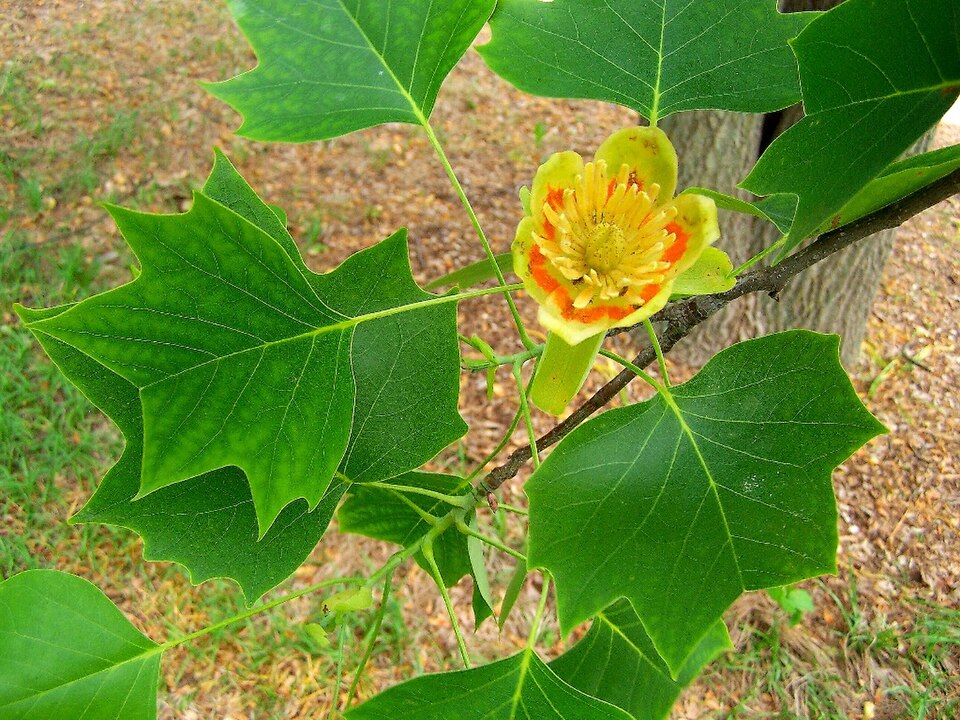
Liriodendron tulipifera, commonly called Tulip Poplar, Tulip Tree, or Yellow Poplar, is one of the most magnificent native trees of eastern North America — the tallest deciduous tree on the continent, capable of reaching 150 feet or more in old-growth forest, and one of the most beautiful in flower, with striking yellow-green, orange-banded tulip-shaped blooms that appear in May and June. Despite its common name, it is not a poplar at all — it is a member of the Magnoliaceae (magnolia family) and is more closely related to Sweetbay Magnolia than to the cottonwoods and aspens of the genus Populus.
In Indiana and Ohio, Tulip Poplar is one of the dominant native forest trees — a fast-growing, long-lived canopy giant that once made up a significant portion of the presettlement mixed deciduous forest. Its straight-grained, easily worked, lightweight wood was the most commonly used timber in early American furniture-making, cabin construction, and boat building throughout the region. Abraham Lincoln reportedly split Tulip Poplar rails in Indiana, and the species holds enormous historical and ecological significance to the entire Ohio Valley region.
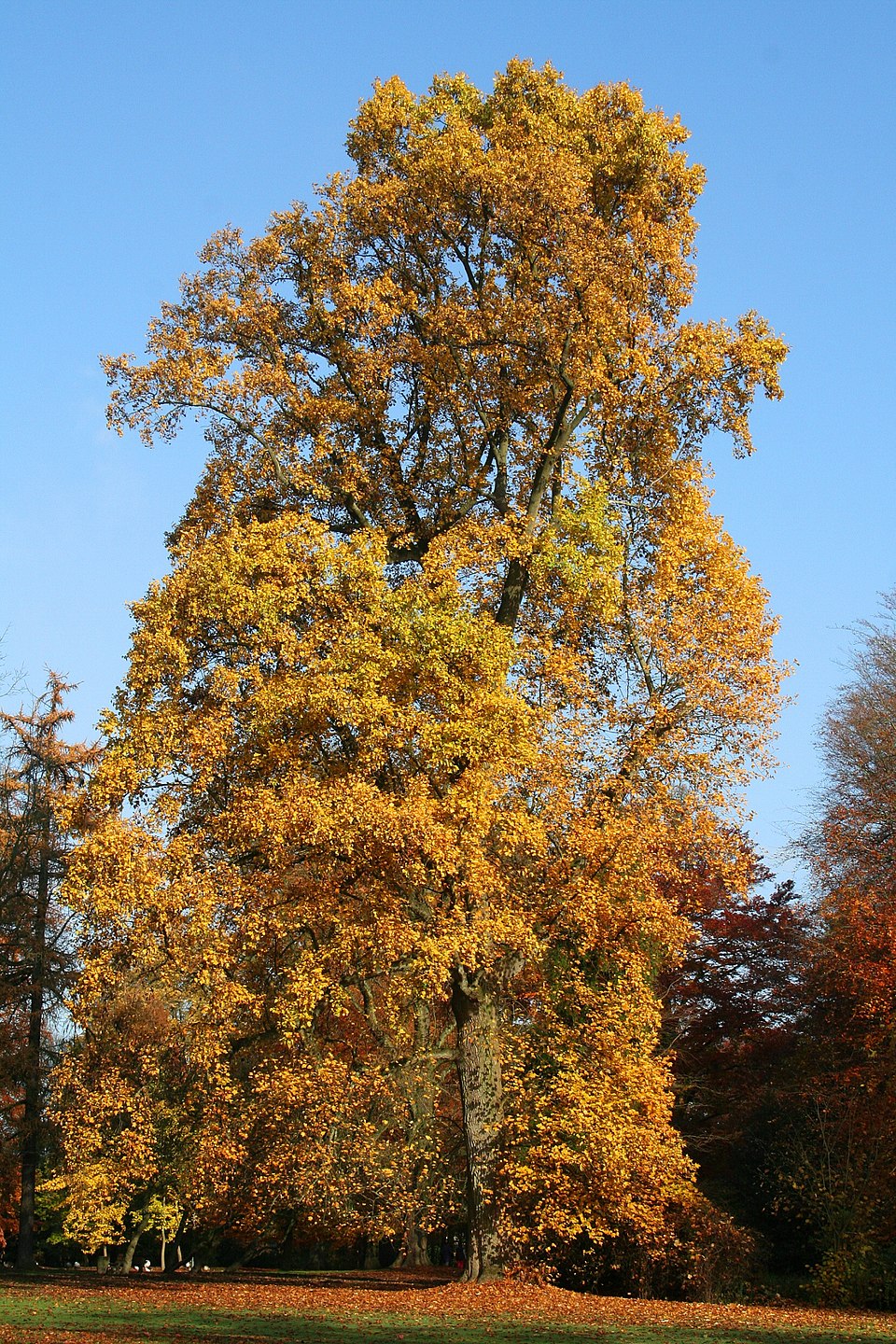
For landscape use, Tulip Poplar is unsurpassed as a large native shade tree where space is available. Its growth rate (2 to 3 feet per year) is exceptional for a large tree, its flowers are among the most spectacular of any North American tree, and its fall color — clear, brilliant yellow — lights up the autumn sky. The large, uniquely shaped leaves are immediately distinctive and give the tree a bold, tropical-looking texture unusual among native deciduous trees.
Identification
Tulip Poplar is a large to very large deciduous tree, typically 70 to 90 feet tall in landscape settings and reaching 100 to 150 feet in old-growth forests. The trunk is straight, smooth, and columnar in young trees, developing a high, spreading crown with age. The branching pattern produces a clean, tall bole (trunk) with the crown occupying the upper third of the tree’s height — a characteristic that gives mature specimens their stately, cathedral-like appearance.
Bark
Young bark is smooth, thin, and greenish to grayish-brown with raised white lines and markings. As the tree matures, the bark develops shallow furrows and interlacing ridges, becoming more prominently textured with age but never as deeply furrowed as oak or hickory. The inner bark, when cut, has a spicy, slightly aromatic scent distinctive to the magnolia family. Very old trunks develop broad, rounded ridges with a grayish appearance, while the upper portions of the tree often retain smoother, paler bark characteristic of younger growth.
Leaves
The leaves are the most immediately distinctive feature of Tulip Poplar — uniquely shaped among all North American trees with four lobes (two lateral and two basal, with the apex truncated or broadly notched rather than pointed). This shape has been variously described as resembling a tulip silhouette, a coat of arms, a cat’s face, or — to some — a simple tulip flower. Leaves are 4 to 8 inches long and equally wide, with a long petiole that allows them to flutter in the slightest breeze. They are dark green above, pale and somewhat waxy below, turning a clean, brilliant yellow in autumn before dropping.
Flowers
The flowers justify the name. Each bloom is a perfect tulip shape, 2 to 3 inches across, with six petals arranged in a cup: petals are pale greenish-yellow with a brilliant orange band across the middle, surrounding a central mass of numerous orange stamens. The overall effect is of yellow, green, and orange — exactly as the batch notes suggest. Flowers appear in May and June, borne at branch tips, and are often not noticed at ground level because of the tree’s height when blooming, but they are breathtaking when a branch is lowered by wind or observed from above. Flowers produce abundant nectar that is a primary food source for Ruby-throated Hummingbirds, orioles, and numerous bees.
Fruit
The fruit is a cone-like aggregate of winged samaras (seeds with papery wings), 2 to 3 inches long, that ripens in September and October. The samaras are wind-dispersed, and the central core of the aggregate persists on the branch through winter as an attractive, upright, light brown structure resembling a small torch or candelabra. These persistent fruit cones provide visual interest and are consumed by numerous wildlife species.
Quick Facts
| Scientific Name | Liriodendron tulipifera |
| Family | Magnoliaceae (Magnolia) |
| Plant Type | Large Deciduous Tree |
| Mature Height | 70–90 ft |
| Sun Exposure | Full Sun |
| Water Needs | Moderate |
| Bloom Time | May – June |
| Flower Color | Yellow-green with orange band |
| Fall Color | Brilliant yellow |
| Growth Rate | Fast (2–3 ft/yr when young) |
| Deer Resistant | Moderate (deer browse young trees) |
| USDA Hardiness Zones | 4–9 |
Native Range
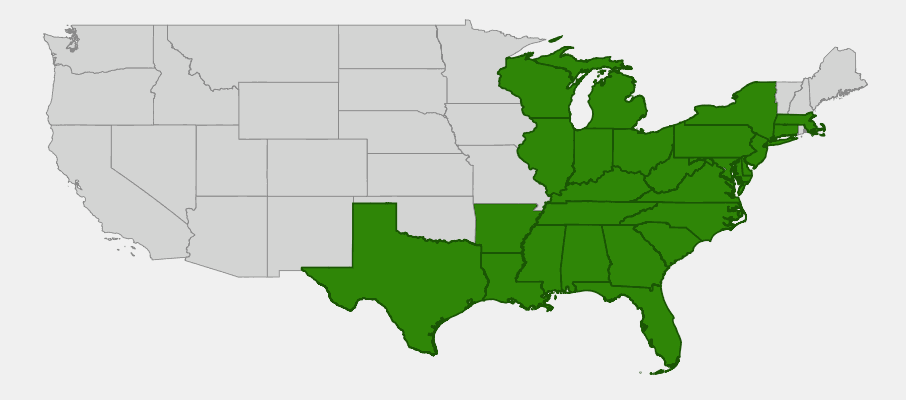
Tulip Poplar is native to a large area of the eastern United States, from southern Connecticut and New York south to northern Florida, and west through Ohio, Indiana, Michigan, Illinois, and to Louisiana and Arkansas. It reaches its greatest size and density in the rich cove forests of the southern Appalachians and in the bottomlands of the Ohio Valley, where it is among the most dominant canopy species. In Indiana and Ohio, it is widely distributed in the southern and central portions of both states, becoming less common north of the glacial boundary where soils become more uniformly fertile and the climate cooler.
Tulip Poplar prefers deep, moist, well-drained, fertile soils — the bottomland and lower slope conditions of river valleys and stream terraces. In presettlement Indiana and Ohio, it was one of the most abundant trees in the vast bottomland hardwood forests that lined the Ohio River and its tributaries. The most famous example of its ecological dominance in the region is the “Big Trees” of the Wabash River valley in Indiana, where historical accounts describe Tulip Poplars reaching 150 feet tall and 8 feet in diameter — specimens that have not been equaled since the original forests were cleared.
Today, Tulip Poplar is the state tree of both Indiana and Kentucky — a recognition of its historical and ecological importance to the region. Second-growth specimens are now common in fencerows, woodland edges, and recovering forests throughout the Ohio Valley, and the species is a primary component of the forest succession that occurs when agricultural fields are abandoned across Indiana and Ohio.
📋 Regional plant lists featuring Tulip Poplar: Indiana & Ohio
Growing & Care Guide
Tulip Poplar is one of the most vigorous and rewarding large native trees for Indiana and Ohio landscapes where adequate space is available. Its fast growth, spectacular flowers, and brilliant fall color make it a high-performance tree, but its ultimate size demands careful site selection.
Light
Tulip Poplar requires full sun. While young trees can tolerate light shade, they become increasingly sun-demanding with age. Trees growing in shade are typically thin-crowned, slow-growing, and susceptible to decline as surrounding trees compete for light. For best growth and flowering, provide an open, full-sun site with adequate space for the crown to develop. This is a forest canopy tree — plan for its mature dimensions from the start.
Soil & Water
Tulip Poplar thrives in deep, moist, well-drained, fertile soils — reflecting its bottomland forest heritage. It performs well in loamy soils with moderate fertility, and tolerates mildly acidic to neutral pH. It does not tolerate compacted, poorly drained, or very shallow soils. Moderate water needs mean it benefits from deep watering during establishment and in prolonged summer dry spells, but is not as sensitive to drought as some bottomland trees once established. It is somewhat sensitive to salt spray and urban air pollution, and performs better in suburban and rural settings than in highly impacted urban cores.
Planting Tips
Plant from container stock in spring or fall. Tulip Poplar has fleshy, sensitive roots and establishes best when root disturbance is minimized during planting. Dig a generous, wide planting hole and settle the tree with good soil contact around all roots. Water thoroughly at planting and weekly for the first growing season. Mulch the root zone with 3 to 4 inches of wood chips or shredded leaves, keeping mulch away from the trunk. Space at least 30 feet from structures and 50 to 60 feet from other large trees to allow for the eventual crown spread of 35 to 50 feet.
Pruning & Maintenance
Young Tulip Poplars may need guidance to develop a single dominant leader (main trunk) if they show a tendency toward multi-stem growth. Beyond this early training, mature trees require minimal pruning. Remove dead or weak branches when young. Avoid heavy pruning of large branches on mature trees — Tulip Poplar is sensitive to large pruning wounds and heals slowly. The most common issues are Tulip Poplar scale (a sap-sucking insect that causes black sooty mold) and Verticillium wilt on poorly drained sites. Yellow leaf drop in summer (natural drought stress response) is common and cosmetically unpleasant but rarely causes lasting harm.
Landscape Uses
- Large residential or commercial shade tree where space permits
- Naturalized woodland planting on deep, moist soils
- Street tree on wide boulevards with adequate soil volume
- Specimen tree as a dramatic focal point in large landscape
- Restoration planting in bottomland hardwood reforestation projects
- Hummingbird and pollinator tree — flowers are exceptional nectar sources
- Wildlife habitat — seeds, flowers, and structure support diverse wildlife
Wildlife & Ecological Value
Tulip Poplar is an extraordinarily valuable wildlife tree throughout its range, supporting a diverse community of birds, mammals, and invertebrates through its abundant food resources and structural features.
For Birds
The flowers of Tulip Poplar are one of the premier nectar sources for Ruby-throated Hummingbirds in the eastern United States — the combination of deep, cup-shaped flowers and abundant nectar production makes Tulip Poplar a critical stopover and refueling resource during spring migration. Baltimore Orioles, Orchard Orioles, and House Finches are also regular visitors. The seeds are consumed by American Goldfinch, Pine Siskin, Purple Finch, and various sparrows. The large, open crown provides nesting habitat for Red-tailed Hawk, Broad-winged Hawk, and American Crow, while cavity-nesting species (Pileated Woodpecker, Red-bellied Woodpecker, Great Crested Flycatcher) use old cavities in large trees.
For Mammals
Eastern Gray Squirrel and Red Squirrel consume the seeds. White-tailed Deer browse young foliage and twigs. Bats use the deeply furrowed bark of old trees for roosting. Black Bears eat the sweet sap of wounded trees, and both bear and raccoon use large cavities in veteran trees for denning.
For Pollinators
The flowers produce extraordinary quantities of nectar and are an important resource for numerous bee species, including bumblebees and native mining bees. Eastern Tiger Swallowtail butterfly larvae use Tulip Poplar as a host plant — this is one of the most important larval food plants for this spectacular and beloved butterfly in the eastern United States. Spicebush Swallowtail and various moth species also use the foliage. Tulip Poplar is considered a high-value tree for supporting the caterpillar biomass on which many breeding songbirds depend.
Ecosystem Role
Tulip Poplar is a pioneer and dominant canopy species of eastern forest succession. Its fast growth allows it to quickly colonize forest gaps and abandoned fields, establishing the canopy cover that enables the recovery of shade-tolerant understory species. Its large leaves decompose relatively rapidly, enriching the soil. Old-growth Tulip Poplars — increasingly rare — provide veteran tree habitat (large cavities, deep furrowed bark, aerial root zones) that supports biodiversity that cannot be replicated by younger trees. Planting and protecting Tulip Poplar is an investment in decades and centuries of increasing ecological value.
Cultural & Historical Uses
Tulip Poplar’s soft, straight-grained, easily worked wood made it the most important timber species in early American history for a range of applications that wood from harder, more difficult species could not provide economically. Native American peoples, including the Iroquois, Cherokee, and Delaware, used Tulip Poplar logs for dugout canoes — the species’ light weight, large size, and ease of hollowing made it superior to any other eastern tree for this purpose. Large canoes capable of carrying 20 or more people were hollowed from single Tulip Poplar logs, and these canoes were used throughout the eastern river systems for trade, travel, and warfare.
Early European-American settlers quickly recognized the same virtues. Tulip Poplar became the primary wood for furniture, paneling, interior millwork, cabinets, and “light” construction throughout the Ohio Valley and Appalachian states. Abraham Lincoln — who grew up in Indiana — is famously associated with rail-splitting, and Tulip Poplar was one of the primary species used for fence rails in the state. The Indiana and Ohio frontier was literally built from Tulip Poplar lumber. Its easy workability, light weight, and resistance to warping made it the “utility wood” of the early republic in a way that oak, hickory, and walnut — harder but more difficult to work — could not match.
Medicinally, Tulip Poplar bark was used by various indigenous nations as a tonic, heart stimulant, and fever remedy. The Cherokee used bark tea for various conditions. Modern phytochemical analysis has confirmed that the bark contains alkaloids with cardiac activity — compounds structurally related to those used in contemporary heart medications — providing a scientific basis for some of these traditional medical uses. The tree is also valued in modern apiculture; Tulip Poplar is considered one of the most important honey plants in the eastern United States, producing a dark, distinctive honey with a slightly spicy, robust flavor that is prized by beekeepers throughout Indiana and Ohio.
Frequently Asked Questions
Is Tulip Poplar really a poplar?
No. Despite the common name, Tulip Poplar is a member of the Magnolia family (Magnoliaceae), not related to true poplars (genus Populus) or aspens. The “poplar” in the name likely derives from the similar leaf shape (both are broadly lobed and flutter in the wind) and the light weight and workability of the wood, which resembles poplar in these properties. Its correct common names are “Tulip Tree” or “Yellow Poplar.” It is the state tree of Indiana and Kentucky.
How fast does Tulip Poplar grow?
Very fast for a large tree — 2 to 3 feet per year when young and growing in good conditions. A tree planted in a favorable site can reach 40 to 50 feet in 15 to 20 years. Growth slows somewhat as the tree reaches maturity but remains relatively fast throughout a long life. The combination of fast growth and impressive ultimate size makes it one of the most efficient trees for establishing a mature-feeling landscape quickly.
Why are the leaves turning yellow and dropping in summer?
Premature summer yellow leaf drop is common in Tulip Poplar, particularly during hot, dry weather. This is a natural drought response — the tree drops older leaves to reduce water stress. It is not typically a sign of disease or serious problems. The tree will produce new foliage if rain returns, though it may look sparse for the remainder of the summer. This behavior is more pronounced in recently planted trees that have not yet established deep roots.
Can Tulip Poplar be planted near a house?
With caution. This is a large, fast-growing tree that can reach 80 feet or more. Maintain at least 30 to 40 feet of clearance from structures and never plant under power lines. Like all large trees, it poses wind damage risks during storms if poorly sited. However, it does not have invasive roots and is generally not considered a threat to foundations when planted at appropriate distances.
Will Tulip Poplar attract hummingbirds?
Absolutely — it is one of the premier hummingbird trees in the eastern United States. The tubular, nectar-rich flowers are precisely the shape and depth favored by Ruby-throated Hummingbirds, and blooming occurs in May and June when hummingbirds are establishing territories and building nests. A single large Tulip Poplar in bloom can attract multiple hummingbirds and will be a reliable focal point of hummingbird activity for the 3 to 4 weeks of peak blooming.