Narrow-leaf Purple Coneflower (Echinacea angustifolia)
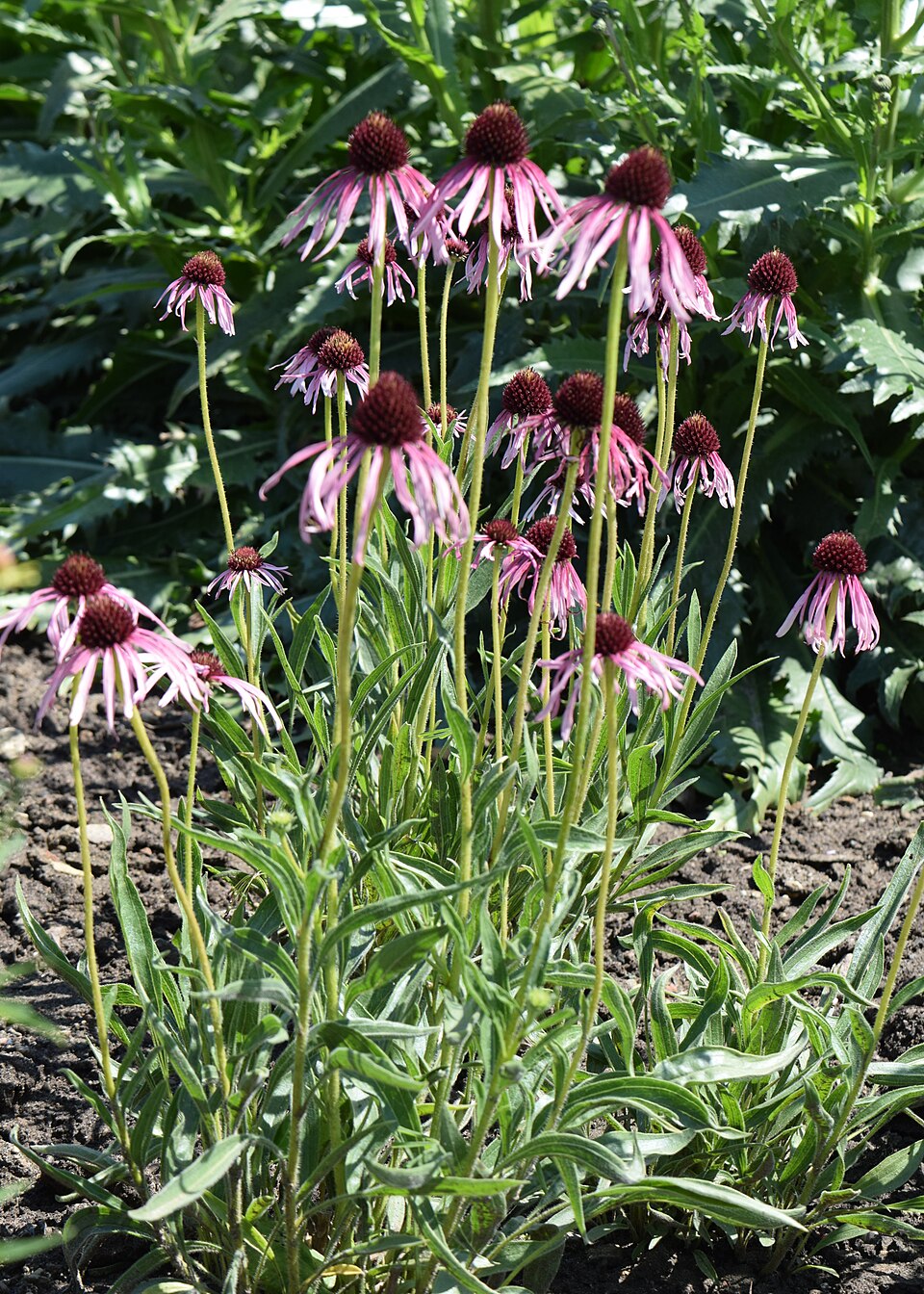
Echinacea angustifolia, commonly known as Narrow-leaf Purple Coneflower or Black Sampson, is one of the most iconic and medicinally significant wildflowers of the Great Plains. This drought-adapted prairie perennial, with its beautiful rose-pink to lavender ray petals drooping gracefully around a prominent spiny orange-brown cone, has played a central role in both Great Plains ecology and Indigenous medicine for thousands of years. Long before its name appeared in herbals and pharmacopoeias, Plains tribes recognized and relied upon this coneflower as one of the most important medicinal plants on the continent.
The genus name Echinacea comes from the Greek word for “hedgehog” or “sea urchin” (echinos), referring to the spiny, bristled central cone — a distinctive feature in all coneflower species. The species name “angustifolia” means “narrow-leaved,” distinguishing this species from the broader-leaved Echinacea purpurea of the eastern tallgrass prairie. Despite its narrower leaves and somewhat smaller stature, E. angustifolia is considered by many herbalists and ethnobotanists to be the most potent and medicinally significant of all the echinacea species — a claim supported by its extraordinary history of use among Plains peoples.
In the landscape, Narrow-leaf Purple Coneflower brings weeks of stunning late-spring and summer color, with its distinctive nodding pink-purple ray flowers and spiny central cone attracting a parade of butterflies, native bees, and goldfinches. Remarkably drought-tolerant, it thrives in the same hot, dry, well-drained conditions that challenge less adapted plants — making it an ideal choice for xeriscape gardens, native plant meadows, and prairie restorations throughout the Montana and Wyoming region. The comments note that its “Purple flowers with brown centers attract butterflies,” a fitting summary of one of the plant’s most celebrated attributes.
Identification
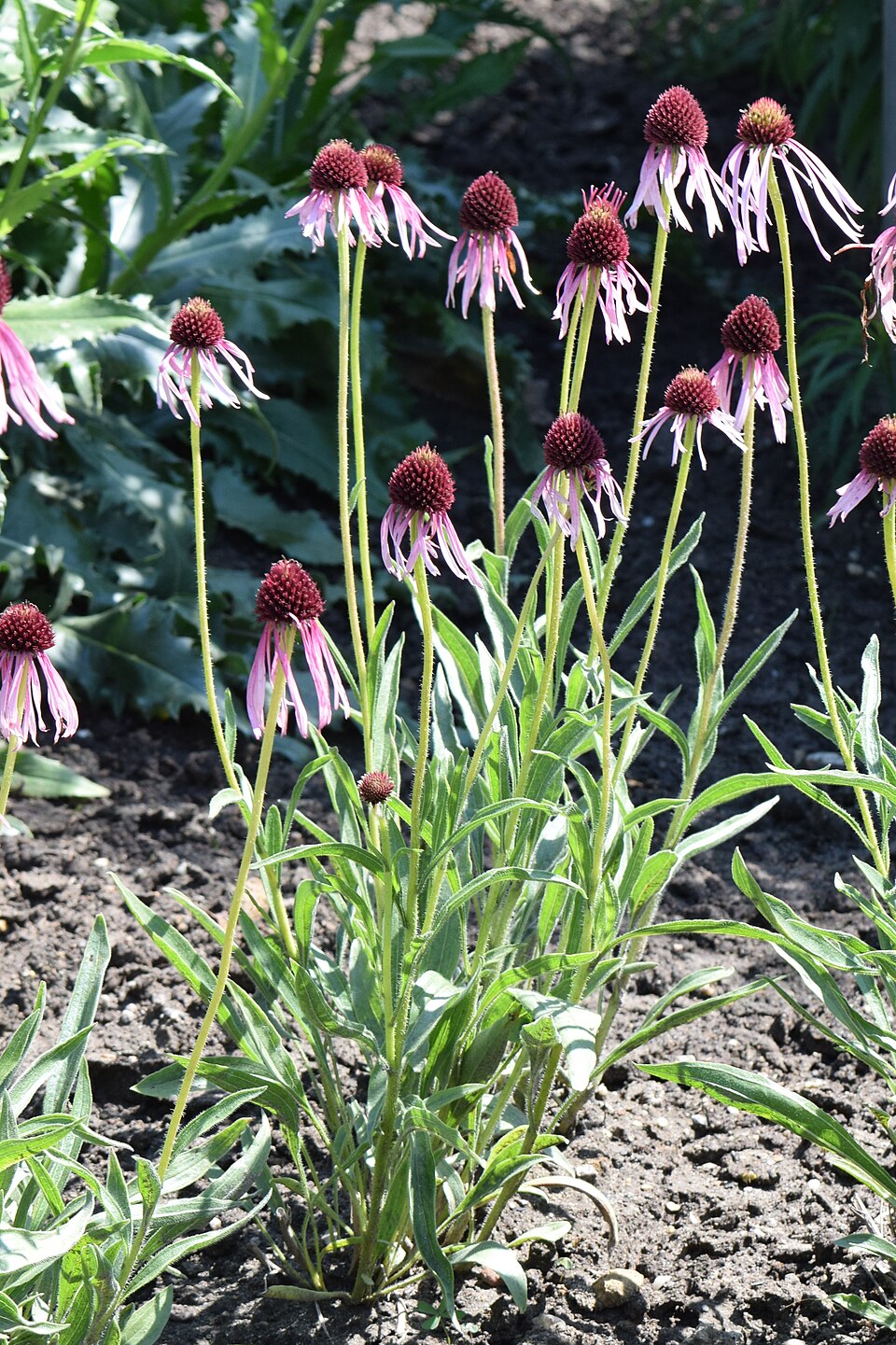
Narrow-leaf Purple Coneflower grows as an erect to spreading perennial forb, typically 1.5–3 feet (45–90 cm) tall. The plant arises from a deep taproot and forms a rosette of basal leaves. Stems are usually unbranched, stiff, and covered with stiff, bristly hairs — characteristic of the species. The overall texture of the plant is noticeably rough and bristly compared to other coneflower species.
Leaves
As the name “angustifolia” (narrow-leaved) suggests, the leaves of this species are distinctly narrow. Basal leaves are lanceolate to linear-lanceolate, 4–10 inches (10–25 cm) long and ½ to 1 inch (1–2.5 cm) wide, with 3–5 prominent parallel veins and a long petiole (leaf stalk). Stem leaves are alternate, smaller, narrower, and stalkless higher on the stem. The leaf surface is covered with stiff hairs that give the plant a distinctly rough, sandpapery texture — a reliable identification feature distinguishing it from the larger, smoother-leaved E. purpurea.
Flowers
The flowerheads are solitary, held at the top of each stem, and typically 2–3.5 inches (5–9 cm) in diameter. The central cone (composed of disc florets) is prominent, rounded to somewhat conical, and covered with stiff, sharply pointed bracts — the “hedgehog” feature giving the genus its name. The cone starts greenish, maturing through orange to dark brown. The 12–20 ray florets (the “petals”) are rose-pink to lavender-purple, drooping downward from the central cone at a characteristic angle — not spreading horizontally as in many other coneflowers. This drooping posture distinguishes E. angustifolia from some other Echinacea species. Ray florets are 1.5–3 inches long and sterile.
Root System
The root system of Narrow-leaf Purple Coneflower is one of its most important botanical features. The plant develops a deep, thick taproot that can penetrate 2–4 feet or more into the soil, often branching at depth. This taproot has a distinctive aromatic, slightly numbing quality when chewed — caused by the alkylamides that are the plant’s primary bioactive compounds. The root was the primary medicinal part of the plant used by Indigenous peoples and remains the primary part used in commercial herbal preparations today.
Quick Facts
| Scientific Name | Echinacea angustifolia |
| Family | Asteraceae (Daisy/Composite family) |
| Plant Type | Perennial Wildflower / Forb |
| Mature Height | 1.5–3 ft |
| Sun Exposure | Full Sun |
| Water Needs | Low to Moderate |
| Bloom Time | June – August |
| Flower Color | Rose-pink to lavender-purple, with brown/orange cone |
| Soil Type | Sandy to clay loam; well-drained; tolerates poor soils |
| Wildlife Value | Exceptional — butterflies, native bees, finches |
| USDA Hardiness Zones | 3–8 |
Native Range
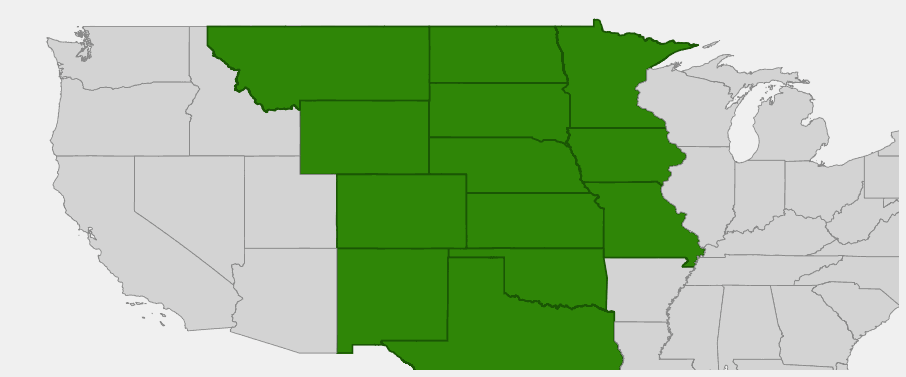
Narrow-leaf Purple Coneflower is native to the central Great Plains and adjacent Rocky Mountain foothills, with its range centered on the mixed-grass and shortgrass prairie zones of central North America. Its core range extends from southern Manitoba and Saskatchewan in Canada south through Montana, Wyoming, Colorado, and New Mexico, and east through the Dakotas, Nebraska, Kansas, Minnesota, Iowa, Missouri, Oklahoma, and Texas. This species is closely associated with the dry, calcareous soils of the Great Plains — it grows on limestone and chalk outcroppings, dry hillsides, and well-drained prairie soils with good permeability.
In Montana and Wyoming, Narrow-leaf Purple Coneflower is found on dry prairie grasslands, open rocky hillsides, and dry ponderosa pine parklands in both the eastern plains and foothill zones. It grows naturally in both lowland prairie sites and at moderate elevations in the Rocky Mountain foothills, where it shares habitat with Blue Grama, Dotted Gayfeather, and other dry prairie specialists. It is more drought-tolerant than its sister species E. purpurea and is better adapted to the continental climate extremes of Montana and Wyoming.
Historically, Narrow-leaf Purple Coneflower was likely more abundant and widely distributed before settlement. Intensive root harvesting — for both commercial herbal markets and local use — reduced populations significantly in some areas. Today, wild populations are protected in some states, and commercial harvesting from wild populations is regulated. Well-established garden plantings can help offset the pressure on wild populations while providing all the ecological benefits of this remarkable plant.
📋 Regional plant lists featuring Narrow-leaf Purple Coneflower: Montana & Wyoming
Growing & Care Guide
Narrow-leaf Purple Coneflower is an adaptable and surprisingly resilient garden plant when given the right conditions. The keys to success are full sun, excellent drainage, and the patience to let it establish its deep taproot before expecting full blooming performance. Once settled, it is drought-tolerant, long-lived, and increasingly beautiful with each passing year.
Light
Full sun — at least 6–8 hours of direct sunlight daily — is essential for Narrow-leaf Purple Coneflower. In partial shade, plants produce fewer flowers, become leggy and weak, and are more susceptible to root disease. In its native habitat it grows in completely unshaded, open prairie and hillside sites. Choose the sunniest, most open location in your garden for this plant.
Soil & Water
Excellent drainage is critical. Narrow-leaf Purple Coneflower grows naturally on well-drained prairie soils, rocky outcroppings, and sandy or loamy soils — never in wet or poorly drained sites. Heavy clay soils should be amended with grit or sand before planting. Once established, this species has moderate drought tolerance — more than E. purpurea but less extreme than some shortgrass prairie specialists. Water deeply during establishment (first 1–2 growing seasons), then reduce to infrequent deep watering during extended summer droughts. Avoid consistent overwatering, which promotes root rot.
Planting Tips
Plant container-grown coneflowers in spring or early fall. Handle the taproot carefully and avoid breaking or bending it. For seed propagation, seeds require a cold stratification period — sow in fall outdoors or stratify seeds for 30–60 days in a refrigerator before spring sowing. Expect flowering in the second or third year from seed, as the plant builds its taproot before allocating energy to blooming. Space plants 18–24 inches apart. Narrow-leaf Purple Coneflower does not transplant well once established due to its deep taproot — choose the planting location carefully.
Pruning & Maintenance
Leave spent coneheads through winter — they are highly attractive to American Goldfinches and other seed-eating birds, which pick the seeds from the dried cones through fall and winter. The dried seed heads also provide visual interest in the winter landscape. Cut plants back to the ground in early spring. Deadheading (removing spent flowers) will promote additional blooming but reduces the wildlife value of the seed heads — a tradeoff worth considering. Divide established clumps only if they become overcrowded, and handle the taproot with great care.
Landscape Uses
Narrow-leaf Purple Coneflower is valuable in:
- Native wildflower meadows — a classic component of Great Plains prairie seed mixes
- Butterfly and pollinator gardens — exceptional nectar source for butterflies, bees, and hummingbirds
- Xeriscape and dry gardens — thrives where water is limited
- Wildlife gardens — attracts goldfinches, monarchs, swallowtails, and native bees
- Mixed perennial borders — provides beautiful early-to-mid summer color
- Prairie restorations — keystone species for mixed-grass prairie communities
- Medicinal herb gardens — grows beautifully alongside other native medicinal plants
Wildlife & Ecological Value
Narrow-leaf Purple Coneflower is one of the premier wildlife plants of the Great Plains, providing food and habitat for an extraordinary diversity of animals from midsummer through winter. Its “Purple flowers with brown centers attract butterflies” as noted in the regional plant list — an understatement of the remarkable diversity of pollinators drawn to this plant.
For Birds
American Goldfinches are perhaps the most spectacular bird visitors to Narrow-leaf Purple Coneflower — they cling acrobatically to the dried seed cones in fall and winter, picking out the seeds one by one. Pine Siskins, Lesser Goldfinches, Indigo Buntings, and various sparrows also consume the seeds. During summer, the plant’s complex structure of stems, leaves, and flowers provides nesting sites and hunting perches for insectivorous birds. The insects attracted to the flowers and seeds make Narrow-leaf Purple Coneflower a productive foraging site for warblers, vireos, and other insect-eating birds during migration.
For Mammals
Deer, Pronghorn, and other large herbivores browse the foliage of Narrow-leaf Purple Coneflower. In areas with high deer pressure, this can be a problem, though established plants with their deep taproots typically resprout vigorously after browsing. Prairie dogs and other burrowing rodents dig the roots as a food source, occasionally damaging garden plantings near prairie dog towns but more commonly contributing to natural population dispersal across prairie landscapes.
For Pollinators
The brilliant rose-purple coneflowers are extraordinary pollinator magnets from June through August — precisely when pollinator activity peaks on the Great Plains. Monarch Butterflies, Painted Ladies, Great Spangled Fritillaries, Tiger Swallowtails, and many other butterfly species visit for nectar. Several specialist native bee species depend on Echinacea pollen as a primary food source for their larvae. Bumble bees, sweat bees, mining bees, and various solitary bee species are all frequent visitors. The centrally visible disc flowers provide a reliable landing platform and nectar reward that makes the plant highly efficient for pollinators.
Ecosystem Role
As a deep-rooted prairie forb, Narrow-leaf Purple Coneflower contributes to soil building, carbon sequestration, and water infiltration in prairie ecosystems. It is a component of stable prairie communities that have evolved over thousands of years, and its presence indicates healthy, diverse native grassland. The plant plays a role in prairie succession by establishing on disturbed sites and providing early structural complexity for prairie communities rebuilding after disturbance. Its allelopathic compounds may also influence neighboring plant communities — a subject of ongoing botanical research.
Cultural & Historical Uses
Narrow-leaf Purple Coneflower (Echinacea angustifolia) has one of the most extensive and well-documented histories of Indigenous medicinal use of any Great Plains plant. Numerous Plains tribes — including the Lakota (Sioux), Comanche, Cheyenne, Arapaho, Blackfoot, Crow, and Kiowa — used this plant extensively for a remarkable range of ailments. The root was the primary medicinal part, used fresh, dried, or as a tea or tincture. Among the most common uses were treatment of toothache (by chewing the root for its numbing, anesthetic properties), snake bites and other venomous bites and stings, wounds, burns, sore throats, coughs, colds, and as a general strengthening medicine.
The numbing, tingling sensation produced by chewing the root — caused by the isobutylamide compounds in the plant — was interpreted by many tribes as evidence of strong medicinal power. The root was often applied directly to toothaches, mouth sores, and sore throats, where its anesthetic properties provided relief. It was also burned and inhaled for headaches, or applied as a poultice to wounds and skin conditions. The Lakota considered Echinacea one of their most important medicinal plants, calling it Íčaŋȟéyapi — “the plant that makes the mouth tingle.”
European-American medicine discovered Echinacea in the 1880s, largely through observation of Indigenous use. H.C.F. Meyer, a Nebraska patent medicine maker, began promoting “Meyer’s Blood Purifier” containing Echinacea root in the 1880s, leading to its introduction into eclectic medical practice. By the early twentieth century, it was the best-selling medicinal plant in the United States. Commercial root harvesting from wild populations reduced prairie populations significantly, and today wild collection is regulated in many states.
In contemporary herbal medicine, Echinacea — particularly E. angustifolia — remains one of the world’s best-selling herbal supplements, used primarily as an immune system support and for prevention and treatment of upper respiratory infections. While scientific evidence for efficacy is mixed and depends on the preparation and species, the plant’s remarkable ethnobotanical history spanning thousands of years of intensive use by numerous independent cultures remains a powerful testament to its significance as a medicinal herb.
Frequently Asked Questions
Is Narrow-leaf Purple Coneflower the same as the echinacea in herbal supplements?
Echinacea angustifolia is one of the three main species used in commercial echinacea herbal products — the others are E. purpurea (Purple Coneflower) and E. pallida (Pale Purple Coneflower). Traditional herbalists and some researchers consider E. angustifolia the most potent of the three, though all are used commercially. Always check the species on any herbal supplement label.
How is Narrow-leaf Purple Coneflower different from Purple Coneflower (Echinacea purpurea)?
The key differences are: E. angustifolia has narrow leaves (½–1 in wide) vs. the broader, wider leaves of E. purpurea (2–4 in wide); E. angustifolia is more drought-tolerant and native to drier prairie habitats; the ray petals of E. angustifolia droop more pronouncedly. E. purpurea is easier to grow in a wider range of garden conditions and is more commonly found in garden centers.
Will Narrow-leaf Purple Coneflower spread in my garden?
Narrow-leaf Purple Coneflower spreads slowly and modestly, primarily by seed. Plants self-seed when seed heads are left on through winter, but the seedlings are easily identified and can be transplanted or thinned if needed. The plant does not spread aggressively and will not become weedy. Over time, a planting will gradually expand through self-seeding, creating a naturalistic grouping.
Can I harvest roots from my garden plants for herbal use?
You can harvest roots from garden-grown plants — this is much more sustainable than wild-harvesting. Harvest from established plants (at least 3 years old) in fall. Dig carefully, take only portions of the root, leaving enough to allow the plant to recover. Wash, slice, and dry the roots at low heat. Note that root harvesting will set the plant back significantly, so harvest sparingly.
Do butterflies really prefer Narrow-leaf Purple Coneflower?
Yes — Narrow-leaf Purple Coneflower is one of the finest butterfly plants for prairie and western gardens. Monarchs, swallowtails, fritillaries, painted ladies, and many skipper species are frequent visitors for nectar. The flat, accessible disc flowers make excellent landing platforms, and the abundant nectar is highly attractive to a wide range of butterfly species throughout the summer blooming period.