Kentucky Coffee Tree (Gymnocladus dioica)
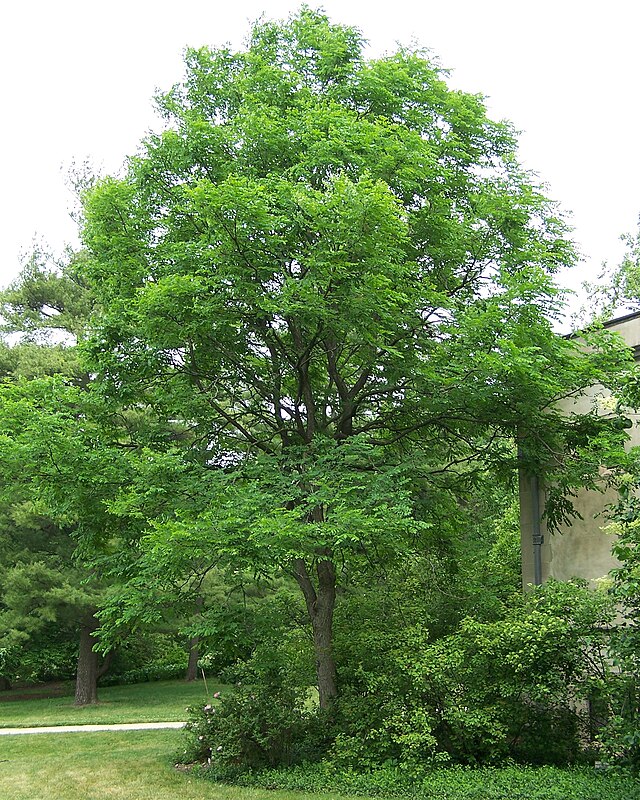
Gymnocladus dioica, commonly known as the Kentucky Coffee Tree, is one of the most architecturally distinctive and historically significant native trees of the central and eastern United States. This large, long-lived deciduous tree of the legume family (Fabaceae) reaches 75 to 100 feet tall at maturity, developing a high-branching, open crown with a bold, coarse winter silhouette unlike any other native tree. Its leaves — enormous bipinnate (twice-compound) structures 1 to 3 feet long and nearly as wide, among the largest of any native North American tree — create dramatic dappled shade in summer and then drop early in fall, leaving behind the tree’s skeletal framework and its large, persistent seed pods for winter interest.
The evocative common name “Kentucky Coffee Tree” stems from the practice of early American pioneers who, in times of need, roasted and ground the plant’s large, dark seeds as a substitute for imported coffee. The seeds contain cytisine, a toxic alkaloid, but thorough roasting destroys this compound and renders them safe for consumption. This practice was learned in part from Indigenous peoples — particularly the Cherokee, who had long used the seeds as food — and was widespread enough during the frontier era that the tree earned its distinctive name. The genus name Gymnocladus means “naked branch” in Greek, a reference to the tree’s notably long leafless season, since the massive leaves emerge late in spring and drop early in fall, leaving the tree bare for more than half the year.
The Kentucky Coffee Tree is dioecious — male and female flowers occur on entirely separate individual trees — a characteristic referenced directly in its species epithet dioica. This biological feature makes it one of only a handful of dioecious native trees in North America, alongside Osage-orange, cottonwood, and a few others. In the landscape, dioecious habit means that seed production requires both male and female trees within pollination distance. The tree is considered a rare species across much of its natural range; while it is not federally listed, it has been significantly reduced by centuries of land clearing and is thought by some botanists to have been maintained in certain areas historically by mastodons and other large Pleistocene megafauna that consumed and distributed the seeds — a phenomenon known as an “evolutionary anachronism.”
Identification
The Kentucky Coffee Tree is one of the most distinctive trees in the eastern North American flora. Its combination of enormous bipinnate leaves, deeply furrowed bark with distinctive recurved plates, and large persistent seed pods make it identifiable in all seasons.
Bark
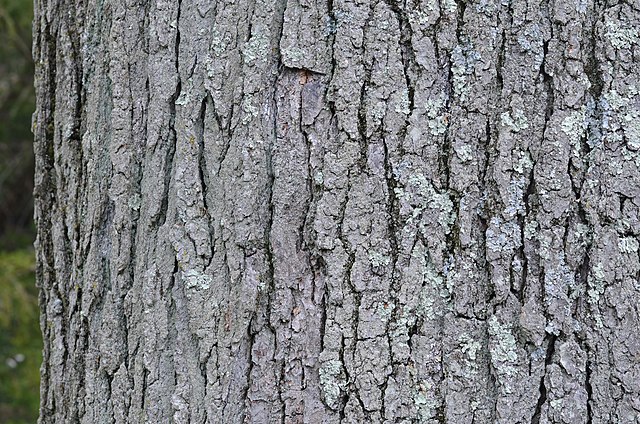
The bark is one of the most diagnostic features of the Kentucky Coffee Tree. Mature trees develop deeply furrowed gray-brown bark with distinctive recurved, scale-like ridges whose edges curve outward and upward from the trunk, creating a shaggy, almost wild-looking texture. This recurved plate pattern is unique among native eastern North American trees and immediately identifies the species even without leaves or pods. The bark pattern becomes increasingly pronounced with age, and old trees develop a deeply corrugated, almost prehistoric appearance that adds tremendous character to winter landscapes.
Leaves
The leaves are bipinnately compound — twice-divided — reaching 1 to 3 feet (30–90 cm) long and up to 2 feet wide. Each leaf is divided into 3 to 7 pairs of primary leaflets (pinnae), and each pinna is further divided into 6 to 14 individual leaflets. The individual leaflets are ovate, 1 to 3 inches long, and smooth-margined, dark green above and paler below. The leaves emerge very late in spring — often not until late May or early June — which is one reason the tree’s leafless season is so remarkably long. They drop in October, frequently before other deciduous trees, leaving the tree bare for up to seven months of the year. In autumn, the leaflets turn yellow before dropping.
Flowers & Fruit
The flowers are small, fragrant, and borne in large clusters (panicles). Female flower clusters are 3 to 12 inches long and compact; male flower clusters are shorter (3–4 inches) and more loosely arranged. Both have five white or greenish-white petals and a noticeable sweet fragrance. Flowers bloom in May and June, after the leaves have emerged. The fruit is a large, leathery, dark reddish-brown to brownish-black pod, 3 to 10 inches long and 1½ to 2 inches wide, containing 3 to 9 large, dark brown seeds embedded in a greenish, sweet pulp. The thick-walled pods persist through winter — often remaining on the tree for a year or more — and are a key winter identification feature. Female trees produce spectacular pod displays; male trees never bear pods.
Quick Facts
| Scientific Name | Gymnocladus dioica |
| Family | Fabaceae (Legume / Bean) |
| Plant Type | Deciduous Tree |
| Mature Height | 75–100 ft |
| Sun Exposure | Full Sun |
| Water Needs | Moderate |
| Bloom Time | May – June |
| Flower Color | White to greenish-white |
| Notable Feature | Dioecious (separate male/female trees); massive bipinnate leaves |
| USDA Hardiness Zones | 3–8 |
Native Range
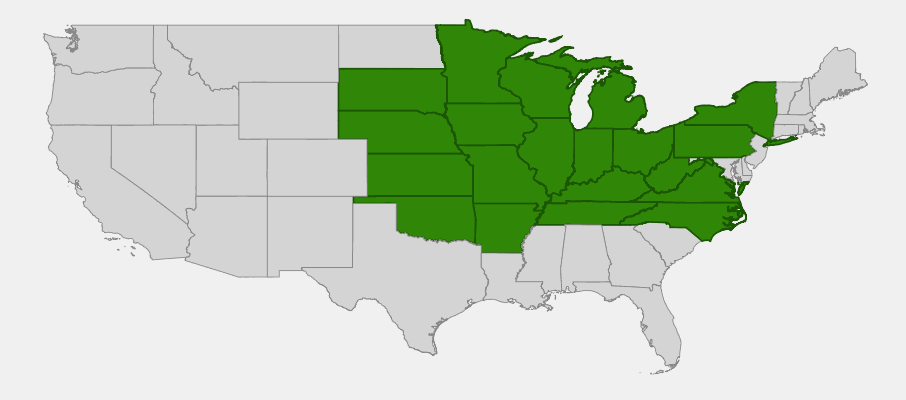
The Kentucky Coffee Tree is native to the central and eastern United States, with a range extending from South Dakota and Nebraska in the west to Pennsylvania and New York in the east, and from southern Ontario in Canada south to Tennessee, Arkansas, and Oklahoma. Despite this broad geographic range, the tree is generally uncommon to rare across most of its territory — it typically occurs as scattered individuals or small groups in rich bottomland forests, floodplains, river terraces, and mesic uplands rather than in dense stands.
Within its range, the Kentucky Coffee Tree is most frequently found in rich, moist alluvial soils along rivers and streams, where it grows alongside Cottonwood (Populus deltoides), Silver Maple (Acer saccharinum), Box Elder (Acer negundo), and Bur Oak (Quercus macrocarpa). In Nebraska and Kansas — the western edge of its native range — it is found primarily along major river corridors including the Missouri, Platte, Republican, and Kansas rivers and their tributaries, in remnant gallery forest habitats. These riparian forests represent some of the most ecologically important and threatened habitats in the Great Plains.
Some botanists have proposed that the Kentucky Coffee Tree may be a relict species — a tree that was once more widespread and abundant during the Pleistocene epoch, when large seed-dispersing megafauna including mastodons, giant ground sloths, and Pleistocene horses were present. These large animals would have consumed the thick, sweet pods and distributed the indigestible seeds over large distances. With the extinction of these megafauna approximately 10,000 years ago, effective long-distance seed dispersal for this species essentially ceased, leading to the fragmented, restricted distribution observed today. This hypothesis makes the Kentucky Coffee Tree a compelling case study in what ecologists call “ecological anachronism.”
📋 Regional plant lists featuring Kentucky Coffee Tree: Nebraska & Kansas
Growing & Care Guide
Despite its impressive ultimate size, the Kentucky Coffee Tree is surprisingly easy to grow and is considered one of the best large native trees for difficult urban conditions. It tolerates a wide range of soil types, moderate drought, air pollution, and compacted soils far better than many native tree species, making it an increasingly popular choice for street tree plantings and urban forestry programs across the Midwest.
Light
Kentucky Coffee Tree is a full-sun species that performs best with at least 6 hours of direct sunlight daily. It is intolerant of shade, and in competitive forest settings it requires open gaps to establish and grow to its full size. In the landscape, plant it as a standalone specimen or canopy tree in open sunny locations. Its naturally high-branching form and open crown provide dappled shade below without excessive light competition for plants growing beneath it.
Soil & Water
This tree is native to rich, deep alluvial soils in bottomland forests, and it grows best in deep, well-drained loam with moderate moisture. However, it demonstrates remarkable adaptability: it tolerates clay, alkaline soils, periodic flooding, and drought with equal grace — a suite of tolerances that makes it exceptionally valuable in challenging urban and suburban landscapes. In its first two years, provide supplemental water during drought periods to support establishment. Once established, it is largely self-sufficient and requires no irrigation except during severe, extended drought.
Planting Tips
Plant Kentucky Coffee Tree as a balled-and-burlapped or container specimen in spring or fall. Because the tree is dioecious, if you want the decorative seed pods (female trees only), plant at least one female tree. Male trees produce no pods and may be preferred in settings where cleanup of fallen pods is a concern. Allow adequate space — this tree reaches 75 to 100 feet tall and 40 to 50 feet wide at maturity. Space away from structures, utility lines, and areas where the large fallen pods and leaflets could become a nuisance.
Pruning & Maintenance
Kentucky Coffee Tree requires minimal pruning. Remove dead, damaged, or crossing branches in winter while the tree is dormant. Prune to a single central leader while young to develop good structural form. The tree rarely suffers from significant pest or disease problems — it is notably resistant to most common tree ailments, making it exceptionally low-maintenance once established. The fallen seed pods can be collected and used as organic mulch after crushing, or left for wildlife.
Landscape Uses
- Large-scale specimen tree for parks, campuses, and large residential properties
- Street tree — one of the best large native trees for urban conditions
- Shade tree — high-branching habit provides excellent filtered shade
- Winter interest — dramatic branching pattern and persistent pods provide year-round character
- Riparian planting — excellent for riverbank and floodplain restoration
- Wildlife corridors — provides canopy habitat and winter cover
Wildlife & Ecological Value
The Kentucky Coffee Tree’s wildlife value is moderate but ecologically significant, particularly for specialized insects and cavity-nesting birds. Its long leafless season and open growth form limit its usefulness as nesting cover compared to denser species, but its ecological contributions are meaningful.
For Birds
The large seed pods of female Kentucky Coffee Trees persist through winter and provide an important food source for wildlife during lean months. Ring-necked Pheasants, Wild Turkeys, and various squirrels break open the pods to access the seeds. The tree’s coarse bark develops deep furrows with age, providing excellent habitat for cavity-nesting birds including Woodpeckers, Chickadees, and Nuthatches. The open branching habit makes the Kentucky Coffee Tree a favored perching and nesting site for large raptors including Red-tailed Hawks and Great Horned Owls.
For Pollinators
The fragrant, white flowers of Kentucky Coffee Tree attract bumblebees, honeybees, and a range of native bee species. The flowers are particularly attractive to larger native bees that can access the nectar of the 5-petaled blooms. Specialist bees associated with legume trees (Fabaceae) may include the Kentucky Coffee Tree in their foraging circuits. The flowers bloom in late May and June — a period when many spring bloomers have finished and summer bloomers have not yet begun, providing valuable nectar during a potentially lean period.
For Mammals
Squirrels (Eastern Gray Squirrel and Fox Squirrel) actively harvest and cache Kentucky Coffee Tree seeds, contributing to seed dispersal. Deer occasionally browse young foliage, though the tree’s size and vigor quickly renders it beyond deer reach. The tree’s size and canopy provide thermal cover and habitat structure for a range of woodland mammals including raccoons, opossums, and various small mammals that den in root cavities of old trees.
Ecosystem Role
As a legume, Kentucky Coffee Tree has root associations with nitrogen-fixing bacteria, enriching the soil around it — a valuable ecological service in degraded or nitrogen-poor soils. The deep, persistent leaf litter from the large leaflets breaks down slowly, creating a rich humus layer. As one of the rarest native canopy trees in its range, protecting and planting Kentucky Coffee Tree contributes directly to the conservation of a species that may once have been keystone components of central North American forest ecosystems.
Cultural & Historical Uses
The Kentucky Coffee Tree carries one of the most remarkable ethnohistorical records of any North American tree. Its seeds, pods, leaves, and bark were utilized by multiple Indigenous nations across its range, and its adoption by European settlers reflects a process of knowledge transfer that was critical to survival on the American frontier. The Cherokee people, who occupied the southern portion of the tree’s range, called it “chicha” and prepared the roasted seeds as a food source. They also used extracts of the bark and leaves medicinally — as a laxative, a treatment for reflex conditions, and in rituals and ceremonies whose full details were not always shared with early colonial observers.
Among European settlers of Kentucky, Tennessee, and the Ohio Valley, the roasted seeds became a genuine substitute for coffee during the Revolutionary War and periods of trade disruption with Europe. The roasting process, which the settlers learned was essential to destroy the toxic cytisine alkaloids present in raw seeds, was likely passed down from Indigenous contacts. The resulting beverage was reportedly satisfactory — not identical to coffee but sufficiently similar in color and mild stimulant effect to be acceptable as a substitute. This widespread use gave the tree its enduring common name, which has stuck for over two centuries despite the plant’s complete absence from the coffee genus or family.
The wood of Kentucky Coffee Tree is hard, durable, and beautiful — a coarse-grained, reddish-brown wood that polishes to a fine finish. It was prized by 19th-century craftsmen for cabinet-making, interior finish work, and fence posts. The wood’s natural durability made it particularly valuable for fence posts and railroad ties, and significant quantities were cut for these purposes during the 19th century. Today, the wood is rarely harvested commercially due to the tree’s scarcity, but antique furniture and interior woodwork in old Kentucky and Tennessee homes sometimes features this beautiful native timber. Contemporary craftspeople occasionally work with fallen specimens or salvaged urban trees, producing furniture and decorative objects of great beauty.
Frequently Asked Questions
Are Kentucky Coffee Tree seeds really edible?
Raw seeds contain cytisine, a toxic alkaloid, and are poisonous. However, thorough roasting at high temperature destroys cytisine, rendering the seeds safe to consume. Early American settlers roasted and ground the seeds to produce a coffee-like beverage, and Indigenous peoples boiled and processed the seeds as food. Do not consume raw seeds or pods under any circumstances.
How do I know if I have a male or female Kentucky Coffee Tree?
Female trees produce the large, leathery brown seed pods — typically 3–10 inches long — that persist through winter. Male trees never produce pods. During May and June, you can distinguish them by their flower clusters: female flowers are in large, fragrant panicles up to 12 inches long; male flower clusters are shorter (3–4 inches). In winter, the presence or absence of pods is the quickest identification.
Why are the leaves so late to emerge in spring?
Kentucky Coffee Tree is one of the last native trees to leaf out in spring — often not until late May or June — and one of the first to drop its leaves in fall. This unusually long dormant season (up to 7 months bare) may reflect an evolutionary adaptation to bottomland environments where late spring flooding was common, or may be a legacy trait from its Pleistocene past. Whatever the cause, this trait creates exceptional opportunities for spring ephemerals and bulbs to thrive in the dappled light beneath Kentucky Coffee Trees.
Is it true that Kentucky Coffee Tree was dispersed by mastodons?
This is a popular and scientifically plausible hypothesis. Botanist Connie Barlow popularized the concept of “ecological anachronisms” — plants that evolved with large Pleistocene megafauna now extinct. The thick, sweet pods of Kentucky Coffee Tree appear well-suited for consumption by mastodons, ground sloths, and other large herbivores that could crack the pods and pass the hard seeds undamaged. The fragmented, scattered natural distribution of the tree today may reflect the loss of these dispersal agents about 10,000 years ago.
How long does a Kentucky Coffee Tree live?
Kentucky Coffee Tree is a long-lived species capable of reaching several hundred years under favorable conditions. Documented specimens over 150 years old are known, and the tree shows no apparent decline at this age. Its slow to moderate growth rate (12–24 inches per year when young, slowing with age) means it takes decades to reach its ultimate size, but once established it is a permanent addition to the landscape for generations.