Turk’s Cap Lily (Lilium michiganense)
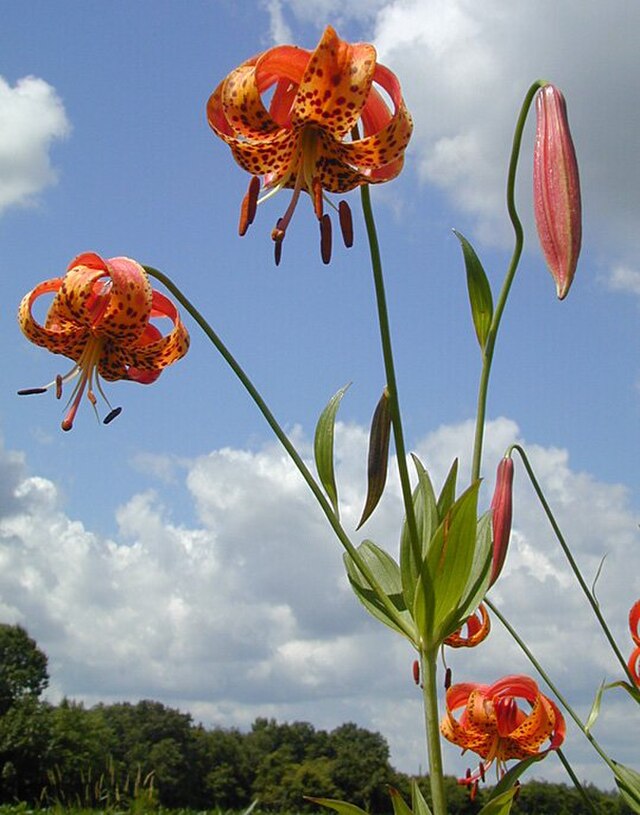
Lilium michiganense, commonly known as the Michigan Lily, Turk’s Cap Lily, or Michigan Turk’s Cap Lily, is one of the most spectacular and beloved native wildflowers of the central United States. Growing 2 to 5 feet tall in moist prairies, meadows, and wetland margins, this native lily produces pendant, nodding flowers of brilliant orange or yellow-orange with the characteristic sharply recurved (reflexed) tepals that give it the whimsical “Turk’s cap” name — referring to the resemblance of the turban-shaped flower to the distinctive headgear associated with Ottoman Turkish fashion. A single mature plant can bear up to 10 or more of these breathtaking blooms simultaneously, creating a display of color and elegance that few native wildflowers can equal.
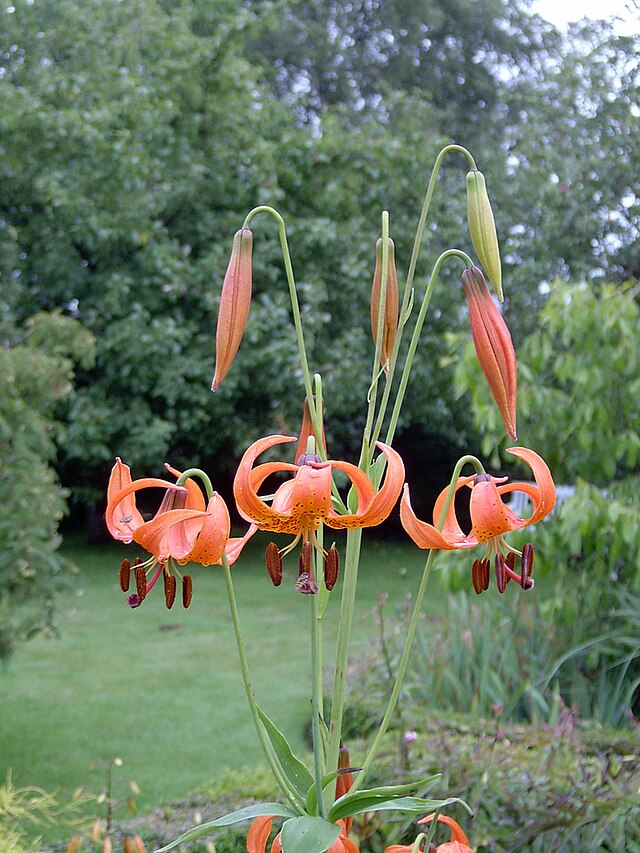
The botanical artistry of the Turk’s Cap Lily flower deserves careful attention. Each bloom consists of six tepals (three petals and three petal-like sepals) that are strongly reflexed — curved backward so dramatically that their tips nearly touch behind the flower, creating a globe-like or lantern shape. The tepals are a warm orange to golden-orange color, with dense spotting of dark maroon or purple spots arranged in complex patterns across the inner surface. From the center of this vivid tepals cluster project six long, prominent stamens bearing large, rust-orange to brown anthers loaded with powdery pollen, creating a striking architectural feature that also functions as a landing platform and nectar guide for pollinators. The overall effect — pendant, richly colored, intensely spotted, with projecting stamens — is arguably the most ornate floral architecture of any native plant in the central United States.
Despite its spectacular beauty, Lilium michiganense has declined dramatically across much of its native range due to the dual pressures of habitat destruction (wetland drainage, prairie conversion) and intense deer browsing pressure. Where healthy populations persist — in restored prairies, protected wetland margins, and nature preserves — the Michigan Lily remains one of the most celebrated wildflowers of the Midwest. Its cultivation in native plant gardens has increased substantially as horticultural interest in native plants has grown, and it performs well in moist, sunny to partially shaded garden conditions when protected from deer.
Identification
The Turk’s Cap Lily is unmistakable when in bloom — no other native wildflower of the central United States combines the pendant orange flowers, dramatically recurved tepals, and prominent stamens that define this species. Out of bloom, the whorled leaves and sturdy erect stem are distinctive.
Stem & Bulb
The stem is erect, stout, and unbranched, typically 2 to 5 feet tall (occasionally to 6 feet in optimal conditions), smooth or slightly rough, green and sometimes purplish-tinged. The plant grows from a perennial bulb — a cluster of fleshy, white, scale-like segments similar in structure to garlic cloves. The bulb is moderately large (1–2 inches across) and reproduces slowly, producing offsets over time. The stem emerges from the bulb in spring and grows rapidly, reaching full height by June. After the seeds mature in fall, the stem withers and the bulb overwinters to produce a new stem the following spring.
Leaves
The leaves are arranged in whorls of 4 to 8 along the stem, a key distinguishing feature. Each leaf is lance-shaped (lanceolate), 3 to 6 inches long and ½ to 1 inch wide, smooth, dark green, and prominently 3-nerved. Near the base and top of the stem, leaves may be alternate rather than whorled. The whorled leaf arrangement, combined with the plant’s size and habitat (moist meadows), makes the vegetative plant distinctively recognizable even before flowering.
Flowers
The flowers are the plant’s defining feature. Each bloom is pendant (nodding downward) on a slender curved stalk (pedicel), 3 to 6 inches long. The six tepals are strongly reflexed (recurved) — meaning they curve sharply backward until the tips nearly point back toward the stem. The tepals are orange to yellow-orange, with dense dark purple or maroon spots covering the lower two-thirds of each tepal. Six long stamens project outward from the flower center, bearing large, versatile (swinging) anthers loaded with rust-orange pollen. The pistil also projects prominently, with a swollen ovary and a long, stigma-topped style. Flowers bloom from late June through August, with peak bloom typically in July. Each flower lasts approximately one week; plants with multiple flowers bloom in succession over two to three weeks.
Fruit & Seeds
The fruit is an erect, 3-chambered capsule, 1 to 2 inches long, that dries and splits open in fall to release dozens of flat, papery, wind-dispersed seeds. Each seed has a thin, wing-like border that facilitates wind dispersal. Seeds require two years of alternating warm and cold stratification to germinate, meaning a plant grown from seed typically does not flower until its third or fourth year.
Quick Facts
| Scientific Name | Lilium michiganense |
| Family | Liliaceae (Lily) |
| Plant Type | Native Perennial Bulb |
| Mature Height | 2–5 ft |
| Sun Exposure | Full Sun to Full Shade |
| Water Needs | Moderate to High |
| Bloom Time | June – August |
| Flower Color | Orange to yellow-orange with dark maroon spots |
| Notable Feature | Pendant recurved flowers; whorled leaves; hummingbird magnet |
| USDA Hardiness Zones | 3–7 |
Native Range
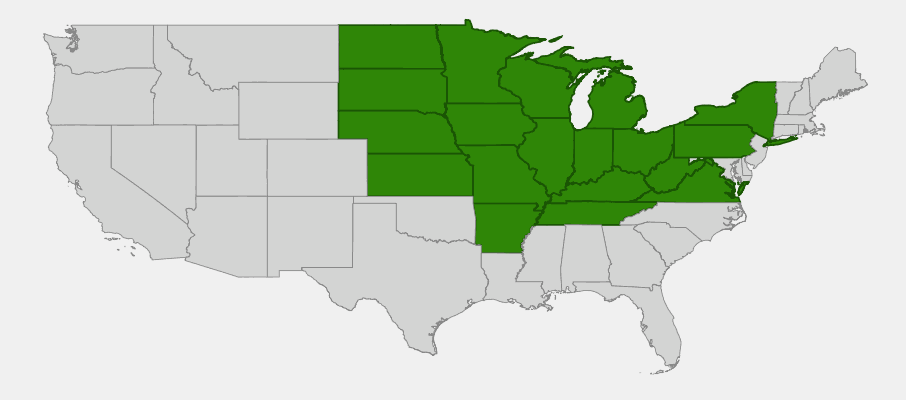
The Michigan Lily is native to a broad swath of central and eastern North America, ranging from Nebraska and Kansas in the west to New York and Pennsylvania in the east, and from North Dakota and Minnesota in the north to Arkansas, Tennessee, and Virginia in the south. Within this range, it is found primarily in moist habitats — wet meadows, prairie swales, sedge marshes, moist roadsides, stream banks, and the moist borders of woodland edges. It is especially characteristic of tallgrass prairie ecosystems in the Midwest, where it grows in the seasonally wet swales and low areas between prairie ridges.
In Nebraska and Kansas, the Michigan Lily is found primarily in the eastern portions of both states, in association with remnant tallgrass prairie and wet meadow habitats. It grows in the deep, rich, seasonally moist soils of prairie swales and stream margins, often in association with other tall prairie wildflowers including Great Blue Lobelia (Lobelia siphilitica), Cardinal Flower (Lobelia cardinalis), Joe-Pye Weed (Eutrochium purpureum), and various moist-prairie grasses. These habitat associations reflect the plant’s moisture requirements and its role as a component of the diverse wet-mesic prairie community that once covered large portions of the Midwest.
Historical accounts suggest that Michigan Lily was once abundant across the Midwest, occurring in large colonies in wet prairie areas that have now been converted to agriculture. The drainage of millions of acres of prairie wetlands during the 19th and 20th centuries eliminated the vast majority of these habitats, and Michigan Lily populations declined correspondingly. Today it is considered uncommon across much of its former range, and encounters with large, vigorous wild colonies are relatively rare outside of protected prairie preserves. This decline makes it an important target species for prairie restoration efforts and native plant gardening initiatives across the central United States.
📋 Regional plant lists featuring Turk’s Cap Lily: Nebraska & Kansas
Growing & Care Guide
The Michigan Lily is one of the most rewarding native plants to grow in a garden setting, providing unmatched floral drama during midsummer. While it requires appropriate site conditions — primarily consistent moisture and reasonable protection from deer — it is a surprisingly adaptable plant that thrives in a range of settings from full sun to partial shade.
Light
Michigan Lily grows in full sun to light partial shade in its natural habitat, adapting to the variable light conditions of prairie swales and woodland margins. In the garden, it performs well in full sun to about 50% shade. Full sun with consistent moisture produces the tallest, most floriferous plants. In partial shade, plants may be slightly shorter but still bloom well. Avoid deep shade, which results in etiolated stems and greatly reduced flowering.
Soil & Water
This is the most critical aspect of successful Michigan Lily cultivation. The plant requires consistently moist to wet soil and cannot tolerate drought. It thrives in rich, loamy to slightly acidic soil that retains moisture without becoming stagnant. It is an excellent candidate for rain gardens, bog gardens, pond margins, and any area that stays reliably moist through summer. In typical garden conditions, consistent irrigation through the growing season is essential — allow the soil surface to dry slightly between waterings but never let the root zone dry out completely. Mulching heavily with organic material helps retain soil moisture and moderates temperature, mimicking the natural moist prairie conditions the plant prefers.
Planting Tips
Plant bulbs in fall (October–November) at a depth of 4 to 6 inches, in groups of 3 or more for the best visual impact. Container-grown plants can be installed in spring or early summer. Allow adequate space — mature plants can spread 1 to 2 feet and need room for the full flower display. Protect newly planted bulbs from deer with a wire cage or fencing until established. In areas with consistent deer pressure, a permanent fence or deer repellent program may be necessary for long-term success. Plants grown from bulbs or divisions will typically flower in 1 to 2 years; plants from seed require 3 to 4 years.
Pruning & Maintenance
Michigan Lily is essentially maintenance-free beyond protecting from deer and ensuring adequate moisture. Allow the stems and leaves to die back naturally after the seeds have matured in fall — the foliage continues to photosynthesize and replenish the bulb through late summer and fall. Cut dead stems to the ground in late fall or early spring. No division is necessary unless the colony becomes crowded (usually after 5 or more years), at which point bulbs can be separated in fall and replanted. The plant naturalizes slowly by producing offset bulblets and, where conditions allow, by seed, gradually creating larger and more impressive colonies.
Landscape Uses
- Rain gardens and moist borders — ideal in consistently wet locations
- Pond and stream margins — thrives in the transition zone between water and upland
- Wet prairie restorations — a characteristic species of tallgrass prairie swales
- Hummingbird gardens — one of the best native plants for attracting Ruby-throated Hummingbirds
- Summer border — dramatic midsummer color when planted in groups
- Naturalistic woodland edge — beautiful in dappled light at forest margins near water
Wildlife & Ecological Value
The Michigan Lily is one of the most ecologically significant native wildflowers of the Midwest for specialized pollinators and hummingbirds. Its large, pendant, nectar-rich flowers represent a highly specific ecological niche — adapted for pollination by long-tongued insects and hovering birds that can access the pendant, recurved blooms.
For Hummingbirds
The Ruby-throated Hummingbird is the primary pollinator of Lilium michiganense across its range. The pendant, orange flowers with reflexed tepals are almost perfectly designed for hummingbird pollination: the nodding orientation positions the stamens and pistil precisely to contact the bird’s forehead and bill as it hovers and probes for nectar. In gardens where both Michigan Lily and hummingbirds are present, the relationship is immediate and unmistakable — hummingbirds will visit repeatedly and reliably throughout the bloom season. This makes Michigan Lily one of the most valuable native plants for attracting Ruby-throated Hummingbirds during their summer breeding season in the Midwest.
For Butterflies
Several large butterfly species visit Michigan Lily for nectar, particularly Eastern Tiger Swallowtail (Papilio glaucus), Giant Swallowtail (Papilio cresphontes), Spicebush Swallowtail (Papilio troilus), and various Monarch Butterflies (Danaus plexippus) during their summer breeding season. These large butterflies have the wingspan and long proboscis necessary to effectively access the pendant flowers, which hang too low for shorter-tongued insects to easily reach. Bumblebee queens also visit the flowers and can physically cling to the stamens to reach the nectar.
For Native Bees
While hummingbirds and large butterflies are the most effective pollinators, Michigan Lily’s large, pollen-laden anthers attract a range of native bees including bumblebees, large carpenter bees, and mining bees. The distinctive rust-orange pollen is collected by several specialist native bee species. The pollen is also consumed by various beetles including Goldenrod Soldier Beetles (Chauliognathus pennsylvanicus) and other pollen beetles that visit the open flowers.
Ecosystem Role
In its natural habitat, Michigan Lily is a mid-successional wildflower that helps maintain the structural diversity of wet prairie communities. Its tall, upright form provides vertical structure in the mid-layer of the prairie plant community, creating habitat complexity and perching points for insects and small birds. As a characteristic species of wet prairie ecosystems — among the most threatened habitats in North America — Michigan Lily serves as an important indicator species for habitat quality in restored prairies and wetlands. Large, healthy populations of Michigan Lily are a sign of high-quality wet prairie habitat.
Cultural & Historical Uses
Native American peoples across the range of Michigan Lily utilized the plant for food, medicine, and ceremony. The Ojibwe (Chippewa) prepared the bulbs by boiling or roasting them, producing a starchy food similar in texture to small potatoes. The Potawatomi collected the bulbs in spring before the stems emerged and cooked them as a vegetable. The Menominee used the bulb medicinally, preparing a decoction for treating fevers and as a general tonic. Among the Dakota (Sioux), the plant was known by names translating to “wood lily” or “fire lily” — reflecting both its habitat associations and the vivid orange color of its flowers, which resemble flames in moist prairie meadows.
The lily’s use as food was practical and widespread: the bulb scales are starchy, nutritious, and reasonably palatable when cooked, though they have a somewhat mucilaginous texture. They were typically collected in fall when the bulbs had replenished their starch reserves after the growing season, or in early spring before all reserves were committed to new growth. The practice of sustainable harvest — taking only a few scales from each bulb rather than removing the entire bulb — allowed continued harvest from the same plants year after year, reflecting sophisticated indigenous knowledge of sustainable use. This practice is important for anyone harvesting wild lily bulbs today (where legal and appropriate) — never remove the entire bulb, which kills the plant.
In the history of American horticulture, native lilies including Lilium michiganense were among the first North American plants to attract serious attention from European botanists and horticulturists. Colonial-era naturalists described native lilies with enthusiasm, and specimens were shipped to European botanic gardens and collectors in the 17th and 18th centuries. The Michigan Lily was formally described to science in 1839 and has been in cultivation in botanical gardens and specialty nurseries since the mid-19th century. Today it is increasingly available from native plant nurseries and is one of the most sought-after native wildflowers for rain gardens, wet meadow restorations, and hummingbird gardens across the Midwest.
Frequently Asked Questions
How is Michigan Lily different from Turk’s Cap Lily (Lilium superbum) of the East?
Michigan Lily (Lilium michiganense) and Turk’s Cap Lily (Lilium superbum) are closely related species that look very similar. The key differences are geographic range (Michigan Lily is native to the Midwest and Great Plains; Turk’s Cap Lily is native to the eastern US), and botanical details including leaf arrangement (Michigan Lily typically has whorled leaves with a few alternate near base and top; Turk’s Cap Lily has mostly whorled leaves throughout), and the green star pattern in the center of Lilium superbum flowers that is absent in Michigan Lily.
Why do my Michigan Lily plants keep getting eaten?
Deer and rabbits can cause severe damage to Michigan Lily — deer may browse the entire stem down to the ground, which weakens and can eventually kill the bulb. Protect plants with wire cages, tree tubes, or deer fencing until established, and use deer repellent sprays during the growing season. Lily Leaf Beetle (Lilioceris lilii), an introduced European pest, can also defoliate lily plants — inspect undersides of leaves for bright red adult beetles and orange eggs in spring and early summer, removing by hand.
Can Michigan Lily grow in regular garden soil?
Yes, if you maintain consistent moisture. The key requirement is that the soil not dry out during the growing season. In heavy clay soils that stay naturally moist, Michigan Lily will thrive without irrigation. In sandy or well-drained soils, consistent irrigation and heavy mulching are necessary. Adding compost to the planting area improves both moisture retention and soil fertility, creating conditions similar to the plant’s natural rich, moist prairie habitat.
How long before a Michigan Lily blooms from a newly planted bulb?
A healthy, large bulb planted in fall should produce a flowering stem the following summer (1 year). Smaller bulbs or offsets may take 2 to 3 years to reach flowering size. Plants from seed typically require 3 to 4 years before first bloom, due to the complex two-stage cold stratification requirement for seed germination. Buying blooming-size bulbs from a reputable native plant nursery is the fastest route to a flowering plant.
Is Michigan Lily toxic to cats?
Yes — all true lilies (Lilium species) are highly toxic to cats, causing potentially fatal kidney failure even from small exposures (including pollen). If you have cats that access your garden, do not plant Michigan Lily or any other Lilium species. Dogs and humans are not affected by the same toxicity, though the bulbs should not be consumed without proper preparation.