Spinulose Wood Fern (Dryopteris carthusiana)
Dryopteris carthusiana, commonly known as Spinulose Wood Fern, Toothed Wood Fern, or Shield Fern, is one of the most beautiful and widely distributed native ferns of the Northern Hemisphere — a lacy, semi-evergreen woodland fern that brings delicate textural elegance to shaded gardens throughout eastern North America. The species name carthusiana honors the Chartreuse (Carthusian) monastery near Grenoble, France, where this fern was first scientifically described. Common names reference the plant’s most obvious characteristic: the pinnae and pinnules (the subdivisions of each frond) bear small, sharp, spine-tipped teeth — the “spinules” that give Spinulose Wood Fern its name.
Spinulose Wood Fern is a member of the large and ecologically important Dryopteris genus — the shield ferns or wood ferns — which contains approximately 250 species worldwide. In eastern North America, it is one of the most commonly encountered Dryopteris species, found in cool, moist forests, wooded swamps, and shaded stream margins from the Canadian Maritimes south to the Carolinas and west across the Great Lakes region. Its nearly tri-pinnate fronds — divided and subdivided into increasingly delicate lacy segments — create a particularly refined, elegant texture compared to the coarser appearance of other wood ferns, making it a favorite among shade garden designers and native plant enthusiasts.
One remarkable characteristic of Spinulose Wood Fern is its tendency to hybridize readily with related species, producing intermediate forms. The most common hybrid, Dryopteris × uliginosa (with Crested Wood Fern, D. cristata), is often found growing alongside both parent species in wet woodland habitats. This hybridization, combined with natural variation within the species, means that identification of individual plants can sometimes be challenging even for experienced botanists. For gardeners in Delaware, New Jersey, and New York, Spinulose Wood Fern is an excellent native choice for the moist to wet shade conditions common in the region’s woodland gardens and streamside plantings.
Identification
Spinulose Wood Fern is a semi-evergreen to nearly evergreen fern forming spreading vase-shaped clumps. Fronds typically grow 2–3 feet (60–90 cm) tall and are carried on erect to arching stipes, creating an elegant, open vase form. In mild winters, the fronds remain green through most of the winter, providing year-round garden presence — a valuable characteristic that distinguishes it from fully deciduous ferns.
Fronds
The fronds are the defining feature of Spinulose Wood Fern. They are twice-pinnate to nearly three-times pinnate (bipinnate-pinnatifid to tripinnate at the base), meaning each major leaflet (pinna) is itself divided into subleaflets (pinnules), which may be further divided or deeply lobed. This high degree of dissection creates the distinctive lacy appearance that makes this fern so ornamentally attractive. The fronds are narrowly triangular in overall outline, widest at the base. Each pinnule has spine-tipped teeth along its margins — the “spinules” that give the fern its name — which can be felt as tiny, sharp points when running a finger across the frond margin.
Stipes and Scales
The stipe (stem) is relatively short compared to the frond blade — about ¼ to ⅓ of total frond length. It is covered with distinctive scales that are pale brown to tan with a dark brown center stripe — this two-toned scale pattern is an important identification character distinguishing Spinulose Wood Fern from similar species. The scales are also present on the rachis (central frond axis) and become smaller toward the frond tip.
Sori
Sori (spore-producing structures) are round to kidney-shaped, covered by a kidney-shaped indusium (protective flap), and arranged in two rows along the underside of pinnules. They are visible from mid-summer onward as neat rows of small, raised dots on the backs of fertile fronds. Spores are released in late summer and fall.
Quick Facts
| Scientific Name | Dryopteris carthusiana |
| Family | Dryopteridaceae (Shield Fern family) |
| Plant Type | Semi-Evergreen Fern |
| Mature Height | 2–3 ft |
| Sun Exposure | Part Shade to Full Shade |
| Water Needs | Moderate to High |
| Bloom Time | None (spore-bearing fern) |
| Frond Description | Nearly tri-pinnate, very lacy with spine-tipped teeth |
| Winter Habit | Semi-evergreen (fronds persist in mild winters) |
| Deer Resistant | Yes (generally avoided) |
| USDA Hardiness Zones | 3–8 |
Native Range
Spinulose Wood Fern has a circumboreal distribution — it occurs across the northern temperate and boreal regions of both North America and Eurasia, reflecting its ancient origins and remarkable adaptability to cool, moist climates. In North America, the species is native from Newfoundland and Quebec south to the Carolinas and west across the Great Lakes states to Minnesota, Iowa, Missouri, and Nebraska. It also occurs in the Pacific Northwest. Across Eurasia, it ranges from western Europe through Russia and into northeastern Asia.
In the mid-Atlantic region, Spinulose Wood Fern is native to Delaware, New Jersey, and New York, where it occupies the cooler, moister habitats: wooded swamps, sphagnum bogs, streamside forests, and moist hardwood forest understories with cool microclimates. In New Jersey’s Pine Barrens, it occurs in the cedar swamp communities where cool, acidic, sphagnum-rich conditions persist even through summer heat. In New York’s Hudson Valley and Catskill foothills, it is found in rich, moist hardwood forests alongside trout lilies, hepatica, and other spring wildflowers.
Like other members of the Dryopteris genus, Spinulose Wood Fern is particularly associated with cool, calcium-poor or moderately acidic soils in the shade of mixed hardwood and conifer forests. It rarely occurs on dry sites and is an indicator of consistently moist, cool, shaded conditions. The regional plant data noting this fern as “nearly tri-pinnate, very lacy looking” precisely captures its distinctive appearance compared to coarser-textured fern species.
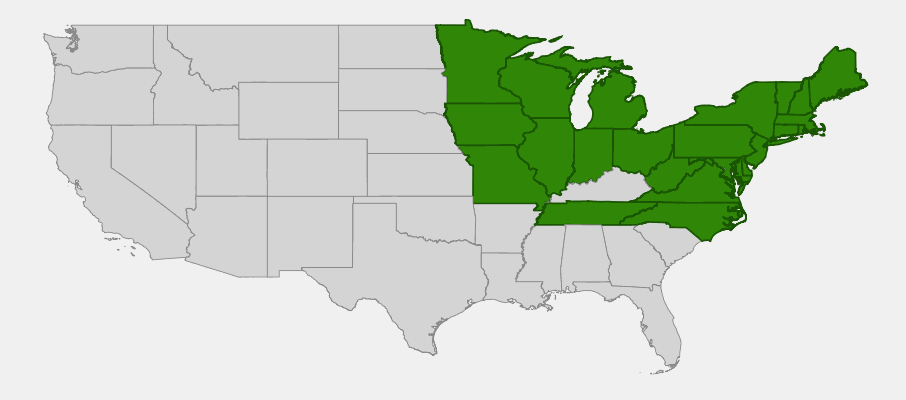
📋 Regional plant lists featuring Spinulose Wood Fern: Delaware, New Jersey & New York
Growing & Care Guide
Spinulose Wood Fern is a superb garden fern for cool, moist, shaded conditions. Its semi-evergreen habit and exceptionally lacy texture make it one of the most ornamentally refined native ferns available for the shade garden.
Light
Part shade to full shade is ideal — dappled light under a deciduous canopy produces the best growth. Spinulose Wood Fern is somewhat more shade-tolerant than many of its relatives and performs well in deep, consistent shade. Morning sun is acceptable if soil moisture is maintained; afternoon sun should be avoided as it causes frond scorch and stress. The plant grows beautifully in the deep shade cast by large oaks and maples, filling niches where few other ornamental plants perform well.
Soil & Water
Cool, moist, moderately acidic soil (pH 5.0–6.5) is optimal. Spinulose Wood Fern grows naturally in wooded swamps and boggy areas — it tolerates wet conditions well and actually thrives in soil that many other garden plants find too wet. In garden settings, consistent moisture is key; the plant should not be allowed to dry out significantly between waterings. Rich, humus-laden soil improves performance, though the plant will grow in ordinary woodland soil if moisture is adequate. Mulch with leaf mold or shredded bark to retain moisture and cool the root zone.
Planting Tips
Plant container-grown or bare-root Spinulose Wood Fern in spring or fall, spacing plants 18–24 inches apart for a naturalistic planting. The crown (where fronds emerge) should be at or just below soil level. Avoid planting in full sun or dry conditions. This fern transplants readily and establishes quickly in appropriate conditions. For a naturalistic effect, plant in groups of 3 or more alongside Cinnamon Fern, Sensitive Fern, or Royal Fern — creating a tapestry of fern textures in a moist shade garden.
Pruning & Maintenance
Essentially maintenance-free in appropriate conditions. Old fronds from the previous year can be cut back in early spring as new fronds emerge — this tidies the planting and removes any winter-damaged foliage. In mild climates, the semi-evergreen fronds remain attractive through winter and can be left in place for both aesthetic appeal and wildlife cover. Division of crowded clumps in early spring (before fronds expand) can be used for propagation. No significant pest or disease issues in properly sited plantings.
Landscape Uses
- Shade gardens — exceptionally fine texture contrasts beautifully with hostas and other bold-leaved shade plants
- Rain gardens and wet sites — tolerates consistently wet conditions
- Pond and stream edges in shaded situations
- Woodland gardens — naturalizes beautifully in moist forest understories
- Mass plantings under deciduous canopies where lawn is difficult to maintain
- Bog gardens in appropriate acid conditions
- Companion planting with spring ephemerals, trilliums, and wild ginger
Wildlife & Ecological Value
While ferns are not primary food plants for most wildlife, Spinulose Wood Fern contributes meaningfully to woodland ecosystems through its structural and microhabitat contributions.
For Birds
The dense, spreading fronds of Spinulose Wood Fern provide important ground-level cover in woodland habitats, sheltering ground-nesting and ground-foraging birds including Ovenbirds, Hermit Thrushes, Veeries, and various sparrows. Wood Thrushes and other woodland thrushes forage among fern colonies for invertebrates in the moist leaf litter. The fibrous old fronds and rootstock material are occasionally incorporated into nest construction by some species. Like Cinnamon Fern, the moist microclimate created by dense fern colonies is essential habitat for salamanders and other woodland amphibians that serve as prey for birds and small mammals.
For Mammals
Spinulose Wood Fern is generally avoided by deer — an important practical advantage in many modern woodland gardens where deer pressure has eliminated much of the native understory. The dense frond cover provides important concealment habitat for fawns and other small mammals. The moist, deep leaf litter accumulated in fern colonies provides feeding habitat for shrews, moles, and other small insectivores.
For Pollinators
As a fern, Spinulose Wood Fern does not produce flowers. However, the moist, cool microclimate of fern colonies is important habitat for numerous invertebrates — particularly salamanders, earthworms, pill bugs, and many insects — that are foundational components of woodland food webs. The decomposing frond material supports rich fungal communities that underpin the soil food web.
Ecosystem Role
Spinulose Wood Fern and related fern species play important roles in the structure and function of northeastern woodland ecosystems. Fern colonies help regulate soil moisture by reducing evaporation, slow the flow of surface water (reducing erosion), accumulate organic matter, and create stable, cool microhabitats essential for numerous woodland specialists. In wooded swamp communities, dense fern coverage helps maintain the cool, moist conditions required by rare and specialized wetland plants, fungi, and invertebrates. The tendency of this species to hybridize with other Dryopteris species also contributes to the genetic diversity of fern populations in mixed-species communities.
Cultural & Historical Uses
Wood ferns of the Dryopteris genus — including Spinulose Wood Fern — have a long history of use in traditional medicine and practical applications throughout the Northern Hemisphere. The rhizomes of several Dryopteris species contain compounds (phloroglucinols) that have anthelmintic (anti-parasitic) properties, and the dried rhizomes of related species were used in European, Asian, and Native American traditional medicine as treatments for intestinal parasites, particularly tapeworms.
In North America, various Indigenous peoples used Dryopteris species medicinally and practically. The Ojibwe and other Great Lakes nations used wood fern rhizomes in preparations for treating rheumatism, skin conditions, and as a wash for sore eyes. The dense frond material was used as bedding material in temporary shelters, and the fibrous rhizomes served as padding in traditional footwear. Some nations used wood fern fronds as a strewing herb in dwellings, taking advantage of the plant’s natural insect-repellent properties.
In European folk medicine, “male fern” — largely referring to Dryopteris filix-mas but applied loosely to many wood fern species — was one of the most important medicinal herbs for treating tapeworms from ancient Greek times through the 19th century. The active compounds (aspidium oleoresin from dried rhizomes) were used in commercial pharmaceutical preparations well into the 20th century before being replaced by safer synthetic anthelmintics. The rhizome extracts are toxic in high doses, making all Dryopteris species worth treating with caution as potential medicinal plants. Today, the primary value of Spinulose Wood Fern is ornamental and ecological — its delicate lacy beauty and exceptional shade tolerance make it a valuable element of natural woodland garden design.
Frequently Asked Questions
How do I distinguish Spinulose Wood Fern from other Dryopteris ferns?
The key features are the nearly tri-pinnate (very finely divided, lacy) frond texture, the spine-tipped teeth on the pinnule margins, and the two-toned scales on the stipe (pale with a dark center stripe). Common Wood Fern (D. intermedia) is very similar but has more curved teeth; Crested Wood Fern (D. cristata) has more narrowly pinnate fronds. The lacy, very finely dissected fronds of D. carthusiana are its most immediately distinctive feature.
Is Spinulose Wood Fern truly evergreen?
It is semi-evergreen — fronds may persist through mild winters but are typically damaged or killed by hard freezes and need to be cut back in early spring. In Zone 6 and warmer parts of Zone 5 (like much of New Jersey and Delaware), fronds often remain green through most of winter. In colder areas (Zone 4 and colder), fronds die back and the plant is essentially deciduous.
Can I grow Spinulose Wood Fern in a container?
Yes, though it requires careful management. Use a large container (at least 12–16 inches wide) with excellent moisture retention, filled with a rich, acidic growing mix. Place in a shaded location and water frequently — the fern is drought-sensitive and containers dry out quickly. Container-grown specimens may need winter protection in colder zones to prevent the root mass from freezing solid.
Why does my Spinulose Wood Fern look similar to neighboring plants but different enough to be confusing?
This is common with wood ferns because Dryopteris carthusiana hybridizes readily with other species — particularly Crested Wood Fern (D. cristata), Intermediate Wood Fern (D. intermedia), and others. These hybrids are often fertile and vigorous, creating a spectrum of intermediate forms that can be genuinely difficult to identify. If you have plants growing in moist shade that look like “wood ferns” but don’t match any species description exactly, a hybrid is the most likely explanation.
How do I propagate Spinulose Wood Fern?
Division is the easiest method: in early spring, carefully dig up an established clump and cut through the rootstock with a sharp spade or knife, ensuring each division has several growing crowns and attached roots. Replant immediately and water well. Spore propagation is also possible but requires specific conditions — sterile growing medium, consistent moisture, and patience, as sporelings take 2–3 years to reach transplantable size.

Looking for a nursery that carries Spinulose Wood Fern?
Browse our native plant nursery directory: Delaware · New Jersey