Sweet Bay Magnolia (Magnolia virginiana)
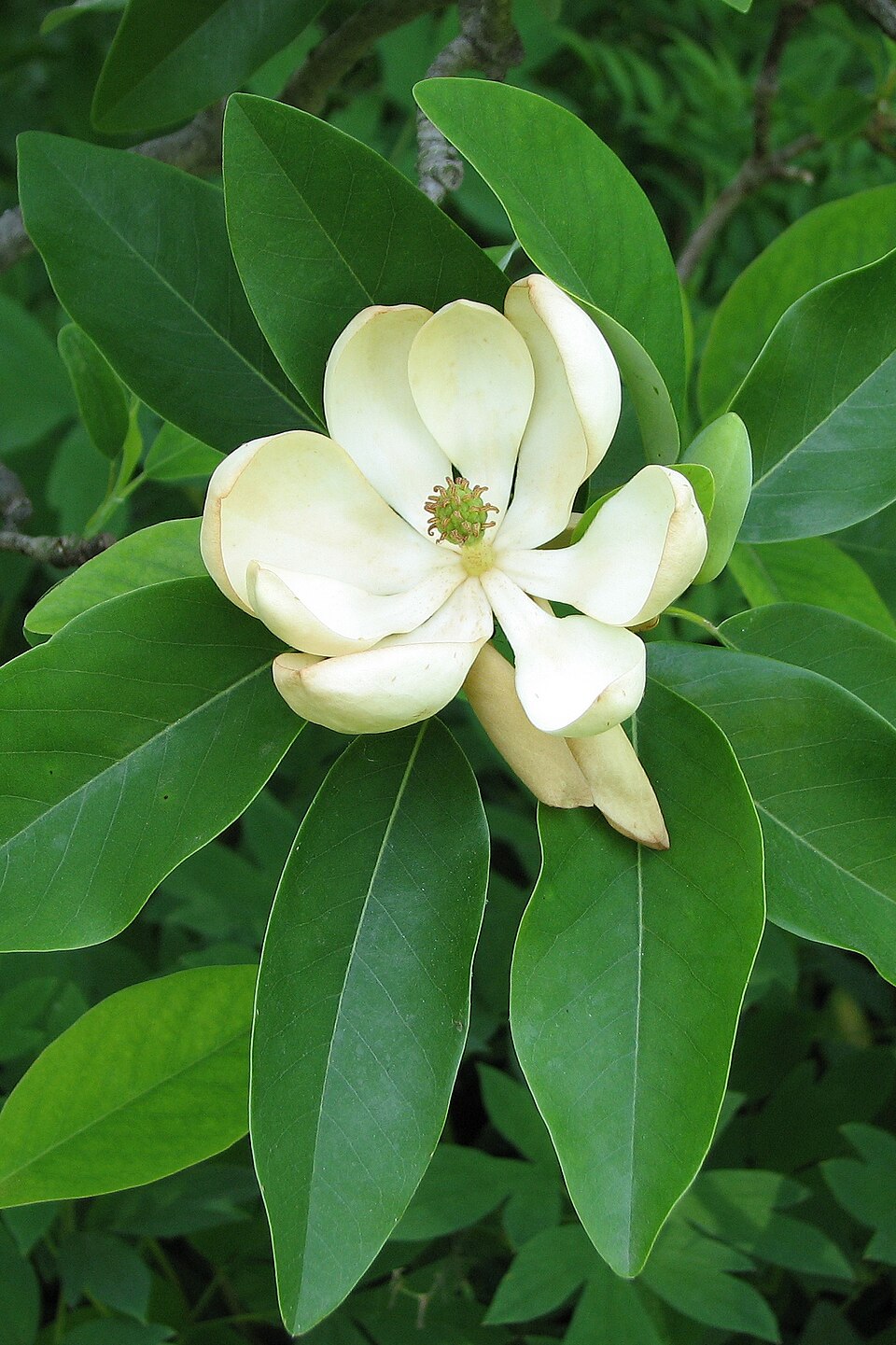
Magnolia virginiana, commonly known as Sweet Bay Magnolia, Swamp Magnolia, Laurel Magnolia, or simply Sweetbay, is one of the most beautiful and ecologically valuable native trees in the eastern United States. This graceful member of the Magnoliaceae family — one of the most ancient of flowering plant families — produces exquisite creamy-white, lemony-fragrant flowers from late May through July, well after most flowering trees have finished blooming. The aromatic flowers, the striking two-toned leaves (dark green above, silvery-white below), and the eye-catching red seeds that emerge from cone-like fruit clusters in fall make Sweet Bay Magnolia a four-season ornamental tree of outstanding beauty.
Sweet Bay Magnolia occupies a unique ecological niche in the eastern United States: it is one of the few native trees that thrives in both moist upland and wetland conditions, growing naturally in swampy forests, pocosins, Atlantic white cedar bogs, and wet flatwoods from Long Island and New Jersey south to Florida and Texas. In the northern portions of its range (including New Jersey and the New York area), it tends to be deciduous to semi-evergreen, while in the Deep South it is fully evergreen year-round. This flexibility makes it an exceptional landscape tree across a wide range of conditions.
In the Delaware, New Jersey, and New York region, Sweet Bay Magnolia is native primarily to the coastal plain, where its preference for moist, acidic soils aligns with the sandy wetland margins and wooded swamps of the New Jersey Pine Barrens and Coastal Plain. It is also widely cultivated outside its native range as an ornamental tree, valued for its graceful habit, fragrant flowers, and adaptability to urban conditions — making it one of the best native trees for mid-Atlantic gardens both within and beyond its natural range.
Identification
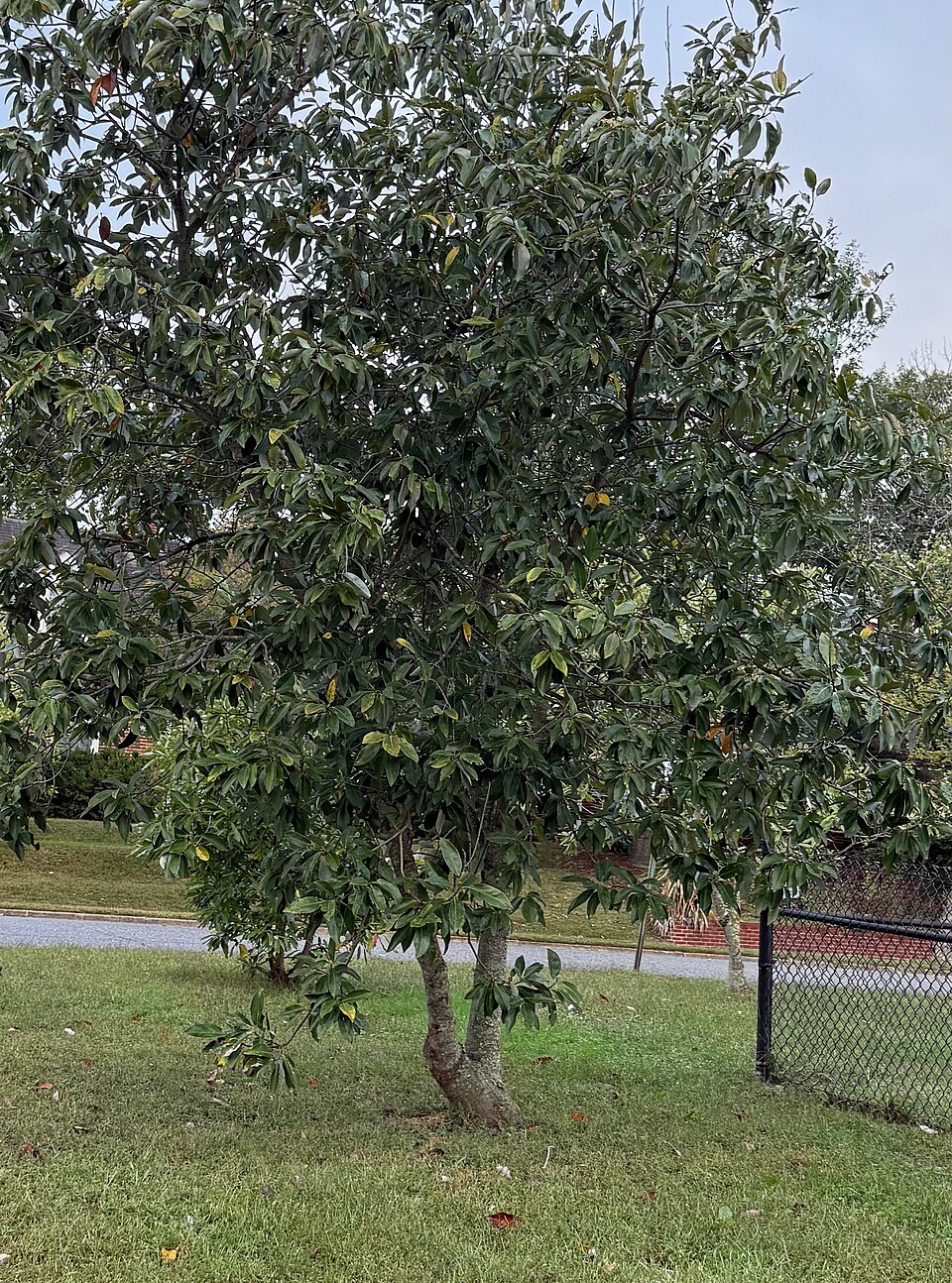
Sweet Bay Magnolia is a large shrub to medium-sized tree, typically 20 to 60 feet tall (occasionally taller in the Deep South), with a multi-stemmed or single-trunked form and a pyramidal to irregular crown. The tree is most reliably identified by its combination of highly aromatic, creamy-white flowers; alternate, elliptic leaves that are distinctively two-toned (dark green above, strikingly silvery-white below); and the cone-like fruit clusters that bear bright red seeds in fall.
Bark
The bark is thin, smooth, and gray to blue-gray — remaining smooth even on older trunks — which distinguishes it from most other large native trees in the region. Breaking a small twig releases a distinctive, pleasantly aromatic scent. Older trunks may develop slight scaling but remain relatively smooth compared to other trees of similar age. The smooth gray bark is attractive in winter and creates an elegant trunk structure in multi-stemmed specimens.
Leaves
Leaves are perhaps the most striking identification feature: simple, alternate, elliptic to oblong, 3 to 5 inches long (occasionally to 7 inches), with entire (smooth, untoothed) margins. The upper surface is glossy, dark green; the underside is strikingly silver-white to pale grayish-green — a contrast so distinctive that it is visible from a considerable distance when the wind stirs the canopy. The leaf undersides give the tree a shimmer in breeze that is genuinely beautiful and is one of the most memorable characteristics of this species. Crushing a leaf releases a distinctly sweet, spicy fragrance — reminiscent of bay laurel, which explains the common name. In the north, leaves drop in late fall; in the south, they are retained year-round.
Flowers & Fruit
Flowers are creamy-white, bowl-shaped, 2 to 3 inches across, with 9 to 12 petals (technically tepals) arranged in three whorls of three. They are exceptionally fragrant with a sweet, lemony scent that carries for considerable distances. Unlike most trees that bloom just once in spring, Sweet Bay Magnolia blooms over an extended period from late May through July (and sometimes into August in warm years), with flowers opening sequentially over many weeks. The fruit is a cone-like aggregate, 1.5 to 2 inches long, that turns red at maturity in September–October, splitting to reveal bright red seeds hanging on silky threads — a striking ornamental display eagerly consumed by birds.
Quick Facts
| Scientific Name | Magnolia virginiana |
| Family | Magnoliaceae (Magnolia) |
| Plant Type | Deciduous to Semi-evergreen Tree |
| Mature Height | 60 ft |
| Sun Exposure | Part Shade to Full Sun |
| Water Needs | Moderate to High |
| Bloom Time | Late May – July (intermittently into August) |
| Flower Color | Creamy white (lemon-scented) |
| Fruit | Red cone-like aggregate with red seeds (Sept–Oct) |
| USDA Hardiness Zones | 5–9 |
Native Range
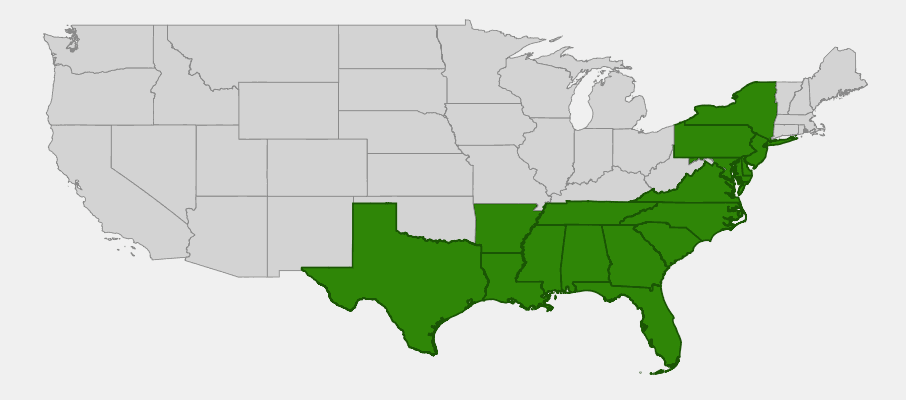
Sweet Bay Magnolia is native to the Atlantic and Gulf Coastal Plain of the eastern United States, ranging from southern New York and coastal Massachusetts south through New Jersey, Delaware, Maryland, Virginia, the Carolinas, Georgia, and Florida, and west along the Gulf Coast through Alabama, Mississippi, Louisiana, and Texas. The species also extends inland in the Southeast into Arkansas and Tennessee. It is most abundant in the coastal plain wetlands of the Carolinas and the Gulf States, where it occurs in extensive pocosins, bay swamps, flatwood wetlands, and Atlantic white cedar bogs.
In New Jersey and Delaware, Sweet Bay Magnolia is a characteristic species of the Pine Barrens, growing in the margins of cedar swamps, shrub swamps, and moist pine-oak lowlands. The tree reaches the northern extent of its natural range in coastal New Jersey and Long Island, New York — where it was described by colonial botanists in the 1600s as one of the most beautiful trees they had encountered. The New Jersey populations are naturally deciduous in harsh winters, becoming more semi-evergreen in the warmer coastal and more southerly sites.
The geographic range of Sweet Bay Magnolia corresponds closely with the distribution of the Atlantic Coastal Plain ecoregion, and the species serves as an indicator of the characteristic wetland plant communities of this globally rare and threatened ecosystem. Many of its natural habitats — bay swamps, pocosins, and flatwoods — are among the most biodiverse and most threatened ecosystems in the eastern United States, making Sweet Bay Magnolia a species of both aesthetic and conservation significance.
📋 Regional plant lists featuring Sweet Bay Magnolia: Delaware, New Jersey & New York
Growing & Care Guide
Sweet Bay Magnolia is one of the most versatile and rewarding native trees for mid-Atlantic gardens. Its adaptability to a wide range of soil moisture conditions — from periodically flooded wetland margins to moderately moist upland soils — and its tolerance of partial shade make it more flexible than many native trees. The combination of summer flowering, fragrance, ornamental bark, and excellent wildlife value places it among the top native trees for the region.
Light
Sweet Bay Magnolia grows well in part shade to full sun. In its natural habitat, it often grows as an understory tree in filtered light beneath larger trees. In the garden, it flowers most abundantly in full sun, but it tolerates and even thrives in part shade — making it one of the few flowering native trees adaptable to shaded or semi-shaded garden settings. Avoid deep shade, which reduces flowering and overall vigor significantly.
Soil & Water
Adaptable to a wider range of soil moisture than most native trees: it grows well in moist to wet soils, periodically flooded sites, and even tolerates some standing water — making it ideal for rain gardens, bioswales, and wet areas where few other trees perform well. It also grows adequately in moderately moist average garden soils as long as it doesn’t experience prolonged drought. Prefers acidic to neutral pH (4.5–6.5). Avoid alkaline soils. Mulch generously to maintain soil moisture, especially in drier settings.
Planting Tips
Plant in spring or fall. Sweet Bay Magnolia is somewhat particular about root disturbance — plant carefully from container stock, handling the root ball gently. Bare-root planting is generally less successful for magnolias. Select a site that reflects its adaptability to wet conditions if possible — low spots, areas near water features, or consistently moist sites are ideal. If planting in drier average garden conditions, ensure generous irrigation during establishment and mulch heavily to maintain moisture. Space single specimens at least 15–20 feet from structures to allow for full crown development.
Pruning & Maintenance
Sweet Bay Magnolia requires minimal pruning. If a single-trunked tree form is desired, remove competing basal sprouts and lower branches in early years. The tree naturally develops a graceful, multi-stemmed large-shrub form if left to its own devices — both forms are attractive and appropriate for different settings. Prune in late summer or fall, after flowering, to avoid removing flower buds. The tree is generally free of serious pest and disease problems. Leaf spots and scale insects may occasionally occur but rarely require treatment.
Landscape Uses
- Wet and rain garden tree — tolerates periodic flooding and saturated soils
- Fragrance garden — the lemon-scented flowers perfume the entire garden area
- Specimen tree for year-round ornamental interest
- Partial shade situations where most flowering trees won’t bloom
- Screen and privacy planting — dense evergreen to semi-evergreen foliage
- Coastal plain restoration in appropriate moist, acidic settings
- Pollinator and wildlife garden anchor
Wildlife & Ecological Value
Sweet Bay Magnolia is an ecologically rich tree that provides food, shelter, and habitat resources for a wide range of wildlife across all seasons. Its extended flowering season, high-visibility red seeds, and dense canopy make it exceptional for wildlife landscaping.
For Birds
The bright red seeds hanging on silky threads from the cone-like fruit clusters in September and October are eagerly consumed by many bird species, including American Robin, Wood Thrush, Hermit Thrush, Gray Catbird, Brown Thrasher, Red-eyed Vireo, Eastern Kingbird, Yellow-bellied Sapsucker, and Rose-breasted Grosbeak. The dense, often multi-stemmed canopy provides excellent nesting habitat — Acadian Flycatcher in southern portions of the range, and various thrushes, vireos, and wood-warblers throughout. The insects attracted to the flowers and foliage support insectivorous birds during breeding season.
For Mammals
White-tailed Deer browse Sweet Bay Magnolia foliage, but the tree’s typically wet habitat provides some natural protection. Squirrels collect and cache the seeds. Black Bears consume the fruit where ranges overlap. The dense wetland thickets that Sweet Bay Magnolia often forms provide important thermal cover and denning sites for a variety of mammals in the coastal plain ecosystem.
For Pollinators
The large, bowl-shaped flowers of Sweet Bay Magnolia are pollinated by beetles — a primitive but effective pollination system retained from the early history of flowering plants. The flowers produce heat through thermogenesis, warming the interior to attract and accommodate beetle pollinators. A variety of native bees and flies also visit the flowers for pollen. The extended flowering season from late May through July provides an important pollen and nectar resource during the summer period when many spring-blooming plants have finished.
Ecosystem Role
Sweet Bay Magnolia is a characteristic structure species in Atlantic Coastal Plain wetland ecosystems — bay swamps, pocosins, and wet flatwoods — where it contributes to the distinctive canopy and creates microhabitats that support specialized flora and fauna. Its leaves decompose relatively rapidly in wetland conditions, contributing to the nutrient cycling processes that support diverse aquatic and semi-aquatic communities. The species serves as an indicator of the quality and ecological integrity of coastal plain wetland habitats.
Cultural & Historical Uses
Sweet Bay Magnolia was one of the first North American trees to be formally described and cultivated in Europe. The English botanist John Banister collected specimens in Virginia in the 1680s, and the tree was introduced to cultivation in England before 1688, becoming one of the earliest North American trees to be grown in European gardens. Subsequent 18th-century botanical explorers — including Mark Catesby, whose Natural History of Carolina, Florida, and the Bahama Islands (1729–1747) featured stunning illustrations of Sweet Bay Magnolia — documented its extraordinary beauty and ecological importance. The genus Magnolia itself was named in honor of the French botanist Pierre Magnol by Charles Plumier in 1703, and virginiana refers to Virginia, where many early European botanical collections were made.
Indigenous peoples of the southeastern United States used Sweet Bay Magnolia extensively in traditional medicine and ceremony. The Cherokee used preparations from the bark and leaves to treat fever, headache, rheumatism, colds, and as a general tonic. The Choctaw and other Gulf Coast peoples used the aromatic leaves as a seasoning — the leaves have a flavor similar to but milder than true bay laurel (Laurus nobilis), and were used as a culinary herb in some traditions. The wood, though not exceptionally strong, was used for furniture, woodenware, and fuel.
In the 18th and 19th centuries, dried Sweet Bay Magnolia bark was sold in American and European pharmacies as “beaver tree bark” — a folk medicine used to treat fever, malaria-like symptoms, and rheumatism. The aromatic properties of the bark and leaves led to widespread use as a natural insect repellent: bundles of dried leaves were placed in wardrobes and chests to repel moths and other fabric pests. Today, Sweet Bay Magnolia is prized exclusively as an ornamental and ecological landscape plant, with its long history of human use adding cultural depth to its already considerable aesthetic and wildlife value.
Frequently Asked Questions
Is Sweet Bay Magnolia truly evergreen?
In the mid-Atlantic region (Zones 5–6), it is semi-evergreen — leaves persist through mild winters but drop in severe cold. In Zone 7 and south, it retains its foliage year-round. Cultivars like ‘Henry Hicks’ have been selected for improved cold-hardiness and evergreen retention in northern gardens. Even when deciduous, the attractive bark and form provide winter interest.
Does Sweet Bay Magnolia tolerate wet, poorly drained soil?
Yes — it is one of the very few native trees that actively thrives in wet, poorly drained conditions. It grows naturally in swamps, pocosins, and wetland edges and can tolerate periodic standing water. This makes it excellent for rain gardens, bioswales, wet corners of the property, and areas near water features where most other trees would decline.
How does Sweet Bay Magnolia differ from Southern Magnolia?
Southern Magnolia (Magnolia grandiflora) is larger (80+ feet), fully evergreen in all zones, with much larger flowers (8–12 inches) and larger, leathery leaves without the silvery underside. Sweet Bay Magnolia is smaller (to 60 feet), semi-evergreen in the north, with smaller flowers (2–3 inches) and the characteristic silver leaf underside. Sweet Bay also tolerates much wetter soils and more shade than Southern Magnolia.
When does Sweet Bay Magnolia bloom, and for how long?
Flowering begins in late May to early June and continues intermittently through July, with some flowers appearing into August in warm years. This extended blooming period — over 6–10 weeks — is one of Sweet Bay Magnolia’s most distinctive and appreciated features, as most flowering trees complete their bloom in 2–3 weeks in spring. The lemon-scented flowers perfume the surrounding area with each new flush of bloom.
Can Sweet Bay Magnolia grow in New York City?
Yes — it grows well throughout Zone 6 of the New York metropolitan area, including Long Island and the boroughs. Choose a protected site on Long Island or in a warmer microclimate in the city for best results. Semi-evergreen cultivars like ‘Henry Hicks’ retain foliage better through the city’s cold winters. Ensure moist soil conditions — the tree does not thrive in the extremely dry soils of some urban sites without irrigation support.

Looking for a nursery that carries Sweet Bay Magnolia?
Browse our native plant nursery directory: Delaware · New Jersey