Crested Wood Fern (Dryopteris cristata)
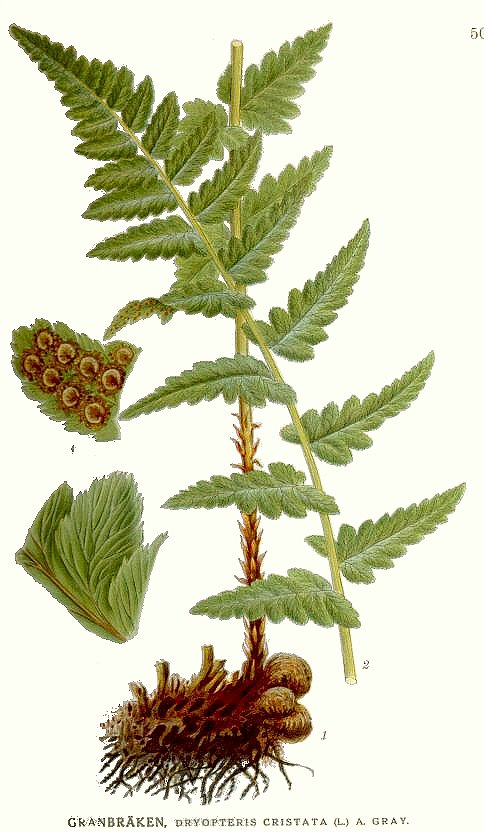
Dryopteris cristata, commonly known as Crested Wood Fern or Crested Shield Fern, is a distinctive native fern of wetland margins, boggy woods, and moist forest edges throughout the northeastern United States and Canada. This semi-evergreen fern is instantly recognizable by its unusual growth form: the fertile fronds stand erect with their pinnae (leaflets) twisted to lie nearly perpendicular to the frond blade — a remarkable adaptation that maximizes spore dispersal. The sterile fronds lie nearly flat, forming a low spreading rosette at the base of the plant.
A member of the wood fern family (Dryopteridaceae), Crested Wood Fern grows 2 to 5 feet tall in optimal conditions, producing both fertile (spore-bearing) and sterile fronds from a stout, creeping rhizome. The species thrives in full sun to part shade in high to moderate moisture conditions — swampy woods, bog edges, stream margins, and wet meadows — making it an excellent choice for rain gardens, bioswales, and other wet-area plantings in the landscape. Its semi-evergreen nature means fronds persist well into winter in mild years, providing four-season interest.
While not as commonly grown as some other native ferns, Crested Wood Fern deserves far greater use in naturalistic landscape design. Its tolerance of wet, boggy conditions fills a niche that few ornamental ferns can occupy, and its distinctive upright fertile fronds add vertical texture to wetland garden compositions. For gardeners in Delaware, New Jersey, and New York working with wet or seasonally flooded sites, Crested Wood Fern offers an authentic, ecologically valuable native solution.
Identification
Crested Wood Fern produces two distinct types of fronds from a central crown: low-growing sterile fronds and upright fertile fronds. This dimorphic growth pattern is a key identifying feature. The fronds are once-pinnate-pinnatifid (divided into pinnae, which are in turn shallowly lobed), giving them a more complex texture than Christmas Fern but less finely divided than many other wood ferns.
Fronds & Pinnae
Sterile fronds are spreading, arching, and shorter (12–20 inches), with pinnae lying flat in the same plane as the frond blade. Fertile fronds are erect and taller (18–40 inches), with a distinctive feature: the pinnae are twisted at their bases to stand perpendicular to the plane of the frond blade, giving the fertile frond a distinctive “ladder rungs” appearance when viewed from the side. This is Crested Wood Fern’s most distinctive characteristic.
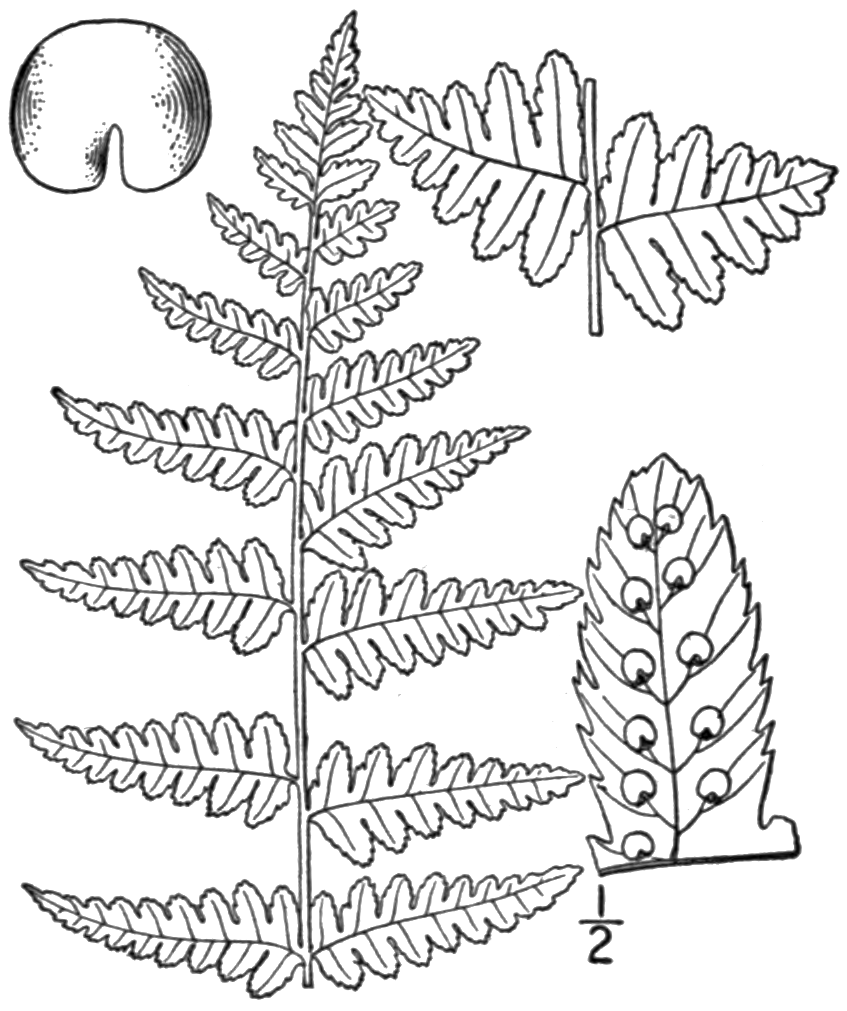
The pinnae are broadly triangular, bluntly toothed, and sparsely set on the midrib — the batch notes describe it as “upright blade with sparse pinnae perpendicular.” The fronds are blue-green in color, somewhat paler than many related species. Sori (spore clusters) on the undersides of fertile pinnae are covered by kidney-shaped indusia and mature from July through September.
Stipe & Rhizome
The stipe (stalk) is relatively short — less than one-quarter the total frond length — with scattered brown scales, especially at the base. The rhizome is stout, creeping or ascending, and densely covered with dark-centered scales. The plant grows slowly by rhizome extension to form small colonies in suitable conditions.
Quick Facts
| Scientific Name | Dryopteris cristata |
| Family | Dryopteridaceae (Wood Fern) |
| Plant Type | Semi-evergreen Fern (Perennial) |
| Mature Height | 2–5 ft |
| Sun Exposure | Full Sun to Part Shade |
| Water Needs | Moderate to High |
| Bloom Time | N/A (fern — reproduces by spores) |
| Spore Maturity | July – September |
| USDA Hardiness Zones | 3–8 |
Native Range
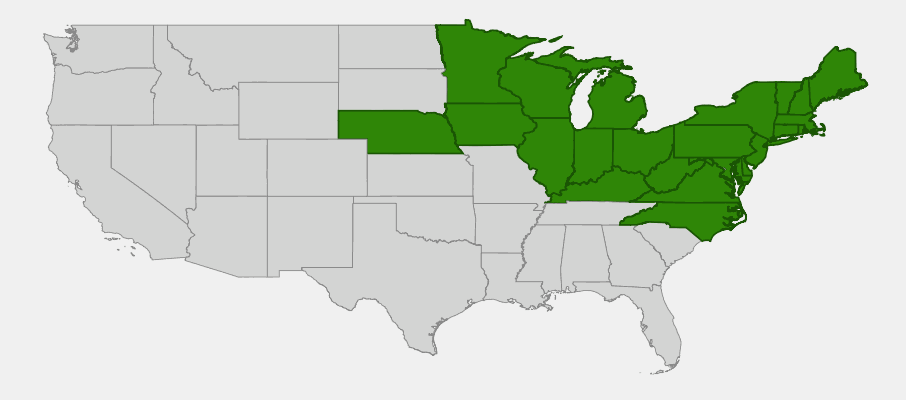
Crested Wood Fern is native to the northeastern United States and southeastern Canada, with a range extending from Newfoundland and Ontario south to North Carolina, and west through the Great Lakes region to Nebraska. It is most abundant in the northeastern states and upper Midwest, where suitable boggy and wet forest habitats are common. Its range closely tracks the distribution of glacially influenced landscapes with high water tables.
In Delaware, New Jersey, and New York, Crested Wood Fern is found primarily in coastal plain wetland forests, swampy woods, and boggy depressions. In New York, it occurs more frequently in the Adirondacks and other northern regions where cool, moist conditions prevail. The species is not common in the warmer, drier portions of its range and tends to decline southward as conditions become less optimal.
Crested Wood Fern occupies a distinctive ecological niche at the interface of wetland and upland. It typically grows where soils remain saturated for extended periods but are not permanently flooded, in the company of Cinnamon Fern, Royal Fern, Swamp Azalea, and various sedges and rushes. It hybridizes naturally with several related Dryopteris species, producing intermediate forms that can complicate identification.
📋 Regional plant lists featuring Crested Wood Fern: Delaware, New Jersey & New York
Growing & Care Guide
Crested Wood Fern thrives in wet, shaded conditions and is ideal for rain gardens, bog gardens, and low-lying areas of the landscape that are difficult to plant with most species.
Light
Crested Wood Fern grows in full sun to part shade. In sunny locations, it requires consistently wet soil to thrive. In part shade with adequate moisture, it develops its best form. Unlike many shade ferns, it tolerates more sun than most Dryopteris species, making it useful for open wetland margins and sunny bog gardens.
Soil & Water
This fern requires consistently moist to wet soil and is ideal for sites that experience seasonal flooding or have permanently high water tables. It tolerates both acidic peat soils and neutral mineral soils as long as moisture is adequate. Avoid dry soils — even brief drought causes frond scorch and dieback. Mulching with organic material helps retain moisture in drier sites.
Planting Tips
Plant Crested Wood Fern in wet, low areas of the garden where water tends to accumulate. It pairs beautifully with Cinnamon Fern, Royal Fern, Blue Flag Iris, and Swamp Milkweed in naturalistic wetland plantings. Space plants 24–30 inches apart; they spread slowly by rhizomes to form colonies. The crown should be at or slightly above soil level.
Pruning & Maintenance
Minimal care is needed. Old fronds can be cut back in late winter or early spring before new growth emerges. In mild winters, fronds may persist through January or February. The fern has no serious pest or disease issues in appropriate, moist conditions.
Landscape Uses
- Rain garden — excellent for wet basins and bioswales
- Bog garden — thrives at the edge of water gardens and ponds
- Wetland restoration — appropriate for wet woodland plantings
- Stream bank stabilization — roots help hold wet, unstable soils
- Wet shade garden — one of the best ferns for wet, shaded spots
Wildlife & Ecological Value
Crested Wood Fern provides valuable habitat structure in wetland woodland communities, creating dense cover for wildlife in challenging wet conditions.
For Birds
The dense fronds of Crested Wood Fern colonies provide ground-level cover for secretive wetland birds including Sora, Virginia Rail, and various snipe species. The moist soil beneath fern colonies teems with invertebrates — worms, beetles, and fly larvae — that support foraging Wood Ducks, Swamp Sparrows, and other wetland birds.
For Mammals
Muskrats and beavers occasionally use wetland ferns as bedding or construction material. The moist habitat created by Crested Wood Fern colonies supports populations of salamanders, frogs, and the invertebrates on which many small mammals depend. Bog turtles and other rare wetland reptiles benefit from the vegetative cover in sensitive wetland habitats.
For Pollinators
As a fern, Crested Wood Fern does not produce flowers or nectar. However, the moist, sheltered microhabitat created by fern colonies provides important refugia for moisture-dependent invertebrates including various flies, beetles, and aquatic insects during their terrestrial life stages.
Ecosystem Role
In wetland woodland communities, Crested Wood Fern stabilizes wet, organic soils, intercepts precipitation, and contributes to the litter layer that drives wetland nutrient cycling. Its presence in wet forests indicates high water quality and natural hydrology, making it a useful indicator species for ecological assessments.
Cultural & Historical Uses
Like many native ferns, Crested Wood Fern was used medicinally by Indigenous peoples of northeastern North America. The Ojibwe and other Great Lakes nations used the rhizomes of various wood ferns, including Crested Wood Fern, in preparations to treat rheumatism, back pain, and as a general tonic. The dried and powdered rhizomes were applied topically to swollen joints. Some nations used fern preparations to treat intestinal parasites, though the compounds involved are now known to be toxic in large doses.
Crested Wood Fern does not have the extensive history of human use that some other native plants possess, partly because of its specialized habitat requirements — wetland areas were often difficult to access and were not primary foraging grounds for most cultural uses. Its ecological value lies primarily in its role as a structural component of northeastern wetland forests, where it helps define and maintain the character of these rare and ecologically rich habitats.
In modern horticulture, Crested Wood Fern is valued primarily by native plant enthusiasts and ecological restoration practitioners who work with wet sites. Its unusual perpendicular pinnae orientation gives it a distinctive, architectural quality that makes it interesting as a specimen plant in wet garden settings. It is increasingly sought after for rain garden designs as awareness of its ecological value and tolerance of wet conditions has grown.
Frequently Asked Questions
Why do the pinnae of Crested Wood Fern twist sideways?
The perpendicular orientation of pinnae on fertile fronds is an adaptation for spore dispersal. By twisting to face upward or outward rather than lying flat, the sori (spore cases) are better positioned to release spores into air currents. The twisted fronds give the fern its “crested” appearance and make it immediately recognizable in the field.
Is Crested Wood Fern suitable for garden use?
Yes, particularly in wet or seasonally flooded sites. It’s one of the best native ferns for rain gardens, bog gardens, and consistently moist low areas. In typical garden soils that dry out in summer, it will struggle and die back.
Does Crested Wood Fern spread aggressively?
No — Crested Wood Fern spreads slowly by rhizomes and forms modest colonies over time. It is not aggressive and will not overtake other plants. Its spread is gradual and controlled.
Can Crested Wood Fern grow in standing water?
It tolerates periodic flooding and saturated soils but does not grow well in permanently flooded conditions. Sites that flood seasonally and drain are ideal.
What is the difference between Crested Wood Fern and Cinnamon Fern?
Cinnamon Fern (Osmundastrum cinnamomeum) is much larger, with highly dimorphic fronds — the fertile fronds are completely cinnamon-colored from spore masses and bear no green tissue. Crested Wood Fern has green fertile fronds with sori on the pinnae undersides and is recognized by its perpendicular pinnae orientation.

Looking for a nursery that carries Crested Wood Fern?
Browse our native plant nursery directory: Delaware · New Jersey