Christmas Fern (Polystichum acrostichoides)
Polystichum acrostichoides, commonly known as Christmas Fern, is one of the most popular, versatile, and dependable native ferns in eastern North America. This elegant evergreen fern earns its festive name from two sources: its dark green fronds remain lush and green through the holiday season, and each individual pinna (leaflet) is shaped like a small Christmas stocking, complete with a “toe” at the base. Whether carpeting the shaded floor of a woodland garden or brightening a north-facing slope in winter, Christmas Fern brings year-round beauty to the landscape.
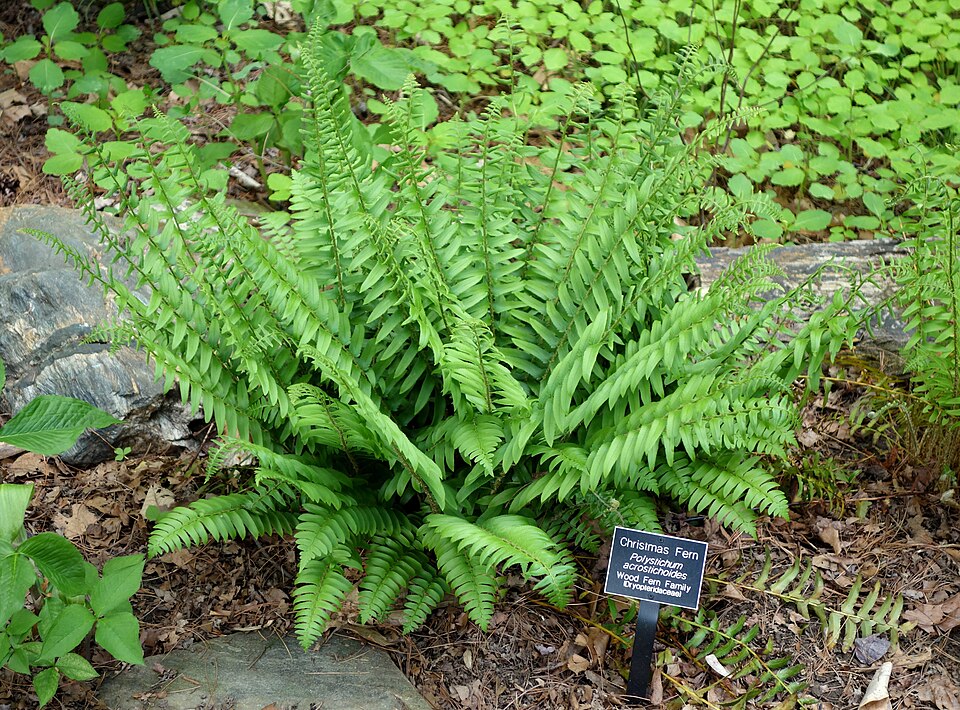
A member of the family Dryopteridaceae, Christmas Fern grows in a graceful arching rosette with lance-shaped, once-pinnate fronds reaching 1–3 feet in length. It thrives in part shade to full shade and moist to moderately moist soils throughout the eastern United States and into Canada. As an evergreen fern, its fronds persist through winter — turning somewhat flattened and prostrate in cold weather — then rise again with fresh new fronds (called croziers or fiddleheads) in spring. The new growth unfurls in tightly coiled croziers covered with silvery-white scales, a beautiful springtime spectacle.
Christmas Fern is one of the most adaptable native ferns for garden use. It tolerates a wide range of light conditions (from part shade to full shade), survives summer drought better than most ferns, and grows in both clay and rocky soils. It spreads slowly by rhizomes to form attractive colonies and is virtually deer-resistant — a significant advantage in areas with high deer pressure. For gardeners in Delaware, New Jersey, and New York seeking a tough, attractive, low-maintenance native groundcover for shaded areas, Christmas Fern is an outstanding choice.
Identification
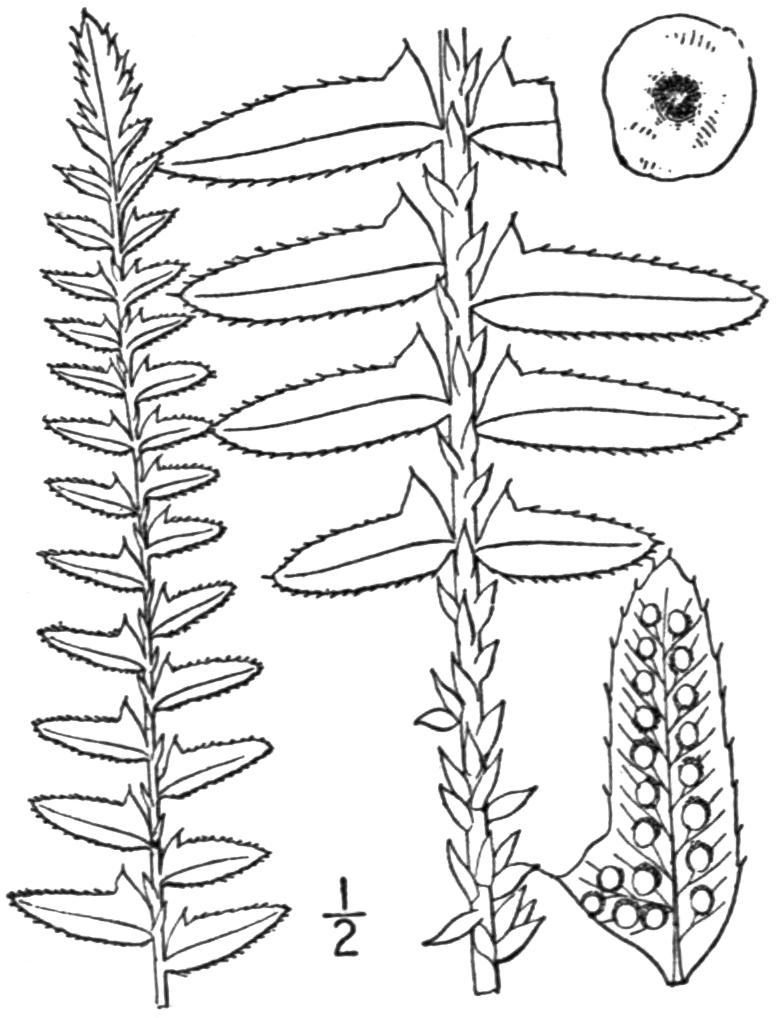
Christmas Fern forms a cluster of arching, lance-shaped fronds growing from a central crown (rootstock). The fronds are once-pinnate — divided into individual leaflets (pinnae) along a central stalk — and can reach 1 to 3 feet long and 3 to 5 inches wide at the widest point. The fronds are dark, glossy green above and paler below, with a leathery texture that persists through winter.
Fronds & Pinnae
The most distinctive identification feature of Christmas Fern is the shape of each individual pinna (leaflet): each has a small lobe or “ear” at the base on the upper side, resembling a Christmas stocking. The pinnae are alternate along the midrib, with minutely toothed margins and a slightly pointed tip. On fertile fronds, the upper pinnae (toward the tip) are noticeably narrower and bear the sporangia (spore cases) on their undersides, giving them a brownish, scaly appearance when mature in summer and fall.
Stipe & Scales
The stipe (leaf stalk) is densely covered with reddish-brown to golden scales, especially when young. These scales are a helpful identification feature that distinguishes Christmas Fern from similar species. The rhizome (underground stem) is thick, scaly, and branching, forming a crown from which multiple fronds emerge in a circular cluster.
Fiddleheads
In early spring, Christmas Fern produces tightly coiled fiddleheads covered with dense, silky, silvery-white scales. These are one of the more ornamental aspects of the fern’s spring emergence and help distinguish it from other species. The fiddleheads are not recommended for eating — unlike ostrich fern fiddleheads — as they may cause digestive upset.
Quick Facts
| Scientific Name | Polystichum acrostichoides |
| Family | Dryopteridaceae (Wood Fern) |
| Plant Type | Evergreen Fern (Perennial) |
| Mature Height | 3–8 ft (frond spread; typical frond length 1–3 ft) |
| Sun Exposure | Part Shade to Full Shade |
| Water Needs | Moderate |
| Bloom Time | None (spore-bearing fern) |
| Spore Maturity | July – October |
| USDA Hardiness Zones | 3–9 |
Native Range
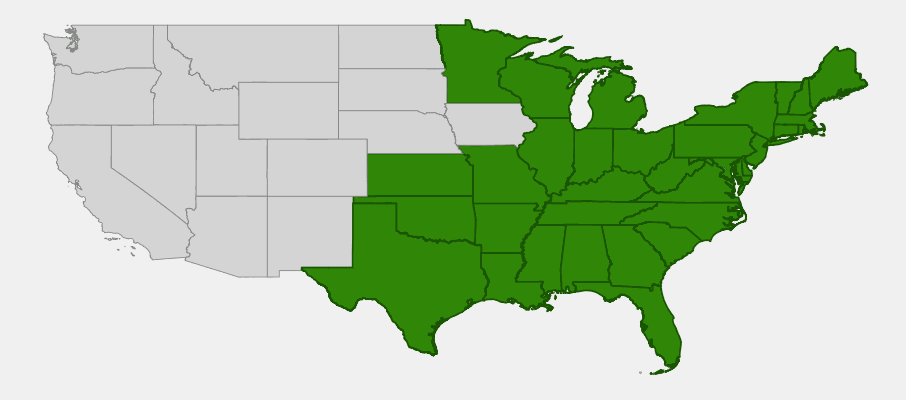
Christmas Fern is native to the eastern half of North America, ranging from Nova Scotia and southern Ontario south to Florida and west to Minnesota, Nebraska, Kansas, Oklahoma, and Texas. It is one of the most widely distributed native ferns in the eastern United States, occurring in virtually every county east of the Mississippi River and in many counties west of it.
In Delaware, New Jersey, and New York, Christmas Fern is a common and characteristic species of moist to mesic deciduous forests, especially in shaded ravines, on rocky slopes, and along stream corridors. It forms some of its most spectacular colonies on north-facing slopes where moisture accumulates and shade is consistent. The fern is often associated with spring ephemeral wildflowers such as Trout Lily, Wild Ginger, and Jack-in-the-Pulpit.
Christmas Fern grows from sea level to over 5,000 feet elevation in the southern Appalachians, demonstrating remarkable adaptability across elevational and climatic gradients. It is one of the few native ferns that maintains green fronds year-round, even under snow, making it a consistent presence in winter woodland landscapes.
📋 Regional plant lists featuring Christmas Fern: Delaware, New Jersey & New York
Growing & Care Guide
Christmas Fern is one of the easiest native ferns to grow and maintain. Its tolerance of shade, drought, and poor soils makes it suitable for challenging sites where few other plants thrive.
Light
Christmas Fern grows best in part shade to full shade — the dappled light beneath deciduous trees or the dense shade of evergreens. It can tolerate more sun in cooler climates or with consistently moist soil, but in hot, sunny sites the fronds may become scorched. It is ideal beneath the canopy of oaks, maples, and other large shade trees.
Soil & Water
Christmas Fern tolerates a wide range of soils including rocky, clay, and sandy soils. It prefers moist, well-drained soil with good organic content but is more drought-tolerant than most ferns once established. Amend clay soils with compost before planting to improve drainage. Water regularly for the first growing season to establish the root system, after which irrigation is generally unnecessary except during extended drought.
Planting Tips
Plant container-grown specimens in spring or fall. Space plants 18–24 inches apart for groundcover effect; they will slowly spread to fill in. The crown should be planted at soil level — not buried. Mulch lightly with shredded leaves to retain moisture and mimic the natural forest floor environment. Christmas Fern is slow to establish from spores but divides readily in early spring before new fronds emerge.
Pruning & Maintenance
Christmas Fern is virtually maintenance-free. Old fronds can be cut back to the crown in late winter or early spring before new croziers emerge — this tidies the planting and removes any winter-damaged fronds. However, leaving the old fronds in place is also acceptable; they naturally flatten and decay, protecting the crown and enriching the soil. Christmas Fern has no serious pest or disease problems and is strongly deer-resistant.
Landscape Uses
- Woodland groundcover — excellent mass planting under trees
- Shade garden — pairs beautifully with spring wildflowers
- Slope stabilization — roots help control erosion on shaded slopes
- Winter interest — one of few evergreen native groundcovers for deep shade
- Stream bank planting — tolerates moist conditions near water
- Rock garden — thrives in rocky, shaded niches
Wildlife & Ecological Value
Christmas Fern provides important ecological services in the woodland garden and natural areas, particularly as a year-round groundcover that shelters small wildlife.
For Birds
The dense, low mats of Christmas Fern fronds provide valuable cover and nesting habitat for ground-nesting and ground-foraging birds including Hermit Thrush, Ovenbird, and Wood Thrush. The rhizome-rich soil beneath Christmas Fern colonies teems with invertebrates — earthworms, beetles, millipedes — that provide foraging opportunities for robins, thrushes, and woodpeckers.
For Mammals
Christmas Fern fronds provide shelter for small mammals including shrews, mice, and salamanders. The dense colonies trap leaf litter and create microclimatic refuges that are important overwintering sites for many woodland invertebrates. Deer typically avoid Christmas Fern — the leathery, scaly fronds are unpalatable to them.
For Pollinators
As a fern, Christmas Fern does not produce flowers or nectar. However, fern spores provide nutrition for certain microorganisms and contribute to the fungal diversity of forest soils that supports mycorrhizal networks underpinning the entire forest ecosystem.
Ecosystem Role
Christmas Fern is a keystone groundcover species in eastern deciduous forests. Its persistent, overlapping fronds trap leaf litter, reduce soil erosion on slopes, retain moisture, and create structurally complex habitat at the ground layer. Its deep rhizome system binds soil on hillsides and ravine walls. As the fronds decompose, they contribute organic matter and return nutrients to the soil, supporting the forest food web.
Cultural & Historical Uses
Christmas Fern has a long history of use by Indigenous peoples of eastern North America. The Cherokee used the plant medicinally — a tea made from the rhizomes was used to treat fever, chills, and rheumatism. The fronds were used externally as poultices for joint pain and sore muscles. Other eastern nations used the rhizomes as a remedy for colds and as a general tonic.
The common name “Christmas Fern” reflects both the plant’s festive timing — its evergreen fronds are bright green and fresh-looking in December when most other vegetation is brown and dormant — and the Christmas-stocking shape of its individual pinnae. Early American colonists and later Victorian-era households gathered Christmas Fern fronds to use as long-lasting greenery in holiday decorations. Unlike many cut plants, Christmas Fern fronds remain green and fresh-looking for weeks after cutting, making them ideal for wreaths, garlands, and table arrangements.
In modern horticulture, Christmas Fern has become one of the most widely used native ferns in landscape design. Its adaptability, deer resistance, evergreen nature, and ease of culture make it indispensable for shade gardens, naturalistic landscapes, and woodland restoration projects throughout the eastern United States. Numerous cultivars have been selected for compact growth, crested fronds, and other ornamental variations, though the straight species remains the most ecologically valuable for wildlife.
Frequently Asked Questions
Does Christmas Fern stay green all winter?
Yes — Christmas Fern is evergreen and its fronds persist through winter. In very cold winters, the fronds may flatten to the ground or become somewhat discolored, but they remain alive and resume normal growth in spring.
Is Christmas Fern deer resistant?
Yes — Christmas Fern is one of the most deer-resistant native ferns. The tough, leathery fronds with their scaly texture are generally avoided by deer, making it an excellent choice for landscapes with heavy deer pressure.
How fast does Christmas Fern spread?
Christmas Fern spreads slowly by rhizomes, gradually expanding outward from the central crown. It typically adds a few new fronds per year per crown and spreads about 6–12 inches per decade under natural conditions. It does not spread aggressively and is not invasive.
Can Christmas Fern grow in deep shade?
Yes — Christmas Fern is one of the most shade-tolerant native plants available, thriving in the deep shade beneath mature tree canopies. It is an excellent choice for north-facing slopes and other low-light situations where few other plants succeed.
What is the difference between Christmas Fern and Wood Fern?
Christmas Fern (Polystichum acrostichoides) has once-pinnate fronds (single row of leaflets) and is evergreen. Wood ferns (genus Dryopteris) typically have more finely divided fronds (bipinnate or bipinnatifid) and may be semi-evergreen or deciduous. The “ear” or “toe” on each Christmas Fern pinna is a distinctive feature not found on most wood ferns.

Looking for a nursery that carries Christmas Fern?
Browse our native plant nursery directory: Delaware · New Jersey