Thimbleberry (Rubus parviflorus)
Rubus parviflorus, commonly known as Thimbleberry, is one of the most distinctive and wildlife-valuable native shrubs of Alaska and the Pacific Northwest. A member of the Rosaceae (rose) family, Thimbleberry is an unarmed (thornless) deciduous shrub that combines ornamental appeal with extraordinary ecological value — offering large white flowers attractive to pollinators in early summer, followed by soft, thimble-shaped red berries beloved by bears, birds, and people alike in late summer. Unlike the thorny blackberries and raspberries that share its family, Thimbleberry’s thornless stems make it a pleasure to harvest and to work with in the garden.
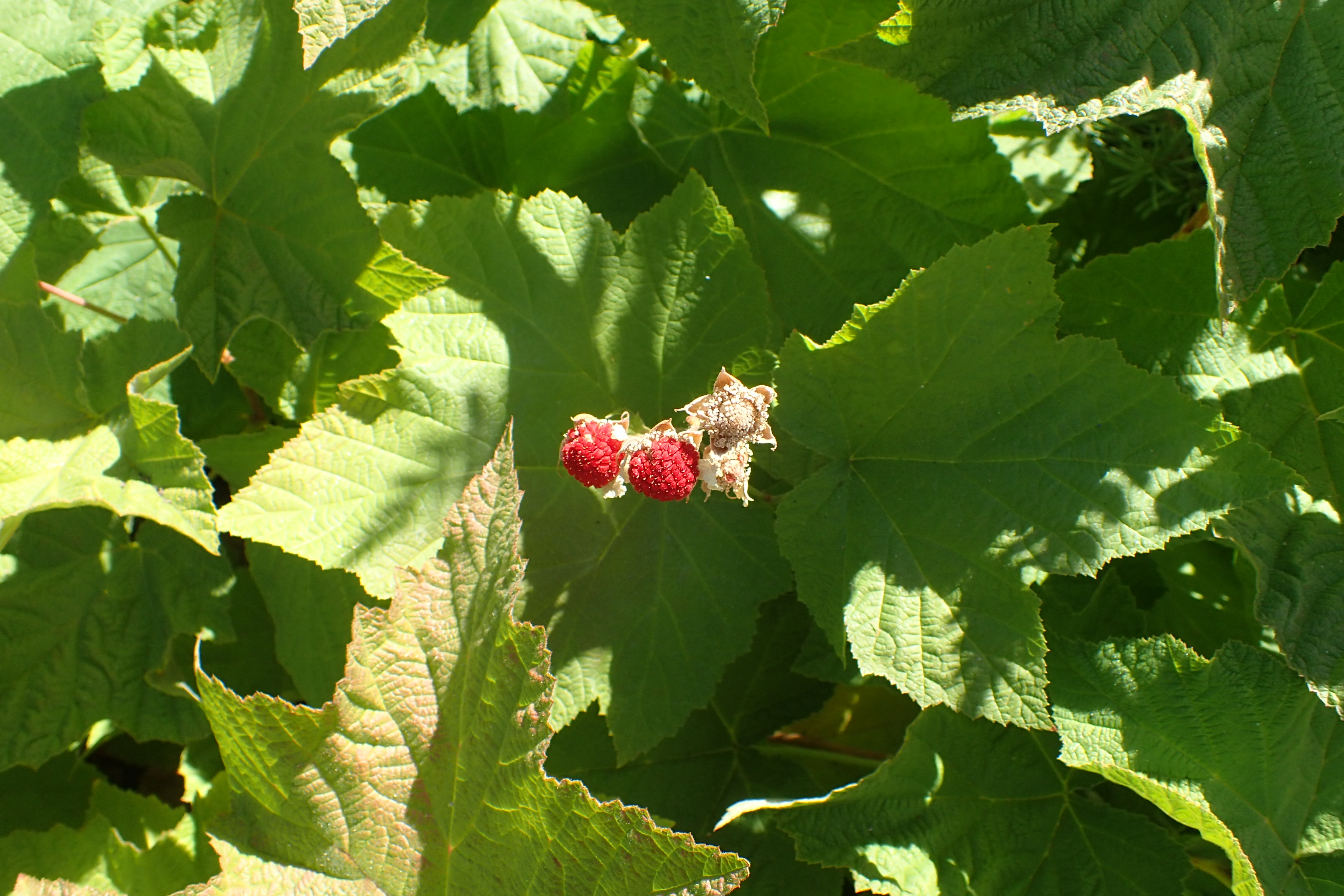
Thimbleberry is immediately recognizable by its exceptionally large, maple-like leaves — the largest leaves of any native Rubus in Alaska, sometimes exceeding 10 inches (25 cm) across — which give the shrub a bold, lush tropical appearance in the moist forests and streamside thickets where it grows. The large, soft leaves are covered with fine glandular hairs that give them a velvety texture, and they create dense shade beneath the shrub’s arching canes. Growing 3 to 6 feet (1–2 m) tall and forming expansive clonal colonies via underground rhizomes, Thimbleberry can quickly colonize disturbed sites and forest edges, creating dense, impenetrable thickets that shelter wildlife through all seasons.
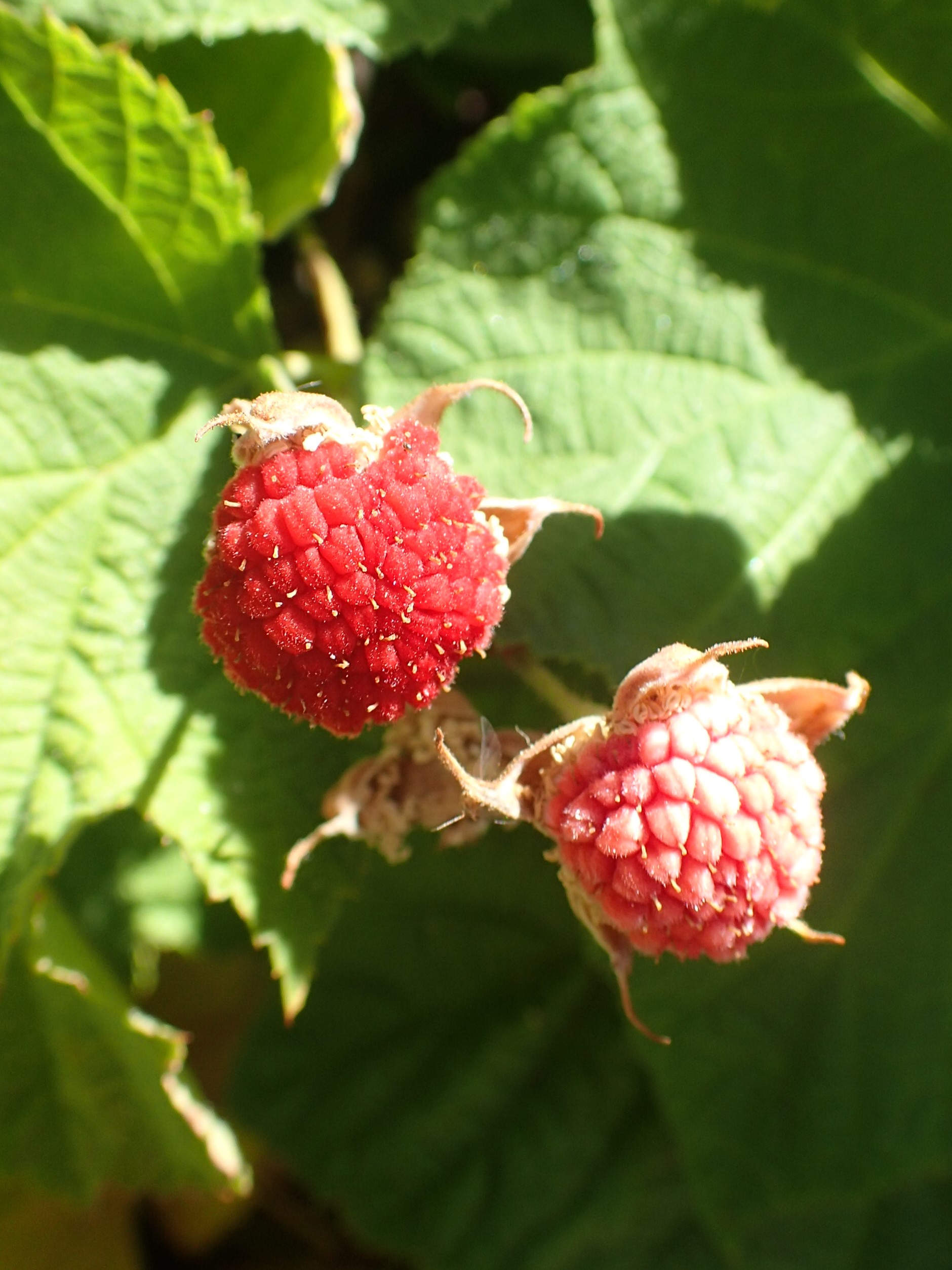
The fruit of Thimbleberry is soft, dome-shaped, and brilliantly red when ripe — resembling a red raspberry in shape but with a distinctly different texture. It pulls cleanly from the plant as a hollow cup (like a thimble), is intensely flavored but somewhat seedy, and is highly perishable — making it rarely available commercially but greatly prized by those who know where to look. Bears consume Thimbleberries in enormous quantities as a pre-hibernation food source, and the berries are among the most important late-summer fruits for wildlife across the Pacific Northwest and Alaska.
Identification
Thimbleberry grows as a multi-stemmed deciduous shrub, typically 3 to 6 feet (1–2 m) tall, with arching, thornless canes that spread by underground rhizomes to form large colonies. The combination of very large maple-like leaves, white flowers, and thornless stems makes Thimbleberry unmistakable among native Pacific Northwest and Alaskan shrubs. Young stems are covered in fine glandular hairs that give them a slightly sticky feel; older canes develop a shredding papery bark typical of the genus.
Leaves
The leaves are the most instantly striking feature — very large (4–10 inches / 10–25 cm across), maple-leaf-shaped with 3 to 7 pointed lobes, softly velvety on both surfaces, and bright green above. The petioles (leaf stalks) are long and slender. The undersurface is covered with dense soft hairs, giving the leaf a pale, felted appearance. Leaves emerge in spring with a fresh, bright green color, remain lush through summer, and turn a warm yellow in fall before dropping. The bold leaf texture and size create a dramatic visual statement in the garden or forest understory.
Flowers
The flowers are large (1–2 inches / 2.5–5 cm across), white, and produced in small clusters of 3 to 11 at the tips of canes. Each flower has five broad, slightly crinkled white petals and numerous bright yellow stamens creating a showy center. Flowers open from late May through July in Alaska, with some variation by elevation. The large, open flowers are excellent sources of pollen and are visited by bumble bees, mining bees, and butterflies. The flowers are followed by the distinctive berries that ripen in July through September.
Fruit
The fruit is an aggregate berry, 0.5 to 1 inch (1.5–2.5 cm) across, composed of many small drupelets (like a raspberry), dome-shaped, and scarlet-red when ripe. It detaches from the plant as a hollow cup — hence “thimbleberry.” The flavor is distinctive: sweet-tart with a seedy texture and intense berry fragrance. Berries are very soft and fragile, making them difficult to harvest intact in quantity. Ripe fruit produces an unforgettable aroma that signals a prime bear foraging site along Alaskan trails.
Quick Facts
| Scientific Name | Rubus parviflorus |
| Family | Rosaceae (Rose) |
| Plant Type | Deciduous Shrub / Colony-forming |
| Mature Height | 6 ft |
| Sun Exposure | Part Shade to Full Sun |
| Water Needs | High |
| Bloom Time | May – July |
| Flower Color | White |
| USDA Hardiness Zones | 3–9 |
Native Range
Thimbleberry is native across a broad swath of western North America, from Alaska and the Yukon south through British Columbia, Washington, Oregon, California, Idaho, Montana, Wyoming, Colorado, Utah, New Mexico, and Arizona. It is a common forest understory shrub throughout the Pacific Northwest and Rocky Mountain regions, and extends into the Great Lakes region in the upper Midwest — Michigan, Wisconsin, and Minnesota — where it grows in moist mixed forests. In Alaska, it is found throughout the southern portion of the state, including coastal southeastern Alaska, Southcentral Alaska, and portions of the interior.
Thimbleberry is a characteristic species of disturbed forest edges, streambanks, roadsides, avalanche chutes, and logged or burned areas throughout its range. It is one of the most rapid colonizers of disturbed moist forest sites, spreading quickly by rhizomes across openings created by windthrow, landslides, and logging. The plant thrives in the partial shade of young second-growth forest and typically persists as a dense, productive understory shrub for decades after forest disturbance — providing critical habitat structure and fruit during the successional period when forest canopy is rebuilding.
In the Kenai Peninsula, Kodiak Island, and southeastern Alaska, Thimbleberry is an important component of the productive coastal forest understory that supports one of North America’s highest densities of Brown Bears. The berries are a crucial pre-hibernation food for bears in these areas, and the dense thickets provide cover for bears, moose, and other wildlife. Resource managers in these areas consider Thimbleberry habitat an important factor in the ecological carrying capacity for large mammals.
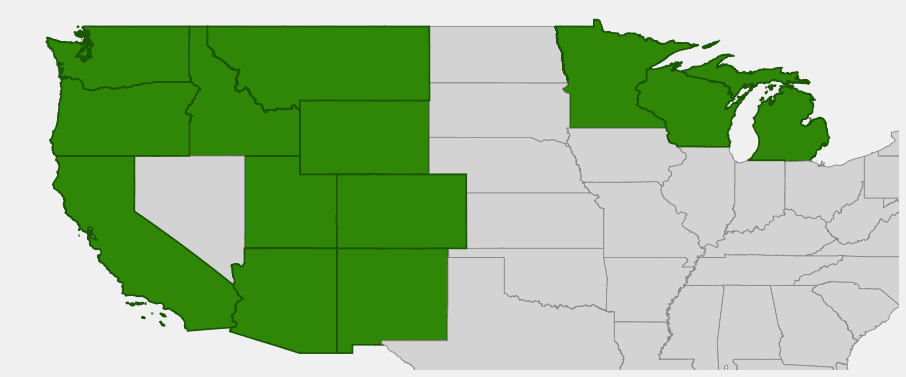
📋 Regional plant lists featuring Thimbleberry: Alaska
Growing & Care Guide
Thimbleberry is a vigorous, adaptable native shrub that establishes quickly and provides excellent returns in terms of wildlife value, fruit production, and ornamental appeal. Its thornless stems make it more garden-friendly than most native fruiting shrubs, and its bold foliage creates striking seasonal interest.
Light
Thimbleberry grows well in partial shade to full sun. It is most productive in terms of fruit set in full sun to partial shade, while in deeper shade it produces more luxuriant foliage but fewer flowers and berries. In its natural habitat, it grows most abundantly at forest edges and in forest openings where it receives at least a few hours of direct sun. In the garden, a site with morning sun and afternoon light shade is ideal for balancing fruit production with the lush foliar display that makes Thimbleberry an ornamental asset.
Soil & Water
Thimbleberry prefers consistently moist, organically rich soil — the kind found in productive forest understory environments. It does not tolerate prolonged drought once established and performs best with high soil moisture throughout the growing season. In Alaska’s naturally wet climate, it typically requires no supplemental irrigation; in drier regions or in gardens with fast-draining soils, regular deep watering is essential. Mulching with wood chips or leaf litter — mimicking the natural forest floor — helps retain moisture and enrich the soil over time.
Planting Tips
Establish Thimbleberry from container stock in spring or fall, or from rooted divisions of established clumps. The plant spreads by underground rhizomes and can be divided regularly — a productive way to propagate it and control its spread. Space plants 4–6 feet apart for a naturalistic colony, or plant singly as a specimen in a large container or raised bed (though container planting limits its spreading potential). Thimbleberry is an excellent choice for naturalizing a moist, partially shaded bank or creating a wildlife-friendly edge planting between lawn and woodland.
Pruning & Maintenance
Unlike thorny brambles, Thimbleberry’s thornless stems make pruning easy and pleasant. Prune out old, unproductive canes at ground level in late winter to encourage vigorous new growth. New canes grow rapidly and produce fruit in their second year (the same fruiting cycle as most Rubus species). Control spread by removing rhizome suckers at the perimeter of the colony as needed. Thimbleberry is essentially pest- and disease-free in appropriate, cool, moist conditions; rust and leaf spot may occasionally appear in warm, humid conditions but rarely cause lasting damage.
Landscape Uses
- Wildlife gardens — exceptional value for bears, birds, and pollinators
- Edible landscape — delicious, thornless fruit accessible to all ages
- Streambank and riparian stabilization — spreads vigorously to hold moist slopes
- Woodland garden understory — bold foliage under conifers or deciduous trees
- Native hedge or screen — creates dense, tall, productive barrier
- Restoration plantings on disturbed moist forest sites
Wildlife & Ecological Value
Thimbleberry is one of the most wildlife-valuable native shrubs in Alaska, providing food, cover, and habitat structure for a remarkable diversity of species across all seasons.
For Birds
The berries are consumed eagerly by American Robins, Varied Thrushes, Cedar Waxwings, Gray Catbirds, Hermit Thrushes, and numerous other fruit-eating birds. The dense, arching canes provide excellent nesting cover for White-crowned Sparrows, Song Sparrows, and Yellow Warblers. In fall, the persistent berries attract migrating thrushes and waxwings in large numbers. The large flowers attract a diverse array of pollinators that in turn feed insectivorous birds including warblers, vireos, and flycatchers.
For Bears
Thimbleberry is a critically important food plant for both Black Bears and Brown Bears throughout Alaska and the Pacific Northwest. Bears consume both the berries and the leaves, and they visit productive Thimbleberry patches repeatedly through the fruit season — sometimes creating well-worn trails through dense thickets as they return to favored patches daily. In areas with high bear densities, Thimbleberry thickets are among the most predictably productive foraging sites during the late-summer hyperphagia period when bears are building fat reserves for hibernation.
For Pollinators
The large, open white flowers of Thimbleberry are excellent sources of pollen for bumblebees, mason bees, and mining bees. The flowers are particularly valuable because they open relatively early in the season — before many other forest shrubs bloom — providing pollen when it is most needed by emerging spring bumblebee queens building their nests. The nectar-rich flowers also attract butterflies, hoverflies, and other beneficial insects.
Ecosystem Role
Thimbleberry plays a significant role in forest succession and ecosystem recovery following disturbance. It is among the fastest-establishing native shrubs after fire, logging, landslides, and avalanche events, quickly covering bare soil and providing the ground-layer structure that protects soil from erosion, creates wildlife habitat, and facilitates the establishment of tree seedlings beneath its canopy. Its deep root system stabilizes banks and slopes, and its dense leaf litter contributes substantially to soil organic matter development in disturbed sites.
Cultural & Historical Uses
Thimbleberry has been a significant food plant for Indigenous peoples throughout its range for thousands of years. Among the Tlingit, Haida, Tsimshian, and other coastal Alaska Native peoples, Thimbleberries were eaten fresh, dried, or mixed with grease as a preserved food. The berries were sometimes dried on wooden racks or on large leaves in the sun — though their fragility and high moisture content made drying difficult. More commonly, they were eaten fresh or cooked into preserves and pemmican-like preparations mixed with other dried foods and fish oil. The large leaves were used as temporary containers for carrying berries — their broad, soft surface making them natural wrapping material.
Interior Alaska Native peoples including Athabascans harvested Thimbleberries as an important late-summer fruit, often gathering them alongside other berries in multi-species harvesting expeditions. The timing of Thimbleberry ripening served as a seasonal indicator — when the berries turned red, it signaled that the summer was well advanced and that preparations for fall and winter needed to begin. Young shoots of Thimbleberry were also eaten in spring as a vegetable — peeled and eaten raw or lightly cooked, with a flavor similar to young asparagus shoots.
The large, soft leaves of Thimbleberry were used throughout the Pacific Northwest as natural wrapping material — for steaming fish, for wrapping foods for transport, and in some nations as temporary plates. Their velvety surface also made them useful as emergency toilet paper — a use noted by Northwest travelers of all backgrounds and still remarked upon by hikers encountering the plant on backcountry trips today. The leaves have mild medicinal properties and were used in some nations as poultices for minor burns and skin irritations.
Frequently Asked Questions
Are Thimbleberries edible?
Yes — Thimbleberries are delicious and have been eaten by Alaska Native peoples and settler communities for centuries. They are sweet-tart with an intense berry flavor, excellent fresh or made into jam, jelly, syrup, or wine. The main limitation is their extreme fragility — they must be eaten within hours of picking and cannot be transported in quantity. This perishability is why they are rarely found commercially, making them one of the most sought-after wild berries by those who know Alaska’s forests.
Is Thimbleberry the same as raspberry?
Thimbleberry and raspberry are both members of the genus Rubus and share the characteristic of producing aggregate berries that separate from the receptacle as a hollow cup. However, Thimbleberry (R. parviflorus) has no thorns, much larger maple-like leaves, larger white flowers, and softer, more fragile berries than most raspberries. The flavor is distinctly different — more intense and complex than most cultivated raspberries. The closely related Salmonberry (R. spectabilis) is another Alaskan thornless Rubus with yellow to red berries.
Does Thimbleberry spread aggressively?
Thimbleberry spreads by rhizomes and can form large colonies over time, but it is not considered invasive in its native range. The spread rate is moderate and easily managed by digging out suckers at the colony perimeter. In smaller gardens, plant in a location where spreading is acceptable — against a fence, along a property edge, or on a slope where ground cover is needed. The thornless stems make management much easier than thorny invasive blackberries.
How do I tell Thimbleberry from Salmonberry?
Thimbleberry (R. parviflorus) has large, maple-like lobed leaves, white flowers, and red dome-shaped berries. Salmonberry (R. spectabilis) has compound leaves with 3 leaflets, pink-to-purple flowers, and orange-to-red berries. Both are thornless native Alaska shrubs, often growing in similar habitats. Thimbleberry leaves are much larger and simpler (not compound); Salmonberry leaves are smaller and look like raspberry leaves.
What is the best way to harvest Thimbleberries?
Harvest Thimbleberries by gently cupping each berry and pulling straight outward — the ripe berry should release cleanly from the stem. Collect in shallow containers lined with leaves or paper to prevent the soft berries from crushing each other. Harvest daily or every other day at peak season as berries ripen quickly and deteriorate rapidly once ripe. The best berries are slightly firm, brilliantly red, and fragrant — not yet fully soft. Use immediately or process into preserves within 24 hours of harvesting.

Looking for a nursery that carries Thimbleberry?
Browse our native plant nursery directory: Alaska