Beach Pine (Pinus contorta)
Pinus contorta, commonly known as Beach Pine, Lodgepole Pine, or Shore Pine, is one of the most widespread and ecologically significant conifers in western North America. Its Latin epithet contorta — meaning “twisted” — refers to the contorted, wind-sculpted form that shore-grown trees often develop in exposed coastal environments. In Alaska, the shore subspecies (P. contorta var. contorta) thrives in bogs, coastal bluffs, and low-elevation forests, while the interior lodgepole form (P. contorta var. latifolia) dominates vast subalpine forests across the Rocky Mountain region.
Despite its name as “Beach Pine,” this species is equally at home on dry mountain slopes and interior plateaus. It is the defining tree of the lodgepole pine forest — a habitat type that covers millions of acres across the western United States and Canada. In Alaska, Beach Pine plays an essential role in coastal ecosystems, stabilizing sandy soils, providing dense cover for wildlife, and offering nesting sites for numerous bird species. Its drought tolerance, full-sun preference, and adaptability to poor soils make it an important pioneer species after disturbance events such as fire, which it is perfectly adapted to exploit.
One of Beach Pine’s most remarkable adaptations is its serotinous cones — resin-sealed cones that remain closed on the tree for years, sometimes decades, until the intense heat of a forest fire melts the resin and releases thousands of seeds simultaneously. This fire-adapted strategy allows Lodgepole Pine to regenerate explosively following fires, often carpeting burned landscapes with dense seedling stands within months. In Alaska’s shore pine habitat, this fire adaptation is less critical, but the species still demonstrates exceptional resilience and colonizing ability.
Identification
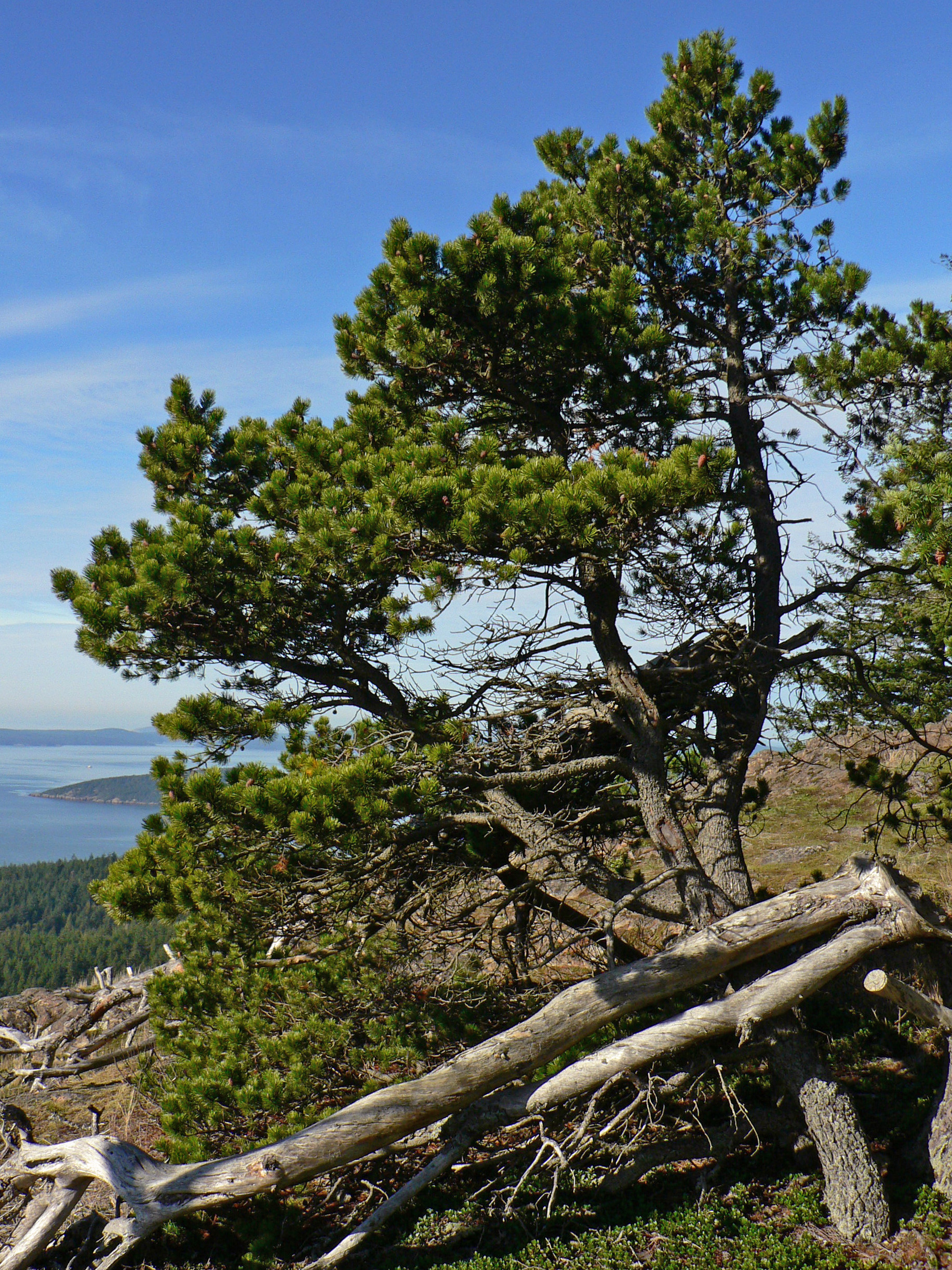
Beach Pine is an evergreen conifer that grows 20 to 30 feet tall in coastal Alaskan settings, though lodgepole forms inland can reach 80 to 100 feet. The growth form varies dramatically: coastal trees are often short, twisted, and multi-stemmed from wind exposure, while protected or inland trees grow straight and single-trunked. The bark is a key identification feature — thin, scaly, and reddish-brown to gray-brown, breaking into irregular plates on older trees.
Needles
The needles are the most reliable identification feature. They occur in bundles of two (fascicles of 2), are 1 to 3 inches (2.5–8 cm) long, and are dark green to yellowish-green. They are often slightly twisted — giving the tree its scientific name — and are arranged in a dense spiral around the branches. Each needle is stiff, sharp-pointed, and somewhat flattened. The needles persist for 4–8 years before dropping.
Cones
Cones are 1 to 3 inches (2.5–7.6 cm) long, ovoid to conical in shape, and yellow-brown to reddish-brown when mature. They are asymmetrical at the base and typically curved. Each cone scale bears a small, persistent prickle. In serotinous populations, the cones remain tightly closed on the branches for years, coated in resin; in non-serotinous populations (more common in coastal Alaska), cones open normally within 1–2 years of maturity.
Bark & Form
Young bark is thin, smooth, and orange-brown; it gradually becomes gray-brown and scaly with age, breaking into irregular, plate-like scales. The crown is irregular and often sparse, with dead lower branches typical of mature trees. In sheltered environments, trees develop a single straight trunk; in exposed coastal or subalpine sites, they may be dramatically wind-pruned, gnarled, or krummholz in form.
Quick Facts
| Scientific Name | Pinus contorta |
| Family | Pinaceae (Pine family) |
| Plant Type | Evergreen Conifer Tree |
| Mature Height | 20–30 ft (coastal AK); up to 100 ft inland |
| Sun Exposure | Full Sun |
| Water Needs | Low (Drought Tolerant) |
| Bark Description | Thin, scaly, red-brown to gray |
| Needles | 2 per bundle, dark green, 1–3 in. long |
| Cone Type | Serotinous or non-serotinous, 1–3 in. |
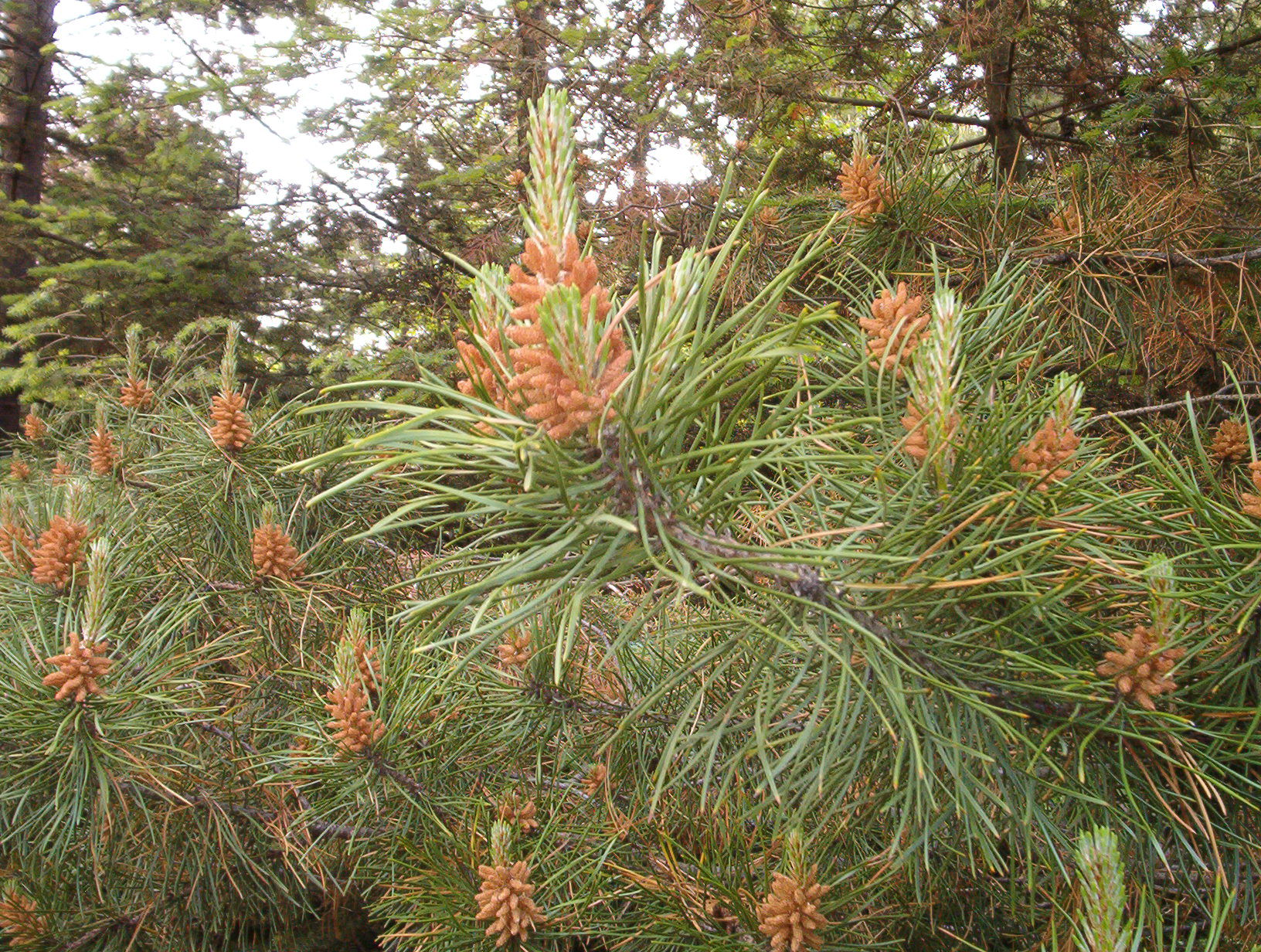
| Bloom Time | May – June (pollen release) |
| Flower Color | Yellow (pollen cones); red-purple (seed cones) |
| USDA Hardiness Zones | 4–9 (var. contorta: 6–9; var. latifolia: 4–8) |
Native Range
Beach Pine (Pinus contorta) has one of the most extensive natural ranges of any North American pine, stretching from Baja California north through the Pacific Coast states and into coastal and interior Alaska, and east across the Rocky Mountains into the Great Plains. In Alaska, the shore pine form (P. contorta var. contorta) grows along the southeastern coast, on islands, and in coastal bogs and bluffs from Ketchikan north to approximately Kodiak Island. It is the northernmost pine native to North America’s Pacific Coast.
Across its range, Pinus contorta occupies an extraordinary diversity of habitats. Coastal forms grow in sphagnum bogs, rocky bluffs, and wet maritime forests at low elevations. Interior lodgepole forms dominate high-elevation subalpine forests throughout the Rockies and Sierra Nevada, often forming pure stands covering millions of acres. This ecological flexibility — from sea-level bogs to 11,000-foot mountain slopes — makes Pinus contorta the definitive “generalist” among western conifers.
Lodgepole Pine forests are strongly associated with fire ecology. Following major wildfire events, serotinous populations release massive seed crops, resulting in dense regeneration stands. These post-fire lodgepole forests are an iconic feature of the intermountain West, as seen dramatically following the 1988 Yellowstone fires. In Alaska, the species is less dependent on fire for regeneration but still demonstrates strong pioneer characteristics, colonizing disturbed, poorly-drained, and nutrient-poor sites where other conifers struggle.
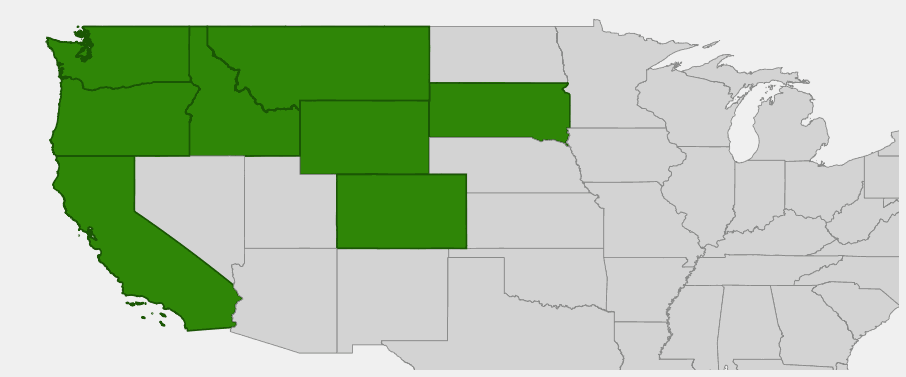
📋 Regional plant lists featuring Beach Pine: Alaska
Growing & Care Guide
Beach Pine is an exceptionally hardy, low-maintenance tree ideal for challenging sites — poor soils, exposed locations, and areas with little supplemental irrigation. Once established, it is highly drought-tolerant and requires virtually no care beyond occasional shaping.
Light
Beach Pine demands full sun and performs poorly in shaded conditions. Plant it where it receives at least 6–8 hours of direct sunlight daily. In its native Alaska habitat, it grows in open, exposed locations — coastal bluffs, bogs, and forest clearings — where light is abundant. It will not thrive under the canopy of taller trees.
Soil & Water
This species is remarkably tolerant of poor soil conditions — sandy, gravelly, rocky, or nutrient-deficient soils are all acceptable. It thrives in well-drained to excessively drained soils but also tolerates the poorly-drained, waterlogged conditions of coastal bogs. Once established (typically after 2–3 growing seasons), Beach Pine is highly drought-tolerant and requires no supplemental watering in most Alaskan climates. Avoid heavy clay soils and over-fertilizing, which can produce excessive lush growth that is susceptible to wind damage and disease.
Planting Tips
Plant container-grown trees in early spring or fall, spacing them 10–15 feet apart for hedgerow or windbreak use, or 20–25 feet for specimen planting. Mulch the root zone with 2–3 inches of wood chips or bark to retain moisture during establishment. Staking is recommended for trees in exposed, windy sites during the first year. Beach Pine transplants relatively easily from small container stock — larger trees can be challenging to establish.
Pruning & Maintenance
Beach Pine is naturally low-maintenance and requires little pruning. Remove dead branches as needed and prune for desired form in late winter before new growth begins. The twisted, sculptural form of coastal trees is part of their ornamental appeal — avoid over-pruning, which can destroy this character. Monitor for pine bark beetles and weevils in stressed trees, and ensure good air circulation to prevent fungal issues in humid Alaskan coastal climates.
Landscape Uses
- Windbreak and privacy screen in exposed coastal or open sites
- Specimen tree for its sculptural, wind-shaped form
- Stabilization planting on coastal bluffs, sandy banks, and disturbed soils
- Wildlife gardens — seeds attract crossbills, nuthatches, and other seed-eating birds
- Bog gardens and wet, poorly-drained sites where other trees fail
- Naturalistic plantings mimicking boreal coastal forest character
Fire Ecology
Beach Pine’s interior lodgepole form is one of the most fire-adapted trees in North America. Serotinous cones remain sealed with resin until fire temperatures (typically above 50°C) melt the resin, releasing seeds en masse. A single tree may hold thousands of seeds in stored cones, enabling explosive post-fire regeneration. Coastal Alaskan populations are generally less serotinous, but the species still regenerates vigorously after disturbance events.
Wildlife & Ecological Value
Beach Pine provides significant ecological value in both coastal and interior habitats, supporting diverse communities of birds, mammals, and invertebrates.
For Birds
The seeds of Beach Pine are a critical food source for specialized seed-eating birds, particularly crossbills — including Red Crossbill (Loxia curvirostra) and White-winged Crossbill (Loxia leucoptera) — whose crossed bills are specifically adapted to extract seeds from conifer cones. Other seed consumers include Clark’s Nutcracker, Pine Siskin, Common Redpoll, and various finches and sparrows. Dense pine stands provide important nesting habitat for owls, hawks, and many songbirds, while the persistent dead snags in older stands serve as nest cavities for woodpeckers, which in turn create habitat for secondary cavity nesters.
For Mammals
Red squirrels and Douglas’s squirrels harvest and cache Beach Pine seeds in large quantities, often burying more than they consume and inadvertently planting future trees. Black bears forage in pine forests for insects and berries found in the understory. Moose, caribou, and deer browse young trees in winter, and porcupines feed on the inner bark. Voles, mice, and other small mammals use dense pine stands for cover and forage extensively on fallen seeds.
For Pollinators
Although Beach Pine is wind-pollinated and doesn’t provide nectar, it supports a rich community of insects. Native moths and sawflies use pine needles as larval food, and these insects in turn feed insectivorous birds during breeding season. The dense canopy supports diverse arthropod communities that are the base of many food webs in coastal Alaskan forests.
Ecosystem Role
Beach Pine is a keystone species in its habitat, defining the structure and character of coastal and subalpine forest ecosystems across western North America. As a pioneer species, it rapidly colonizes disturbed areas, stabilizes soils, and creates the structural complexity needed for other species to establish. Its needle litter acidifies the soil and creates a distinctive forest floor community. As trees age and die, snags and downed logs provide critical habitat for cavity-nesting birds, small mammals, amphibians, and countless invertebrates, driving nutrient cycling in nutrient-poor forest soils.
Cultural & Historical Uses
Beach Pine and its lodgepole form have been central to Indigenous cultures across western North America for thousands of years. Numerous First Nations and Alaska Native peoples — including the Tlingit, Haida, Tsimshian, and interior Athabascan groups — utilized the tree for a wide range of practical purposes. The straight, lightweight poles of the interior lodgepole form were ideal for tipi poles (hence the name “lodgepole”), a use that spread these trees across the Plains trade networks. Indigenous groups harvested the cambium layer (inner bark) in spring as an emergency food source. The pitch was used medicinally — applied to wounds, burns, and skin infections — and practically as a waterproofing agent and adhesive for canoes and baskets.
For Alaska coastal communities, the compact shore pine form provided timber for smaller structures, tool handles, and fuel wood. The resinous wood burns with high heat and was valuable in regions where other fuels were scarce. Coastal groups also used pine roots and inner bark in basket-weaving and as binding material. The smoke from burning pine was used ceremonially in some traditions.
In modern times, lodgepole pine is one of the most commercially important timber trees in western North America, harvested extensively for lumber, pulp, and poles. Massive logging operations throughout the 20th century shaped today’s lodgepole forests, many of which are now dominated by even-aged stands following industrial harvest. Conservation of old-growth pine forest is an ongoing concern, particularly for the complex wildlife communities dependent on mature forest structure. Ecologically, Beach Pine’s fire adaptations have made it a subject of intensive research as climate change alters fire regimes across its range.
Today, native plant gardeners in Alaska and the Pacific Northwest increasingly recognize Beach Pine’s value as an ornamental and habitat tree. Its sculptural form, drought tolerance, and exceptional wildlife value make it a compelling choice for sustainable native landscaping — particularly for coastal and exposed sites where few other trees thrive.
Frequently Asked Questions
What is the difference between Beach Pine and Lodgepole Pine?
Both are subspecies of Pinus contorta. Beach Pine (var. contorta) is the coastal form — shorter, often twisted, adapted to maritime climates and wet soils. Lodgepole Pine (var. latifolia) is the interior form — taller, straighter, adapted to mountain climates and fire-prone landscapes. In Alaska, you are most likely to encounter the coastal shore pine form.
Is Beach Pine invasive in Alaska?
No — it is a native species in Alaska. However, lodgepole pine (var. latifolia) has become invasive in parts of New Zealand and Scotland where it has been introduced. In its native range, it is an ecologically appropriate and valuable species.
Why do Beach Pine cones stay closed for so long?
Many Pinus contorta populations have serotinous cones — sealed with resin that only melts in the heat of a wildfire. This is an evolutionary adaptation: by releasing thousands of seeds only after fire, when competition from other plants is minimal, the tree maximizes seedling survival. Coastal Alaskan populations tend to be less serotinous than interior lodgepole populations.
How drought-tolerant is Beach Pine?
Very drought-tolerant once established. It is adapted to xeric (dry) sandy and rocky soils throughout much of its range. In coastal Alaska, rainfall is abundant, but the species can still thrive in well-drained sites that dry out quickly. Its needle structure — waxy, small surface area, bunched in fascicles — is specifically adapted to reduce water loss.
Can I grow Beach Pine as a bonsai or ornamental tree?
Yes! The naturally compact, twisted shore pine form makes an excellent ornamental or bonsai subject. Its tolerance for pruning and its sculptural, wind-shaped character make it particularly attractive for Japanese-inspired gardens and naturalistic landscaping. Choose coastal seed sources for the most compact and interesting growth forms.

Looking for a nursery that carries Beach Pine?
Browse our native plant nursery directory: Alaska