
Sky Blue Aster (Symphyotrichum oolentangiense)
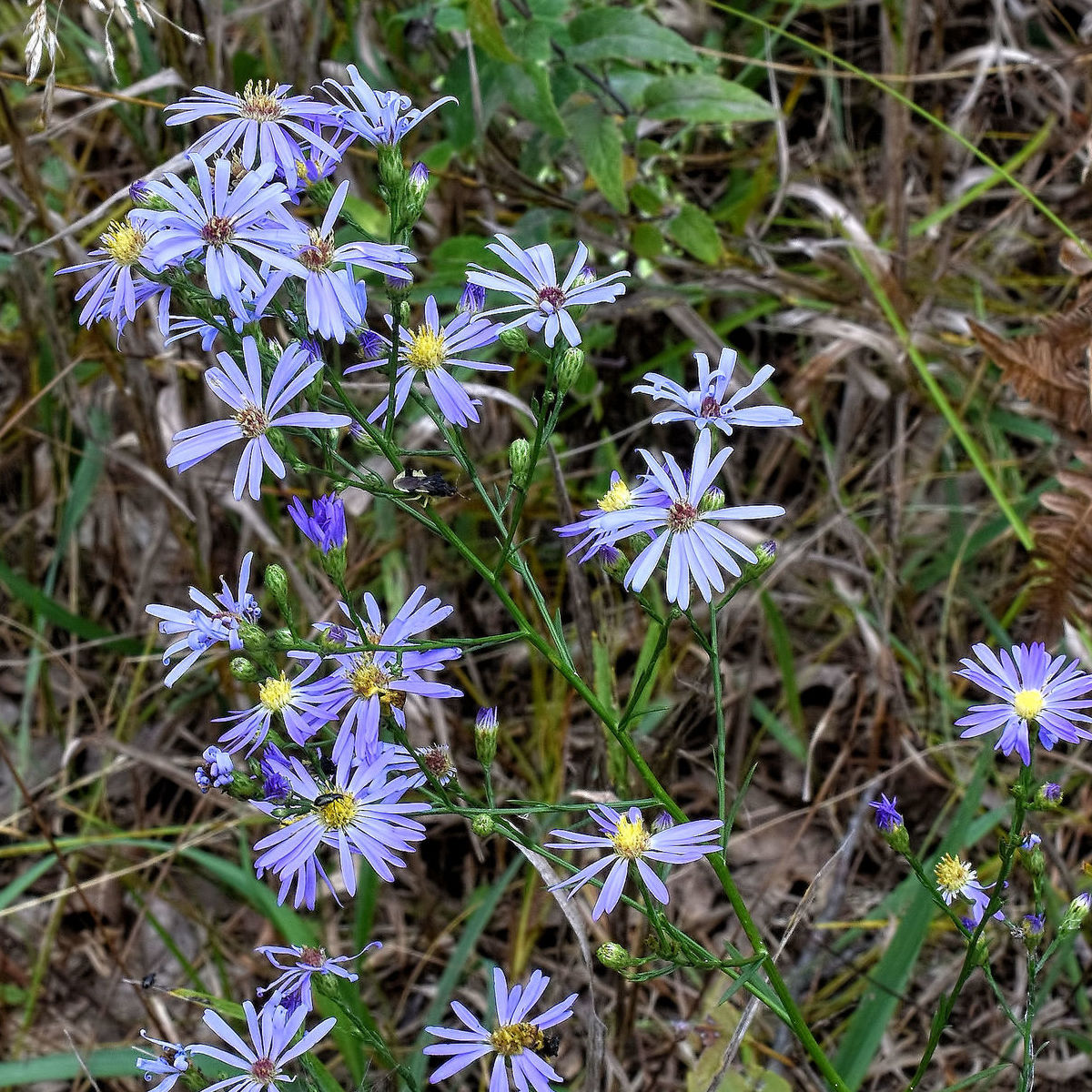
Sky blue aster (Symphyotrichum oolentangiense) carries a loose, branching spray of small blue to lavender flower heads above relatively restrained foliage. It is a useful late-season perennial for a prairie-style border, an open savanna garden, or a sunny woodland edge. Rather than making one heavy flower, it spreads color through many small heads that remain readable among grasses.
Older references and our legacy regional table call it Aster oolentangiensis; Aster azureus is another familiar synonym. These names refer to the same taxonomic concept addressed here, not to the separate smooth blue aster. The accepted name matters when ordering seed, matching photographs, or deciding whether an old table row already has a page.
This species is especially useful where gardeners want a late flower without relying on a constantly wet border. It grows in dry-to-average settings as well as suitable moist, drained soil. Like any native perennial, it still needs establishment care and a locally appropriate source. Its appearance in a multistate list does not make every county in that region part of its native range.
Identification
Stems and Overall Form
The plant is an herbaceous perennial with an upright stem that branches most conspicuously near the flower cluster. Typical plants are roughly one and a half to three feet tall, while some garden accounts allow three to four feet. A large branched head can cause a stem to lean. That open, sometimes slightly informal outline is part of its character rather than proof that it must be staked.
Basal and Lower Leaves
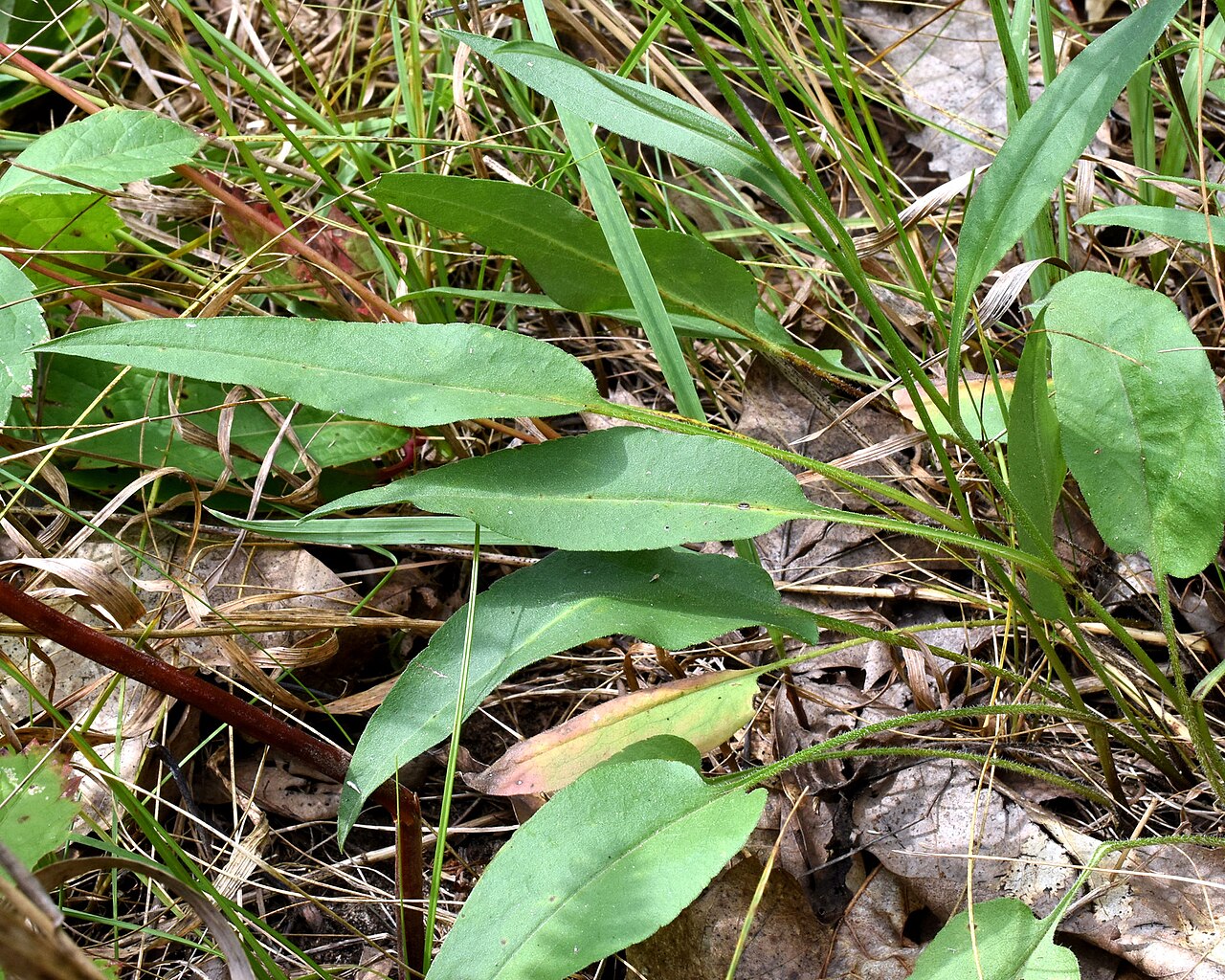
The lower leaves are broader than those near the top and have petioles. Basal leaves may be oval to somewhat heart-shaped and can persist as a low tuft. Look at an entire stem when identifying an aster; a single detached upper leaf misses the important change in leaf shape from base to tip. Lower leaves can become less conspicuous by flowering time.
Upper Leaves
Leaves become narrower and smaller upward along the stem, with the upper ones essentially stalkless. Their relatively smooth margins and the contrast with the broader lower foliage help build an identification. Hairiness varies and should be evaluated alongside other characters. It is safer to use a regional key than to name every blue autumn aster by color.
Flower Heads
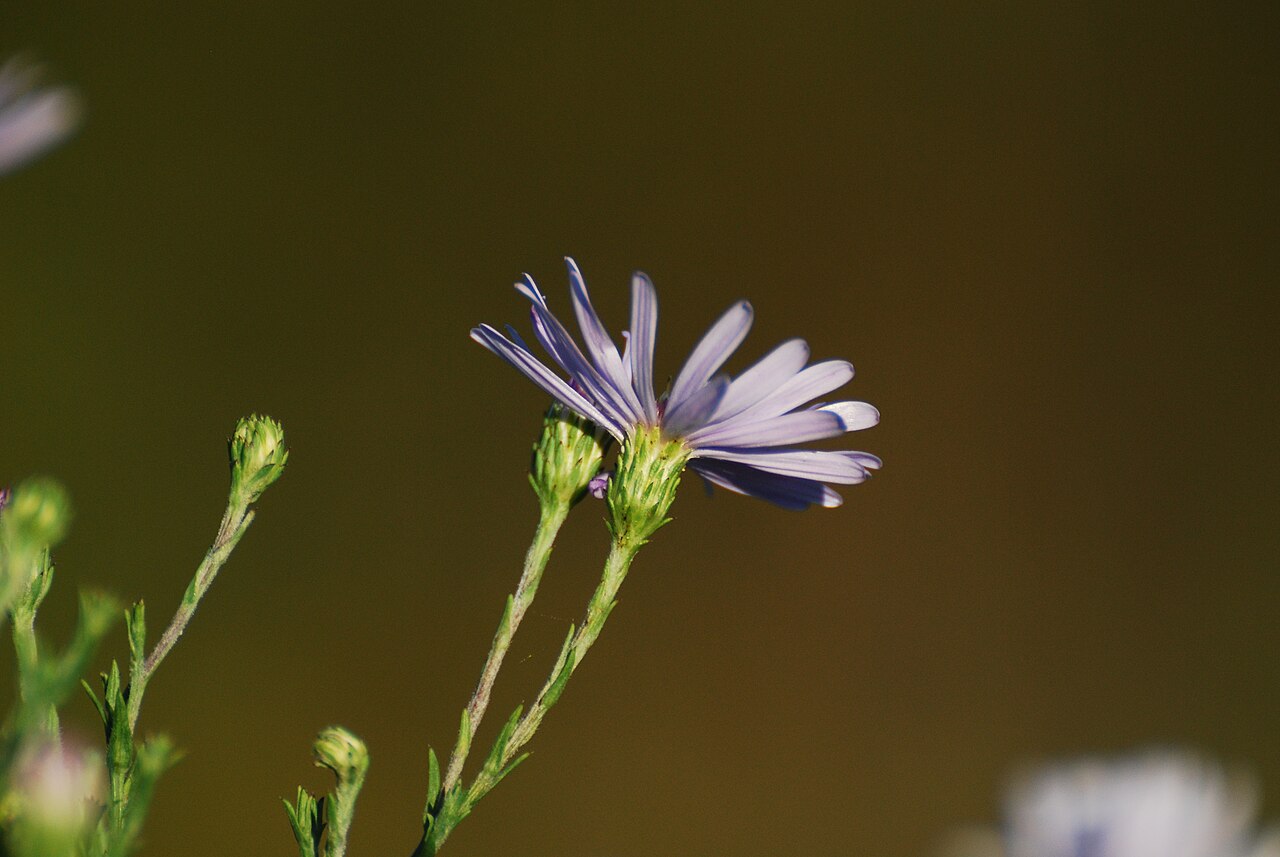
Each small daisy-like head consists of blue or lavender ray florets around a central group of tubular disk florets. The disk begins yellow and can darken as the head ages. Several levels of branches create an open panicle, so the total display is much larger than one head. The heads are generally around half an inch across or a little larger, not enormous daisies.
Involucre and Seed
The small bracts beneath the head are useful diagnostic structures; their green tips and arrangement should be examined with a hand lens. After flowering, small dry fruits with hairlike tufts disperse on the wind. Leave some mature stems where seed and winter texture are welcome, or remove selected heads before dispersal if controlling volunteers is important.
Separating Similar Asters
Smooth blue aster, Symphyotrichum laeve, is a different species and has a different pattern of leaf attachment. Short’s aster also resembles this plant but differs in leaf characters and habitat. Use the lower and middle leaves, upper foliage, head bracts, and local range together. A label that says only “blue aster” is not enough for species-specific native planting.
Quick Facts
| Scientific Name | Symphyotrichum oolentangiense |
| Synonyms | Aster oolentangiensis; Aster azureus |
| Family | Asteraceae — aster family |
| Plant Type | Herbaceous perennial wildflower |
| Mature Height | Usually 1.5–3 ft; some garden plants reach 4 ft |
| Mature Spread | A modest clump; rhizomes and seedlings can enlarge a patch |
| Growth Rate | Moderate, dependent on site and competition |
| Sun Exposure | Full sun to partial sun |
| Water Needs | Dry to average; suitable moist soil must drain |
| Soil Type | Loam, sand, rocky soil or drained clay |
| Soil pH | Adaptable; use local soil and provenance |
| Bloom Time | Late summer through autumn |
| Flower Color | Blue to lavender rays with yellow aging disks |
| Fall Color | Primarily valued for flowers rather than foliage |
| Fruit | Small dry fruits with wind-dispersal tufts |
| Deer Resistant | Browse can occur; not reliably deer-proof |
| USDA Hardiness Zones | Often listed for zones 3–9; choose regional stock |
Native Range
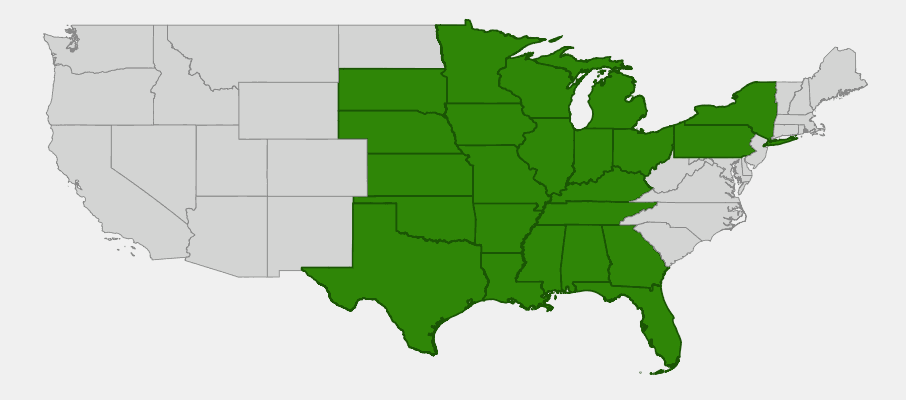
Kew’s Plants of the World Online accepts Symphyotrichum oolentangiense and documents a native range from southeastern Canada through the central and eastern United States into northeastern Mexico. The U.S. distribution is uneven, with prairie, savanna, open woodland, and related habitats providing local context. A state shaded on the map does not mean the plant occurs across every landscape within it.
Kansas and Nebraska are included in the documented range. Colorado is not included in the Kew state list used for this map, even though the legacy regional table combines Nebraska, Kansas, and eastern Colorado. A gardener in Colorado should not interpret that table membership as certification of local nativity. Use county records and a regional flora before selecting it for habitat restoration there.
The map follows Kew’s native-state list rather than adding states from ornamental cultivation. Ontario and northeastern Mexico belong to the wider range but are outside this U.S. map. Local provenance remains valuable even within the mapped states, because an established wild population reflects a particular climate, soil, and biological community.
📋 Regional plant list: Nebraska, Kansas and Eastern Colorado
Growing & Care Guide
Light
Choose a sunny or partly sunny position. An open woodland edge or savanna-like garden can be appropriate, but a dark closed-canopy bed is a different environment. Watch how neighboring shrubs grow over time; a site that works for a young planting may become shaded later. Some afternoon shade can be compatible with the plant, provided competition and moisture remain suitable.
Soil and Water
Dry-to-average conditions are a useful starting point. The species can grow in varied soil textures, including sandy, rocky, loamy, and suitably drained clay ground. It does not require a permanently moist rain-garden basin. Water newly planted stock while roots establish, then adjust to rainfall and the actual soil rather than keeping a meadow perennial on an annual-flower irrigation schedule.
Planting
Use a healthy nursery plant or seed lot with a full name and known provenance. Set a container plant at its existing crown level, firm the surrounding soil, and water to settle the roots. Remove aggressive perennial weeds before planting. Small asters cannot establish well if immediately overtopped by dense turf or a mat of invasive groundcover.
Spacing and Support
Allow room for the branching flower head and nearby companions. A little mutual support from compatible meadow plants can be more natural-looking than isolating every stem with a stake. If plants become excessively weak or floppy, investigate shade, overfeeding, and crowding. Do not assume that a late-season lean always requires a chemical or a structural intervention.
Fertility
Avoid routine heavy feeding. Rich conditions can encourage excessive growth or vigorous competitors, while the plant is adapted to many comparatively lean habitats. A soil test is useful when a deficiency is suspected. More fertilizer is not a substitute for removing shade, improving drainage, or giving roots space. The goal is a healthy flowering perennial, not the largest possible stem.
Maintenance
Remove unwanted weeds early and retain the basal plant when tidying the bed. Old stems may be left for winter structure where appropriate, then cut before new growth is crowded. Selective deadheading can limit seed or tidy a path edge, but removing every mature head also removes seed resources. Choose a maintenance pattern that fits the setting rather than a universal calendar.
Propagation by Division
An established cultivated clump can be divided when growing conditions are mild and replanting can be followed by adequate water. Retain healthy roots and buds with each piece. Replant promptly and mark the new divisions. Do not collect divisions from high-quality natural areas simply because the plant is locally familiar. Nursery stock protects those existing communities.
Propagation by Seed
Use correctly identified seed and follow the supplier’s instructions for dormancy treatment and sowing. The small seedlings require attention to weeds and moisture during establishment. Label trays with both accepted name and known synonym if working from older records. Seed-grown material provides variation; it should not be expected to behave like a single selected ornamental clone.
Leaf Problems
Powdery mildew can occur, especially where air movement and light are poor. A few marked lower leaves do not automatically justify treatment. Keep plants suitably spaced, avoid unnecessary wetting of foliage, and obtain a diagnosis if damage is severe or unusual. Preserve beneficial insects and do not spray a flowering native border merely to make every leaf cosmetically perfect.
Regional Planting Decisions
Use the plant where its local range and habitat support the project’s goals. A decorative garden may include a responsibly managed plant outside its historic range, but that should be described honestly rather than called local restoration. In the Nebraska–Kansas–Colorado list, pay particular attention to the Colorado boundary. A regional heading is a navigation aid, not a botanical distribution record.
Landscape Uses
- Late blue color in prairie-style native borders.
- Open savanna gardens with compatible grasses and forbs.
- Dry-to-average sunny slopes and well-drained meadow openings.
- A late-season complement to locally native goldenrods and earlier bloomers.
Wildlife & Ecological Value
Late-Season Flower Visitors
The composite heads provide nectar and pollen to a variety of visiting insects, including bees and flies. Their timing is useful when some earlier meadow flowers have finished. Include several flowering species with overlapping seasons rather than relying on a single aster to supply the entire garden. Observe visitors without assuming every insect is a pest.
Foliage and Food Webs
Asters support a variety of plant-feeding insects as a group. Species-level host claims should be made carefully, but some leaf feeding is a normal part of a functioning native planting. Tolerate modest damage where the plant remains healthy. A garden designed only for unblemished leaves can remove much of the ecological value it was intended to provide.
Seeds and Browsing
Dry heads can provide small seeds and winter texture. Deer, rabbits, and other herbivores may browse asters, so the plant should not be sold as universally deer-proof. Protect young plants if local browsing is intense, then assess whether the established patch can coexist with that pressure. Match the management to observed damage rather than a blanket label.
Community Structure
Sky blue aster adds a late-flowering broadleaf component among grasses and other prairie plants. Its value is strongest as part of an appropriately diverse community. Keep invasive weeds from replacing that community, and avoid collecting plants or seed without permission from remnant habitats that may already be conservation-sensitive.
Cultural & Historical Uses
The older names Aster azureus and Aster oolentangiensis remain useful for reading historic garden lists and herbarium records. Modern botanical treatments place the plant in Symphyotrichum. Recording both the accepted name and synonyms prevents duplicate purchases and, on a plant website, duplicate pages for the same taxon.
The blue late-season display has made this species appealing in prairie and native-border horticulture. Its suitability for a dry-to-average setting offers a different design option from moisture-demanding asters. Garden recommendations should still distinguish regional horticultural performance from the documented native range.
This guide does not assign medicinal or food uses to the plant. Its documented botanical identity, late-season flowers, and role in a native planting provide ample reasons to grow it without inventing an ethnobotanical story. Use propagated stock and keep a record of origin when the planting is intended to support local ecological communities.
Frequently Asked Questions
Is Aster oolentangiensis a different plant?
It is an older synonym of Symphyotrichum oolentangiense, the species covered here. Aster azureus is another synonym.
Is sky blue aster the same as smooth blue aster?
No. Smooth blue aster is Symphyotrichum laeve. Compare leaf attachment and other diagnostic characters, not just flower color.
Does it need a wet garden?
No. Dry-to-average, well-drained sites can be suitable. Provide establishment water without creating permanent saturation.
Can I assume it is native in Colorado because of the regional table?
No. The table combines three states. Colorado is not in the Kew native distribution used for this page; check local botanical records.
Should I remove every seed head after flowering?
Only if that suits your management goal. Leaving some heads retains seed and seasonal structure; selective removal can control volunteers near paths.
Sources & Further Reading
- Kew Plants of the World Online: accepted name and native distribution
- University of Illinois Extension
- Illinois Wildflowers identification account
- Illinois Natural History Survey taxonomy
- USDA PLANTS
Find Native Plants
Ask growers about nursery propagation and regional provenance. Browse our NE native plant nurseries, KS native plant nurseries directory for suppliers. Explore the native nursery finder.