
Dwarf Iris (Iris lacustris)
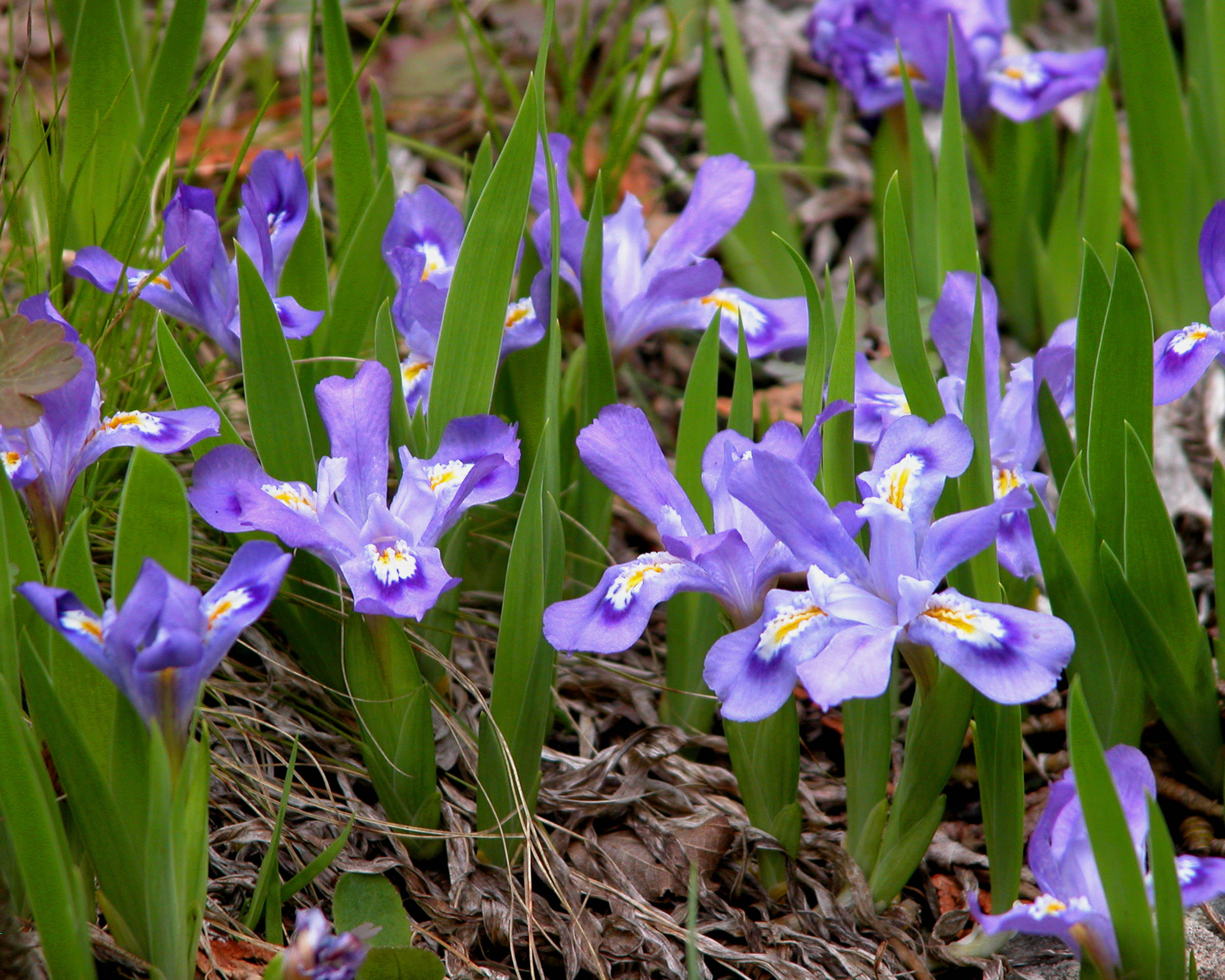
Iris lacustris, known as Dwarf Iris or Dwarf Lake Iris, is one of the smallest and rarest irises in North America — a diminutive, rhizomatous perennial that forms a low, spreading mat only 2 to 6 inches tall, with blue-violet flowers barely rising above its fan of narrow leaves. It is found nowhere else on Earth outside the shores of the upper Great Lakes, growing almost exclusively on thin, calcium-rich soils over limestone or dolomite bedrock within a few miles of Lake Michigan and Lake Huron.
Dwarf Iris is listed as a federally threatened species under the U.S. Endangered Species Act (listed in 1988), and it carries additional state protection in both Michigan and Wisconsin. Its entire global population is concentrated in a narrow band of shoreline habitat that has been steadily lost to residential and vacation-home development, road widening, shoreline hardening, and recreational trampling. Because of its rarity and legal protection, Dwarf Iris should never be dug or collected from the wild — plants for gardens should come only from nurseries propagating legally sourced, cultivated stock, never from wild populations.
Despite its rarity in the wild, Dwarf Iris is a well-behaved, long-lived garden plant where it can be legally grown from nursery-propagated material, slowly spreading by rhizome to form a dense, almost moss-like mat of foliage topped with delicate blue-violet flowers each spring. It is prized by rock gardeners and native plant enthusiasts for its tidy scale and is one of the few true groundcover irises available.
Identification
Dwarf Iris is unmistakably small compared to any other North American iris — the entire plant, leaves and all, rarely exceeds 6 inches in height, spreading slowly by thin, branching rhizomes just beneath the soil surface to form expanding colonies or mats over time.
Leaves
Leaves are narrow, sword-shaped (ensiform), and arranged in flat, overlapping fans only 2 to 6 inches long and about a quarter-inch wide, noticeably elongating somewhat after flowering is complete. The foliage is a clean medium green and stays low and tidy through the growing season.
Flowers
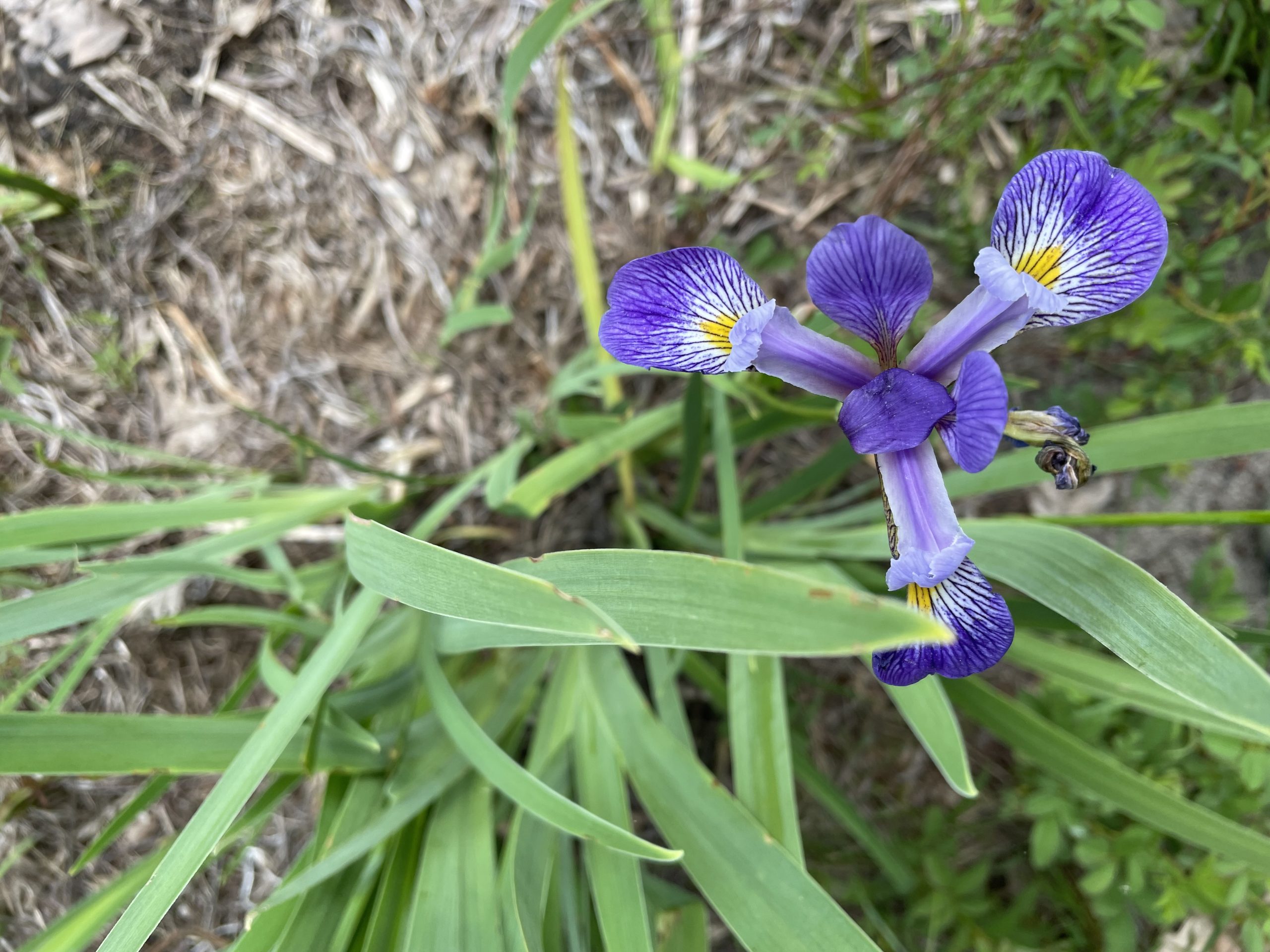
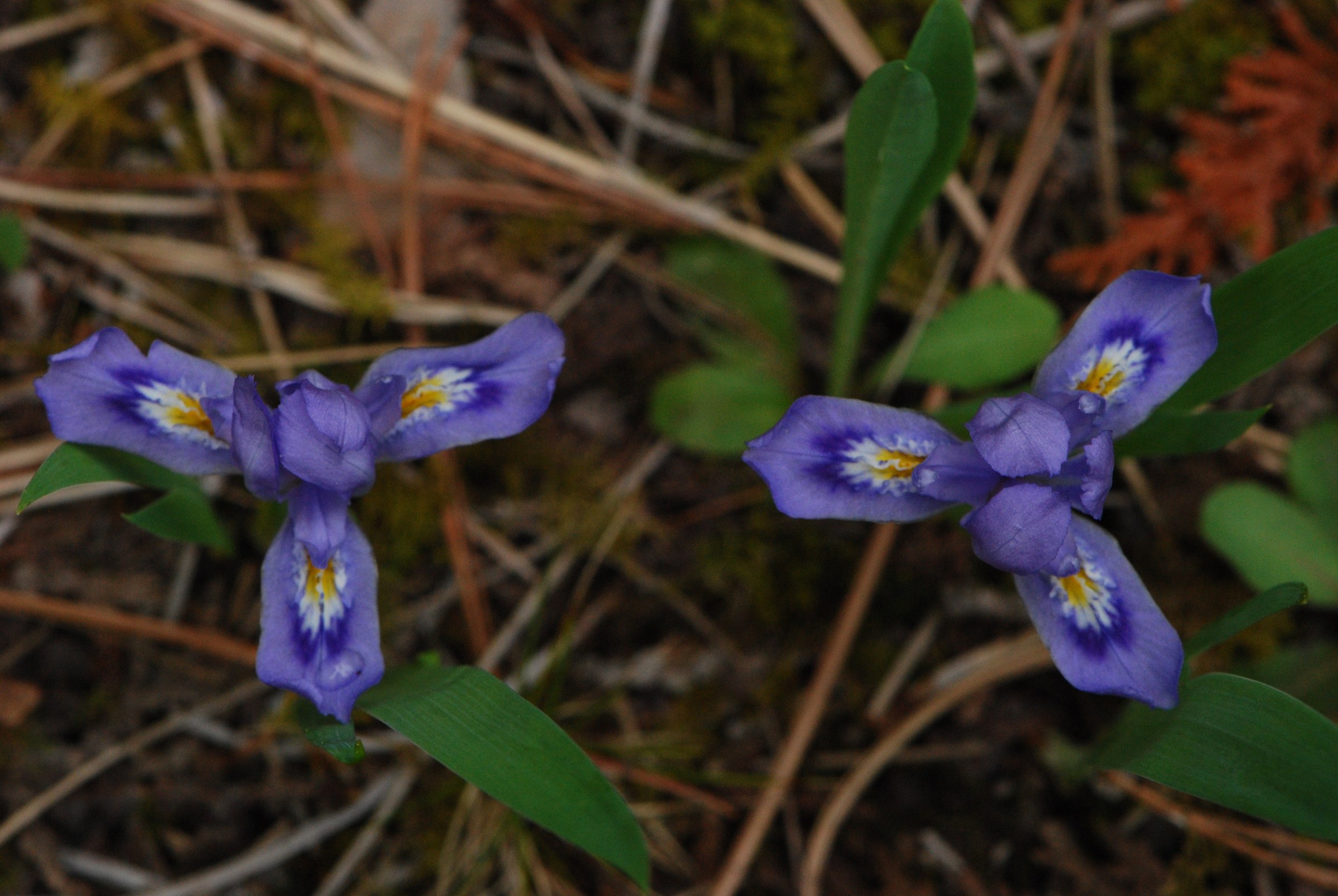
Each flower stalk is so short that the blue-violet flowers appear to sit almost directly atop the leaf fan. Flowers are about 2 inches across with the classic iris form: three drooping “falls” marked with a white and yellow signal patch veined in deep violet, and three smaller upright “standards” in clear blue-violet. Bloom is brief, typically just one to two weeks in mid to late spring.
Fruit & Seeds
After flowering, a small three-chambered seed capsule develops at ground level, eventually splitting to release seeds. In the wild, most reproduction and spread happens vegetatively through the branching rhizome system rather than by seed.
Quick Facts
| Scientific Name | Iris lacustris |
| Family | Iridaceae (Iris) |
| Plant Type | Rhizomatous Herbaceous Perennial |
| Mature Height | 2–6 in |
| Mature Spread | Slowly spreading mat, indefinite with age |
| Growth Rate | Slow |
| Sun Exposure | Full Sun to Part Shade |
| Water Needs | Moderate |
| Soil Type | Thin, calcium-rich soil over limestone or dolomite; well-drained |
| Soil pH | 7.0–8.0 (neutral to alkaline) |
| Bloom Time | May – June |
| Flower Color | Blue-violet with yellow-and-white signal |
| Fall Color | Foliage remains green into late fall |
| Fruit | Small three-chambered seed capsule |
| Deer Resistant | Yes |
| USDA Hardiness Zones | 3–7 |
Native Range
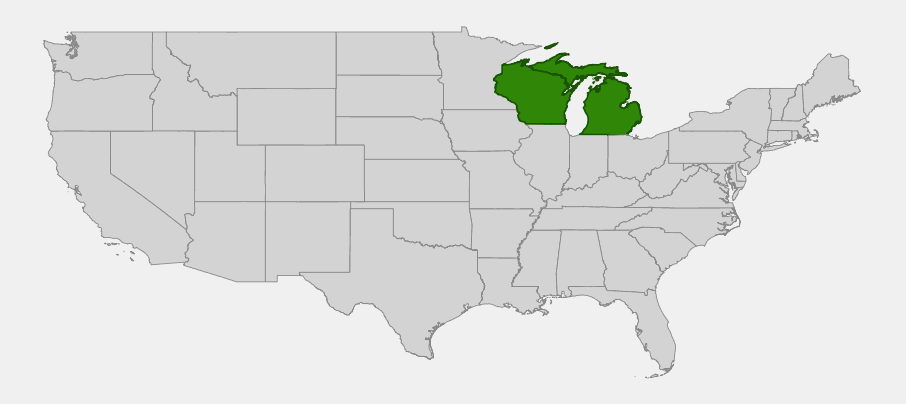
Dwarf Iris has one of the most restricted native ranges of any North American wildflower: it occurs only along the shorelines of Lake Michigan and Lake Huron, essentially entirely within Michigan and Wisconsin, with a small disjunct presence across the Canadian border in Ontario. Historical records indicate it once grew as far south as the Milwaukee area and possibly near the Detroit River in Ontario, but those southern populations have been lost.
Within its narrow U.S. range, the species is concentrated along the northern Lower Peninsula and Upper Peninsula shorelines of Michigan — including the Leelanau Peninsula, the Straits of Mackinac area, and Door County-style limestone shorelines — and along Wisconsin’s Door Peninsula on Lake Michigan. It is not native to any other state; references to the species occurring more broadly in the Great Lakes region reflect its close relative, the more widespread Dwarf Crested Iris (Iris cristata), a different species found in the eastern and southern U.S.
Dwarf Iris is a habitat specialist, restricted to thin soils directly over alkaline limestone or dolomite bedrock within the moderating influence of the Great Lakes — typically in the dappled shade of cedar and conifer woodlands close to shore, or in open, sunnier gravelly shoreline habitats called alvars. This narrow, specific habitat requirement is the central reason for both its rarity and its vulnerability to shoreline development.
📋 Regional plant lists featuring Dwarf Iris: Michigan, Wisconsin & Eastern Minnesota
Growing & Care Guide
Because Dwarf Iris is a federally threatened species, plants for the garden should come only from reputable native plant nurseries that propagate it legally from cultivated stock — never dig or transplant it from a wild population, even on private land, without the required permits. Once legally sourced, it is a rewarding, low-maintenance groundcover for the right site.
Light
Dwarf Iris does best in dappled shade to part sun, mimicking the open conifer woodlands and shoreline edges where it grows wild. It tolerates more sun in consistently cool, moist climates but appreciates afternoon shade further south in its hardiness range.
Soil & Water
This species needs sharply drained, neutral to alkaline soil — it struggles in acidic garden soil and benefits from added lime or a naturally limestone-derived soil if your garden is acidic. Keep soil evenly moist but never waterlogged; good drainage is essential, echoing its native thin-soil-over-bedrock habitat.
Planting Tips
Plant rhizome divisions shallowly, just at or barely below the soil surface, in spring or early fall. Space plants 6 to 12 inches apart if establishing a mat, since mature colonies fill in slowly over several years. A rock garden, alpine trough, or the edge of a shaded woodland path over naturally alkaline or limestone-amended soil suits it well.
Pruning & Maintenance
Dwarf Iris needs essentially no pruning. Remove old, tattered foliage in late fall or early spring if desired, and topdress with a thin layer of leaf litter or compost rather than heavy mulch, which can smother the shallow rhizomes.
Landscape Uses
Its tiny scale makes Dwarf Iris a specialty plant for the right setting:
- Rock gardens and alpine or scree plantings
- Shaded woodland groundcover at path edges
- Alkaline soil gardens where limestone is near the surface
- Container or trough plantings for close viewing of the small flowers
- Conservation and rare-plant demonstration gardens
Wildlife & Ecological Value
Within its narrow habitat niche, Dwarf Iris contributes early-season nectar and ground cover in a plant community that is itself uncommon and ecologically distinctive.
For Pollinators
The flowers are visited by early-season bees, which must be strong enough to pry open the tightly furled petals to reach nectar — a classic iris pollination mechanism that favors larger native bees over smaller generalist insects.
For Birds
Dwarf Iris plays a minor direct role for birds, though its low, mat-forming growth contributes ground-level cover within the sparse understory of the cedar woodlands it shares with ground-nesting and ground-foraging species.
For Mammals
Like most irises, Dwarf Iris contains compounds that make it unpalatable and generally avoided by deer and rabbits, helping it persist even under moderate browse pressure in its native habitat.
Ecosystem Role
Dwarf Iris is considered an indicator species for the rare alkaline shoreline and cedar-forest communities of the upper Great Lakes; its presence signals a largely intact, undisturbed limestone shoreline ecosystem, and its decline across much of its historical range has tracked closely with the loss of that habitat type to development.
Cultural & Historical Uses
Because of its small size, restricted range, and rarity, Dwarf Iris has little documented history of traditional use by Indigenous peoples or early settlers compared to more widespread native plants — unlike many irises, it was never common or abundant enough across a broad area to become a significant resource plant.
Its modern significance is primarily as a conservation symbol. Dwarf Iris has been studied extensively by botanists and conservation agencies since its 1988 federal listing, and it serves as something of a flagship species for Great Lakes alkaline shoreline conservation, drawing attention to a habitat type that supports numerous other rare plants.
Today, where legally propagated nursery stock is available, Dwarf Iris is grown by rock gardeners and native plant collectors as a connoisseur’s groundcover, valued for its rarity, tidy scale, and the satisfaction of supporting a threatened species’ genetic conservation through cultivated garden populations.
Frequently Asked Questions
Is it legal to grow Dwarf Iris in my garden?
Yes, as long as the plant comes from a nursery that propagates it from legally obtained cultivated stock. It is illegal to collect this federally threatened species from the wild, including from private land in many cases, without the required permits.
Why is Dwarf Iris so rare?
It has an extremely narrow natural habitat requirement — thin, alkaline soil over limestone or dolomite bedrock within the moderating climate influence of Lake Michigan and Lake Huron. That habitat has been heavily developed for shoreline homes and recreation, shrinking an already small historical range.
Can Dwarf Iris grow outside Michigan and Wisconsin?
It can be cultivated well outside its native range in similar alkaline, well-drained conditions (zones 3–7), but it is only naturally native to the Great Lakes shoreline of Michigan and Wisconsin, plus a small historical presence in Ontario.
How is Dwarf Iris different from Dwarf Crested Iris?
They are different species that are often confused by name. Dwarf Crested Iris (Iris cristata) is more widespread across the eastern and southern U.S. and has a distinctive ridged, “crested” signal on its falls, while Dwarf Iris (Iris lacustris) is restricted to the Great Lakes shoreline and has a smooth, non-crested signal patch.
Does Dwarf Iris spread aggressively?
No — it spreads slowly by rhizome and is not aggressive or weedy. Established colonies take years to fill in, which is part of why wild populations recover so slowly from disturbance.

Looking for a nursery that carries Dwarf Iris?
Browse our native plant nursery directory: Michigan & Wisconsin region