Hops (Humulus lupulus)
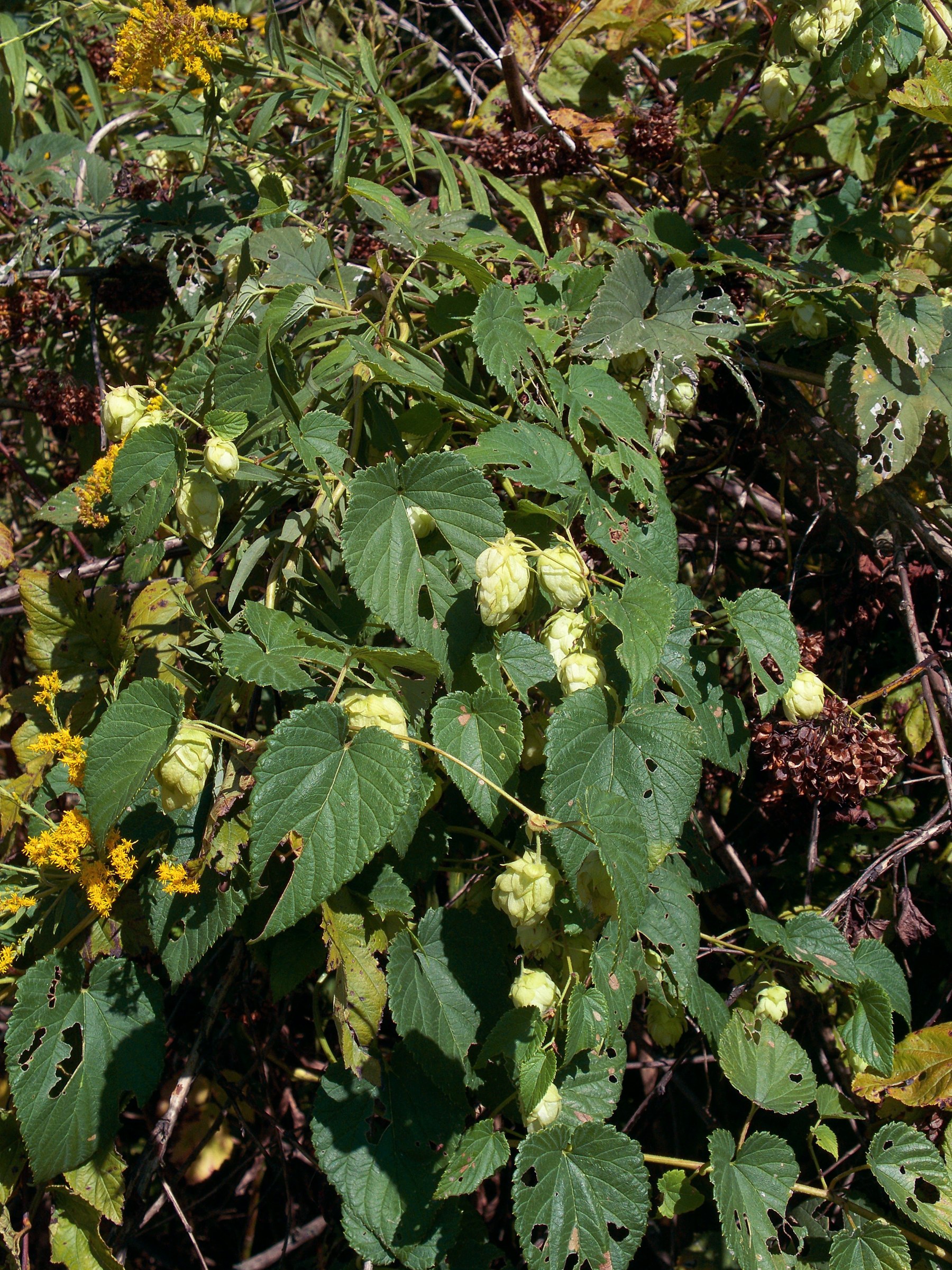
Humulus lupulus, commonly known as Hops or Common Hop, is a vigorous herbaceous perennial vine in the hemp family (Cannabaceae) that climbs by twining rather than tendrils, hauling itself 15 to 25 feet up fences, shrubs, and streamside trees in a single growing season before dying back to the ground each winter. Three native North American varieties — Humulus lupulus var. lupuloides (the widespread wild hop of the eastern woodlands and Midwest), var. pubescens (centered on the Midwest prairies), and var. neomexicanus (the Rocky Mountain and Southwestern form) — are true natives of this continent, distinct from the European Humulus lupulus var. lupulus that was brought over by colonists and is now the variety grown commercially in the Pacific Northwest hopyards of Washington, Oregon, and Idaho. The European variety has also escaped cultivation and naturalized in parts of the East and Midwest, so a hop vine along a fencerow is not automatically the wild native plant — this page covers the native varieties.
Where it grows wild, hops forms dense, scrambling thickets in streamside woods, fencerows, thicket edges, and disturbed ground with full sun to light shade and reliably moist soil. The vines emerge from a perennial rootstock each spring, climb rapidly by wrapping their rough, bristly stems clockwise around any available support, and by late summer are hung with distinctive papery, cone-like female flower clusters (strobiles) that give the plant its brewing fame. Male and female flowers grow on separate plants, so only female vines produce the familiar hop cones.
Beyond its role in beer, wild hops is a valuable larval host plant for several butterfly and moth species, provides dense summer cover for birds and small mammals along field edges and streambanks, and its spring foliage is an early food source for emerging wildlife. A note of caution for pet owners: hops is toxic to dogs — ingestion, especially of spent brewing hops, can cause a rapid and sometimes fatal rise in body temperature (malignant hyperthermia), so keep dogs away from both the growing vine and any discarded hop cones.
Identification
Hops is a climbing herbaceous perennial that dies back to its rootstock each winter and sends up new bines (twining stems, as opposed to tendril-climbing vines) in spring. The stems are rough to the touch, covered in stiff, hooked hairs that help the plant grip rather than cling, and they always twine clockwise around their support.
Leaves
Leaves are opposite, rough-textured, and deeply palmately lobed, usually with three to five lobes and coarsely toothed margins, closely resembling grape leaves but with a sandpapery feel on both surfaces. They are borne on long petioles and arranged in pairs along the twining stems.
Flowers
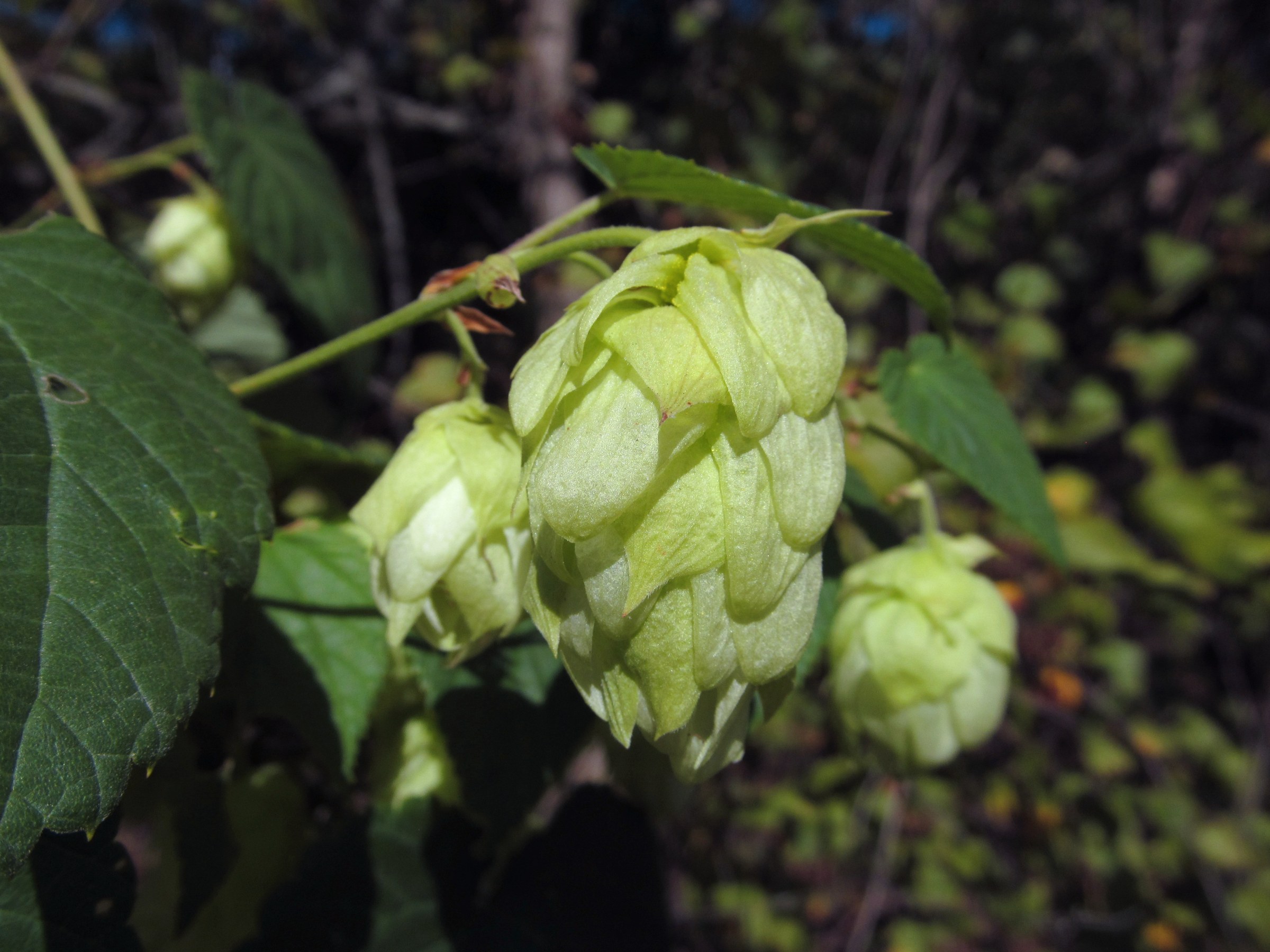
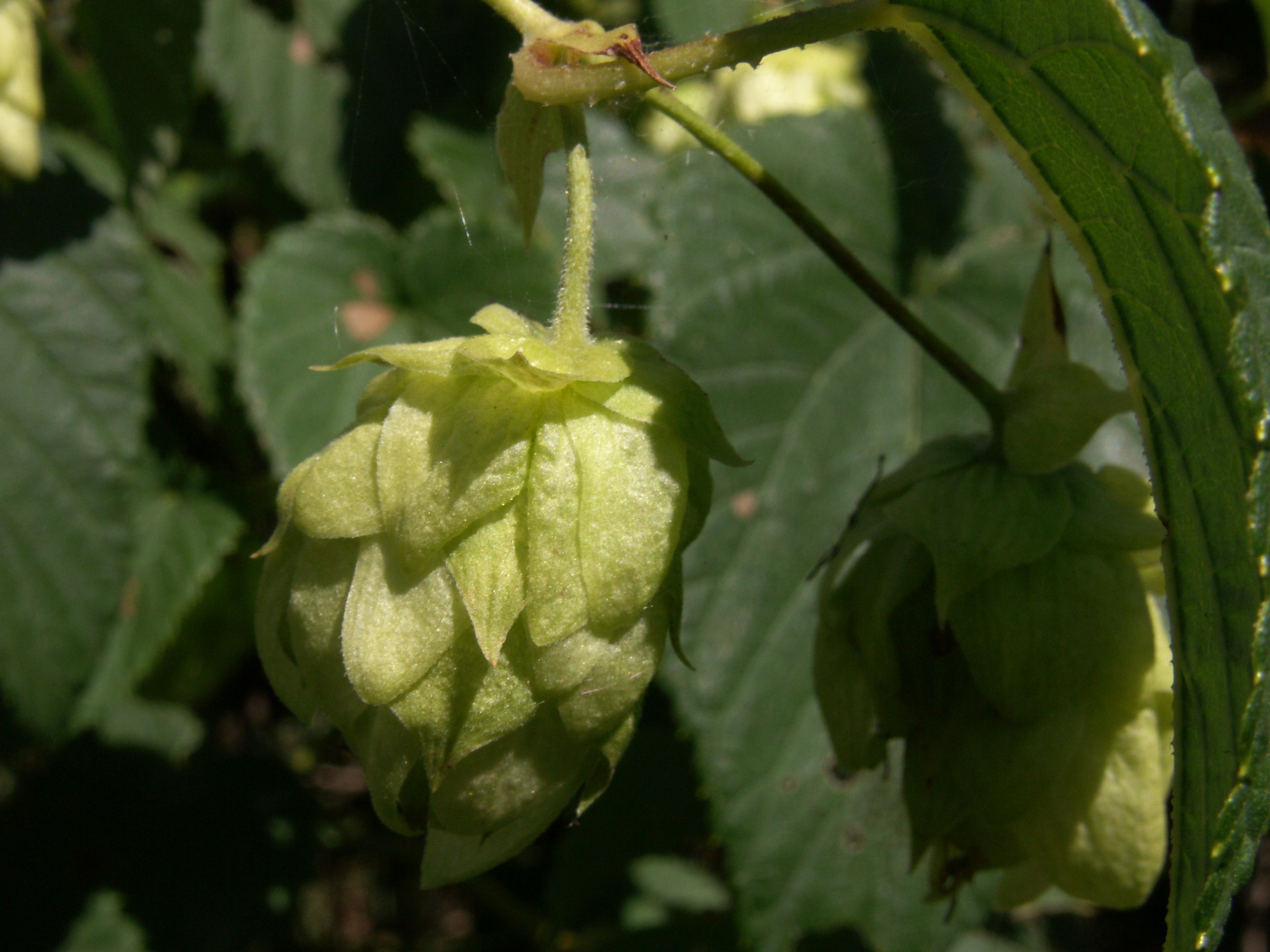
Hops is dioecious — male and female flowers grow on separate plants. Male flowers form loose, branching panicles of small greenish-yellow blooms. Female flowers develop in short spikes that mature into the hop cone: an inch or two of overlapping, papery, pale green bracts (a strobile), each bract cupping a small fruit dusted with sticky yellow lupulin glands — the resinous powder that carries the plant’s bittering and aromatic compounds.
Fruit & Seeds
The cones ripen from green to a dry, straw-colored tan in late summer and early fall, becoming papery and lightweight, with a small hard achene at the base of each bract. Cones persist on the vine into autumn and are an important late-season food source for seed-eating birds.
Quick Facts
| Scientific Name | Humulus lupulus (native vars. lupuloides, pubescens, neomexicanus) |
| Family | Cannabaceae (Hemp) |
| Plant Type | Herbaceous Perennial Vine |
| Mature Height | 15–25 ft of annual climbing growth |
| Mature Spread | 3–6 ft at the base, spreading by rhizome |
| Growth Rate | Fast (up to several inches per day in summer) |
| Sun Exposure | Full Sun to Part Shade |
| Water Needs | Moderate to High |
| Soil Type | Rich, moist, well-drained loam |
| Soil pH | 6.0–7.5 (neutral to slightly acidic) |
| Bloom Time | July – August |
| Flower Color | Greenish-yellow |
| Fall Color | Yellow before dieback |
| Fruit | Papery green-to-tan hop cones (strobiles) |
| Deer Resistant | Yes (rough, bitter foliage) |
| USDA Hardiness Zones | 3–8 |
Native Range
The three native North American varieties of hops together span a broad swath of the eastern, central, and Rocky Mountain United States. Var. lupuloides is the common wild hop of the Northeast, Great Lakes, and Appalachian region; var. pubescens occupies the Midwestern prairie states; and var. neomexicanus takes over through the Rocky Mountains and Southwest, intergrading with the other varieties where their ranges meet across the Dakotas and the Plains. None of the three native varieties is native to the Pacific Coast states.
This is an important distinction for gardeners: the hop industry of Washington, Oregon, and Idaho is built almost entirely on the introduced European variety, Humulus lupulus var. lupulus, which is not native to North America and has also escaped cultivation into hedgerows and riverbanks well outside its native European range. A wild-looking hop vine in the Willamette or Yakima valleys is virtually always this introduced form, not a native plant.
Across its true native range, hops favors moist bottomland soils — riverbanks, floodplain thickets, fencerows bordering wet meadows, and the brushy edges of woodlands — where it can find both sun and something sturdy to climb. It tends to avoid the acidic, sandy soils of the Southeastern coastal plain and the arid lowlands of the desert Southwest, which is why its native range skips over the Deep South and the hottest, driest parts of the West.
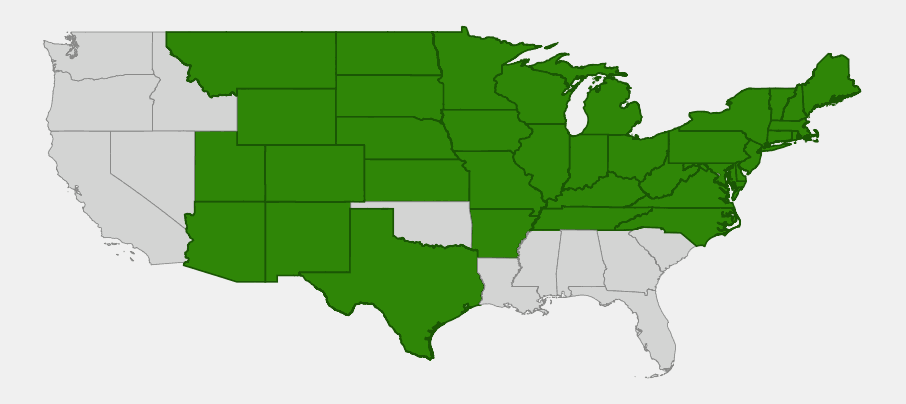
📋 Regional plant lists featuring Hops: Arkansas, Louisiana, Eastern Oklahoma & Eastern Texas · Arizona & New Mexico · North Dakota, South Dakota & Western Minnesota · Delaware, Southern New Jersey & Long Island, New York · Illinois, Iowa & Missouri · Ohio & Indiana · Kentucky & Tennessee · Maryland, Virginia & West Virginia · Michigan, Wisconsin & Eastern Minnesota · Montana & Wyoming · North Carolina & South Carolina · Nebraska, Kansas & Eastern Colorado · New Hampshire, Maine & Vermont · Connecticut, Massachusetts & Rhode Island · New York, Pennsylvania & Northern New Jersey · Utah & Western Colorado
Growing & Care Guide
Native hops is an easy, enthusiastic grower once given something to climb, and it is one of the fastest-growing perennial vines available for native gardens — well suited to a trellis, arbor, or chain-link fence where its rapid summer growth can be put to good use as seasonal shade or screening.
Light
Hops flowers and cones best in full sun but tolerates part shade, particularly in hot climates where afternoon shade can prevent leaf scorch. Vines grown in too much shade climb taller searching for light but produce fewer cones.
Soil & Water
Give hops rich, well-drained soil with consistent moisture, especially during the vigorous growth spurt in late spring and early summer. It is not a plant for dry, sandy, or heavy clay sites — think of the moist streambanks and bottomlands where it grows wild. A thick mulch layer helps retain soil moisture and keeps the shallow rhizomes cool.
Planting Tips
Plant rhizome divisions or container stock in spring after the last frost, siting them at the base of a sturdy trellis, arbor, or fence at least 8 feet tall — the vines will use every inch of it. Space plants 3 to 4 feet apart if growing more than one. Only female plants produce cones, so if hop production matters to you, source a known female division rather than wild seed, which produces an unpredictable mix of males and females.
Pruning & Maintenance
Cut the dead bines to the ground each winter after the foliage browns; new growth emerges from the crown in spring. In its second and later years, hops can send up a dozen or more shoots per crown — thin to 3 or 4 of the strongest to keep the planting manageable and encourage larger cones. The rhizomes spread gradually and may need dividing or containing after several years in rich soil.
Landscape Uses
Hops rewards a gardener willing to give it structure to climb:
- Seasonal privacy screen on an arbor, trellis, or chain-link fence
- Streambank and riparian restoration plantings
- Wildlife hedgerow mixed with other native vines and shrubs
- Vertical accent for a native plant garden with limited ground space
- Pollinator and songbird habitat along field edges
Wildlife & Ecological Value
Wild hops contributes food and cover across the growing season, particularly valuable in the thicket and edge habitat it naturally occupies.
For Pollinators
Hops is wind-pollinated rather than insect-pollinated, so it offers little nectar, but its dense summer foliage shelters many beneficial insects, and the related wind-blown pollen is a minor food source for some pollen-feeding insects in midsummer.
For Birds
Seed-eating birds, including goldfinches and sparrows, feed on the small achenes inside mature hop cones in fall and winter. The tangled summer growth also provides excellent nesting cover for birds that favor dense thicket habitat.
For Mammals
Deer and rabbits generally avoid the rough, bitter foliage, making hops one of the more reliably deer-resistant native vines. Small mammals use the dense low growth at the base of the vine for cover.
Ecosystem Role
As a fast-growing herbaceous vine of streambanks and forest edges, hops helps stabilize disturbed soil along waterways and quickly fills gaps in hedgerows and thicket margins, contributing structural complexity to edge habitat without the long-term woody presence of a shrub or tree.
Cultural & Historical Uses
Long before hops became synonymous with beer, Indigenous peoples across the plant’s native range used the fibrous stems for cordage and incorporated the plant into traditional preparations, according to historical ethnobotanical records. European settlers, familiar with hops from Old World brewing traditions, quickly recognized the value of the wild American vines and in some regions cultivated or encouraged native stands near homesteads.
Hops rose to major commercial importance in the 1800s as American brewing expanded, with New York State becoming a leading hop-growing region for a time before production shifted west to the Pacific Northwest in the early 20th century, where the cooler, drier climate and irrigation suited the introduced European variety particularly well. That shift is why the hop farms of Washington’s Yakima Valley today grow almost exclusively non-native stock, even though wild native hops still climbs fencerows across much of the rest of the country.
Today, home brewers and native plant gardeners alike grow hops both for its ornamental, fast-climbing habit and, where a known female selection is used, for a modest home harvest of cones. The native varieties are of particular interest to breeders seeking genetic diversity and disease resistance not found in the narrower European cultivated stock.
Frequently Asked Questions
Is wild hops the same plant used to brew beer?
It’s the same species, but most commercial beer is brewed with cultivars of the introduced European variety, Humulus lupulus var. lupulus. The native American varieties covered on this page are a different, wild lineage; they can be used similarly but are not the source of most commercial hop cultivars.
Are hops toxic to pets?
Yes — hops is toxic to dogs. Ingesting hop cones or plant material, especially spent hops from home brewing, can trigger a dangerous and sometimes fatal spike in body temperature. Keep growing vines and any hop cones or brewing waste well out of reach of dogs.
Does hops need a male and female plant to produce cones?
No. Hops is wind-pollinated, and female plants produce cones whether or not a male plant is nearby — pollination simply affects whether the cones develop viable seed. Most growers want unpollinated, seedless cones, so a female-only planting is typical.
How invasive is hops in the garden?
Hops spreads by rhizome and can form a substantial colony over several years in rich, moist soil, so it benefits from being planted where its root spread is bounded by a path, driveway, or root barrier, or simply given room to roam in a naturalized planting.
Can hops grow in a container?
Yes, in a large container with a tall support, though it will need more frequent watering than an in-ground planting and will likely need dividing or root-pruning every few years as the rhizome fills the pot.

Looking for a nursery that carries Hops?
Browse our native plant nursery directory: AZ/AR region · CO/CT/DE region · IL/IN/IA/KS region · KY/ME/MD/MA/MI/MN/MO/MT region · NE/NH/NJ/NM/NY/NC/ND/OH region · PA/RI/SD/TN/TX/UT/VT/VA region · WV/WI/WY region