
Sea Asparagus (Sarcocornia pacifica)
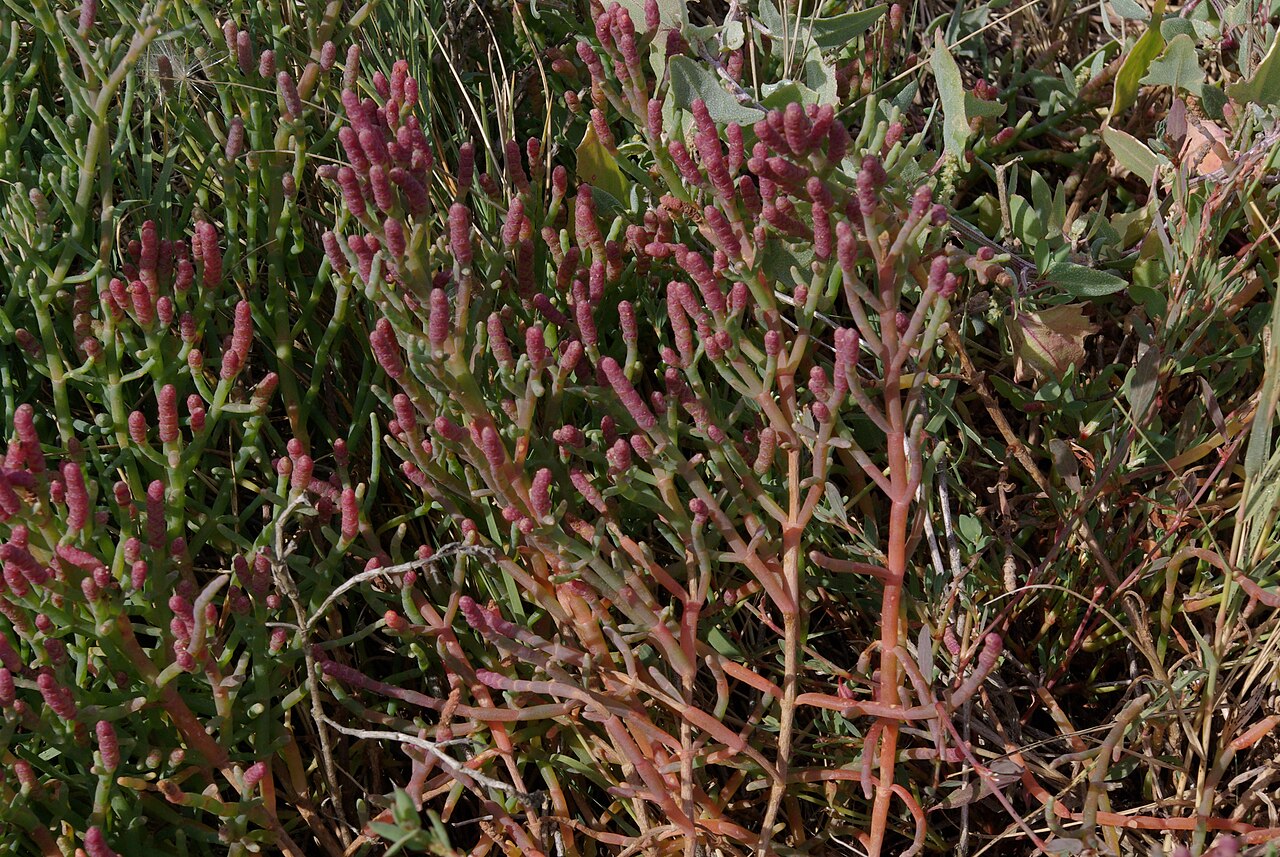
Sarcocornia pacifica (long known as Salicornia pacifica or Salicornia virginica), commonly called Sea Asparagus, is the low, jointed succulent that carpets the lower zones of Pacific coast salt marshes from Alaska to Baja California. Gardeners and foragers alike know it by half a dozen names — pickleweed, Pacific swampfire, American glasswort, beaded glasswort — all pointing to the same odd little plant: a mat-forming subshrub with no true leaves, just chains of fat, succulent segments that store the plant’s own antifreeze against salt and tide.
Sea Asparagus belongs to the Amaranthaceae (formerly Chenopodiaceae), the saltbush and goosefoot family, and it is one of the toughest native plants in North America, built to survive twice-daily flooding by salt water that would kill almost anything else. The stems are segmented like a strand of green beads, each joint swelling with stored water and salt; in late summer the tips take on a wine-red to orange flush that is one of the signature colors of a healthy tidal marsh. Tiny, inconspicuous flowers are sunk into pits along the upper joints and need no insect visitors — the plant self-pollinates or relies on wind.
In the garden or in restoration work, Sea Asparagus is not a conventional ornamental; it is a foundation species. Where the ground is too salty and too wet for anything else, it is often the first native plant that can be reestablished, and it is a critical food source and nesting substrate for marsh wildlife, including the endangered salt marsh harvest mouse of San Francisco Bay. It is edible, with a briny, crunchy texture, and has a long history of use as a fresh or pickled vegetable — but see the cautions below before harvesting.
Identification
Sea Asparagus is low and spreading, usually 6 to 20 inches tall, forming loose mats or low mounds that can cover large areas of open, bare mud through rhizomatous spread. It has no normal leaves or woody bark in the usual sense — the entire above-ground plant is built from fleshy, jointed stems.
Stems
The stems are the plant’s defining feature: segmented into a series of swollen, cylindrical joints, each about ¼ to ½ inch long, giving the plant a strung-bead or “sea bean” look. New growth is bright green; by late summer and fall, stems commonly turn yellow-green, red, or deep burgundy, especially where salinity is highest or soil moisture drops. Lower stems become slightly woody and can persist for more than one season, while the upper branches die back each winter.
Leaves
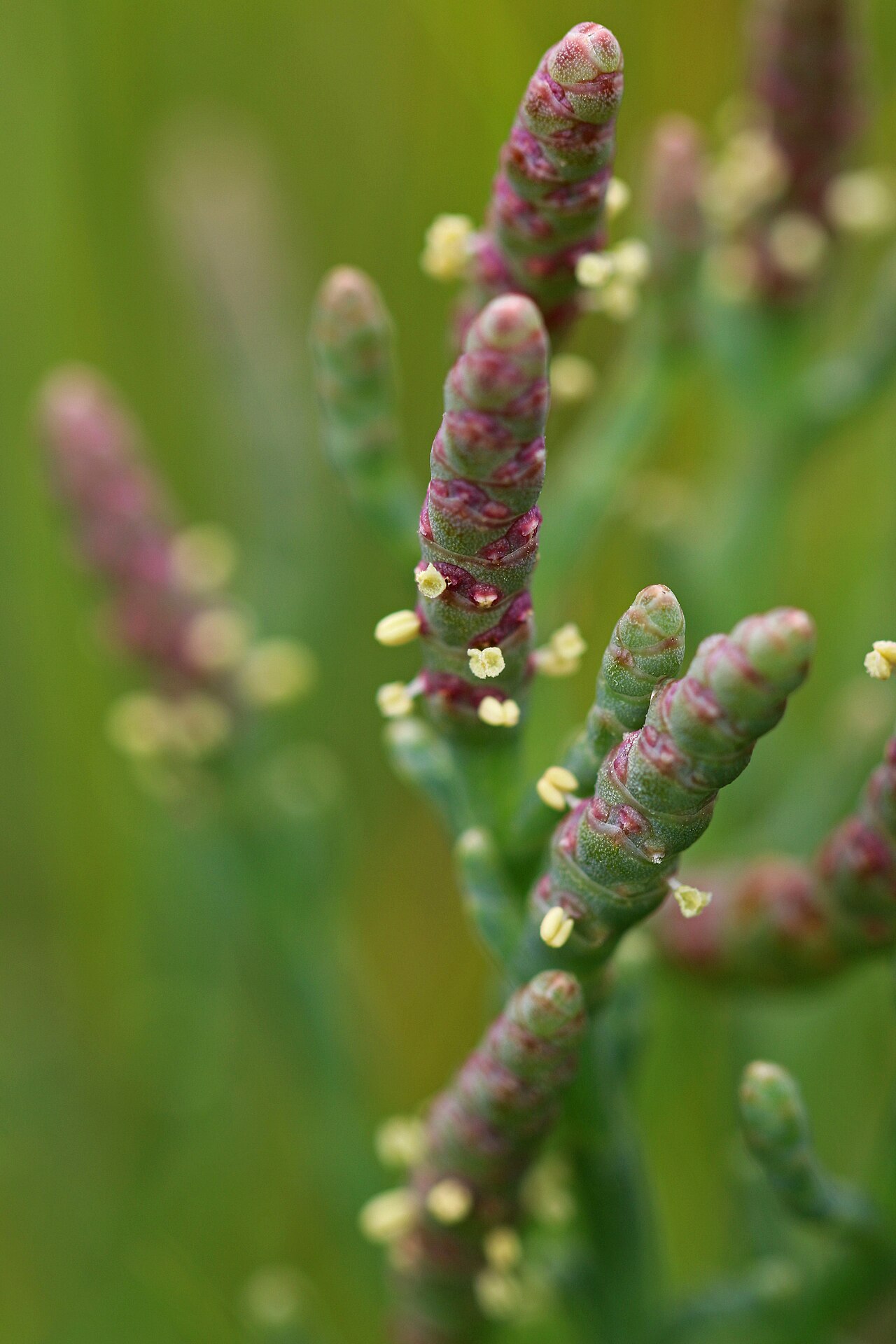
True leaves are absent. What looks like the stem’s surface is actually a pair of fused, scale-like leaf bases wrapped tightly around each joint, so the whole plant functions as a photosynthetic stem system rather than a leafy one — an adaptation shared with its cactus-like relatives in salt deserts worldwide.
Flowers & Fruit
Flowers are minute and easy to miss: three flowers are sunk in shallow pits arranged in threes along the upper, narrower joints of the flowering spikes, each flower reduced to a tiny anther and stigma with no petals. Bloom runs from mid to late summer into fall. The fruit is a tiny, single-seeded utricle enclosed in the old flower tissue, shed with the joint itself rather than opening on the plant.
Quick Facts
| Scientific Name | Sarcocornia pacifica (syn. Salicornia pacifica, Salicornia virginica) |
| Family | Amaranthaceae (Goosefoot/Saltbush) |
| Plant Type | Succulent Perennial Subshrub |
| Mature Height | 6–20 in |
| Mature Spread | Spreading, forms mats several feet across |
| Growth Rate | Moderate to fast by rhizomes |
| Sun Exposure | Full Sun |
| Water Needs | Wet, tidally flooded or saturated soils |
| Soil Type | Saline or brackish mud, clay |
| Soil pH | Neutral to alkaline; tolerates high salinity |
| Bloom Time | Mid-summer to fall |
| Flower Color | Inconspicuous, pale yellow-green |
| Fall Color | Red to burgundy stem color |
| Fruit | Tiny single-seeded utricle, shed with the joint |
| Deer Resistant | Yes (salt content deters most browsers) |
| USDA Hardiness Zones | 7–10 |
Native Range
Sea Asparagus is native along the Pacific coast of North America from the salt marshes of south-coastal and southeastern Alaska, through coastal Washington and Oregon, and south through California’s bays and estuaries. It is strictly a coastal, tidal-wetland plant: it does not grow away from salt or brackish water, so its range hugs bays, river-mouth estuaries, and lagoons rather than following state lines inland.
Within that coastal band it is one of the most widespread and abundant native plants, often forming the dominant low-marsh to mid-marsh vegetation band between open mudflats and higher marsh grasses and shrubs. California’s San Francisco Bay and other large estuaries support especially extensive pickleweed marshes, which are now the focus of major tidal wetland restoration efforts because so much of this habitat was diked and filled through the 20th century.
Sea Asparagus should not be confused with Atlantic and Gulf coast glassworts (species such as Salicornia depressa and Salicornia bigelovii), which are related but distinct species native to the East and Gulf coasts; those are not treated here. Gardeners outside its native tidal-marsh range should not attempt to plant Sea Asparagus inland or in non-saline soil, where it will not persist.
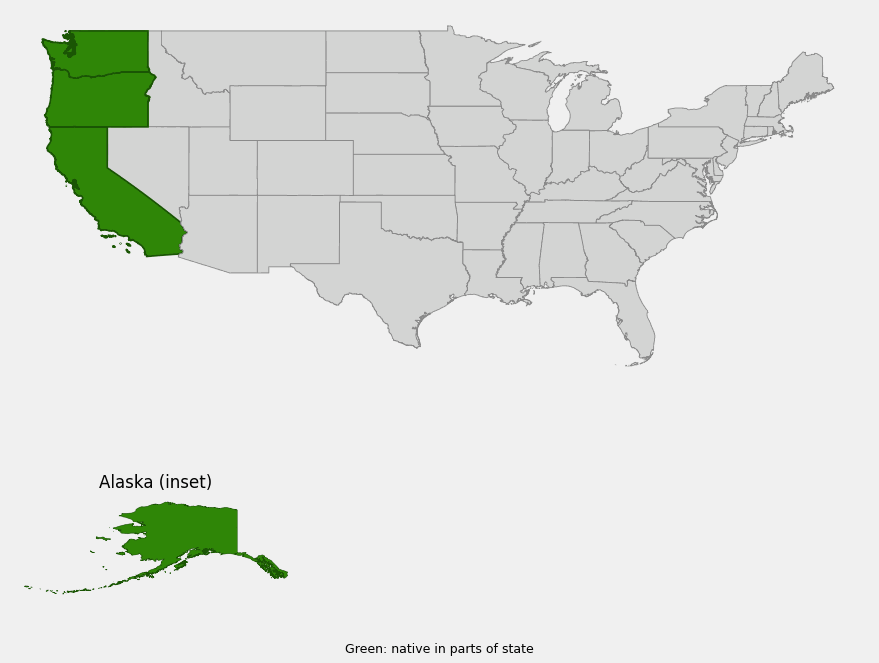
📋 Regional plant lists featuring Sea Asparagus: Alaska · Western Oregon & Western Washington
Growing & Care Guide
Sea Asparagus is a specialist, not a general-purpose garden plant — it is grown almost exclusively in coastal, tidally influenced restoration sites, rain gardens that receive salt spray, or specialty container gardens that replicate a salt marsh. It is not suited to ordinary home landscaping away from brackish water.
Light
Give it full sun. In the open, low-marsh zone it naturally occupies, Sea Asparagus has no competition from taller vegetation and does not tolerate shade.
Soil & Water
This is a true halophyte: it needs saline or brackish, consistently wet to saturated soil, and actually performs best where it is regularly flooded by tides or brackish groundwater. In fresh water or ordinary garden soil, it is quickly outcompeted by other plants and tends to decline. Restoration plantings typically use dredged or graded marsh mud at the correct tidal elevation rather than conventional topsoil.
Planting Tips
Sea Asparagus is propagated from rhizome divisions or rooted stem cuttings taken from existing marsh stands, planted into prepared tidal marsh substrate at the appropriate elevation — too low and the plant drowns, too high and salinity or desiccation stresses it. This work is almost always done as part of a permitted wetland restoration project rather than typical home gardening, since most jurisdictions regulate activity in tidal wetlands.
Propagation
Division of established rhizome mats is the most reliable method; seed germination is possible but slower and less predictable under restoration timelines. Cuttings taken in the growing season root readily when kept consistently moist and brackish.
Landscape Uses
Sea Asparagus has a narrow but important set of uses:
- Tidal marsh restoration — often the first colonizer planted on regraded or re-flooded marsh
- Erosion stabilization on low-energy tidal mudflats and channel edges
- Wildlife habitat plantings for marsh birds and the endangered salt marsh harvest mouse
- Edible landscaping in coastal gardens with brackish irrigation or salt spray exposure
- Stormwater or brackish detention basin plantings where salinity rules out most other natives
Wildlife & Ecological Value
Sea Asparagus is a foundation species of the Pacific salt marsh ecosystem, and its ecological role goes far beyond its modest appearance.
For Birds
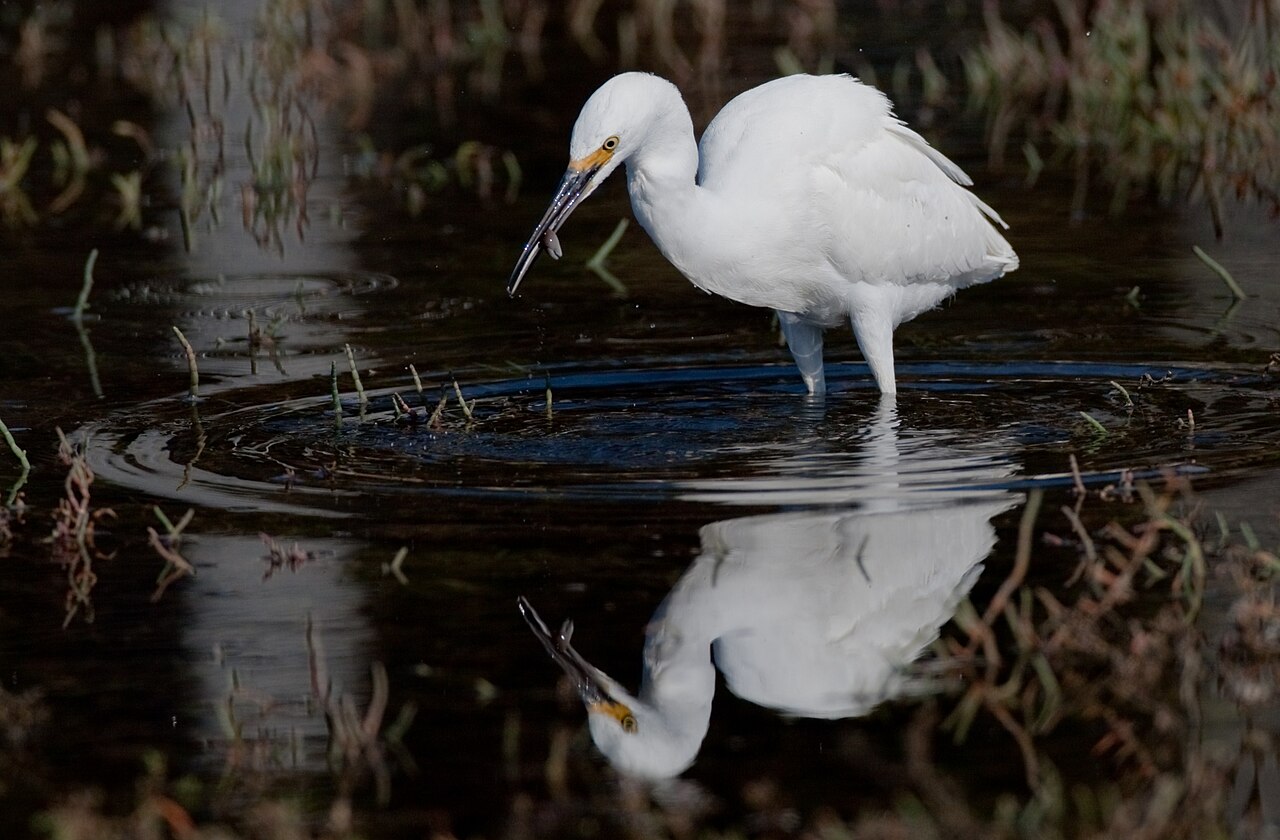
Dense pickleweed stands are critical nesting and foraging cover for marsh-dependent birds, including rails, sparrows such as the Savannah and song sparrow, and marsh wrens. Wading birds like egrets and herons hunt the small crabs, insects, and fish that shelter among the stems at the marsh edge, as seen above at Morro Bay.
For Mammals
In San Francisco Bay, Sea Asparagus is the primary food and cover plant for the federally endangered salt marsh harvest mouse, which rarely strays from pickleweed stands and depends on their structure for escape cover during high tides. Other small mammals use the dense mats for similar refuge.
For Pollinators & Invertebrates
Though the flowers are wind- and self-pollinated rather than insect-pollinated, the plant’s structure and the invertebrates living among its stems and root mats support a food web that includes shorebirds, fish at high tide, and marsh insects.
Ecosystem Role
As one of the few plants able to colonize the lower, most frequently flooded part of the marsh, Sea Asparagus stabilizes sediment, slows tidal flow, and helps build marsh elevation over time — a function increasingly valued as coastal marshes face sea-level rise. Its extensive rhizome mats trap fine sediment and organic matter, gradually raising the marsh surface and allowing less salt-tolerant species to establish further inland.
Cultural & Historical Uses
Coastal Indigenous peoples of the Pacific Northwest and California, including Coast Salish and California coastal groups, gathered Sea Asparagus as a seasonal vegetable, valuing its salty crunch fresh or lightly cooked. It remains a traditional food plant in many coastal communities today.
In more recent decades, Sea Asparagus has become known in American and international markets as “sea bean” or “sea asparagus,” sold fresh in specialty produce sections and used raw in salads, briefly sautéed, or pickled much like its European relative, glasswort. Commercial foraging and small-scale cultivation of related Salicornia species for this market has grown steadily.
Harvesting wild Sea Asparagus from a natural marsh should be done cautiously and sparingly, if at all: many Pacific coast tidal marshes are sensitive, regulated habitats, repeated harvesting can damage the rhizome mats that hold the marsh together, and the plant should never be gathered from sites with water quality concerns, since it readily takes up pollutants from marsh sediment and runoff.
Frequently Asked Questions
Is Sea Asparagus the same as pickleweed?
Yes. “Sea Asparagus,” “pickleweed,” “Pacific swampfire,” and “American glasswort” are all common names for Sarcocornia pacifica, the plant long known in older references as Salicornia pacifica or Salicornia virginica.
Can I grow Sea Asparagus in a regular garden bed?
No. It is a true halophyte adapted to tidally flooded, salty mud. In ordinary garden soil without regular salt exposure and saturation, it struggles and is usually outcompeted. It belongs in coastal restoration sites or specialty brackish-water container plantings, not conventional landscaping.
Is Sea Asparagus edible?
Yes, it has a long history as a foraged and now commercially sold edible green, eaten raw, lightly cooked, or pickled for its salty, crunchy texture. Harvest only from clean, unpolluted sites and sparingly, since marsh harvesting can damage sensitive habitat.
Why does Sea Asparagus turn red in the fall?
The red-to-burgundy color is a stress response tied to rising salinity and cooling temperatures as the growing season ends — a normal, attractive part of its late-season appearance in coastal marshes.
Does Sea Asparagus grow outside the Pacific coast?
Within the United States, Sarcocornia pacifica is native only to the Pacific coast states listed above. Similar-looking glassworts on the Atlantic and Gulf coasts are different, related species and are not the same plant.

Looking for a nursery that carries Sea Asparagus?
Browse our native plant nursery directory: Alaska · Washington · Oregon · California