Sand Blossoms (Linanthus parryae)
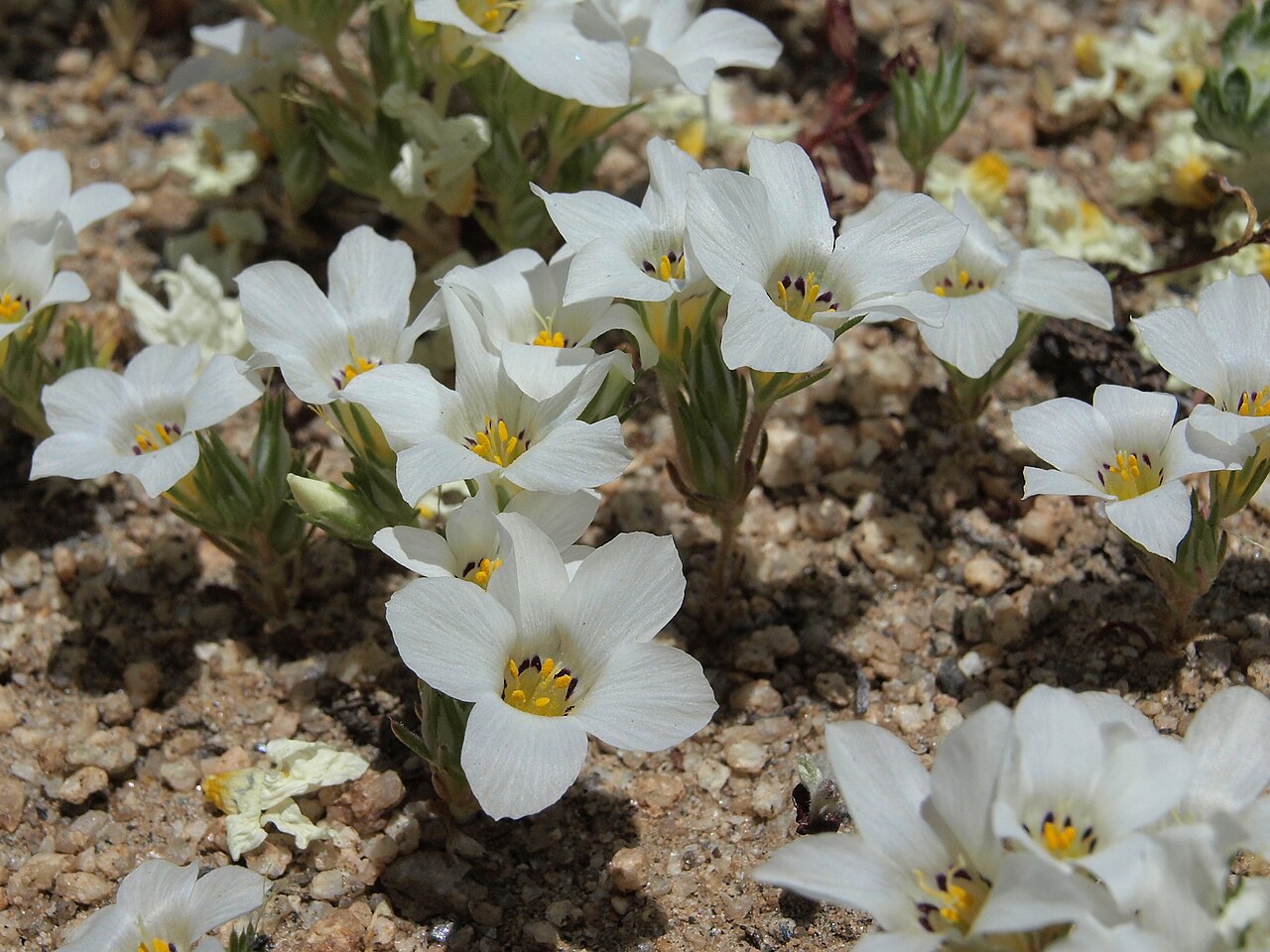
Linanthus parryae, commonly called sand blossoms, is a tiny desert annual in the phlox family (Polemoniaceae) that is endemic to California — found nowhere else in the world. Named for the 19th-century botanist Charles Christopher Parry, this inconspicuous little plant becomes one of the most photogenic sights of the California desert in a good rain year, when entire flats and bajadas turn white with its small, upward-facing flowers. Despite being only a few inches tall, sand blossoms is a favorite subject for wildflower photographers and a textbook example in population genetics, famous for the striking patchwork of white- and blue-flowered populations studied for decades by evolutionary biologists.
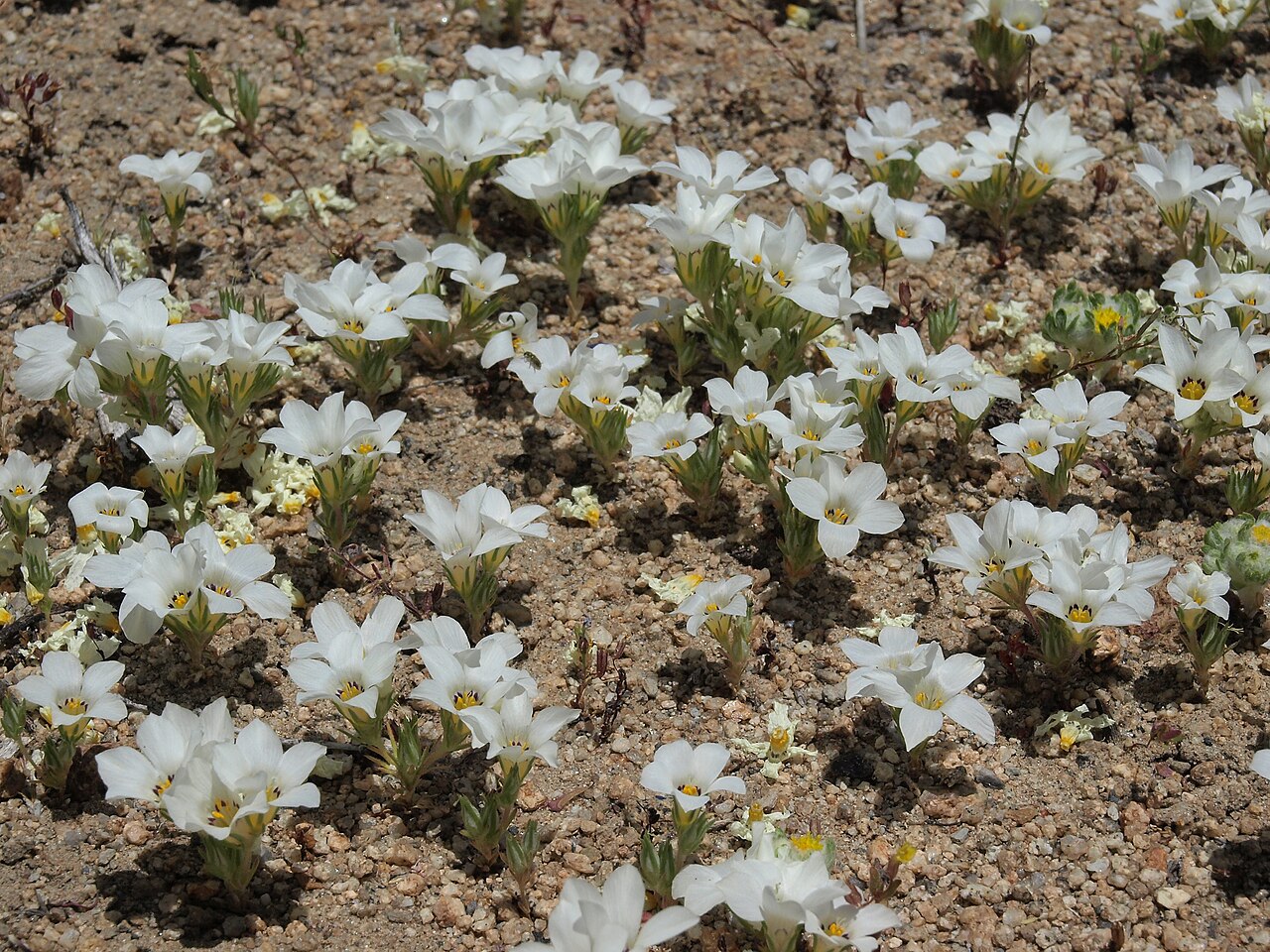
Sand blossoms grows low to the ground as a diminutive, cushion-forming annual, rarely reaching more than 4 inches tall. Its slender stems branch repeatedly from the base, each tipped with a single funnel-shaped flower that can be solid white, pale lavender-blue, or bicolored, depending on the population. The effect of thousands of these small flowers blooming together is a shimmering carpet across otherwise bare desert pavement, Joshua tree woodland floors, and sandy flats of the Mojave Desert, western Colorado Desert, and the dry foothills ringing California’s Central Valley.
Because it is a true desert ephemeral, sand blossoms completes its entire life cycle — germination, growth, flowering, and seed set — within a few weeks of adequate winter and spring rainfall, then disappears until the following year’s rains (or longer, as its seeds can remain dormant in the soil for years). This makes it a valuable, low-maintenance choice for rock gardens, desert wildflower meadows, and restoration seeding in its native range, where it adds an early-spring carpet of white without requiring supplemental water once established.
Identification
Sand blossoms is small enough that it is easy to overlook until it blooms, at which point the sheer number of flowers makes it unmistakable. It is a low, spreading, much-branched annual herb typically 1 to 4 inches (2.5–10 cm) tall, forming loose mats or cushions across open, sandy or gravelly ground.
Stems & Leaves
The stems are slender, wiry, and freely branching from the base, often reddish at the nodes. Leaves are opposite, narrow, and deeply divided into thread-like lobes (palmately parted), giving the plant a wispy, almost leafless appearance that is easy to miss among surrounding gravel and rock. The foliage is often finely hairy and rarely draws attention compared to the flowers.
Flowers
Each flower is solitary at the stem tips, funnel-shaped with five spreading lobes, and about ⅜ to ⅝ inch (1–1.5 cm) across. Petal color is the plant’s most famous feature: flowers can be pure white, pale blue to lavender, or white with a blue or purple throat, and the proportion of color morphs shifts dramatically from one population to the next across the Mojave Desert — a pattern that has made sand blossoms a well-studied example of genetic drift and natural selection acting on flower color. The narrow, tubular throat is typically pale yellow at the very base, and five stamens with small anthers sit just inside the petal lobes. Bloom time runs from March through May, timed to late-winter and spring rains.
Fruit & Seeds
After flowering, each plant produces a small, dry, three-chambered capsule that splits open at maturity to release tiny seeds. The seeds are mucilaginous when wetted, which helps them stick to soil particles and resist being blown or washed away — an adaptation well suited to the loose sandy and gravelly substrates sand blossoms favors. Seed banks in the soil can remain viable for years, allowing the species to skip unfavorable (drought) years entirely and reappear in force once rainfall returns.
Quick Facts
| Scientific Name | Linanthus parryae |
| Family | Polemoniaceae (Phlox) |
| Plant Type | Annual Wildflower |
| Mature Height | 1–4 in (2.5–10 cm) |
| Mature Spread | 4–8 in (10–20 cm), mat-forming |
| Growth Rate | Fast (completes life cycle in weeks) |
| Sun Exposure | Full Sun |
| Water Needs | Low (relies on winter/spring rain) |
| Soil Type | Sandy, gravelly, decomposed granite; fast-draining |
| Soil pH | 6.5–8.0 (neutral to alkaline) |
| Bloom Time | March – May |
| Flower Color | White, pale blue, or lavender (varies by population) |
| Fall Color | None (plant senesces after spring seed set) |
| Fruit | Small dry capsule with mucilaginous seeds |
| Deer Resistant | Yes (low palatability, low biomass) |
| USDA Hardiness Zones | 7–10 |
Native Range
Sand blossoms is endemic to California, meaning it grows naturally nowhere else on Earth. Its range stretches from the Central Valley and inner South Coast Ranges, through the western Mojave Desert and the foothills ringing the Sierra Nevada, and into scattered desert washes and bajadas across San Bernardino, Kern, Los Angeles, and Riverside counties. It is most abundant and most often photographed in the western Mojave Desert, including areas around the Antelope Valley and the desert flats east of the Sierra Nevada.
Within this range, sand blossoms favors open, sparsely vegetated ground: desert pavement, sandy flats, decomposed granite slopes, and the gravelly margins of washes, typically between about 1,000 and 7,500 feet in elevation. It grows alongside other low desert annuals and often shares its habitat with Joshua trees, creosote bush, and desert shrubs that provide little competing shade. Because it needs open soil to germinate, disturbed or naturally barren ground often supports denser stands than areas crowded with perennial shrubs or invasive annual grasses.
Sand blossoms has become a well-known subject in evolutionary biology because of the mosaic of flower-color populations across its Mojave Desert range — patches of nearly all-white flowers sit beside patches of blue-throated or blue-flowered plants, with sharp boundaries that have persisted for decades. This makes populations within its native range scientifically significant, and gardeners and land managers working within its range should use regionally appropriate, locally sourced seed rather than mixing seed from distant populations.
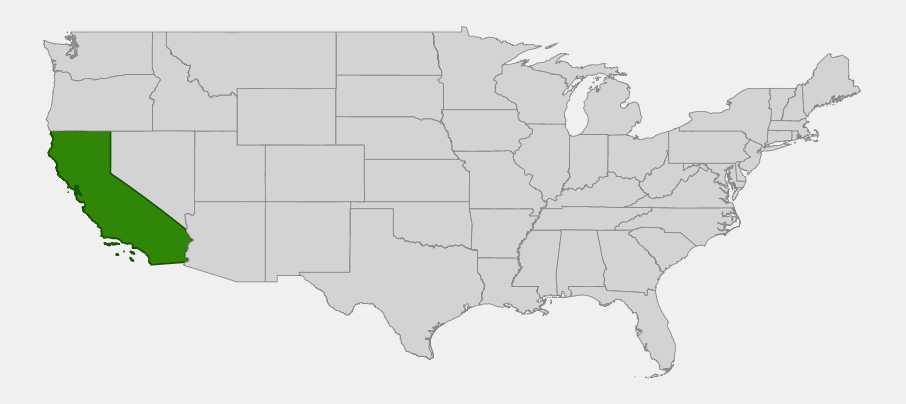
📋 Regional plant lists featuring sand blossoms: California & Nevada
Growing & Care Guide
Sand blossoms is an easy, low-maintenance annual wildflower for anyone gardening within its native California range, provided the basics of desert ephemeral care are respected: open soil, full sun, and a hands-off approach once seed is sown.
Light
Give sand blossoms full sun. It is adapted to open, unshaded desert ground and performs poorly if crowded by taller plants or heavy mulch that shades out its small rosettes before they can flower.
Soil & Water
Fast-draining, sandy or gravelly soil is essential — sand blossoms struggles in heavy clay or any soil that stays wet. In its native setting, it depends entirely on winter and early-spring rainfall; in a garden, a deep soak at fall planting followed by occasional watering through germination and early growth is usually enough. Established seedlings need no supplemental irrigation if winter rains are adequate, and overwatering can cause rot or encourage weeds to outcompete the tiny seedlings.
Planting Tips
Sow seed directly in fall, just before the rainy season, on bare, lightly raked soil — seeds need good soil contact and light to germinate, so do not bury them deeply. Because sand blossoms is so small, it is best used en masse: scatter seed across a dedicated area of a rock garden, desert wildflower meadow, or restoration site rather than as an isolated specimen, where its effect is lost. Only use seed sourced from California, ideally from a population near your site, given the species’ well-documented genetic structure.
Pruning & Maintenance
No pruning is needed or possible — sand blossoms is a short-lived annual that completes its cycle and dries up on its own by late spring or early summer. Leave spent plants in place to drop seed for the following year rather than clearing them away immediately after bloom.
Landscape Uses
Sand blossoms earns its keep in a handful of specific garden settings:
- Desert wildflower meadows and seed mixes for naturalistic spring color
- Rock gardens and gravel gardens with sharp drainage
- Restoration and revegetation of disturbed desert pavement or sandy flats
- Low-water demonstration gardens that highlight true desert ephemerals
- Container or raised bed plantings paired with other small desert annuals
Wildlife & Ecological Value
Small as it is, sand blossoms plays an outsized role in the spring ecology of the California desert, providing an early, reliable nectar source in a landscape where flowering resources are often scarce and unpredictable.
For Pollinators
The flowers attract small native bees, flies, and other short-tongued pollinators that work the open, shallow blooms for nectar and pollen. Because sand blossoms often flowers in dense, synchronized carpets, it can provide an unusually concentrated nectar source for a brief window each spring, supporting pollinator activity at a time when many other desert plants have not yet bloomed.
For Birds & Small Wildlife
The tiny seeds contribute to the diet of ground-foraging birds and small mammals that sift through desert soils for seed, particularly in years of heavy bloom when seed production is correspondingly high. The low, dense growth habit also offers minor cover for small insects and arthropods active on the desert floor.
Ecosystem Role
As a true desert ephemeral, sand blossoms is part of the boom-and-bust annual wildflower community that defines desert productivity: in wet years, it and its associates convert a pulse of rainfall into a burst of biomass, seed, and pollinator activity that ripples through the food web, while in dry years its dormant seed bank waits underground. Its preference for open desert pavement also makes it a useful bioindicator — dense stands generally reflect undisturbed, uncrusted soil, while its absence can signal soil compaction or heavy invasion by introduced annual grasses.
Cultural & Historical Uses
Sand blossoms has no significant history of use as food, medicine, or material by Indigenous peoples or early California settlers, owing to its tiny size and low biomass; its cultural value instead lies almost entirely in its role as a wildflower-season spectacle. California desert wildflower displays, including dense stands of sand blossoms, have drawn visitors and naturalists for well over a century, and the species remains a staple subject in desert wildflower photography and nature writing.
Scientifically, sand blossoms holds an unusually prominent place in the history of evolutionary biology. Beginning in the 1940s, geneticist Sewall Wright and botanist Carl Epling undertook a decades-long study of the striking patchwork of blue- and white-flowered populations across the Mojave Desert, using sand blossoms as a model system to investigate genetic drift, selection, and population structure in natural populations. That research — continued and revisited by later generations of biologists using modern genomic tools — helped shape foundational ideas in population genetics and remains frequently cited today.
More recently, sand blossoms has become a minor fixture of regional restoration and native-seed programs in Southern California, valued for its ease of germination from locally collected seed and its contribution to naturalistic desert wildflower displays in parks, preserves, and demonstration gardens.
Frequently Asked Questions
Why do some sand blossoms patches have blue flowers and others white?
This is one of the most studied phenomena in California desert botany. Populations of sand blossoms across the Mojave Desert vary consistently in flower color — some patches are almost entirely white, others mostly blue or lavender-throated — and the boundaries between these color zones have remained stable for decades. Researchers have linked the pattern to a combination of genetic drift and differences in pollinator behavior and soil conditions between patches.
Can I grow sand blossoms outside California?
It is not recommended. Sand blossoms is endemic to California and adapted specifically to Mojave Desert and Central Valley conditions; outside its native range it offers little value to local pollinators and ecosystems. Gardeners outside California should look for a regionally native annual wildflower instead.
How do I get sand blossoms to reappear each year?
Let plants complete their cycle and drop seed naturally rather than deadheading or clearing them immediately after bloom. Because the seeds can remain viable in the soil for years, an established patch will often reappear on its own in years with adequate winter rain, even skipping bloom entirely during drought years.
Is sand blossoms the same as other small white desert wildflowers?
No — several unrelated California desert annuals produce similarly small white flowers in spring, including species of Eriastrum, Cryptantha, and Chaenactis. Sand blossoms is distinguished by its thread-like, palmately divided leaves, funnel-shaped five-lobed flowers, and extremely low, cushion-forming growth habit.
Does sand blossoms need fire or disturbance to germinate?
No. Unlike some California natives, sand blossoms does not require fire or soil disturbance to germinate — it responds primarily to adequate fall and winter rainfall on open, uncrowded soil. However, it does germinate poorly where dense stands of non-native annual grasses have built up thatch or shaded the soil surface.

Looking for a nursery that carries sand blossoms?
Browse our native plant nursery directory: California