
Puerto Rico Zephyrlily (Zephyranthes puertoricensis)
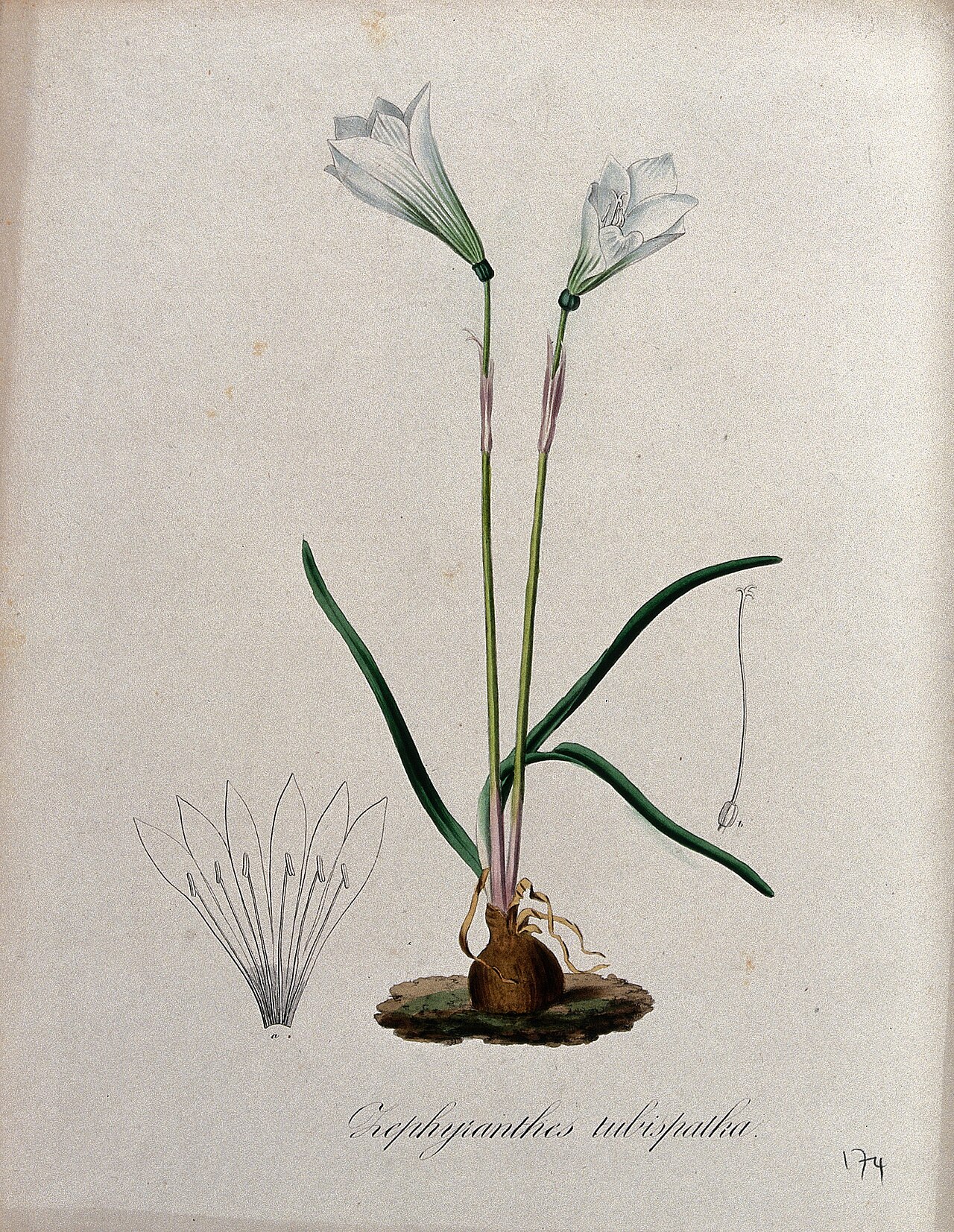
Zephyranthes puertoricensis, the Puerto Rico zephyrlily or Puerto Rico rain lily, is a small bulb of the amaryllis family that sends up white, funnel-shaped flowers soon after rain. In Puerto Rico it is known as duende blanco. Like other rain lilies, it can spend weeks with only a tuft of narrow, glossy leaves, then bloom suddenly when a heavy shower ends a dry spell.
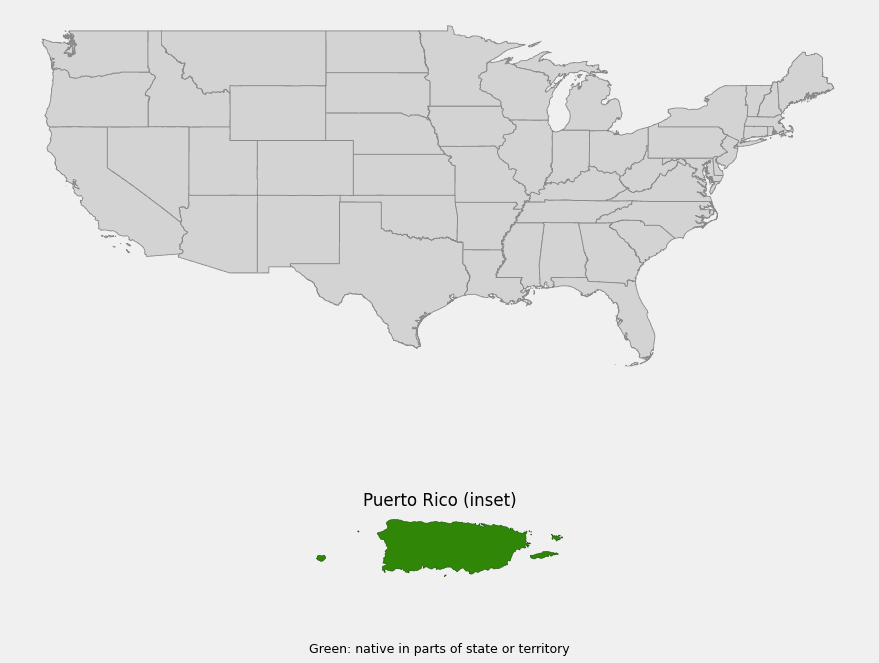
Despite its name, it is not confined to Puerto Rico. USDA PLANTS lists it as native in Puerto Rico and the U.S. Virgin Islands, and it ranges across the West Indies to Panama, Colombia, Venezuela and Suriname. In Puerto Rico it grows in low-elevation grasslands, open grassy places and moist forest, including on Vieques.
The Puerto Rico zephyrlily is a charming, easy native for sunny lawns, borders, rock gardens and pots. In the past it was often identified as Zephyranthes tubispatha or Z. insularum, names that USDA now lists as synonyms or misapplications, so older books and plant labels may use them.
Identification
Puerto Rico zephyrlily is a small, grass-like bulb that is easy to overlook until it flowers. Its solitary white flowers on short, leafless stalks are the best clue.
Bulb & Leaves
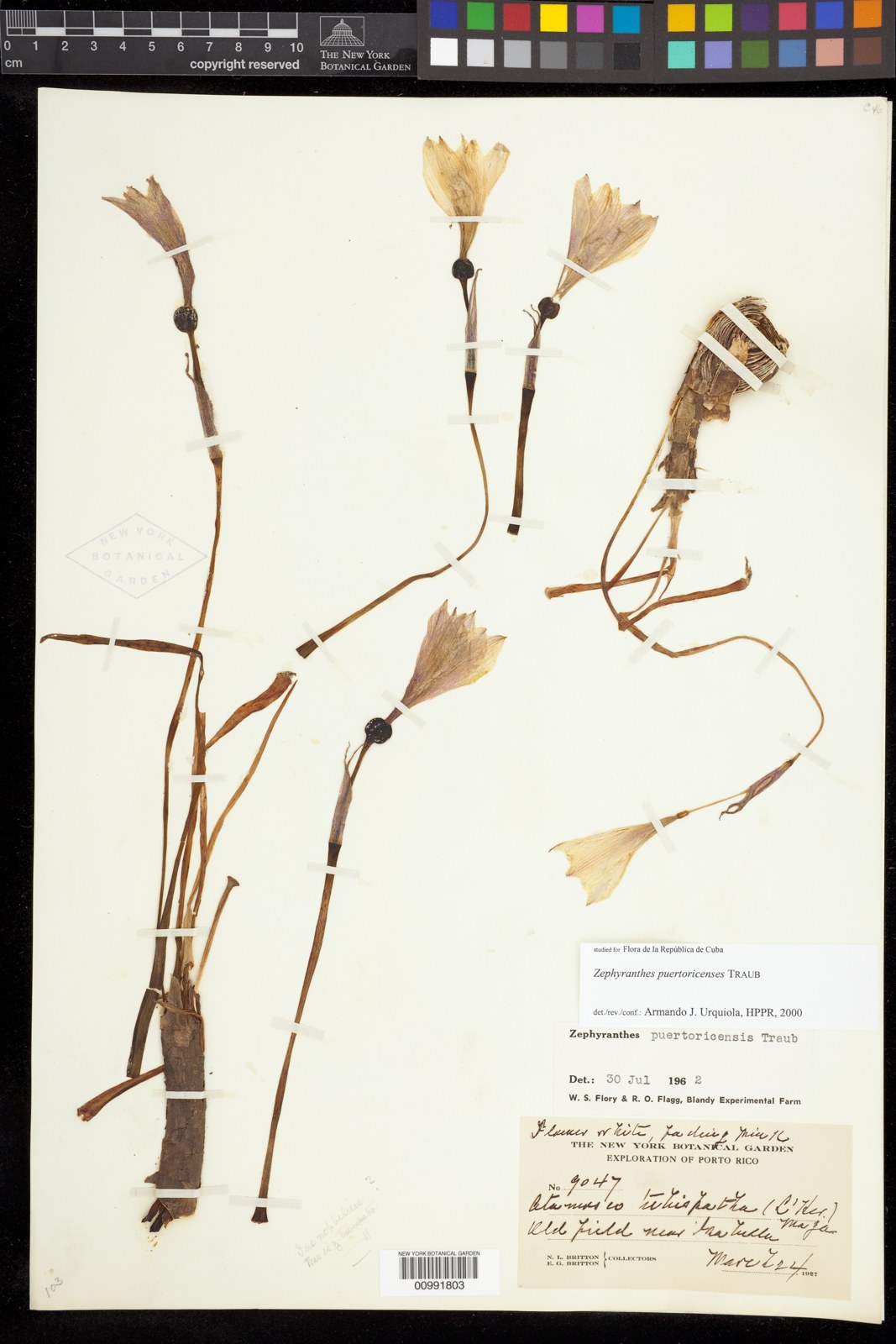
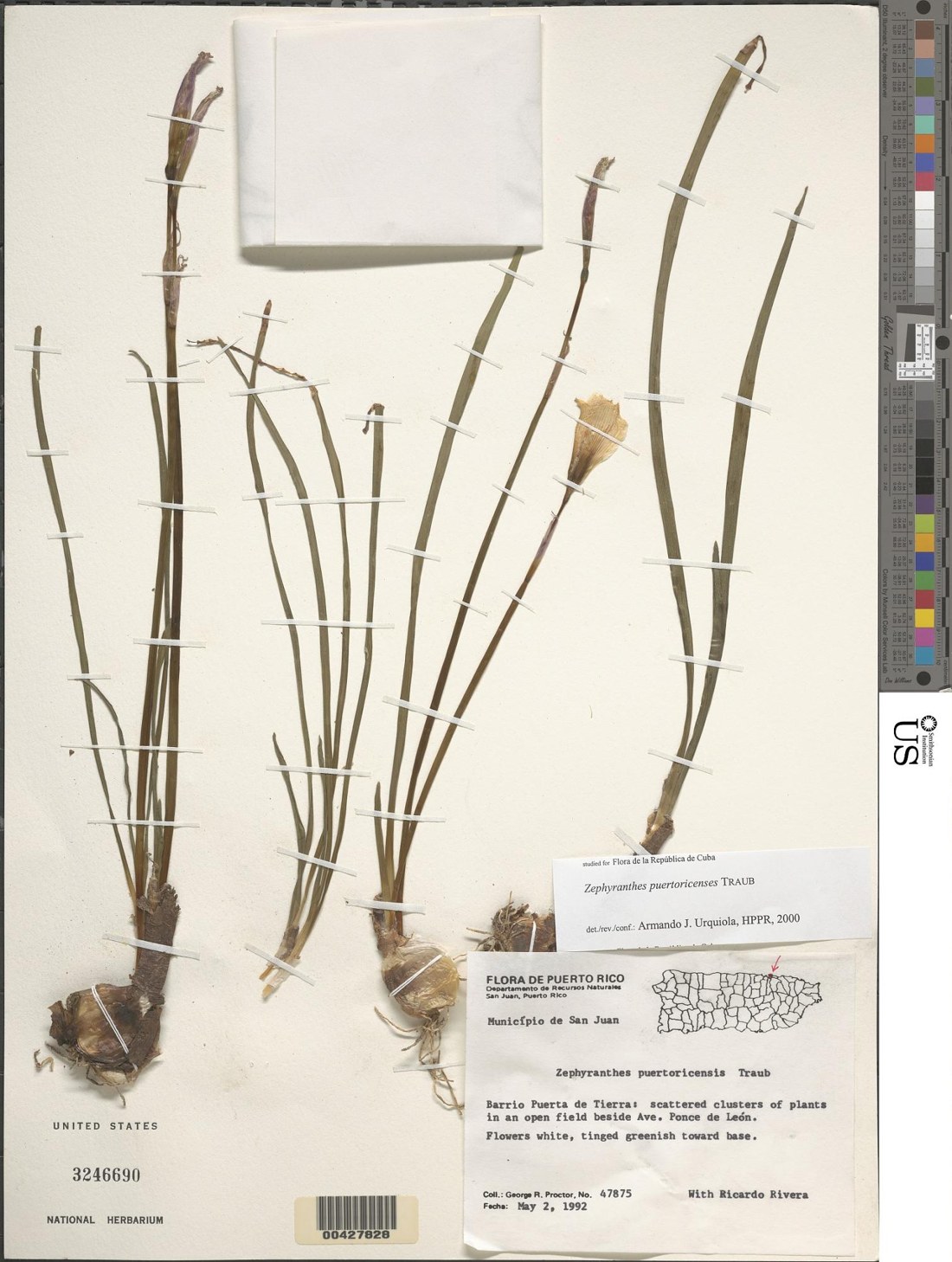
It grows from a small, rounded bulb about half an inch (1.5 cm) across. The leaves are shiny, dark green, narrow and linear, up to about 14 inches (35 cm) long, and arise in a tuft from the bulb.
Flowers
Each flowering stalk (scape) is about 4 inches (9 to 11 cm) tall and carries a single funnel-shaped flower. The six tepals are about 1.5 inches (4 cm) long and white to greenish white.
Bloom Pattern
Flowers appear in flushes a few days after soaking rain, a habit shared by all rain lilies. Each flower lasts only a short time, but a group of bulbs can bloom repeatedly through the rainy season.
Fruit & Seeds
The fruit is a small, three-lobed capsule that splits open to release flat, black, papery seeds.
Quick Facts
| Scientific Name | Zephyranthes puertoricensis Traub |
| Family | Amaryllidaceae (amaryllis family) |
| Plant Type | Bulbous perennial |
| Mature Height | 4–14 in |
| Mature Spread | 3–6 in per clump |
| Growth Rate | Moderate; clumps slowly |
| Sun Exposure | Full sun to partial shade |
| Water Needs | Moderate; blooms after rain, tolerates dry spells |
| Soil Type | Well-drained loam, sand or clay-loam |
| Soil pH | Slightly acidic to slightly alkaline |
| Bloom Time | After rains, mainly in the wet season |
| Flower Color | White to greenish white |
| Fall Color | None |
| Fruit | Three-lobed capsule with flat black seeds |
| Deer Resistant | Not a concern in Puerto Rico, which has no native deer |
| USDA Hardiness Zones | 10–12; frost-sensitive |
Native Range
USDA PLANTS lists the Puerto Rico zephyrlily as native in Puerto Rico and the U.S. Virgin Islands. The Smithsonian’s Flora of the West Indies records it from Puerto Rico, including Vieques, from the Virgin Islands, from Jamaica and from many islands of the Lesser Antilles, among them Antigua, Barbados, Martinique, Montserrat, Saba, St. Eustatius, St. Lucia and St. Vincent. Kew’s World Checklist also includes Panama, Colombia, Venezuela and Suriname.
In Puerto Rico it is a plant of low-elevation grasslands and other open, grassy places, and it also grows in moist forest. The USDA Forest Service includes it among the plants of El Yunque National Forest. It also turns up in grassy lawns and roadsides, including in San Juan.
The species was described in 1951 by the American botanist Hamilton P. Traub, from plants grown from bulbs collected in Puerto Rico.
📋 Regional plant lists featuring Puerto Rico Zephyrlily: Puerto Rico
Growing & Care Guide
Rain lilies are among the easiest bulbs to grow in the tropics. The Puerto Rico zephyrlily needs sun, decent drainage and occasional deep watering to keep it flowering.
Light
It blooms best in full sun to light shade. In deep shade it produces leaves but few flowers.
Soil & Water
Plant it in well-drained soil. It tolerates dry periods, when it may rest with few leaves, and responds to soaking rain or a deep watering with a flush of flowers a few days later. Avoid soil that stays waterlogged, which can rot the bulbs.
Planting Tips
Set bulbs about 1 to 2 inches deep and 2 to 4 inches apart, in groups for the best display. They work well along path edges, in rock gardens, among low groundcovers, in grassy meadows, and in containers.
Pruning & Maintenance
Little care is needed. Leave the foliage in place so the bulbs can recharge, and divide crowded clumps every few years when they stop blooming well.
Propagation
Divide offsets from established clumps, or sow fresh seed on the surface of moist potting mix soon after the capsules split. Buy bulbs from nurseries that sell locally sourced stock rather than digging wild plants.
Landscape Uses
- Rain garden edges: flowers in flushes after storms
- Rock gardens and borders: small, tidy clumps of narrow leaves
- Containers: easy to grow in pots on patios and balconies
- Grassy meadows: naturalizes among low native grasses
- Pollinator plantings: white flowers for small bees and other insects
Wildlife & Ecological Value
Small as it is, the Puerto Rico zephyrlily adds flowers to open, grassy habitats at times when rain triggers a burst of insect activity.
For Pollinators
The open, funnel-shaped flowers offer pollen to small bees and other insects. Rain lilies in general are visited by bees, which collect pollen from the prominent stamens.
For Birds
The plant has little direct value for birds, but the grassy habitats where it grows are used by ground-feeding birds such as doves and ground-doves.
For Mammals
No important mammal interactions are documented. Like many members of the amaryllis family, the bulbs contain alkaloids and should not be eaten.
Ecosystem Role
As a native bulb of open grassland and forest openings, it is part of the diverse low herb layer that has become rare in Puerto Rico’s lowlands, much of which has been converted to pasture or development.
Cultural & Historical Uses
The genus name Zephyranthes means “flower of the west wind,” from Zephyrus, the Greek god of the west wind, and anthos, flower. The common name rain lily refers to the plants’ habit of flowering after rain.
The Puerto Rican name duende blanco means “white elf” or “white sprite,” a fitting name for a small flower that seems to appear out of nowhere after a storm.
The plant’s names have shifted over the years. Early botanists in the West Indies often called it Zephyranthes tubispatha, and the historical name Barbados snowdrop was used for the white rain lily of the islands. Hamilton P. Traub named it Zephyranthes puertoricensis in 1951, and USDA now uses that name.
Frequently Asked Questions
Is the Puerto Rico zephyrlily native to Puerto Rico?
Yes. USDA PLANTS lists Zephyranthes puertoricensis as native in Puerto Rico and the U.S. Virgin Islands. It also grows across much of the West Indies and northern South America.
What is the Puerto Rico zephyrlily called in Spanish?
In Puerto Rico it is called duende blanco.
Why does it bloom after rain?
Like all rain lilies, it responds to soaking rain after a dry period by quickly sending up flowers, usually within a few days.
Can I grow it in a pot?
Yes. It grows well in containers with well-drained potting mix, placed in sun and watered deeply now and then.
Is it the same as Zephyranthes tubispatha?
Older works often used that name for the white rain lily of the West Indies, and USDA lists it as a synonym. The plant is now called Zephyranthes puertoricensis.

Looking for a nursery that carries Puerto Rico Zephyrlily?
Our nursery directory does not yet include Puerto Rico. Browse the native plant nursery directory by state: Alabama–Arkansas · California · Colorado–Hawaii · Idaho–Kansas · Kentucky–Montana · Nebraska–Oklahoma · Oregon · Pennsylvania–Virginia · Washington · West Virginia–Wyoming