
Irrigation Controllers That Make Smart Watering a Breeze: Top 4 Models for Effortless Lawn Care
We independently select all products and services. If you click through links we provide, Plant Native may earn a commission with no extra cost to you.
Last updated: November 8, 2026
Irrigation controllers have revolutionized the way we manage our lawns and gardens. These devices automate watering schedules, ensuring plants receive the right amount of hydration at optimal times.
Smart irrigation controllers take this concept further by incorporating weather data and soil moisture sensors to fine-tune watering patterns.
Smart watering systems can significantly reduce water waste and lower utility bills. They adapt to changing weather conditions, skipping unnecessary watering cycles during rainy periods or increasing frequency during dry spells.
This level of precision not only conserves water but also promotes healthier plant growth by maintaining ideal soil moisture levels.
When choosing an irrigation controller, it’s crucial to consider compatibility with existing sprinkler systems, ease of programming, and the number of zones it can manage. We also recommend looking for models with Wi-Fi connectivity for remote access and those that offer detailed water usage reports.
We tested several irrigation controllers to find the ones that make smart watering effortless and efficient.
Best Irrigation Controllers for Smart Watering
We’ve researched and tested numerous irrigation controllers to bring you the top options for effortless smart watering. Our curated list features devices that combine advanced technology with user-friendly interfaces, allowing you to maintain a lush landscape while conserving water and saving time.
Our top pick

- Customizable watering schedules
- Weatherproof case for indoor or outdoor installation
- Remote control via smartphone app
Cons
- Initial setup can be complex
- Limited compatibility with some smart home systems
- Only 6 zones, so larger systems need a bigger model
The Orbit B-hyve 6-zone controller combines app scheduling and remote zone control with a weatherproof case that mounts indoors or outdoors, at a modest price for a smart controller. When you weigh all the factors, this one rises above the rest.
Best for beginners

- Intuitive app for easy scheduling
- Weather-based watering adjustments, which adds real practical value and helps make gardening tasks easier and more enjoyable
- Seamless smart home integration
Cons
- Higher initial cost
- Requires stable Wi-Fi connection
- Indoor-style housing needs a sheltered spot or separate outdoor enclosure
The Rachio 3 8-zone is a DIY-friendly smart controller: a quick install, an app that builds schedules for you, and automatic weather skips with no monthly fees. It takes the guesswork out of the equation for newcomers.
Best high-performance pick
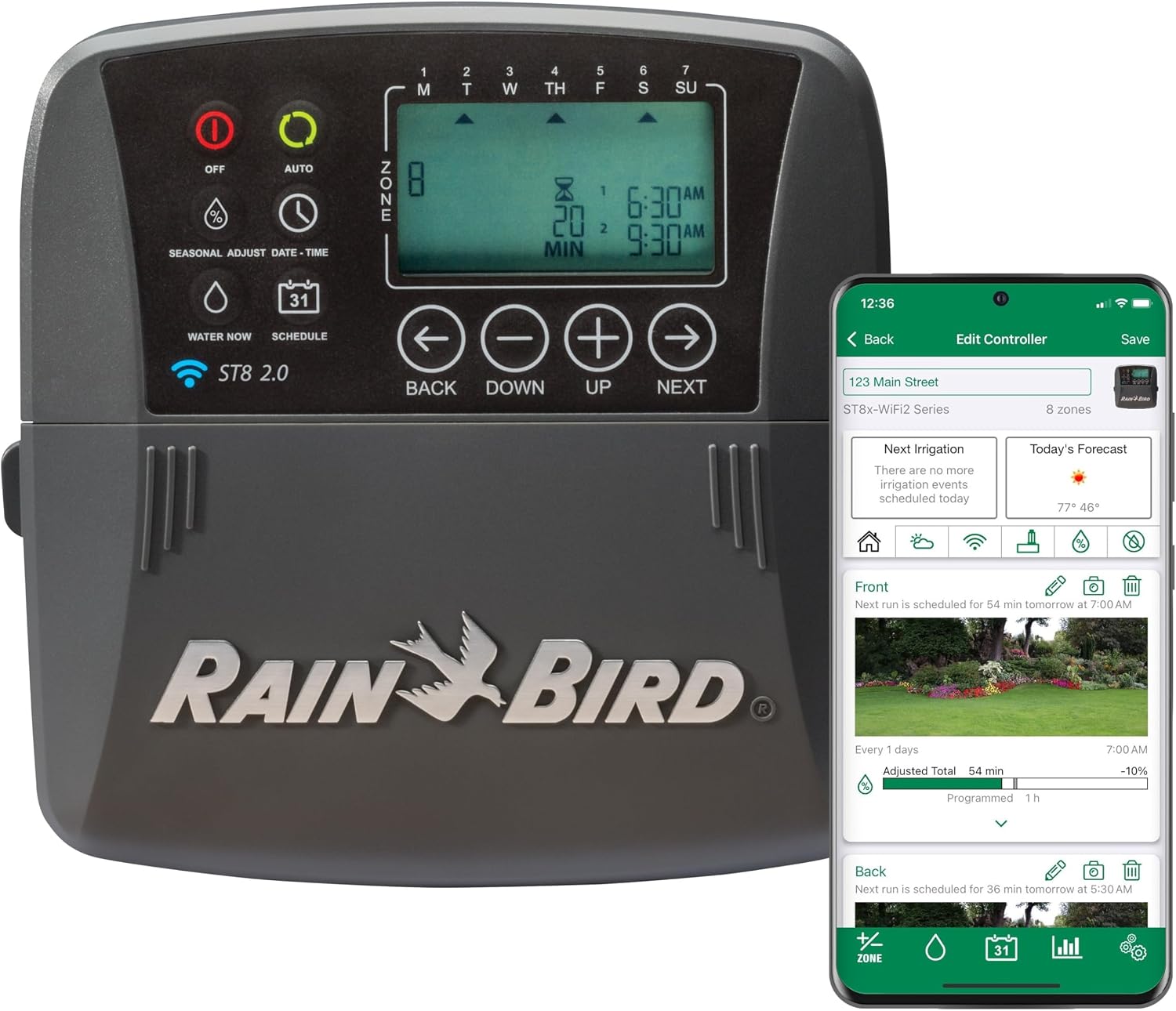
- Weather-based seasonal adjustment of watering times
- Works with Alexa and Google Assistant
- Up to 6 start times per zone and a 1–14 day watering delay
Cons
- Indoor model; outdoor mounting needs the ST8O version
- Higher price point compared to basic controllers
- App setup requires a stable home Wi-Fi signal
The Rain Bird ST8I-2.0 brings a major irrigation brand’s smart features to eight zones: weather-adjusted daily schedules, voice-assistant support and a full control panel on the unit. It delivers exactly where it counts most.
Best value set

- Easy-to-use mobile app for remote control
- Precise, automated watering schedules
- Helps conserve water and save money
Cons
- Initial setup can be time-consuming
- Hub must sit within range of the faucet timer
- Some users report leaks
The Orbit B-hyve Smart Hose Timer brings app scheduling and weather-aware watering to a single hose faucet, with no in-ground system needed. It punches well above its price tag, making every dollar count.
Buying Guide
When choosing an irrigation controller, we recommend considering several key factors:
Compatibility
Check if the controller works with your existing system and valve types. Some are designed for specific brands or setups.
Smart Features
Look for WiFi connectivity and smartphone app control. These allow remote adjustments and monitoring.
Weather-based watering uses local forecasts to optimize schedules automatically.
Zones
Count your irrigation zones and choose a controller that can handle that many or more for future expansion.
Indoor vs Outdoor
Decide where you’ll install the controller. Outdoor models need weatherproof housing.
Ease of Use
A clear display and intuitive interface make programming simpler. Voice control compatibility adds convenience.
Water-saving Tools
Features like cycle and soak, rain delay, and soil moisture sensing help conserve water.
Power Options
Most use standard outlet power, but some offer battery backup. Solar-powered models work well in sunny areas.
Certifications
Look for EPA WaterSense certification. This indicates proven water efficiency.
| Feature | Why It Matters |
|---|---|
| WiFi | Allows remote access and updates |
| Weather data | Enables smarter watering decisions |
| Multiple programs | Provides flexibility for different plant needs |
| Seasonal adjust | Allows easy whole-system changes |
By weighing these factors, we can choose an irrigation controller that best fits our needs.
We independently select all products and services. If you click through links we provide, Plant Native may earn a commission with no extra cost to you. As an Amazon Associate I earn from qualifying purchases.
i’d say smart controllers with soil sensors save less water than this makes it sound.
skipping watering cycles automatically during rainy stretches is exactly what my old timer can’t do.
Thank you for the kind words! Wishing you a great growing season. -Plant Native Team
wifi access and water usage reports are features i’d want for our new place.