Bald Cypress (Taxodium distichum)
Taxodium distichum, commonly known as Bald Cypress, is one of North America’s most iconic and ecologically vital native trees — a majestic deciduous conifer that has graced the swamps, bayous, and river floodplains of the southeastern United States for millions of years. Despite being a conifer, Bald Cypress sheds its needles each autumn in a spectacular display of russet-orange color, earning the name “bald.” It is the defining tree of the great Southern cypress swamps, forming the canopy of primeval ecosystems from the Chesapeake Bay to the Gulf Coast and inland along the Mississippi Valley into southern Illinois.
This remarkably long-lived tree — individuals over 1,000 years old have been documented — grows to 65–90 feet tall in cultivation, reaching even greater heights in the wild. Its most distinctive features are its fluted, buttressed trunk base, reddish-peeling bark, feathery needles that turn rusty orange before dropping, and the extraordinary “knees” — woody projections rising from the roots in wet soils — that have long fascinated botanists, though their exact function (possibly gas exchange or structural support in soft sediments) is still debated. In the landscape, Bald Cypress is surprisingly adaptable: it grows well not only in standing water and wet bottomlands but also in ordinary, even somewhat dry, upland soils once established.
For gardeners and restoration ecologists in the Mid-Atlantic, South, and Midwest, Bald Cypress offers exceptional value. It is among the most long-lived trees available for planting, provides structural habitat for wildlife, tolerates flooding and even salt spray, and delivers breathtaking fall color in a tree with an elegant pyramidal form. The Delaware, New Jersey, and New York region marks the northern edge of its natural coastal plain range, where it grows naturally in swampy lowlands and river margins, making it a historically appropriate native for these states as well.
Identification
Bald Cypress is a large deciduous conifer typically growing 65–90 feet (20–27 m) tall in cultivation, with wild specimens occasionally exceeding 120 feet (37 m). The crown is broadly conical to irregular in older trees. The trunk base is conspicuously swollen and buttressed, often featuring prominent, fluted ridges — an adaptation to life in soft, saturated soils that provides structural stability. The root system frequently produces “knees” — blunt, conical woody projections rising vertically from horizontal roots, sometimes reaching heights of several feet above the waterline.
Bark
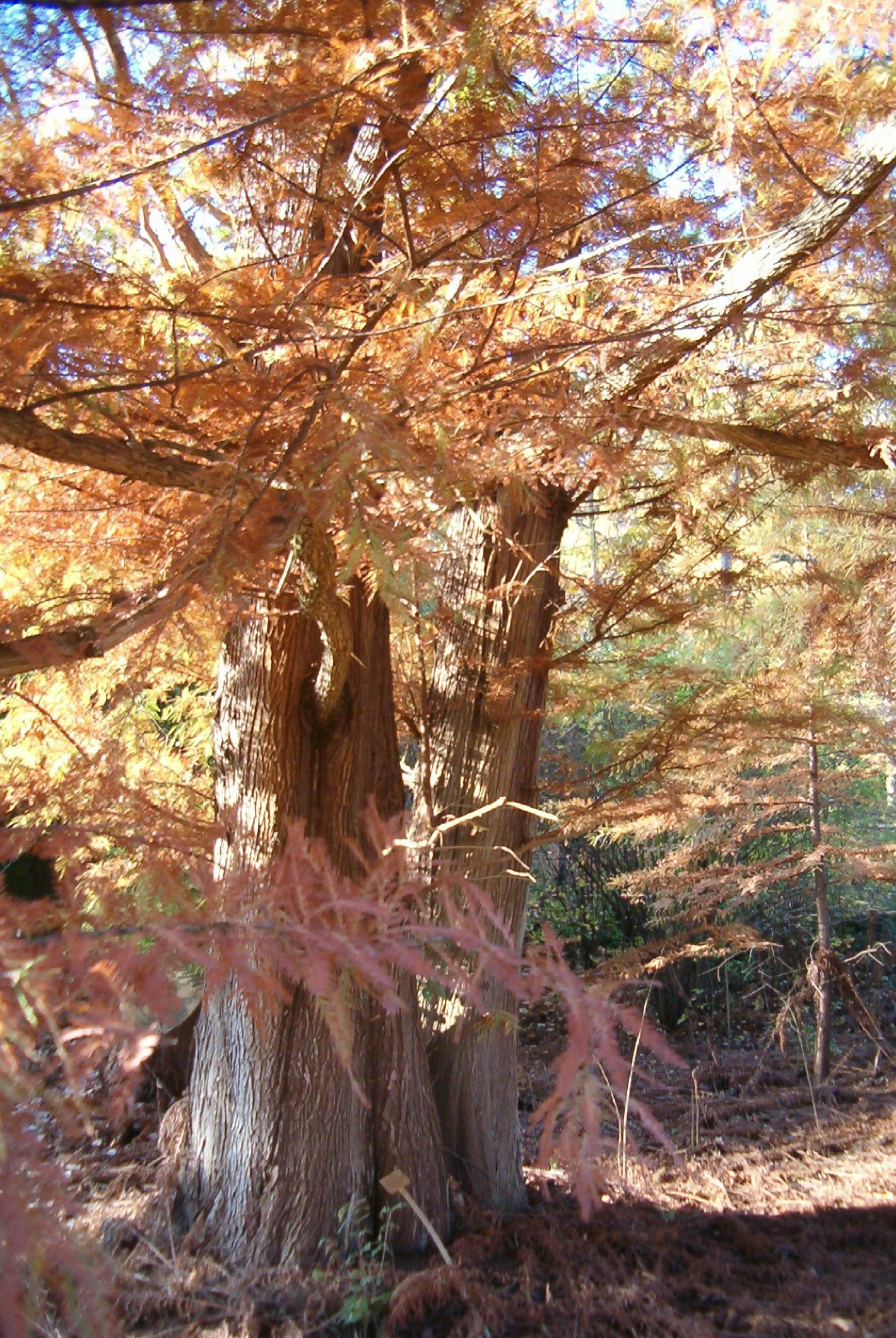
The bark is one of Bald Cypress’s most beautiful features: reddish-brown to silver-gray, fibrous, and peeling in long, thin strips. The texture is distinctly fibrous and stringy, similar to Coast Redwood (a close relative), with an attractive shaggy appearance up close. As trees age, the bark develops deeper furrows and ridges. The comments in the native plant data note “Reddish, peeling bark and rusty fall color” — both immediately diagnostic field characteristics.
Leaves
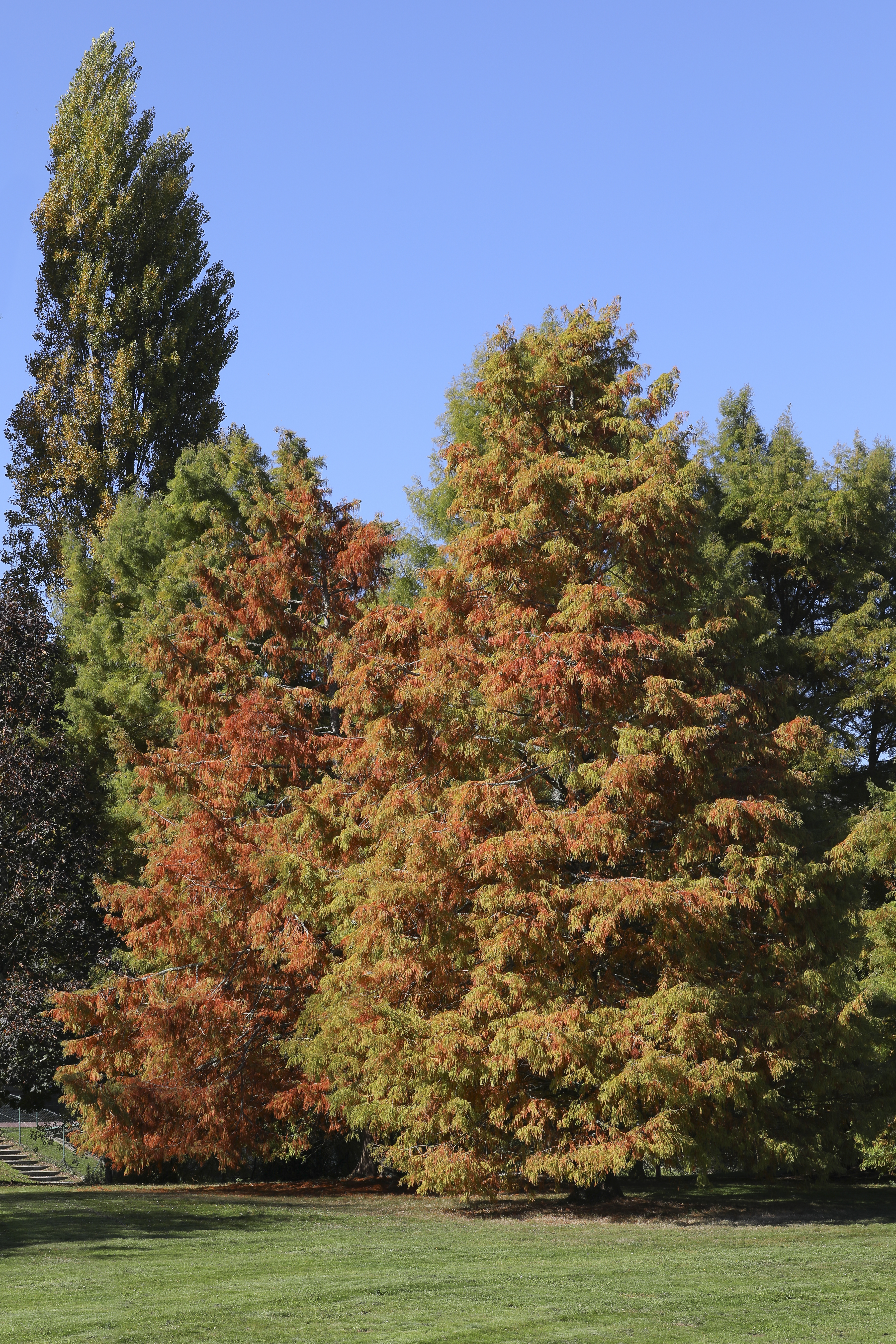
The leaves are needle-like and feathery, arranged in two flat rows along branchlets (giving a frond-like appearance), each needle ½ to ¾ inch (12–19 mm) long. They are soft, flexible, and bright green in spring and summer, turning a warm russet-orange to brick-red before dropping entirely in late autumn. The deciduous habit distinguishes Bald Cypress from most other conifers and gives the tree its name — it stands “bald” throughout winter, revealing its attractive branching structure.
Cones & Seeds
Male pollen cones form in hanging clusters in late winter and release pollen in early spring. Female seed cones are round to globose, about 1 inch (2.5 cm) in diameter, green turning purplish-brown at maturity in October–November. Each cone contains 9–21 angular, wrinkled seeds. The cones often persist on the tree through winter after opening. Seeds are important food for wild turkeys, wood ducks, and other wildlife that inhabit cypress swamps.
Quick Facts
| Scientific Name | Taxodium distichum |
| Family | Cupressaceae (Cypress) |
| Plant Type | Deciduous Conifer / Large Tree |
| Mature Height | 65–90 ft |
| Sun Exposure | Full Sun to Part Shade |
| Water Needs | Moderate to High |
| Bloom Time | March – April (pollen release) |
| Flower Color | Not showy; wind-pollinated |
| Fall Color | Russet orange to brick red |
| Bark | Reddish-brown, fibrous, peeling |
| USDA Hardiness Zones | 4–10 |
Native Range
Bald Cypress is native to a broad swath of eastern North America, with its core range encompassing the coastal plain and river floodplains from southern Delaware and New Jersey south through the Atlantic and Gulf Coastal Plains to southern Florida, west along the Gulf Coast to eastern Texas, and north up the Mississippi Alluvial Valley into southern Illinois and southwestern Indiana. It reaches its greatest size and abundance in the vast swamps of Louisiana, Mississippi, and Florida, where ancient cathedral groves once covered millions of acres.
In its natural range, Bald Cypress is a bottomland and wetland specialist, occupying river floodplains, swamp margins, bayous, tidal marshes, and the borders of ponds and lakes. It is the characteristic tree of the great Southern cypress-tupelo swamp ecosystem — one of North America’s most biologically rich wetland types. Along the mid-Atlantic coast, it reaches the northern limits of its natural range in Delaware’s coastal plain wetlands and New Jersey’s Pine Barrens river systems, where scattered natural populations persist. In New York, it is at the very edge of its native range.
Bald Cypress can also be found naturally at considerable distances from standing water along river bottoms and in oxbow wetlands throughout the Mississippi watershed. Its extraordinary flood tolerance — it can survive months of inundation — combined with its ability to adapt to drier upland soils once established makes it one of the most ecologically flexible large native trees in eastern North America. Planted specimens thrive far outside the natural range in USDA Zones 4–10, including throughout New England and the northern Midwest.
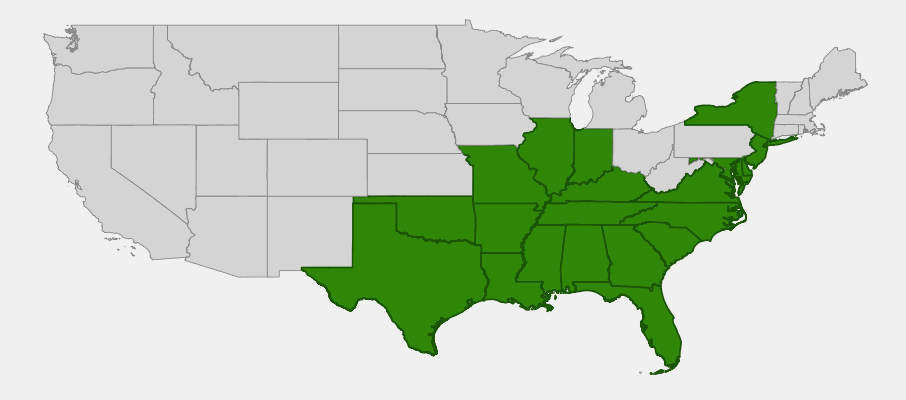
📋 Regional plant lists featuring Bald Cypress: Delaware, New Jersey & New York
Growing & Care Guide
Bald Cypress is one of the most adaptable large native trees available for planting in eastern North America. While it is famous as a wetland and swamp tree, it grows remarkably well in ordinary garden soils — even somewhat dry ones — once established. This makes it an excellent choice for a wide range of landscape situations beyond the water’s edge.
Light
Bald Cypress thrives in full sun, which produces the densest, most symmetrical crown and the best autumn color. It will also grow in part shade, particularly when young, but develops a less compact form with age in shaded locations. For the best ornamental results and fastest growth, site it in full sun with at least 6 hours of direct light daily.
Soil & Water
The tree is extraordinarily adaptable in terms of soil and moisture. It grows naturally in standing water, saturated soils, seasonally flooded bottomlands, and — somewhat surprisingly — ordinary upland soils. In cultivation, it performs well in clay, loam, or sandy soils across a wide pH range (4.5–8.0). The tree is highly flood-tolerant and can survive months of inundation; it is also moderately drought-tolerant once established. In dry upland sites, supplemental watering during the first 2–3 years after planting ensures good establishment. After that, Bald Cypress generally fends for itself, even in moderate drought conditions.
Planting Tips
Plant in spring or fall for best establishment. Dig a wide, shallow hole — twice the diameter of the root ball but no deeper. Do not add amendments to the backfill; let roots adjust to native soil. Stake young trees in exposed sites. Mulch heavily (3–4 inches) around the root zone to retain moisture and suppress weeds. Note that in upland, non-flooded soils, Bald Cypress typically will not develop “knees” — that trait is triggered by growing in standing water.
Pruning & Maintenance
Bald Cypress requires little pruning. Remove dead or crossing branches in late winter while the tree is dormant. Young trees naturally develop a strong central leader — avoid pruning it. The tree has no significant pest or disease problems and is generally free of issues in suitable climates. In the northern part of its cultivated range, late frosts can occasionally damage emerging needles, but the tree quickly recovers. Leaf drop in fall is minimal compared to broadleaf trees; the fine needles decompose quickly without matting.
Landscape Uses
Bald Cypress is a magnificent specimen tree for large properties, parks, and naturalized landscapes. Its uses include:
- Stormwater management — ideal for rain gardens, bioswales, and wet retention areas
- Pond and lake edges — provides structure and wildlife habitat
- Street tree — several cultivars (e.g., ‘Shawnee Brave’) are used in urban plantings
- Specimen tree — dramatic pyramidal form with excellent fall color
- Riparian buffer — exceptional for streambank stabilization
- Wetland restoration — a keystone species in southeastern swamp restoration
- Allée planting — striking when planted in rows
Wildlife & Ecological Value
Bald Cypress is a keystone species in southeastern wetland ecosystems, supporting an extraordinary web of wildlife from insects to large mammals.
For Birds
Bald Cypress groves are premier nesting habitat for colonial waterbirds including Great Blue Herons, Great Egrets, Little Blue Herons, Tricolored Herons, and Anhinga, which form large rookeries in the trees’ canopy. Osprey build their massive stick nests atop tall cypresses near water. The seeds are consumed by Wood Ducks, Wild Turkeys, and various waterfowl. Cavity nesters including Barred Owls, Wood Ducks, and Pileated Woodpeckers use old-growth cypress cavities. The fibrous bark strips are used by many small birds as nesting material.
For Mammals
Swamp rabbits, white-tailed deer, and black bears use cypress swamps for cover and feeding. Beaver actively coppice young Bald Cypress trees (which resprout vigorously from stumps), creating complex mosaic habitats. River otters, mink, and muskrats inhabit cypress swamp systems, and the extensive root systems provide cover for alligators and numerous amphibians. Squirrels consume the seeds in upland cypress stands.
For Pollinators
As a wind-pollinated conifer, Bald Cypress does not provide significant direct pollinator resources through flowers. However, the tree supports a diverse community of insects — particularly specialist moths and beetles associated with cypress bark and wood — which in turn serve as prey for insectivorous birds and bats. The canopy provides shelter habitat for numerous insects.
Ecosystem Role
Bald Cypress swamps rank among the most ecologically important ecosystems in North America. They are extraordinary water purifiers, removing nutrients, sediments, and pollutants from floodwater. They provide irreplaceable flood control by absorbing and slowly releasing floodwaters. Their deep, dark soils — built from centuries of organic accumulation — store massive amounts of carbon. The complex three-dimensional structure of cypress swamps, with submerged roots, emergent knees, water surfaces, and forest canopy, supports more biodiversity per acre than almost any other eastern forest type.
Cultural & Historical Uses
Bald Cypress holds an extraordinary place in American history, culture, and commerce. Indigenous peoples throughout the Southeast used the durable wood for dugout canoes — a single massive trunk could be hollowed into a large vessel capable of carrying many people — and the fibrous inner bark was woven into fabric and used for fire-starting. The Attakapa and other coastal Gulf peoples used cypress knees as musical instruments and for carved ritual objects. The dense, straight-grained, decay-resistant wood made it highly valuable for traditional building, and villages were often deliberately sited near cypress swamps for ready access to this material.
The commercial timber industry devastated old-growth cypress forests across the American South during the 19th and early 20th centuries. Before European settlement, bottomland cypress forests covered an estimated 4–5 million acres along the Gulf Coastal Plain; today, less than 5% of old-growth cypress remains. The wood — called “wood eternal” by early settlers — was prized for its natural rot resistance (from compounds called taxodiol and other phenolics) and used extensively for coffins, water tanks, boat hulls, shingles, fencing, railroad ties, and building construction. Many historic Southern buildings still stand on foundations of long-submerged cypress beams that show virtually no decay after 200+ years.
Today, Bald Cypress is recognized as a vital ecological resource and a tree of exceptional landscape value. Conservation efforts have protected remaining old-growth stands, and restoration programs are actively replanting cypress in degraded wetlands throughout its range. The tree has become increasingly popular as a landscape ornamental, with several cultivars selected for upright habit, compact form, and excellent cold hardiness extending its appeal well beyond its natural range.
Frequently Asked Questions
Will Bald Cypress grow in my yard if I don’t have a pond or swamp?
Absolutely. Bald Cypress grows well in ordinary, well-drained garden soils — even in moderate drought conditions once established. The wetland habitat is its natural home, but it adapts readily to upland garden conditions. In dry soils, it won’t develop “knees,” and it may not reach the same size as specimens in ideal conditions, but it grows into a handsome, healthy tree.
How fast does Bald Cypress grow?
Bald Cypress is a moderate to fast grower under good conditions — expect 1.5–3 feet of height gain per year in the first decade. Growth slows as the tree matures, and old individuals can live over 1,000 years. Young trees have a strongly pyramidal form that becomes more open and irregular with age.
Why does Bald Cypress have “knees”?
Knees are woody, conical projections that grow upward from the horizontal roots. They only develop when the tree grows in standing or regularly flooded water. Their exact function is still debated — theories include gas exchange (providing oxygen to submerged roots), structural anchoring in soft sediments, and nutrient uptake. In dry upland soils, Bald Cypress does not produce knees.
Is Bald Cypress native to New Jersey and Delaware?
Yes — Bald Cypress is native to the coastal plain wetlands of both states, particularly in swampy lowlands, river margins, and cedar-cypress bogs. New York is at the northern edge of its native range. It has been used in regional plantings and restoration projects throughout the tri-state area.
Does Bald Cypress change color in fall?
Yes — despite being a conifer, Bald Cypress is deciduous. Its feathery needles turn a beautiful russet-orange to brick-red color in autumn before dropping entirely, leaving the tree “bald” through winter. This makes it one of the most distinctive and beautiful autumn-color trees available for eastern landscapes.

Looking for a nursery that carries Bald Cypress?
Browse our native plant nursery directory: Delaware · New Jersey