
How to Pick the Best Garden Rake for Your Yard: Essential Tips for Lawn Care Success
We independently select all products and services. If you click through links we provide, Plant Native may earn a commission with no extra cost to you.
Last updated: November 13, 2026
Garden rakes are essential tools for maintaining a tidy and healthy yard. These versatile implements help with tasks like clearing leaves, leveling soil, and preparing seedbeds. A quality garden rake can make yard work more efficient and enjoyable, saving time and effort on various landscaping projects.
Selecting the right garden rake depends on the specific tasks you need to accomplish.
Leaf rakes are ideal for gathering fallen leaves and debris, while bow rakes excel at soil preparation and leveling. Some rakes feature adjustable heads or interchangeable attachments, offering versatility for multiple yard maintenance needs.
When choosing a garden rake, consider factors such as tine material, handle length, and overall durability.
The tine material affects the rake’s performance on different surfaces, while handle length impacts comfort and reach.
We researched and tested numerous garden rakes to identify the best options for various yard sizes and tasks.
Best Garden Rakes for Your Yard
We’ve carefully evaluated and selected the top garden rakes to help you maintain a tidy and healthy yard. Our picks cover a range of rake types and features to suit different needs and lawn sizes. Read on to find the perfect rake for your gardening tasks.
Our top pick
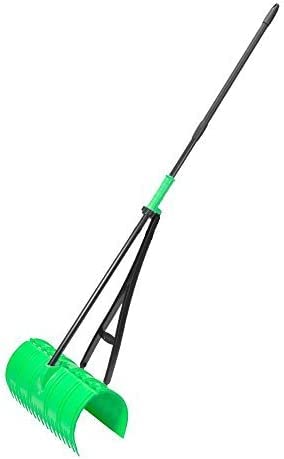
- Eliminates bending and stooping
- Lightweight and easy to maneuver
- Multifunctional design for raking and scooping
Cons
- Costs more than a standard leaf rake
- Learning curve for effective use
- May not handle heavy, wet leaves well
The Amazing Rake is a game-changer for yard work. Its 3-in-1 design lets you rake, scoop and pick up debris without bending over or touching it: just rake, grab and bag.
At just 2.5 pounds, the rake is lightweight, and its head is made of copolymer polypropylene that the maker describes as unbreakable.
There’s a slight learning curve to using the rake effectively, but it can speed up cleanup and spare your back during long sessions.
Best runner-up

- Adjustable head width from 8″ to 17″
- Extendable handle for comfortable use
- Compact and portable design
Cons
- Metal tines may bend under heavy use
- Assembly required
- Plastic handle top may not be as durable as metal
The Oliynedy Adjustable Leaf Rake is a versatile, budget-friendly choice. Its expandable metal head adjusts from about 8 to 17 inches, so you can switch between narrow and wide raking.
The narrow setting is designed for tight spots around shrubs and flower beds, while the full 17-inch width speeds up raking on larger lawn areas.
The 30″ to 58″ handle suits users of different heights. The 1-inch diameter metal is painted black to resist rust, though the tines may flex under heavy debris.
It assembles in about a minute by screwing the poles together with no tools, and it breaks down compactly for storage or camping trips. The handle top is plastic rather than metal.
Best budget option

- Telescoping handles for comfortable use
- Durable construction with powder-coated steel
- Versatile for various yard debris
Cons
- At about 4 pounds, heavier than all-plastic leaf grabbers
- May struggle with wet or heavy materials
- Slightly pricey compared to basic rakes
The Earthwise Gator Grabber is a strong choice for yard maintenance if you want to pick up debris without bending.
Its telescoping handles adjust to a comfortable length, and the heavy-duty poly-fiber jaws with teeth grip leaves, pinecones and other common yard debris.
The powder-coated steel shafts add durability, and the tool is easy to assemble, take apart and store.
It is best suited to dry leaves and light debris; wet or heavy material is harder to grab. For those seeking to reduce back strain during yard work, it offers good value.
Best premium choice

- High-quality metal construction
- Long 63-inch detachable handle with non-slip texture
- 17 prongs for efficient soil work
Cons
- Bow-rake head is better for soil and debris than for big leaf piles
- Assembly required
- Limited color options
The LLARGUEST Garden Rake is a sturdy all-metal bow rake for soil work.
Its 17 evenly spaced prongs span a 16-inch head and are designed to loosen and aerate soil, level ground, remove weeds and rake leaves.
The 63-inch handle detaches for storage and has a non-slip texture for a secure grip.
It suits flower beds, lawns and garden beds, from removing dead leaves and gathering thatch to leveling soil, and works for both home and professional gardeners.
Also great

- Large size for quick leaf collection
- Adjustable handles fit various hand sizes
- Versatile for multiple yard debris types
Cons
- Plastic construction may not be as durable as metal
- Limited to two-handed use
- May be awkward for reaching under bushes
These GardenHOME leaf scoops are an efficient way to bag leaves by hand.
Each oversized 15 x 12 inch scoop grabs large piles of leaves, grass clippings, mulch and yard debris with fewer passes, and the adjustable handles fit different hand sizes and work with gloves.
The lightweight plastic pair is easy to carry and rinse, nests together and has hanging holes for storage. The plastic may not last as long as metal, and the large scoops can be awkward under dense bushes.
When selecting a garden rake, we recommend considering several key factors to ensure you choose the best tool for your needs.
The rake’s material affects its durability and weight. Common options include:
Tines are the “fingers” of the rake. Their shape and spacing impact functionality:
Choose a handle length that suits your height and the tasks you’ll be performing:
The rake’s head width determines its coverage area:
Look for ergonomic designs that reduce fatigue:
We suggest trying different rakes to find one that feels comfortable and suits your specific gardening needs.
We independently select all products and services. If you click through links we provide, Plant Native may earn a commission with no extra cost to you. As an Amazon Associate I earn from qualifying purchases.
Some of this might be region-specific. What works in the south doesn’t always apply up north.
You’re right that soil prep is crucial — we should probably expand on that. Thanks for the feedback! -Plant Native Team
Has anyone tried this in raised beds? That’s all we have to work with.