Dangleberry (Gaylussacia frondosa)
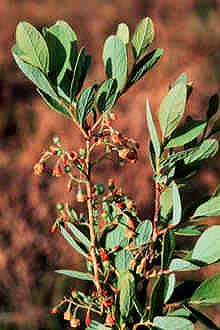
Gaylussacia frondosa, commonly known as Dangleberry or Blue Huckleberry, is a graceful native deciduous shrub of the eastern United States coastal plain — a member of the heath family (Ericaceae) closely related to blueberries and huckleberries. Named for the French chemist Joseph Louis Gay-Lussac, the genus Gaylussacia is distinguished from the closely related blueberries (Vaccinium) by having ten prominent resin glands on the undersides of the leaves (giving the foliage a distinctive sticky feel), by producing fruits with exactly 10 hard nutlets (seeds), and by growing in underground rhizome colonies rather than from a single crown.
Dangleberry is particularly distinctive among the huckleberries for its open, graceful branching habit, its long-stalked flower clusters that give the plant an airy appearance in bloom, and its especially appealing dark blue to blue-black fruits — larger, juicier, and arguably tastier than those of most other huckleberries. The common name “dangleberry” refers to the way these fruits hang on long, slender stalks (pedicels) beneath the drooping branches, dangling in clusters like tiny blue ornaments. The dark blue fruit is critically important to wildlife, consumed by dozens of bird species, black bears, white-tailed deer, and numerous small mammals.
In the wild, Dangleberry forms extensive colonies by rhizome spread in acidic, well-drained to somewhat moist, sandy or loamy soils — the pine barrens, oak-pine scrubs, and pocosins of the Atlantic coastal plain from Maine to Florida are its natural home. It thrives in the very conditions that challenge most ornamental plants: strongly acidic, nutrient-poor, sandy soils in partial shade. For gardeners in Delaware, New Jersey, and New York — particularly those with coastal plain or Pine Barrens conditions — Dangleberry is an outstanding native choice that provides year-round interest, exceptional wildlife value, and minimal maintenance once established.
Identification
Dangleberry is a loosely branched deciduous shrub typically growing 3–6 feet (0.9–1.8 m) tall, though colonial patches can spread more widely. The overall form is open and graceful, with arching branches and a more elegant, less compact appearance than many other heath family shrubs. It spreads by underground rhizomes to form loose colonies.
Stems and Bark
Young stems are yellowish-green to reddish, somewhat angular, and covered with fine hairs when young, becoming more gray-brown and smooth with age. The branching pattern is irregular and open, giving the shrub an airy, see-through quality quite different from the dense mound of lowbush blueberry. The colonial growth habit means plants spread gradually outward from a central clump.
Leaves
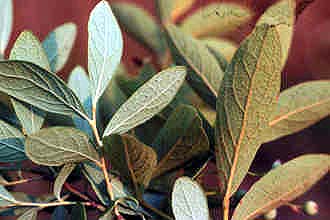
The leaves are alternate, simple, and elliptic to oblong, 1–2.5 inches (2.5–6 cm) long. The upper surface is bright green to blue-green; the underside is pale and covered with numerous tiny, yellowish resin glands — visible with a hand lens and responsible for the characteristic slightly sticky feel of the leaves. Leaf margins are entire (smooth, not toothed) — an important characteristic distinguishing Dangleberry from many blueberries. In autumn, leaves turn attractive shades of red, orange, and yellow before dropping.
Flowers
Flowers bloom April–June in pendant, elongated racemes (clusters) of 6–12 flowers on long, drooping stalks — giving the plant a graceful, dangling quality at bloom time. Individual flowers are small, cylindrical, and greenish-white to pinkish, about ¼ inch long, in the characteristic urn-shaped (urceolate) form of the heath family. The long-stalked flower clusters are more open and pendulous than the tighter clusters of most blueberries.
Fruit
The fruit is a dark blue to blue-black berry, ¼ to ½ inch (6–12 mm) in diameter, ripening July–September. The fruits hang on the characteristic long, slender pedicels in loose, pendant clusters — the source of the common name “dangleberry.” Each fruit contains exactly 10 hard, bony nutlets (seeds), distinguishing huckleberry fruits from the numerous tiny seeds of blueberries. The flesh is bluish-purple, sweet, and flavorful, slightly less juicy than blueberries but with a distinctive pleasant taste. The fruits have a white waxy bloom similar to blueberries.
Quick Facts
| Scientific Name | Gaylussacia frondosa |
| Family | Ericaceae (Heath family) |
| Plant Type | Deciduous Shrub (colonial) |
| Mature Height | 3–6 ft |
| Sun Exposure | Part Shade to Full Shade |
| Water Needs | Moderate |
| Bloom Time | April – June |
| Flower Color | Greenish-white to pinkish |
| Fruit | Dark blue to blue-black berries (July–September) |
| Fall Color | Red, orange, yellow |
| USDA Hardiness Zones | 5–9 |
Native Range
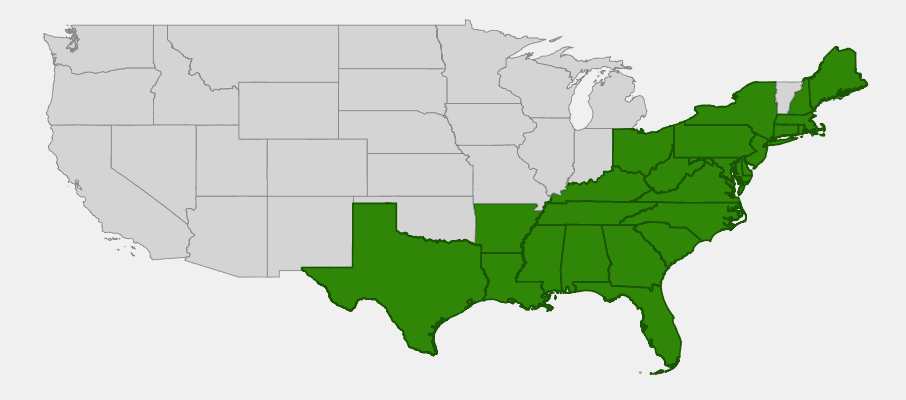
Dangleberry is native to the eastern United States, with a range centered on the Atlantic and Gulf Coastal Plains and extending into the interior Southeast. Its core range runs from coastal Maine and southern New Hampshire south through Massachusetts, Rhode Island, Connecticut, New York, New Jersey, Delaware, Maryland, Virginia, North Carolina, South Carolina, Georgia, and Florida, and westward through Alabama, Mississippi, Arkansas, and Louisiana. It reaches western limits in eastern Texas and is locally present in Kentucky, Tennessee, and parts of Ohio.
Throughout this range, Dangleberry is most characteristic of the pine barrens, coastal plain pine-oak scrub, and pocosins (shrub bogs) of the Atlantic Coastal Plain — habitats defined by nutrient-poor, strongly acidic, sandy or peaty soils. In New Jersey’s famous Pine Barrens — one of the largest remaining coastal plain ecosystems on the eastern seaboard — Dangleberry is an abundant and characteristic shrub of the pine-oak understory. In Delaware, it grows in similar conditions along the coastal plain, and in New York it is found locally in the Long Island pine barrens and related coastal plain habitats.
Dangleberry is a fire-adapted species that regenerates vigorously from underground rhizomes after fire, quickly re-colonizing burned areas. Historic fire suppression has reduced its abundance in some parts of its range, while recent prescribed burning programs in coastal plain conservation areas have helped restore it. It is an important component of the globally rare Atlantic Coastal Plain pine barrens ecosystem, which supports numerous endemic and rare species.
📋 Regional plant lists featuring Dangleberry: Delaware, New Jersey & New York
Growing & Care Guide
Dangleberry requires specific soil conditions but is low-maintenance and long-lived in appropriate settings. The key to success is matching its need for acidic, well-drained, nutrient-poor soil.
Light
Dangleberry naturally grows under the partial shade of pine and oak canopies — it thrives in part shade to moderate shade. It can tolerate full shade but produces fewer fruits in deep shade. For maximum fruit production and best growth, site it where it receives 3–5 hours of direct sun, ideally morning sun with afternoon shade. In the garden, it performs well under open pine canopies or at the edge of deciduous woodlands.
Soil & Water
Strongly acidic soil (pH 4.5–5.5) is essential — Dangleberry will not thrive in neutral or alkaline soils. Sandy, loamy, or peaty soils that drain well but hold some moisture are ideal. The plant is adapted to nutrient-poor conditions and actually performs better without fertilization in most cases. Avoid adding lime or wood ash near the plant. If your soil pH is above 6.0, amend with elemental sulfur, use acidic mulches (pine bark, pine needle), or grow in a raised bed with acidic growing medium. Water needs are moderate — the plant tolerates brief drought once established but prefers consistent moisture.
Planting Tips
Plant in fall for best spring establishment, or in spring when the ground is workable. Prepare planting sites by mixing native soil with pine bark or acidic compost to improve drainage and lower pH. Plant multiple plants together to ensure cross-pollination and better fruit set — Dangleberry produces more fruit when multiple genetically distinct plants are present. Mulch with pine needles or pine bark chips, which maintain soil acidity as they decompose. Avoid overhead watering if possible; drip irrigation or soaker hoses are preferred.
Pruning & Maintenance
Dangleberry requires minimal pruning. Remove dead wood in late winter. To maintain a tidy form, tip-prune long, arching branches after flowering. The plant spreads slowly by rhizomes — if you want to contain the colony, cut back rhizome shoots at the colony’s edge. No significant pest or disease problems are typical in appropriate conditions; leaf spot diseases can occur in high humidity but are rarely serious.
Landscape Uses
- Wildlife gardens — exceptional fruit production for birds and mammals
- Pine barren or heathland gardens — ideal for sandy, acidic soil landscapes
- Native understory beneath pine or oak canopies
- Rain garden edges in appropriate soil conditions
- Slope stabilization on sandy, acidic slopes
- Naturalized borders — forms attractive colonies over time
- Edible landscape — fruits are edible and flavorful
Wildlife & Ecological Value
The dark blue fruit of Dangleberry is described in the regional plant data as “important to wildlife” — and this is no exaggeration. Few native shrubs in the coastal plain provide comparable fruit resources.
For Birds
Dangleberry fruits are consumed by dozens of bird species, including American Robin, Eastern Bluebird, Gray Catbird, Brown Thrasher, Hermit Thrush, Wood Thrush, Eastern Towhee, Cedar Waxwing, Wild Turkey, Northern Mockingbird, and many others. Migrating songbirds arriving in fall rely heavily on huckleberry fruits to fuel their migration. The shrub’s dense, twiggy structure also provides excellent nesting cover for many songbirds, particularly thrashers and catbirds that nest low in shrubby vegetation.
For Mammals
Black bears are major consumers of all Gaylussacia fruits throughout the species’ range, with Dangleberry a primary food source in coastal plain areas. White-tailed deer browse the foliage and twigs. Raccoons, foxes, opossums, and black bears consume the fruits. The rhizomatous root system provides food for voles and other small rodents during winter.
For Pollinators
The tubular flowers of Dangleberry are visited by bumblebees (which perform “buzz pollination” by vibrating the anthers to release pollen), native bees, and hummingbirds. As a member of the Ericaceae family, Dangleberry supports specialist bees that have co-evolved with the heath family, including several species of Andrena and Colletes bees that are specifically adapted to collect pollen from ericaceous plants.
Ecosystem Role
In the pine barren ecosystem, Dangleberry is a structural keystone — along with lowbush blueberry (Vaccinium angustifolium), black huckleberry (Gaylussacia baccata), and bearberry (Arctostaphylos uva-ursi), it forms the characteristic heath shrub layer that defines the pine barrens ecosystem. This shrub layer is critical habitat for numerous rare and endemic species, including the federally threatened Karner Blue Butterfly (whose caterpillars feed on wild blue lupine growing in heath openings) and many rare plant species. The colonial growth and fire-resprouting ability of Dangleberry is essential to the post-fire recovery of the pine barrens ecosystem.
Cultural & Historical Uses
Dangleberry fruits have been eaten by Indigenous peoples throughout its range for thousands of years. The Lenape people — the original inhabitants of the Delaware Valley, New Jersey, and New York coastal plain — gathered huckleberries including Dangleberry as a significant food source. Fruits were eaten fresh, dried for winter use, incorporated into pemmican, and mashed into sauces. The Powhatan Confederacy in Virginia and other Algonquian peoples throughout the coastal plain similarly used huckleberries as both food and medicine. The fruits were mixed with cornmeal in traditional breads and puddings.
European colonists quickly adopted huckleberry harvesting from Indigenous peoples, and wild huckleberry picking remained an important late-summer activity in coastal communities throughout New England and the Mid-Atlantic through the early 20th century. Dangleberry fruits — larger and more flavorful than many other huckleberries — were particularly prized for eating fresh and for making jams, jellies, and pies. Early American cookbooks from New England and the mid-Atlantic frequently include huckleberry recipes alongside blueberry preparations, and the two names were often used interchangeably in historical records.
The pine barren habitats where Dangleberry thrives have their own distinctive cultural history. New Jersey’s Pine Barrens — home to one of the largest Dangleberry populations — are recognized as a UNESCO Pinelands National Reserve, a vast, largely intact coastal plain ecosystem that has been shaped by both natural fire ecology and centuries of human use, including charcoal production, iron manufacturing, cranberry and blueberry cultivation, and traditional foraging. Dangleberry and its fellow heath shrubs are integral to the ecological identity of this remarkable landscape.
Frequently Asked Questions
Can I eat Dangleberry fruits?
Yes — Dangleberry fruits are edible and quite tasty. They are sweeter and larger than the fruits of many other huckleberries, with a pleasant flavor similar to blueberries but with a slightly drier texture due to the hard nutlets inside. They can be eaten fresh, cooked in pies and jams, or dried. Note that the 10 hard nutlets inside each fruit are edible but make the texture different from blueberries.
What is the difference between huckleberry and blueberry?
Both are in the Ericaceae family, but different genera. True huckleberries (Gaylussacia) have 10 large, bony seed nutlets per fruit and leaves with visible resin glands. Blueberries (Vaccinium) have numerous tiny seeds per fruit and lack the resin glands. In culinary use, the terms are often used interchangeably, and the flavor of Dangleberry is very similar to blueberry.
Will Dangleberry grow in regular garden soil?
Only if the soil is acidic (pH below 5.5) and reasonably well-drained. Dangleberry will not grow well in neutral or alkaline soils. Test your soil pH before planting; if it’s above 6.0, amend with sulfur or grow in a raised bed filled with acidic growing medium. Sandy, pine barren-type soils are ideal.
How much does Dangleberry spread?
Dangleberry spreads slowly by underground rhizomes, forming loose colonies over time. The spread is gradual — typically a foot or two per year — so it’s manageable in most garden situations. If you want to contain it, cut back new rhizome shoots at the edge of the colony each spring before they establish.
When does Dangleberry fruit ripen?
Dangleberry fruits typically ripen July through September, with peak ripeness in August in most of the Mid-Atlantic region. The fruits turn from green to red to dark blue-black as they ripen. Harvest when they are fully dark blue-black and come away from the stem easily.

Looking for a nursery that carries Dangleberry?
Browse our native plant nursery directory: Delaware · New Jersey