Eastern Redbud (Cercis canadensis)
Cercis canadensis, commonly known as Eastern Redbud, Redbud, or Judas Tree, is one of North America’s most beloved native flowering trees, heralding spring’s arrival with its spectacular display of rosy-pink flowers that bloom directly on bare branches and even the trunk. This member of the Fabaceae (legume) family creates one of nature’s most stunning early-season spectacles, transforming entire woodland understories into clouds of pink before most other trees have even begun to leaf out. The common name “redbud” refers to the deep pink buds that appear in late winter, though the flowers themselves range from bright pink to purplish-pink, with occasional white-flowered forms.
Growing naturally throughout much of eastern North America, from southern Ontario to northern Florida and west to southeastern Nebraska, Eastern Redbud is equally at home in rich bottomlands and dry upland woods. This small deciduous tree typically reaches 20 to 30 feet tall with an irregular, often multi-trunked form that adds to its charm. Beyond its spectacular spring bloom, Redbud offers year-round interest with distinctive heart-shaped leaves that emerge bronze-red and mature to bright green, followed by clusters of flat, bean-like seed pods that persist into winter. The smooth, dark bark becomes attractively furrowed with age, while the tree’s graceful, somewhat zigzag branching pattern creates an elegant winter silhouette.
Eastern Redbud’s ecological value matches its ornamental appeal. As one of the earliest native trees to bloom, it provides crucial nectar and pollen for native bees, butterflies, and other pollinators emerging from winter dormancy. The seeds feed numerous bird species, while the heart-shaped leaves serve as host plants for several native butterfly larvae. Its tolerance for both sun and partial shade, combined with adaptability to various soil conditions, makes Eastern Redbud an excellent choice for naturalistic gardens, woodland edges, and even formal landscapes throughout its extensive native range.
Identification
Eastern Redbud is easily recognized by its distinctive combination of heart-shaped leaves, pink spring flowers, and characteristic growth habit. This small to medium-sized deciduous tree typically develops multiple trunks or a short main trunk that branches low to the ground, creating a broad, flat-topped or rounded crown that is often wider than it is tall.
Bark
The bark is initially smooth and reddish-brown on young trees, becoming darker gray-brown with age and developing shallow furrows and scaly ridges as the tree matures. On older specimens, the bark may become quite dark, almost black, with pronounced ridges. The bark has a slightly bitter taste and contains compounds that have been used medicinally by Indigenous peoples. One distinctive feature is that flowers often bloom directly from the bark of older trunks and branches, creating the tree’s most striking visual characteristic.
Leaves
The leaves are the tree’s most distinctive identifying feature: simple, alternate, and perfectly heart-shaped (cordate) with a smooth margin and prominent parallel veins. Each leaf is 3 to 5 inches (7.5–13 cm) long and nearly as wide, with a pointed tip and deeply indented base. New leaves emerge bronze-red to purplish in early spring, quickly maturing to bright green on top with a paler underside. The leaf stalks (petioles) are 3 to 5 inches long, allowing the leaves to flutter in even light breezes. In autumn, the foliage turns a clear yellow before dropping, though fall color can be variable and sometimes lackluster.
Flowers & Fruit
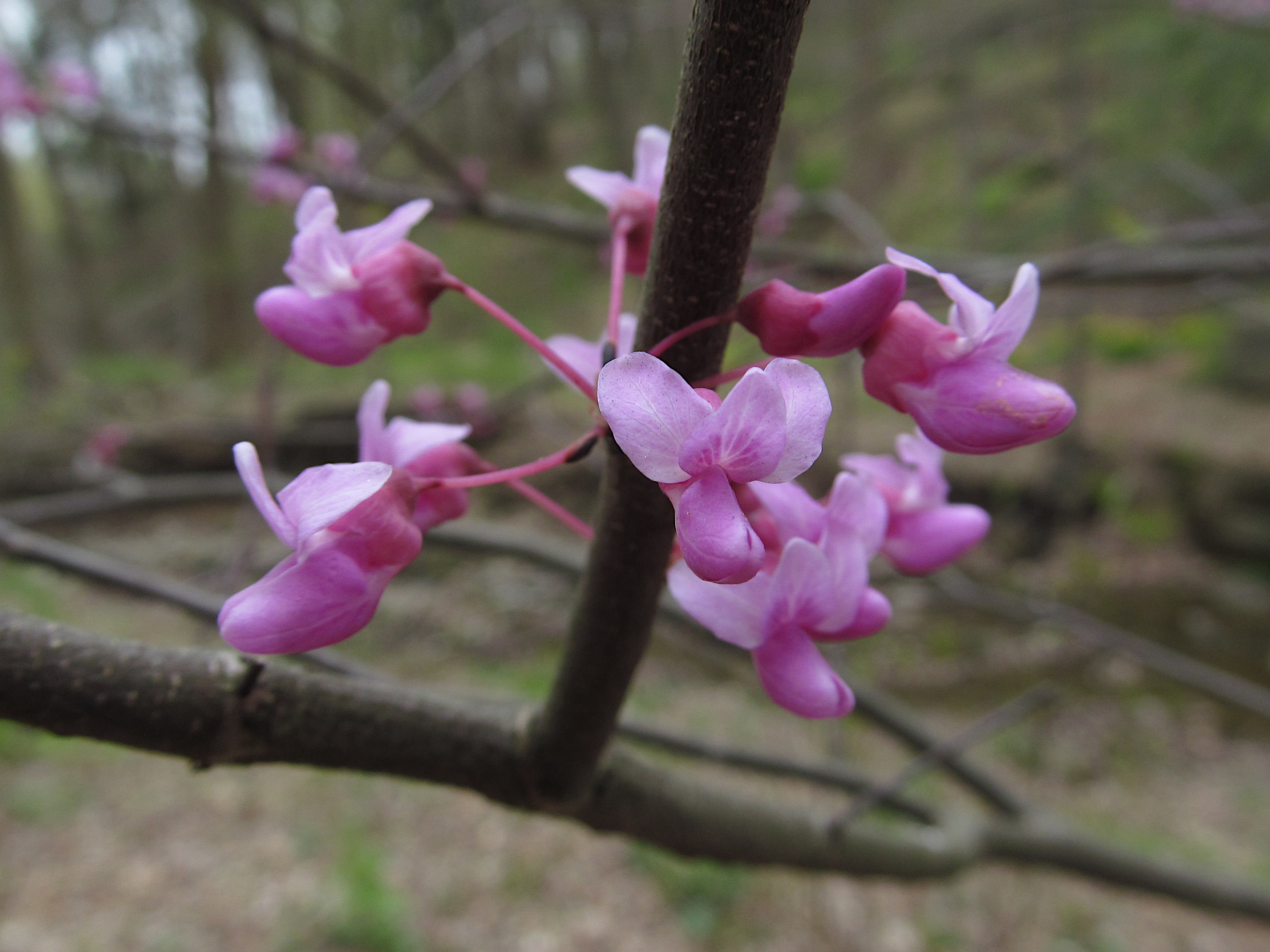
The flowers are Eastern Redbud’s crowning glory: small, pea-like blossoms about ½ inch (1.3 cm) long that appear in clusters of 4 to 8 along branches, twigs, and even the main trunk. Each flower has five petals in the typical legume arrangement, with the upper petal (banner) being the largest. The normal color is bright rosy-pink to purplish-pink, though pure white forms exist. Flowers typically appear in March to May, before the leaves, covering the entire tree in color. The blooming period lasts 2 to 3 weeks.
The fruit is a flat, oblong legume (pod) 2 to 4 inches (5–10 cm) long and about ½ inch wide, initially green but turning brown as it matures in late summer. Each pod contains 4 to 10 small, hard, brown seeds. The pods often persist on the tree well into winter, rattling in the wind and providing winter interest. The seeds are an important food source for birds including quail, rose-breasted grosbeak, and chickadees.
Quick Facts
| Scientific Name | Cercis canadensis |
| Family | Fabaceae (Legume) |
| Plant Type | Deciduous Tree |
| Mature Height | 20–30 ft |
| Sun Exposure | Full Sun to Full Shade |
| Water Needs | Moderate to Low (Drought Tolerant) |
| Bloom Time | March – May |
| Flower Color | Pink to purplish-pink |
| USDA Hardiness Zones | 4–9 |
Native Range
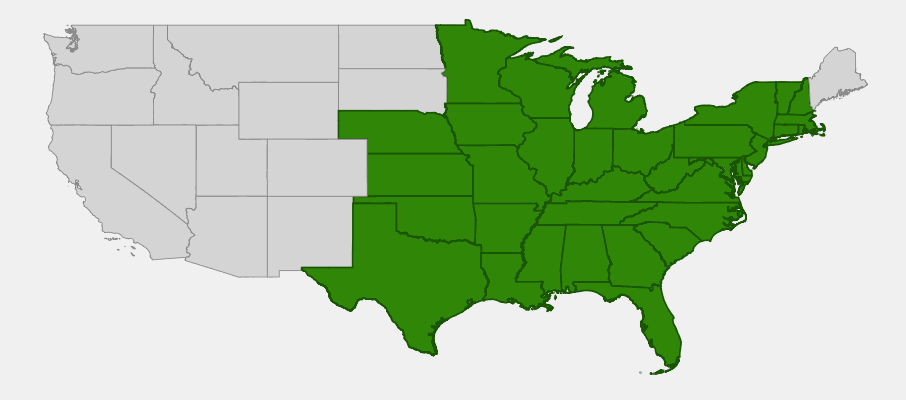
Eastern Redbud has one of the most extensive native ranges of any North American flowering tree, stretching from southern Ontario and southwestern Quebec south to northern Florida, and from the Atlantic Coast west to southeastern Nebraska, eastern Kansas, and central Texas. The species reaches its greatest abundance in the rich, moist soils of river valleys and lower mountain slopes throughout the eastern deciduous forests, but also occurs in drier upland sites, rocky outcrops, and forest edges. Its remarkable adaptability has allowed it to colonize diverse habitats from sea level to elevations of approximately 2,000 feet in the Appalachian Mountains.
Within this vast range, Eastern Redbud shows considerable ecological flexibility. In the northern portions of its range, it typically grows as an understory tree in mixed hardwood forests dominated by oak, hickory, and maple. Moving southward, it becomes common in bottomland hardwood forests alongside sweetgum, tulip poplar, and various oak species. In the western portions of its range, it often appears along stream corridors and in rocky woodland openings, where its drought tolerance becomes particularly valuable. The species is notably common throughout the southeastern states, where it has become an iconic component of spring wildflower displays.
Eastern Redbud’s extensive distribution reflects both its ancient origins and its remarkable adaptability to different climatic conditions. Fossil evidence suggests that ancestors of modern Redbud species were widespread across North America during warmer geological periods. The current range represents a contraction from this former distribution, but Eastern Redbud remains one of our most successful native trees, thriving in habitats from the humid Southeast to the more continental climate of the Great Plains edge.
📋 Regional plant lists featuring Eastern Redbud: North Carolina & South Carolina
Growing & Care Guide
Eastern Redbud is one of the most versatile and rewarding native trees for home landscapes, combining spectacular spring beauty with minimal maintenance requirements once established. Its adaptability to a wide range of growing conditions, from full sun to deep shade and moist to moderately dry soils, makes it suitable for almost any garden situation.
Light
Eastern Redbud demonstrates remarkable adaptability to light conditions, thriving in everything from full sun to deep shade. In full sun locations, the tree develops a denser, more compact form with abundant flowering, while in shadier situations it tends to grow taller and more open as it reaches for available light. The most prolific flowering typically occurs with at least 4-6 hours of direct sunlight daily, but even trees in considerable shade will produce a respectable display. This shade tolerance makes Redbud excellent for understory plantings beneath taller trees or for transitional areas between woodland and open lawn.
Soil & Water
While Eastern Redbud prefers moist, well-drained soil rich in organic matter, it demonstrates impressive drought tolerance once established, making it suitable for xeriscaping and low-water gardens. The tree grows best in slightly acidic to neutral soil (pH 6.0-7.5) but adapts to both more acidic and alkaline conditions. It tolerates clay soils better than many trees, provided drainage is adequate, and also grows well in sandy or rocky soils. Newly planted trees benefit from regular watering the first year, but established specimens can survive extended dry periods, though growth may slow and some leaf drop may occur during severe drought.
Planting Tips
Plant Eastern Redbud in spring or fall when temperatures are moderate. Choose a location that provides morning sun and some afternoon protection in the hottest climates. The tree transplants best when young, so select smaller specimens (under 6 feet tall) for best establishment success. Dig the planting hole twice as wide as the root ball but no deeper, and backfill with native soil rather than amendments. Water thoroughly after planting and maintain consistent moisture the first growing season. Mulch around the base with 2-3 inches of organic material, keeping mulch away from the trunk to prevent pest problems.
Pruning & Maintenance
Eastern Redbud requires minimal pruning and is best left to develop its natural, somewhat irregular form. Remove dead, damaged, or crossing branches in late winter or immediately after flowering. Avoid heavy pruning, as Redbud wood can be brittle and the tree heals slowly from large cuts. If you must remove large branches, do so gradually over several years. The tree may develop multiple trunks naturally, which adds to its charm and shouldn’t be discouraged unless a single-trunk specimen is specifically desired. Young trees may benefit from light structural pruning to establish good branch angles.
Landscape Uses
Eastern Redbud’s versatility makes it valuable in numerous landscape applications:
- Specimen tree — Outstanding as a focal point in spring gardens
- Understory planting — Excellent beneath taller shade trees
- Woodland edge — Natural transition between forest and open areas
- Street tree — Suitable for smaller streets and residential areas
- Naturalistic gardens — Essential component of native plant communities
- Wildlife gardens — Provides early nectar and bird food
- Slope stabilization — Root system helps control erosion
- Container growing — Smaller cultivars work in large containers
Wildlife & Ecological Value
Eastern Redbud provides exceptional ecological value throughout the seasons, serving as both an early-season pollinator magnet and an important food source for birds and other wildlife. Its role as one of the first trees to bloom makes it particularly crucial for native bees and other pollinators emerging from winter dormancy when few other nectar sources are available.
For Birds
The seeds of Eastern Redbud are consumed by numerous bird species, including Northern Bobwhite, Wild Turkey, Rose-breasted Grosbeak, Northern Cardinal, and various finches and sparrows. The flat seed pods provide easy access to the nutritious seeds, and many birds have learned to split the pods to extract them. The tree’s branching structure also provides good nesting sites for smaller songbirds, while the dense foliage offers shelter and protection. Hummingbirds occasionally visit the flowers for nectar, though they are not the primary pollinators.
For Mammals
White-tailed deer browse the foliage, twigs, and seed pods of Eastern Redbud, particularly in winter when other food sources are scarce. Squirrels and chipmunks collect and cache the seeds, helping with seed dispersal. Various small mammals use the tree for shelter, and the bark has historically been used by Indigenous peoples for food and medicine. In some areas, livestock will browse the leaves and young shoots, though this should be monitored as excessive browsing can damage young trees.
For Pollinators
Eastern Redbud is a crucial early-season nectar source, blooming when few other flowering trees are active. Native bees, including carpenter bees, bumble bees, and various solitary bee species, are the primary pollinators. The flowers’ structure makes them particularly well-suited to bee pollination, with the landing platform formed by the wing petals providing easy access to nectar and pollen. Butterflies, including early-emerging species like mourning cloaks and question marks, also visit the flowers. The tree serves as a host plant for the larvae of Henry’s elfin butterfly (Callophrys henrici) in some regions.
Ecosystem Role
As a member of the legume family, Eastern Redbud has the ability to fix nitrogen through symbiotic relationships with soil bacteria, potentially improving soil fertility for other plants. The tree’s leaf litter decomposes relatively quickly, adding organic matter to the soil. Its extensive native range and adaptability make it an important component of forest succession, often appearing in disturbed areas and helping to stabilize soil while providing shade for slower-growing forest trees to establish. The early bloom time helps extend the pollinator season, bridging the gap between early spring wildflowers and later-blooming trees and shrubs.
Cultural & Historical Uses
Eastern Redbud holds a rich place in North American cultural history, with Indigenous peoples having used virtually every part of the tree for food, medicine, and practical purposes long before European settlement. The Cherokee, Creek, Delaware, and other tribes consumed the flowers raw or cooked them as fritters, appreciating their mildly sweet, slightly tart flavor. The flowers were often mixed into salads or used as a colorful garnish. The young seed pods were cooked and eaten like green beans, while the inner bark was used to treat various ailments including whooping cough and fever.
The tree’s wood, while not considered high-quality timber, has been used locally for fence posts, tool handles, and small woodworking projects. The bark contains tannins and has been used for leather tanning on a small scale. During the Civil War era, the inner bark was sometimes used as a dye source, producing colors ranging from yellow to red-brown depending on the mordant used. The roots were occasionally used to create a red dye for baskets and textiles.
In American folk medicine, various preparations from Eastern Redbud were used to treat dysentery, leukemia, and other conditions, though modern science has not validated these uses and some parts of the tree may be mildly toxic if consumed in large quantities. The tree earned the common name “Judas Tree” from European settlers who associated it with the Mediterranean species Cercis siliquastrum, which according to legend was the tree from which Judas Iscariot hanged himself. This association has largely fallen out of favor in modern times, with “Eastern Redbud” being the preferred common name.
Today, Eastern Redbud continues to hold cultural significance as one of America’s most beloved native flowering trees. It has been designated as the state tree of Oklahoma and is featured prominently in spring festivals throughout its range. The tree’s association with renewal and spring’s arrival has made it a popular choice for memorial plantings and community beautification projects. Modern ethnobotanical interest has led to renewed appreciation for the edible flowers, which are now featured in upscale restaurants and wild food cookbooks, though harvesting should always be done sustainably and with landowner permission.
Frequently Asked Questions
Why isn’t my Eastern Redbud blooming?
Several factors can prevent flowering: insufficient sunlight (needs at least 4-6 hours daily), tree too young (may take 4-6 years to bloom), late spring frost damage to buds, or excessive nitrogen fertilization that promotes leaf growth at the expense of flowers. Drought stress can also reduce flowering the following year.
Are Eastern Redbud flowers and pods edible?
Yes, the flowers are edible and have a mildly sweet, slightly tangy flavor. They can be eaten raw, added to salads, or cooked into fritters. Young seed pods can be cooked and eaten like green beans when tender. However, avoid eating large quantities, and never consume any plant part without being absolutely certain of the identification.
How long do Eastern Redbuds typically live?
Eastern Redbuds are generally considered short- to medium-lived trees, with an average lifespan of 50-70 years, though some specimens may live longer under ideal conditions. Factors affecting longevity include growing conditions, climate stress, disease pressure, and mechanical damage. The tree may be more prone to storm damage due to its somewhat brittle wood.
Can Eastern Redbud grow in containers?
Yes, especially dwarf cultivars like ‘Ace of Hearts’ or ‘The Rising Sun.’ Use a large container (at least 20-25 gallons for long-term growth), ensure good drainage, and provide regular watering and fertilizing. Container-grown trees will need winter protection in colder climates and may require repotting every 3-5 years.
Is Eastern Redbud susceptible to any serious diseases or pests?
While generally healthy, Eastern Redbud can be affected by canker diseases, verticillium wilt, and leaf spot. Borers may attack stressed trees. Good cultural practices — proper siting, avoiding root damage, and maintaining tree health — are the best prevention. Avoid overhead watering to reduce fungal disease risk.

Looking for a nursery that carries Eastern Redbud?
Browse our native plant nursery directory: North Carolina · South Carolina