
Grass-leaved Goldenrod (Euthamia graminifolia)
Euthamia graminifolia, commonly known as Grass-leaved Goldenrod, Flat-top Goldenrod, or Lance-leaved Goldenrod, is a distinctive native perennial that brings bright yellow color to late summer and fall landscapes across much of North America. This member of the Asteraceae (sunflower) family stands apart from its more familiar goldenrod cousins with its narrow, grass-like leaves and flat-topped flower clusters that create a completely different visual texture in the garden.
Unlike the plume-like flower displays of most goldenrods, Grass-leaved Goldenrod produces dense, flat-topped clusters (corymbs) of tiny yellow flowers that create a table-like canopy of color from July through September. This unique flowering structure, combined with its narrow linear leaves that resemble grass blades, makes it easily distinguishable from other goldenrod species and gives it particular value in naturalistic plantings where a more refined, architectural appearance is desired.
Native to wetlands, prairies, and meadows across a vast range from the northern Great Plains to the Atlantic Coast, Grass-leaved Goldenrod is especially valuable for sites with consistent moisture. Its ability to thrive in both full sun and partial shade, combined with its tolerance for wet soils and extended bloom period, makes it an excellent choice for rain gardens, native plant gardens, and wildlife habitat plantings where late-season color and pollinator support are priorities.
Identification
Grass-leaved Goldenrod typically grows 1 to 4 feet tall, forming colonies through underground rhizomes that create loose to dense stands over time. The plant’s upright stems are smooth, often with a slight bluish or purplish tinge, and branch primarily in the upper portion where the flower clusters form.
Leaves
The leaves are the plant’s most distinctive vegetative feature. They are linear to lance-shaped, 2 to 5 inches long and only ⅛ to ½ inch wide, giving them a distinctly grass-like appearance that inspired the common name. The leaves are alternate, smooth-margined (entire), and have 3 to 5 prominent parallel veins running lengthwise — a characteristic that helps distinguish this species from true grasses, which have only parallel veins without the branching network typical of dicots. The leaves are bright green and somewhat thick and fleshy, an adaptation to the wet soils where the plant often grows.
Flowers
The flowers are arranged in distinctive flat-topped to slightly rounded clusters (compound corymbs) that can measure 4 to 8 inches across. Each tiny flower head is only about ⅛ inch wide and consists of 7 to 15 small yellow ray flowers surrounding a center of 3 to 8 disc flowers. The overall effect is a dense carpet of bright yellow that appears almost crystalline in texture. This flat-topped arrangement is quite different from the plume-like panicles of most other goldenrods and makes identification relatively straightforward.
Seeds
Like other members of the sunflower family, Grass-leaved Goldenrod produces small achenes (seed-like fruits) topped with white bristles (pappus) that aid in wind dispersal. The seeds are tiny, brown, and mature in late summer to early fall. A single plant can produce thousands of seeds, and the species also spreads vegetatively through its rhizome system.
Quick Facts
| Scientific Name | Euthamia graminifolia |
| Family | Asteraceae (Sunflower) |
| Plant Type | Herbaceous Perennial |
| Mature Height | 1–4 ft |
| Sun Exposure | Full Sun |
| Water Needs | Moderate to High |
| Bloom Time | July – September |
| Flower Color | Bright Yellow |
| USDA Hardiness Zones | 3–9 |
Native Range
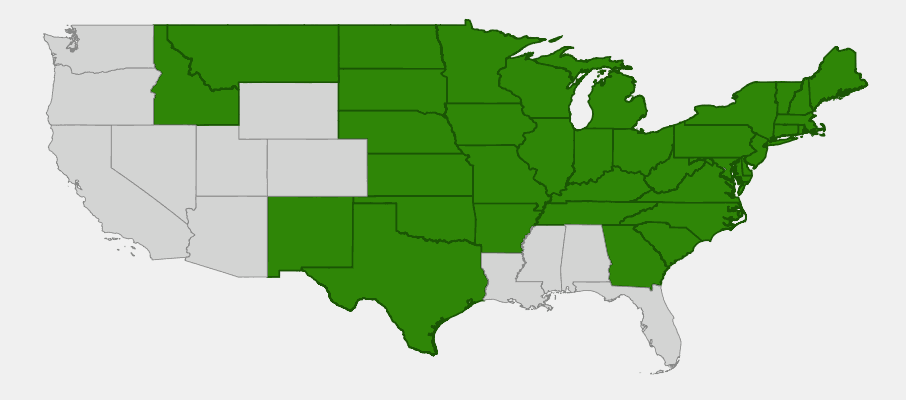
Grass-leaved Goldenrod has one of the most extensive native ranges of any North American goldenrod, spanning from the northern Great Plains and southern Canada east to the Atlantic Coast and south to the Gulf of Mexico. It occurs naturally in every U.S. state east of the Rocky Mountains and in several western states where suitable wetland habitats exist. This wide distribution reflects the plant’s adaptability to various climate conditions and habitat types, from the prairie potholes of the northern Great Plains to the coastal plain wetlands of the Southeast.
The species is particularly common in the Great Lakes region and northern prairie states, where it occurs in wet prairies, sedge meadows, marshes, and along the edges of lakes and streams. In the eastern United States, it’s found in coastal plain wetlands, mountain bogs, wet meadows, and along stream corridors. The plant typically occurs in areas with high soil moisture throughout much of the growing season, though it can tolerate periodic drying.
Grass-leaved Goldenrod’s extensive range and habitat flexibility have made it an important species for wetland restoration projects across much of North America. It’s often among the first native plants to establish in restored wetlands and plays a key role in stabilizing soils and providing early successional habitat for wildlife.
📋 Regional plant lists featuring Grass-leaved Goldenrod: North Dakota, South Dakota & Western Minnesota
Growing & Care Guide
Grass-leaved Goldenrod is one of the easier native goldenrods to grow and is particularly valuable for gardeners dealing with wet or periodically flooded sites. Its tolerance for a wide range of conditions, from wet to merely moist soils, makes it adaptable to many garden situations, while its distinctive appearance adds textural interest that differs from typical goldenrod plantings.
Light
This species performs best in full sun, where it develops its most compact growth habit and produces the most abundant flowers. It will tolerate partial shade, especially in consistently moist sites, but may become taller and more open in habit. In shadier locations, flowering may be reduced, though the plant will still contribute attractive foliage texture to the garden throughout the growing season.
Soil & Water
Grass-leaved Goldenrod thrives in moist to wet soils and is particularly well-suited for sites that receive consistent moisture throughout the growing season. It performs well in clay, loam, or sandy soils as long as adequate moisture is present. The plant is quite tolerant of periodic flooding and can handle soils that are waterlogged for weeks at a time, making it excellent for rain gardens and bioretention areas. While it prefers consistent moisture, established plants can tolerate brief dry periods, though flowering and overall vigor may be reduced.
Planting Tips
Plant Grass-leaved Goldenrod in spring or fall, spacing plants 18-24 inches apart if creating a mass planting. The species establishes readily from nursery stock and will begin spreading through rhizomes within the first year. If starting from seed, scatter in fall or early spring; seeds need light to germinate, so barely cover or simply press into the soil surface. The plant may take 2 years to reach full flowering size from seed.
Pruning & Maintenance
This low-maintenance perennial requires little care once established. Cut back stems in late fall or early spring, leaving 4-6 inches of stubble for overwintering beneficial insects. If you want to prevent aggressive spreading, deadhead flowers before seeds mature, though this eliminates food for seed-eating birds. In favorable conditions, the plant may spread more rapidly than desired; excess shoots can be easily removed in spring. Division is rarely necessary but can be done in early spring if you want to control spread or create new plants.
Landscape Uses
Grass-leaved Goldenrod’s unique appearance and moisture tolerance make it valuable in several landscape applications:
- Rain gardens and bioswales — excellent for sites with periodic flooding or consistently moist conditions
- Wetland restoration and naturalization — important component of prairie pothole and marsh edge plantings
- Pollinator gardens — provides crucial late-season nectar when many other flowers have finished
- Native plant borders — adds textural contrast with its grass-like foliage and flat-topped flowers
- Naturalized meadows — works well in wet prairie and meadow plantings
- Erosion control — rhizomatous growth helps stabilize wet soils along streams and pond edges
Wildlife & Ecological Value
Grass-leaved Goldenrod is an ecological powerhouse, particularly valuable for its late-season flowering when many other native plants have finished blooming. Its extensive flower clusters and extended bloom period make it one of the most important fall nectar sources in many wetland and prairie ecosystems.
For Birds
The seeds of Grass-leaved Goldenrod are important food for numerous bird species, particularly seed specialists like American Goldfinches, which often feed directly on the seed heads in fall. Other frequent visitors include various sparrow species, siskins, and redpolls. The dense colonies that the plant forms provide cover and nesting habitat for ground-nesting birds and small mammals. During migration periods, the persistent seed heads continue to provide food well into winter.
For Mammals
Small mammals, including mice and voles, collect the seeds both from standing plants and from the ground after dispersal. The rhizomatous root system creates habitat for various soil-dwelling mammals and invertebrates. In some regions, muskrats and other wetland mammals use the dense colonies as cover and nesting material.
For Pollinators
This species is exceptionally valuable for pollinators, supporting over 100 species of native bees, butterflies, and beneficial insects. The flat-topped flower clusters provide easy landing platforms and abundant nectar during the critical late-summer period when many butterflies are building up energy reserves for migration or overwintering. Native bee species, including various sweat bees, leafcutter bees, and bumble bees, are common visitors. The plant is also important for beneficial insects like predatory wasps and parasitoid flies that help control pest insects.
Ecosystem Role
Grass-leaved Goldenrod plays important roles in wetland and prairie ecosystems. Its extensive rhizome system helps prevent soil erosion and creates microhabitats for numerous invertebrates. The plant is often among the first to colonize disturbed wetlands and helps stabilize soils during early succession. In restoration contexts, its rapid establishment and soil-binding properties make it valuable for sites recovering from disturbance or degradation.
Cultural & Historical Uses
While not as extensively documented in ethnobotanical literature as some other goldenrods, Grass-leaved Goldenrod was used by several Indigenous peoples across its range for various medicinal and practical purposes. Like other goldenrods, it was sometimes used in traditional medicine preparations for treating respiratory ailments, wounds, and digestive issues, though specific documented uses are less common than for the more widespread Canada Goldenrod (Solidago canadensis).
The plant’s most significant historical role was probably ecological rather than cultural — serving as an important indicator species for wetland habitats and contributing to the vast biodiversity of North America’s prairie and wetland ecosystems. Early European naturalists and settlers noted its abundance in wet prairies and its value as forage for wildlife, particularly waterfowl and other wetland-dependent species.
In modern times, Grass-leaved Goldenrod has gained recognition as a key species in wetland restoration and green infrastructure projects. Its ability to thrive in constructed wetlands, bioretention areas, and rain gardens has made it valuable for sustainable stormwater management systems. Urban planners and ecological restoration specialists increasingly recognize its dual value as both a functional stormwater plant and a wildlife habitat provider.
The species has also found a place in contemporary native plant gardening movements, where its distinctive appearance and reliable late-season color have made it popular among gardeners seeking alternatives to non-native fall-flowering plants. Its tolerance for difficult growing conditions and minimal maintenance requirements have contributed to its increased use in sustainable landscaping across much of North America.
Frequently Asked Questions
Will Grass-leaved Goldenrod spread aggressively in my garden?
The plant does spread through underground rhizomes and can form colonies over time, but it’s generally not considered aggressively invasive in garden settings. The spread is gradual and can be easily managed by removing unwanted shoots in spring. In favorable wet conditions, it may spread more quickly, so consider this when choosing planting locations.
How can I tell this apart from other goldenrods?
The combination of narrow, grass-like leaves and flat-topped flower clusters makes Grass-leaved Goldenrod quite distinctive. Most other goldenrods have broader leaves and plume-like or branching flower arrangements. The flat, table-like appearance of the flower clusters is particularly diagnostic.
Does this plant cause allergies like other goldenrods?
Like other goldenrods, this species produces relatively heavy pollen that doesn’t become airborne easily, so it’s not typically a significant allergen. The timing of its bloom coincides with ragweed, which is the actual culprit in most fall allergy cases. Goldenrods are often wrongly blamed because they’re more visible than the inconspicuous ragweed flowers.
Can I grow this in a regular perennial border?
While it can be grown in traditional garden settings, Grass-leaved Goldenrod performs best with consistent moisture. If you have a regularly irrigated border or naturally moist conditions, it can work well. However, it’s really at its best in rain gardens, bog gardens, or naturalized wet areas where its moisture requirements are easily met.
When should I cut back the plants?
For best wildlife value, leave the seed heads standing through winter to provide food for birds and shelter for beneficial insects. Cut back in late winter or early spring before new growth begins. If you want to prevent seeding, you can deadhead after flowering, but this eliminates the wildlife food value.

Looking for a nursery that carries Grass-leaved Goldenrod?
Browse our native plant nursery directory: North Dakota · South Dakota · Minnesota