
Heart-Leaved Golden Alexanders (Zizia aptera)
Zizia aptera, commonly known as Heart-Leaved Golden Alexanders or Meadow Parsnip, is a distinctive native perennial wildflower that brings early-season golden color to prairies, savannas, and woodland edges throughout much of eastern and central North America. This member of the Apiaceae (carrot) family is easily distinguished from its close relative, Golden Alexanders (Zizia aurea), by its characteristic heart-shaped basal leaves and slightly different flowering pattern. The bright yellow flowers bloom from May through June, providing crucial early nectar for pollinators when few other prairie flowers are in bloom.
Growing 1 to 3 feet tall, Heart-Leaved Golden Alexanders forms attractive clumps with distinctive heart-shaped leaves at the base and compound leaves on the flowering stems. The plant adapts well to various light conditions from full sun to partial shade, though it generally prefers slightly drier conditions than its cousin Golden Alexanders. This makes it particularly valuable for prairie restorations, dry meadows, and naturalized landscapes where reliable early-season color is desired.
Like other members of the carrot family, Heart-Leaved Golden Alexanders plays an important ecological role as a host plant for black swallowtail butterflies, whose distinctive caterpillars feed exclusively on Apiaceae species. The flowers attract a wide variety of beneficial insects including native bees, parasitic wasps, and other pollinators, while the seeds provide food for birds. Its deep taproot helps improve soil structure and provides excellent drought tolerance once established.
Identification
Heart-Leaved Golden Alexanders is a herbaceous perennial that typically grows 1 to 3 feet tall, forming small colonies over time through short rhizomes. The plant is most easily identified by its distinctive basal leaves and bright yellow umbel flowers that bloom in late spring and early summer.
Stems
The stems are smooth, hollow, and typically unbranched below the flowering portion. They can reach heights of 1 to 3 feet and often have a slight reddish tinge when young. The stems contain a clear sap and are somewhat succulent when fresh, becoming hollow and brittle as they mature and dry.
Leaves
The leaves provide the most reliable identification feature. The basal leaves are simple and distinctly heart-shaped (cordate), measuring 1 to 4 inches across, with long petioles (leaf stalks). These heart-shaped leaves persist throughout the growing season and are unique among North American Zizia species. The stem leaves are compound, typically divided into 3 leaflets, and become progressively smaller up the stem. All leaves are bright green with serrated edges and have a slightly aromatic scent when crushed.
Flowers
The bright golden-yellow flowers are arranged in compound umbels (umbrella-like clusters) similar to other carrot family plants. Each umbel is 2 to 4 inches across and composed of 6 to 18 smaller umbellets, each containing 10 to 20 tiny individual flowers. The flowers bloom from May through June, slightly later than Golden Alexanders, and create a showy display that attracts numerous pollinators.
Fruits & Seeds
Following flowering, the plant produces small, oval, flattened seeds typical of the carrot family. The seeds are initially green, maturing to brown by late summer, and are arranged in pairs (schizocarps). Each seed is about 1/8 inch long with prominent ribs and provides food for birds, particularly goldfinches and other small songbirds.
Quick Facts
| Scientific Name | Zizia aptera |
| Family | Apiaceae (Carrot) |
| Plant Type | Herbaceous Perennial |
| Mature Height | 1–3 ft |
| Sun Exposure | Full Sun to Part Shade |
| Water Needs | Low to Moderate |
| Bloom Time | May – June |
| Flower Color | Golden Yellow |
| USDA Hardiness Zones | 4–8 |
Native Range
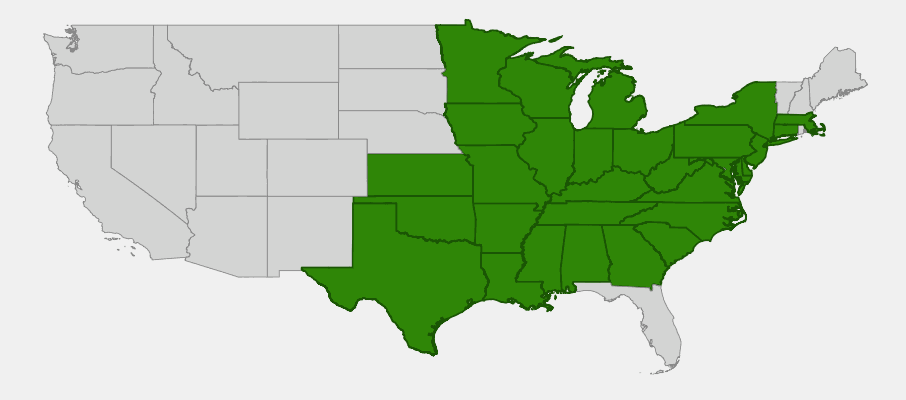
Heart-Leaved Golden Alexanders is native to eastern and central North America, with a range that extends from southern Canada south to the Gulf Coast states and from the Atlantic seaboard west to the Great Plains. The species is found from southern Ontario and Quebec south to Georgia and Alabama, and west to Saskatchewan, North Dakota, Kansas, and eastern Texas.
Throughout its range, Heart-Leaved Golden Alexanders typically inhabits prairies, savannas, open woodlands, and woodland edges. It shows a preference for well-drained soils and is often found on slopes, in openings, and along the margins between prairie and forest. The species is particularly common in the tallgrass prairie region of the Midwest, where it serves as an important early-season component of native plant communities.
This extensive native range makes Heart-Leaved Golden Alexanders suitable for native plant gardens throughout much of the eastern and central United States. It’s especially valuable in prairie restoration projects and is increasingly planted in sustainable landscapes, butterfly gardens, and naturalized areas where early-season pollinator support is needed.
📋 Regional plant lists featuring Heart-Leaved Golden Alexanders: North Dakota, South Dakota & Western Minnesota
Growing & Care Guide
Heart-Leaved Golden Alexanders is an excellent choice for low-maintenance native plant gardens, offering reliable early-season color with minimal care requirements. Its adaptability to various growing conditions and drought tolerance once established make it valuable for sustainable landscaping throughout its native range.
Light
Heart-Leaved Golden Alexanders performs best in full sun to partial shade, with at least 4-6 hours of direct sunlight per day for optimal flowering. It tolerates more shade than many prairie plants but may become leggy in deep shade. In very hot climates, some afternoon shade can be beneficial, especially during the hottest months of summer.
Soil & Water
This species prefers well-drained soils and is more drought-tolerant than Golden Alexanders, making it excellent for dry prairie gardens and xeriscaping. It adapts to various soil types including clay, loam, and sandy soils, and tolerates both slightly acidic and alkaline conditions (pH 6.0-8.0). While it appreciates moderate moisture during establishment, mature plants are quite drought-tolerant thanks to their deep taproot. Avoid waterlogged soils, which can cause root rot.
Planting Tips
Plant Heart-Leaved Golden Alexanders from transplants in spring or fall, or grow from seed sown in fall for natural stratification. Seeds benefit from 30-60 days of cold, moist stratification if spring-planted. Space plants 18-24 inches apart to allow for natural spreading. The plant will gradually form small colonies through short rhizomes, creating natural-looking drifts over time.
Pruning & Maintenance
This low-maintenance perennial requires minimal care once established. Deadheading spent flowers may encourage a second flush of blooms, but many gardeners prefer to leave the seed heads for birds and to allow self-seeding. Cut back to ground level in late fall or early spring. The plant may self-seed moderately in favorable conditions, which is usually desirable in naturalized settings.
Landscape Uses
Heart-Leaved Golden Alexanders is versatile in many landscape applications:
- Prairie gardens — essential early-blooming component of authentic prairie plantings
- Dry meadows — thrives in well-drained sites with minimal irrigation
- Butterfly gardens — important host plant for black swallowtail butterflies
- Pollinator gardens — provides critical early-season nectar for native bees
- Savanna restoration — appropriate for woodland edge and semi-shaded areas
- Native borders — adds early color and structure to perennial plantings
- Slope stabilization — deep taproot helps prevent erosion on well-drained slopes
Wildlife & Ecological Value
Heart-Leaved Golden Alexanders provides exceptional wildlife value as both a nectar source for pollinators and a host plant for specialized butterfly species. Its early blooming period makes it particularly valuable for supporting wildlife during a time when few other flowers are available.
For Birds
The seeds are eagerly consumed by many bird species, particularly American Goldfinches, which often feed on the ripening seeds in late summer. Other seed-eating birds including various finches, sparrows, and juncos also utilize the nutritious seeds. The plant structure provides some cover for small ground-dwelling birds and nesting material when the dried stems are left standing through winter.
For Mammals
While not a primary browse species, Heart-Leaved Golden Alexanders may occasionally be eaten by deer and rabbits, though it’s generally not preferred. Small mammals such as mice and voles may consume the seeds along with birds. The plant’s bitter compounds in the foliage generally make it less palatable to herbivores than many other prairie species.
For Pollinators
Heart-Leaved Golden Alexanders is exceptionally valuable for pollinators, attracting a wide variety of beneficial insects. The flat-topped flower clusters provide ideal landing platforms for many native bees, including sweat bees, mining bees, and mason bees. The flowers also attract butterflies, particularly skippers and smaller species, as well as beneficial wasps and beetles that provide natural pest control.
Most significantly, Heart-Leaved Golden Alexanders serves as a crucial host plant for black swallowtail butterflies. The distinctive green, black, and yellow striped caterpillars feed exclusively on plants in the carrot family, making this species essential for maintaining local swallowtail populations. The plant’s early emergence and long growing season provide multiple opportunities for butterfly reproduction.
Ecosystem Role
As an early-blooming prairie species, Heart-Leaved Golden Alexanders helps support pollinator populations during the critical spring period when food sources are limited. Its deep taproot improves soil structure and nutrient cycling while providing excellent drought tolerance. The plant serves as an indicator of healthy prairie and savanna ecosystems and plays an important role in plant succession and community stability.
Cultural & Historical Uses
Heart-Leaved Golden Alexanders has been utilized by Indigenous peoples throughout its range for various medicinal purposes, though it was generally considered less important than some other carrot family species. Several Native American tribes recognized the plant’s therapeutic properties and incorporated it into their traditional healing practices, though specific uses varied by region and tribal tradition.
The distinctive heart-shaped basal leaves made this species easily recognizable and helped distinguish it from other similar-appearing plants in the carrot family. This clear identification was important for both medicinal use and safety, as some carrot family plants can be toxic. The plant’s reliable early appearance each spring also made it useful as a phenological indicator, helping Indigenous peoples track seasonal changes and plan other important activities.
Early European settlers often grouped this species together with other “meadow parsnips” and sometimes confused it with European relatives. The common name “Meadow Parsnip” reflects this historical confusion, though Heart-Leaved Golden Alexanders is quite distinct from true parsnips and other European carrot family plants.
In modern times, Heart-Leaved Golden Alexanders has gained recognition as an important species for prairie restoration and native plant gardening. Its role as a black swallowtail host plant has made it particularly popular among butterfly gardeners and conservation-minded landscapers. The plant is increasingly valued for its contribution to pollinator conservation and sustainable land management practices throughout its range.
Frequently Asked Questions
How can I tell Heart-Leaved Golden Alexanders apart from regular Golden Alexanders?
The key distinguishing feature is the basal leaves: Heart-Leaved Golden Alexanders has simple, heart-shaped basal leaves, while Golden Alexanders has compound basal leaves divided into leaflets. Heart-Leaved Golden Alexanders also tends to prefer slightly drier conditions and blooms slightly later.
Are the heart-shaped leaves present all season?
Yes, the distinctive heart-shaped basal leaves persist throughout the growing season and are the most reliable way to identify this species. They may become less prominent as the flowering stems develop, but they remain visible at the base of the plant.
Is Heart-Leaved Golden Alexanders more drought-tolerant than Golden Alexanders?
Yes, Heart-Leaved Golden Alexanders generally prefers drier conditions and is more drought-tolerant once established. This makes it better suited for dry prairies, slopes, and areas with less irrigation, while Golden Alexanders prefers moister sites.
Will this plant spread in my garden?
Heart-Leaved Golden Alexanders spreads slowly through short rhizomes and moderate self-seeding. It forms small, manageable colonies over time but is not considered aggressive. Most gardeners appreciate its gentle spreading habit for creating natural-looking prairie plantings.
When is the best time to see black swallowtail caterpillars on this plant?
Black swallowtail butterflies typically lay eggs on Heart-Leaved Golden Alexanders from late spring through summer. Look for the distinctive green, black, and yellow striped caterpillars from May through September, depending on your location and the number of butterfly generations per year.

Looking for a nursery that carries Heart-Leaved Golden Alexanders?
Browse our native plant nursery directory: North Dakota · South Dakota · Minnesota