Hobblebush (Viburnum alnifolium)
Viburnum alnifolium Marshall (syn. V. lantanoides), commonly known as Hobblebush, American Wayfaring Tree, or Witch Hobble, stands as one of the most distinctive and ecologically important understory shrubs in eastern North America’s cool forests. This member of the Adoxaceae (moschatel) family has earned its memorable common name from its sprawling, irregular growth habit and tendency to form dense thickets that can indeed “hobble” unwary hikers attempting to navigate through northern woodlands.
Native from the Maritime Provinces and northern New England south along the Appalachian Mountains to North Carolina and South Carolina, Hobblebush thrives in the cool, moist conditions of montane and boreal forests. Its distinctive heart-shaped leaves—among the largest of any native viburnum—create bold textural contrasts in shade gardens, while its spectacular flat-topped clusters of white flowers provide crucial early-season nectar for pollinators in forest ecosystems where few other plants are blooming.
What truly sets Hobblebush apart is its remarkable ecological adaptability and wildlife value. The shrub’s unique growth strategy involves arching branches that root where they touch the ground, creating interconnected colonies that can persist for centuries. This natural layering ability, combined with its tolerance for deep shade and acidic soils, makes Hobblebush an invaluable plant for naturalized landscapes, woodland gardens, and restoration projects in cooler regions of its range.
Identification
Hobblebush typically grows as a large, spreading shrub, reaching 6 to 10 feet (1.8–3 m) tall and often wider than tall due to its distinctive arching and layering growth habit. The irregular, open form creates a naturalistic appearance that distinguishes it from more formal landscape shrubs. Young plants may appear upright, but mature specimens develop the characteristic sprawling form with branches that arch outward and downward.
Bark
The bark on young twigs is smooth and green to reddish-brown, often with a slight downy pubescence. As branches mature, the bark becomes gray-brown and develops a slightly rough texture. The distinctive feature is the way older branches develop a twisted, gnarled appearance where they have been bent by snow load or have rooted upon touching the ground, creating the “hobbling” effect that gives the plant its name.
Leaves
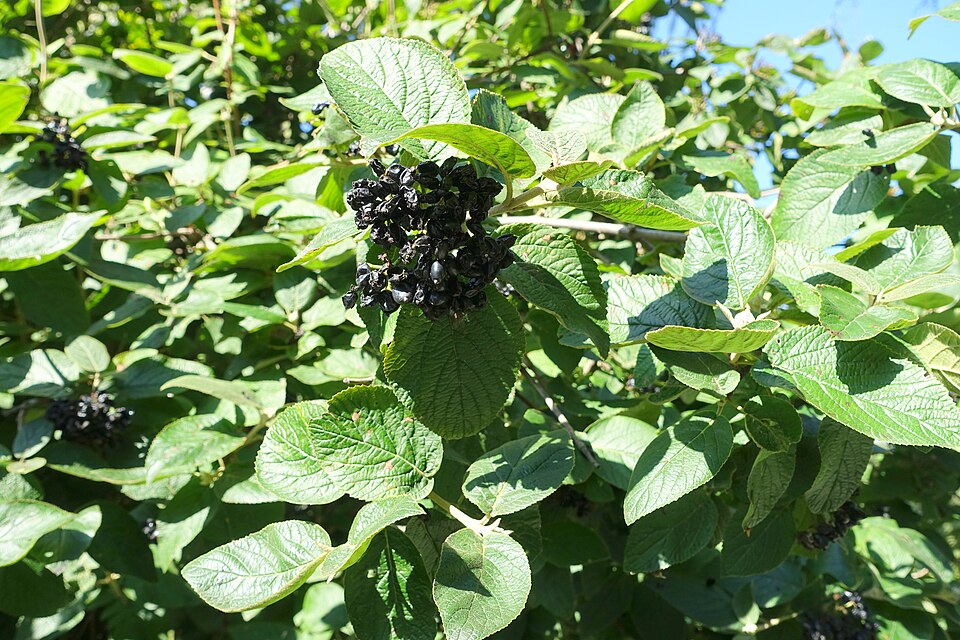
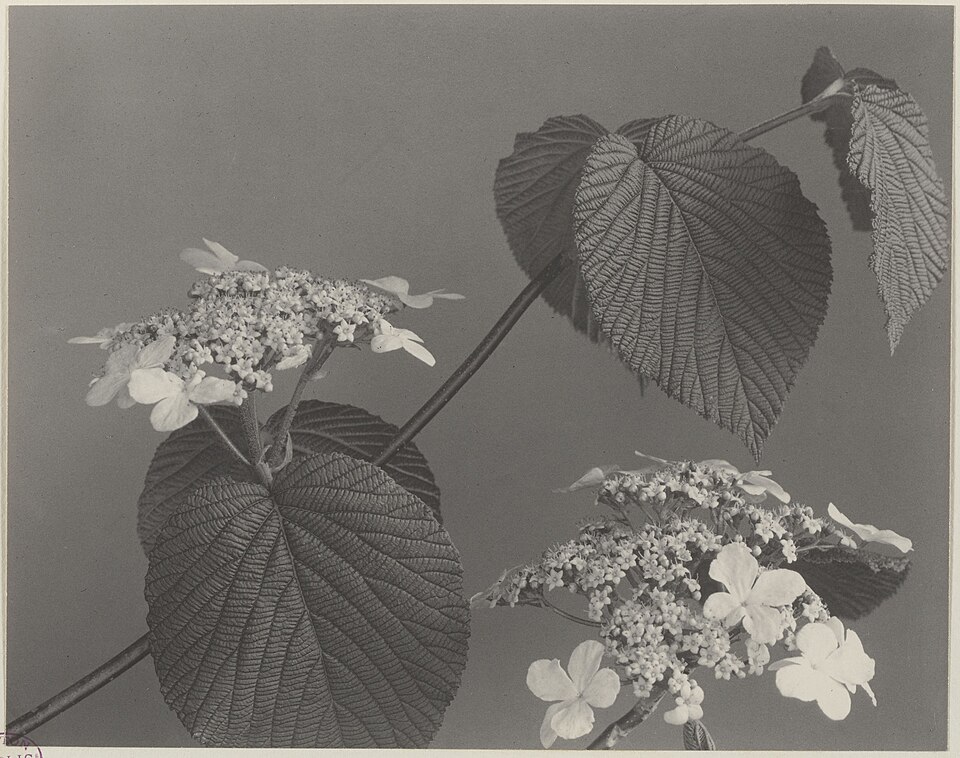
The leaves are the most immediately recognizable feature of Hobblebush—large, simple, and broadly oval to heart-shaped (cordate), measuring 4 to 8 inches (10–20 cm) long and 3 to 6 inches (7.5–15 cm) wide. They are arranged in opposite pairs along the branches and have finely serrated margins. The upper surface is bright green and slightly rugose (wrinkled), while the underside is paler with fine star-shaped hairs (stellate pubescence) along the veins. The prominent veination creates a distinctive quilted texture. Fall color is variable but often includes brilliant reds, oranges, and purples, creating spectacular autumn displays in forest settings.
Flowers & Fruit
The flowers appear in late spring to early summer in flat-topped clusters (cymes) 3 to 5 inches (7.5–12.5 cm) across. Each cluster consists of two types of flowers: small, fertile flowers in the center surrounded by larger, showy, sterile flowers around the edge. The sterile flowers have four white petals and can be up to 1 inch (2.5 cm) across, serving as landing platforms and advertisements for pollinators, while the smaller fertile flowers actually produce the fruit.
The fruit develops as oval drupes about ⅓ inch (8 mm) long, ripening through a spectacular color progression from green to yellow to bright red and finally to dark purple or black. The colorful fruit display can persist into fall, with different stages of ripeness visible simultaneously. The fruits are technically edible but quite bitter when raw, though they become more palatable after frost and were traditionally used by Indigenous peoples after careful preparation.
Quick Facts
| Scientific Name | Viburnum alnifolium |
| Family | Adoxaceae (Moschatel) |
| Plant Type | Deciduous Shrub |
| Mature Height | 8 ft |
| Sun Exposure | Part Shade to Full Shade |
| Water Needs | Moderate |
| Bloom Time | May – July |
| Flower Color | White |
| USDA Hardiness Zones | 3–6 |
Native Range
Hobblebush has a distinctly northern and montane distribution, reflecting its preference for cool, moist forest conditions. The species ranges from the Maritime Provinces of Canada (Nova Scotia, New Brunswick, and Prince Edward Island) and northern New England (Maine, New Hampshire, and Vermont) south along the Appalachian Mountains through New York, Pennsylvania, and into the high elevations of North Carolina and South Carolina, with scattered populations in eastern Tennessee.
This distribution pattern reveals Hobblebush as a classic example of a northern species that extends southward only at higher elevations, following the cool, moist conditions of mountain environments. In the southern Appalachians, it typically occurs at elevations above 3,000 feet, where temperatures remain cool enough to support this cold-adapted species. The plant is particularly abundant in the spruce-fir forests of the highest peaks, where it often forms dense understory colonies beneath Red Spruce and Fraser Fir.
Throughout its range, Hobblebush is characteristic of mature northern hardwood and mixed coniferous forests, thriving in the acidic, organic-rich soils typical of these ecosystems. It commonly grows in association with Sugar Maple, American Beech, Yellow Birch, Eastern Hemlock, and various other cool-climate forest species. The shrub’s ability to persist in deep shade makes it an important component of old-growth forest understories, where it can live for many decades under dense canopies.
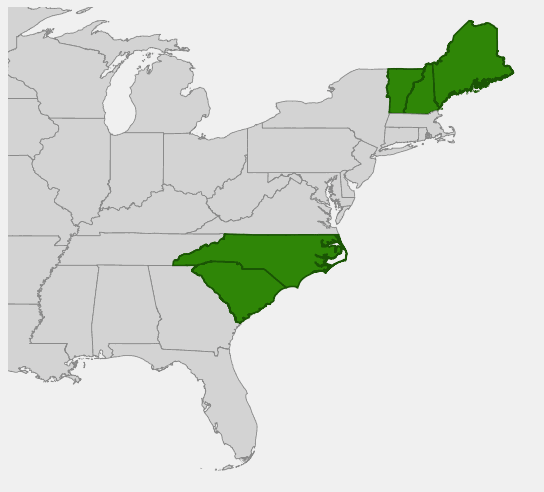
📋 Regional plant lists featuring Hobblebush: North Carolina & South Carolina
Growing & Care Guide
Hobblebush can be challenging to grow outside its natural range but is highly rewarding for gardeners in cool, northern climates or higher elevations where conditions match its native preferences. Success requires understanding and replicating the cool, moist, acidic conditions of its natural forest habitat.
Light
Hobblebush thrives in partial shade to full shade, making it ideal for woodland gardens and areas beneath mature trees. In its native habitat, it typically grows under 70-90% shade, so full sun conditions should be avoided except in the coolest climates. Morning sun with afternoon shade can be tolerated in northern locations, but deep shade is preferred in warmer areas. The plant’s large leaves are adapted for maximum photosynthesis in low-light conditions.
Soil & Water
This species requires consistently moist, well-drained, acidic soil (pH 4.5-6.0) rich in organic matter, similar to natural forest floor conditions. The soil should never be allowed to dry out completely, but waterlogged conditions should also be avoided. Adding generous amounts of leaf mold, peat moss, or composted pine needles helps create ideal soil conditions. Mulching with organic matter helps maintain consistent moisture and soil acidity while suppressing weeds.
Planting Tips
Plant Hobblebush in early spring or fall, choosing the shadiest, coolest location available. The plant does best when sited on north-facing slopes or in naturally cool microclimates such as near water features or under evergreen canopies. Space plants 6-8 feet apart to allow for the natural spreading growth habit. Container-grown plants establish more readily than bare-root specimens, though all plantings benefit from careful attention to watering during the first two seasons.
Pruning & Maintenance
Minimal pruning is needed for Hobblebush, and heavy pruning should be avoided as it can destroy the natural form and reduce flowering. Remove dead or damaged wood in late winter, and allow the natural arching and layering habit to develop. If space is limited, selectively remove some of the longest arching branches, but understand that this reduces the plant’s ability to form new colonies. The natural messiness is part of the plant’s charm and ecological function.
Landscape Uses
Hobblebush excels in specialized landscape applications:
- Woodland gardens — authentic understory plantings in naturalized settings
- Shade gardens — provides bold texture and seasonal interest
- Wildlife gardens — supports moths, butterflies, and seed-eating birds
- Restoration projects — re-establishing native understory communities
- Erosion control — natural layering habit stabilizes slopes
- Mountain landscaping — appropriate for high-elevation gardens
- Naturalized areas — creates authentic northern forest character
Wildlife & Ecological Value
Hobblebush provides exceptional ecological value in northern forest ecosystems, serving as both a foundation species that creates habitat structure and a crucial resource for specialized wildlife that depend on cool forest understories.
For Birds
The berries of Hobblebush are consumed by numerous bird species, including American Robin, Veery, Hermit Thrush, Cedar Waxwing, and various vireos and warblers. The fruit’s extended ripening period, with berries progressing from red to purple to black over several weeks, provides food throughout late summer and early fall. The dense, layered branching structure creates important nesting habitat for ground-nesting and low-nesting bird species, while also providing thermal cover during harsh winter conditions.
For Mammals
White-tailed deer browse the foliage, particularly in winter when other food sources are scarce, though the bitter leaves make it less preferred than many alternatives. Small mammals including chipmunks, squirrels, and mice consume the fruits and help disperse seeds. Black bears occasionally feed on the berries in areas where populations overlap. The dense thickets provide important cover for small mammals, creating protected microclimates within forest ecosystems.
For Pollinators
The late spring to early summer flowering period makes Hobblebush particularly valuable for forest pollinators, as it blooms when few other understory plants are flowering. Native flies, beetles, and small bees are primary pollinators, while the flowers also attract various beneficial insects. The specialized moth Hemaris thysbe (Hummingbird Clearwing) uses Hobblebush as a host plant, with caterpillars feeding on the leaves.
Ecosystem Role
As a dominant understory species in northern forests, Hobblebush plays crucial roles in ecosystem function. Its layering habit helps bind soil on slopes, preventing erosion in steep forest terrain. The dense colonies create specialized microclimates that support other shade-adapted forest plants, while the annual leaf litter contributes to soil organic matter and supports mycorrhizal networks. The species’ longevity and ability to persist under dense canopies make it an indicator of old-growth forest conditions.
Cultural & Historical Uses
Hobblebush holds an important place in the cultural traditions of northern Indigenous peoples, particularly the Wabanaki confederacy (including the Penobscot, Passamaquoddy, and Maliseet peoples), who knew this plant as wabiguan or similar variations. The bitter fruits were traditionally gathered in fall after frost had improved their palatability, then cooked into jellies or dried for winter use. The flexible young stems were used in basketry and for binding purposes, while the inner bark provided material for cordage and traditional medicines.
European settlers in northern New England quickly learned to recognize Hobblebush as both a navigational landmark and a source of frustration. The sprawling, irregular growth habit and tendency to form dense thickets made it a notorious obstacle for travelers, loggers, and hunters moving through northern forests. This characteristic earned it various colorful common names including “witch hobble,” “devil’s shoestring,” and “trip-toe,” all referencing its ability to entangle unwary forest travelers.
In traditional Appalachian folk medicine, Hobblebush bark and twigs were used to prepare remedies for various ailments, including stomach problems and skin conditions. The plant’s association with cool, old-growth forests also made it a symbol of wilderness and untamed nature in early American literature and folklore, appearing in the writings of naturalists like John Burroughs and John Muir as representative of the deep, mysterious character of northern woodlands.
Modern ecological research has revealed Hobblebush’s importance as an indicator species for high-quality forest habitats. Its presence often signals intact old-growth or late-successional forest conditions, making it valuable for conservation planning and forest health assessment. Climate change studies have identified Hobblebush populations as particularly vulnerable to warming temperatures, making the species an important subject for research on forest ecosystem adaptation and resilience in a changing climate.
Frequently Asked Questions
Why is it called Hobblebush?
The name comes from the shrub’s growth habit of sending out long, arching branches that often root where they touch the ground, creating dense, irregular thickets that can “hobble” or trip people walking through the forest. The interlocking branches and unpredictable growth pattern made it notorious among early forest travelers and loggers.
Can Hobblebush grow in warmer climates?
Hobblebush is specifically adapted to cool climates and generally does not thrive in areas with hot summers. It’s best suited for USDA zones 3-6 and requires consistent cool temperatures. In warmer regions, it may survive at high elevations where temperatures remain cool year-round, but is unlikely to thrive at lower elevations.
How do I propagate Hobblebush?
The easiest method is to take advantage of the natural layering habit—simply bury a portion of an arching branch in soil and it will often root naturally. You can also collect seeds from ripe berries in fall, but they require cold stratification over winter. Cuttings are possible but challenging and success rates are generally low.
Are the berries poisonous?
The berries are not poisonous but are quite bitter and astringent when raw. Indigenous peoples traditionally prepared them by cooking or allowing them to be frosted, which improves the flavor. They’re best left for wildlife, which are much better adapted to process them than humans are.
Will Hobblebush grow under pine trees?
Yes, Hobblebush can grow under conifers, particularly if the soil is acidic and consistently moist. It often grows naturally under Eastern Hemlock and other conifers in its native range. The acidic needle litter actually helps create favorable soil conditions for this acid-loving shrub.

Looking for a nursery that carries Hobblebush?
Browse our native plant nursery directory: North Carolina · South Carolina