Honeylocust (Gleditsia triacanthos)
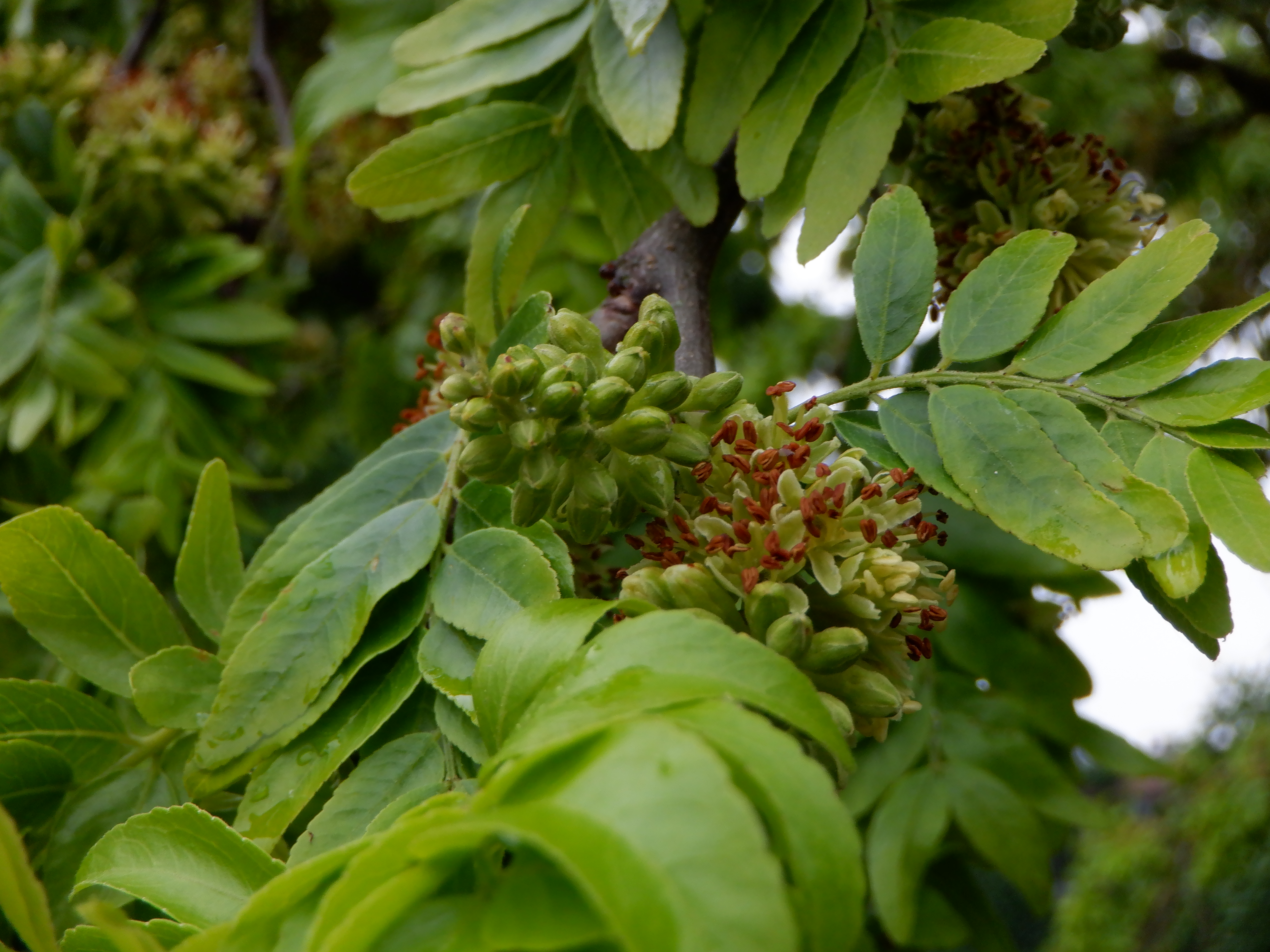
Gleditsia triacanthos, commonly known as Honeylocust, is a native deciduous tree of the central and eastern United States that combines striking beauty, extraordinary toughness, and exceptional ecological value. A member of the legume family (Fabaceae), Honeylocust is famous for three distinctive features: its breathtakingly long, often branching thorns — capable of reaching 12 inches or more — its graceful, fine-textured bipinnate foliage that casts a light, dappled shade, and its long, twisted seed pods filled with sweet, edible pulp that wildlife eagerly consume. The “honey” in Honeylocust refers to this sugary pod pulp, a traditional food source for both wildlife and people.
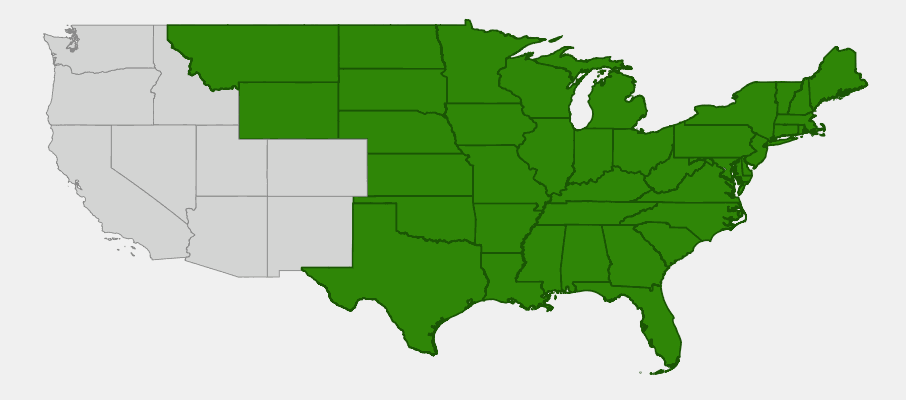
Native to a broad swath of the Midwest and South — from Pennsylvania west to Nebraska and Kansas, and south to Alabama and Texas — Honeylocust has been widely planted far outside its natural range due to its exceptional drought tolerance, adaptability to urban conditions, and ornamental appeal. Thornless cultivars have become one of the most commonly planted street trees in North America. In Montana and Wyoming, where the native range barely reaches or lies just beyond the border, Honeylocust is sometimes used in challenging plantings on the eastern plains where its drought and cold tolerance make it a viable choice where few other shade trees thrive.
In natural settings, Honeylocust is a tree of bottomlands, floodplains, and open woodlands — tough enough to colonize disturbed ground and open pastures, yet beautiful enough to serve as a specimen shade tree in any landscape. Its ecological importance to wildlife — particularly white-tailed deer, elk, and a host of small mammals that consume the nutritious pods — combined with its legendary site adaptability makes it one of the most versatile native trees in the eastern and central United States.
Identification
Honeylocust is a medium to large deciduous tree, typically reaching 30 to 70 feet (9–21 m) tall with a broad, spreading, open crown. In open settings, the crown is often wider than the tree is tall, creating a characteristic vase-shaped to broadly spreading form. The trunk can reach 2 to 3 feet (60–90 cm) in diameter at maturity. One of the most distinctive identification features is the presence of large, often branching thorns on the trunk and branches — these thorns are not merely modifications of leaves or stipules but are true stem thorns, emerging directly from the bark.
Thorns & Bark
The thorns are among the most formidable in the plant kingdom — stout, reddish-brown to nearly black, often 3 to 12 inches long, and frequently branched into deadly clusters of three or more spines. On young trees, these thorns are particularly abundant and sharp. The bark is grayish-brown to dark brown, becoming deeply furrowed with age into long, narrow ridges with a slightly scaly texture. Thornless specimens occur naturally and have been selected for cultivation as the commonly planted street tree form.
Leaves
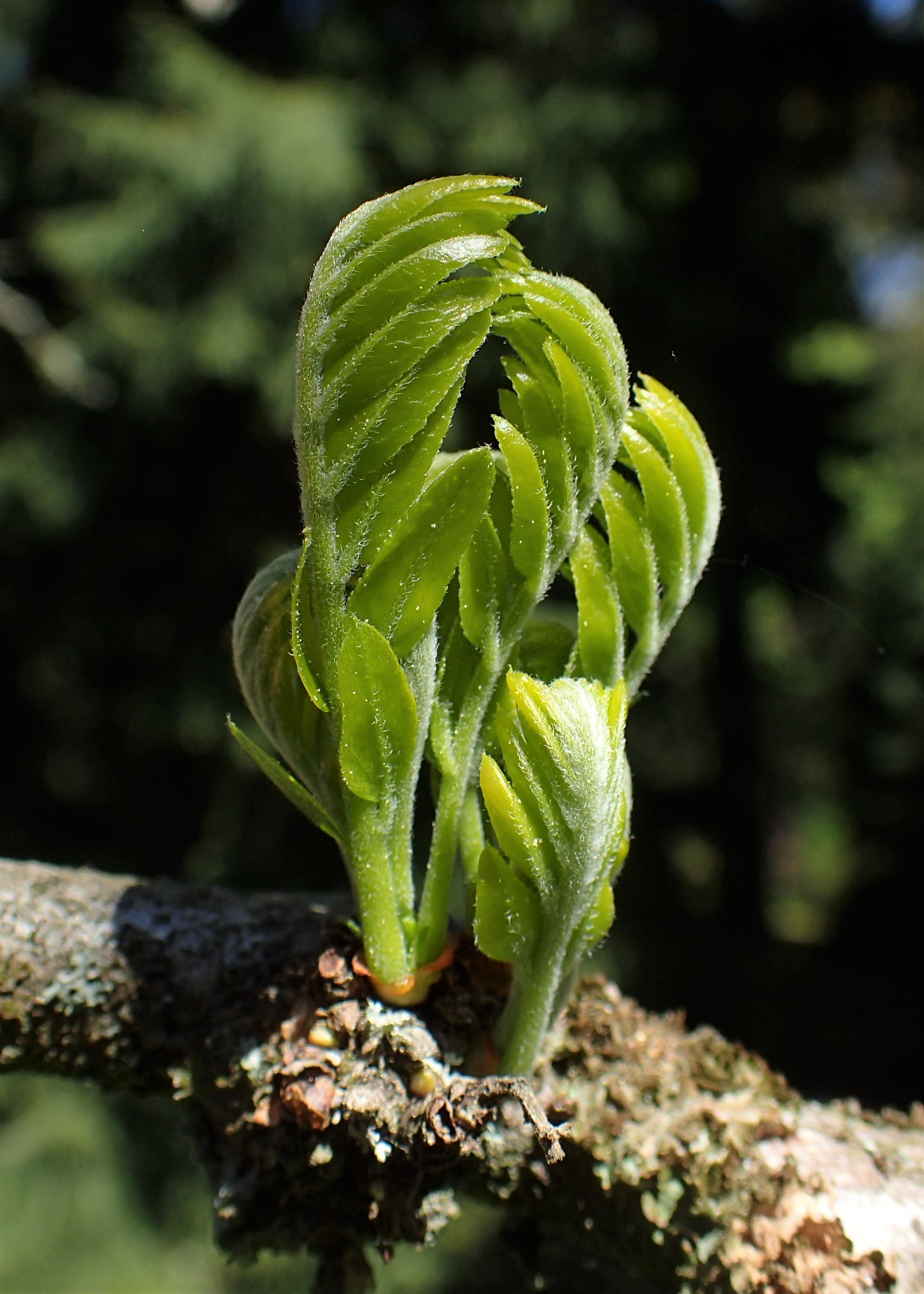
The foliage is one of Honeylocust’s most elegant features: leaves are pinnately or bipinnately compound, 7 to 8 inches (18–20 cm) long, with 15 to 30 small, oval leaflets each about ¾ inch (2 cm) long. This creates an exceptionally fine texture — almost ferny — that casts a light, dappled shade allowing grass to grow beneath the canopy. The leaves emerge bright yellowish-green in spring, mature to a deeper green in summer, and turn a lovely golden-yellow in fall before dropping. The small leaflet size means the leaves decompose quickly and rarely need raking.
Flowers
The flowers are small (about ¼ inch), with five greenish-white petals, borne in drooping racemes 2 to 5 inches long from the leaf axils. Despite their modest size, they are intensely fragrant — a rich, honey-like scent that perfumes the air during the brief bloom period in late spring (May–June). Male and female flowers are typically on separate trees (the species is often functionally dioecious), though some trees produce flowers of both sexes. The fragrance attracts bees, wasps, and many other pollinators.
Fruit & Seeds
The fruit is a long, flat, twisted or spirally curved pod, 6 to 18 inches (15–45 cm) long, reddish-brown to dark brown when ripe in fall, containing 12 to 14 hard, oval seeds surrounded by a sweet, sticky, yellowish pulp. This pulp is genuinely palatable — early settlers and Native peoples ate it directly, and it has a pleasant, honey-like sweetness. The pods persist on the tree through much of winter, providing food for wildlife over an extended period.
Quick Facts
| Scientific Name | Gleditsia triacanthos |
| Family | Fabaceae (Legume / Pea family) |
| Plant Type | Deciduous Tree |
| Mature Height | 15–20 ft (typical garden); up to 70 ft (wild) |
| Sun Exposure | Full Sun |
| Water Needs | Moderate |
| Bloom Time | May – June |
| Flower Color | Greenish-white (highly fragrant) |
| Fall Color | Golden yellow |
| USDA Hardiness Zones | 3–9 |
Native Range
Honeylocust is native to the central and eastern United States, with a natural range centered on the Midwest and Upper South. It is native from Pennsylvania and New York west through Ohio, Indiana, Illinois, and Iowa to Nebraska and Kansas, and south through Missouri, Arkansas, Oklahoma, and Tennessee to Alabama, Georgia, and northern Florida. Within this range, it is most abundant in the river bottoms, floodplains, and disturbed uplands of the Midwest — particularly the Ohio River Valley and the mixed prairie-woodland ecotone of the eastern Great Plains.
Honeylocust has been so widely planted outside its native range that its natural distribution is difficult to determine precisely in many states. It naturalizes readily from seed and has established feral populations across much of the eastern and central United States beyond its original native territory. In Montana and Wyoming, where it is included in regional planting guides for difficult sites, it represents a near-range or marginally native species capable of surviving the harsh climate of the eastern plains with its exceptional drought and cold hardiness.
Within its native range, Honeylocust occupies floodplain forests, river terraces, open bottomland woodlands, forest edges, and disturbed ground. It is highly competitive in disturbed and edge habitats and can form dense thickets in abandoned pastures. Its tolerance of flooding, drought, salt, compaction, heat, and cold makes it one of the most stress-tolerant native trees in eastern North America — a quality that has made it enormously valuable in urban forestry programs across the continent.
📋 Regional plant lists featuring Honeylocust: Montana & Wyoming
Growing & Care Guide
Honeylocust is one of the most adaptable native trees available for challenging sites. Its exceptional tolerance of drought, flooding, heat, cold, salt, compaction, and poor soils makes it a top choice where other trees struggle. Whether used as a shade tree, windbreak component, or wildlife planting, Honeylocust performs reliably across a wide range of conditions.
Light
Honeylocust is a full-sun tree that performs best with 6 or more hours of direct sunlight daily. It will grow in partial shade but produces a more open crown, fewer flowers and pods, and less vibrant fall color in shaded conditions. For street tree and landscape use, choose full-sun locations where the tree can develop its characteristic broad, spreading crown.
Soil & Water
Honeylocust is remarkably tolerant of diverse soil conditions, from rich bottomland loams to poor, compacted clay and sandy soils. It thrives in both acid and alkaline soils. Once established, it tolerates drought periods well, though young trees benefit from regular watering during the first two growing seasons. It also tolerates periodic flooding — a native adaptation to its bottomland habitat. Avoid overwatering in well-drained garden settings; Honeylocust does not require consistently moist conditions.
Planting Tips
Plant balled-and-burlapped or container-grown trees in spring or fall. Honeylocust transplants readily. Note that native Honeylocust with thorns is not suitable for most garden settings — choose named thornless varieties for landscape use. However, if planting for wildlife habitat, the thorned native form provides superior food (pods) and cover. Give the tree ample space: allow 30–40 feet from structures, power lines, and other trees for mature specimens.
Pruning & Maintenance
Prune Honeylocust in late winter while dormant. The tree has a somewhat weak branch structure prone to breakage in ice storms, so remove any co-dominant leaders early. The small leaflets require no raking as they decompose quickly. Honeylocust is generally pest- and disease-resistant, though it can be subject to mimosa webworm and podgall midge in some regions. Water during establishment; once established, supplemental irrigation is rarely needed in most climates within its range.
Landscape Uses
- Shade tree — light, filtered shade allows grass and understory plants to grow beneath
- Street tree (thornless varieties) — exceptional tolerance of urban stress
- Wildlife planting — pods are a critical food source for deer, elk, and many small mammals
- Windbreaks — fast growth and cold tolerance suit it to Great Plains shelterbelts
- Floodplain restoration — excellent tolerance of periodic inundation
- Disturbed site revegetation — aggressive colonizer of open ground
Wildlife & Ecological Value
Honeylocust provides outstanding wildlife value, particularly through its sweet, nutritious pods that feed a wide variety of animals through fall and winter.
For Mammals
White-tailed deer, elk, and bison historically consumed Honeylocust pods in enormous quantities. The sweet pod pulp is high in sugars and the seeds are rich in protein — a critical nutritional combination for large mammals in fall and winter. Squirrels, rabbits, foxes, opossums, and many other small and medium-sized mammals also eat the pods. Wild hogs consume them avidly where ranges overlap. Some researchers suggest that the original evolutionary dispersers of Honeylocust pods were Pleistocene megafauna — mastodons and giant ground sloths — whose extinction may explain why Honeylocust pods accumulate in such abundance, with few modern herbivores capable of processing them as effectively.
For Birds
The intense spring fragrance of Honeylocust flowers attracts a variety of pollinators and insectivorous birds. The dense, often thorny branches provide excellent nesting cover for various songbirds. Bobwhite Quail, Wild Turkeys, and other ground-foraging birds eat seeds that fall from the pods. The tree’s structure also provides good foraging habitat for woodpeckers seeking insects in the deeply furrowed bark of older specimens.
For Pollinators
The intensely fragrant flowers are a major nectar source for honey bees, bumble bees, and native bee species. Honeylocust honey is highly prized for its distinctive flavor. Wasps, hoverflies, and other beneficial insects also visit the flowers. The brief but prolific bloom period provides a significant nectar flow for pollinators in late spring.
Ecosystem Role
As a legume, Honeylocust fixes atmospheric nitrogen through root associations with Rhizobium bacteria, improving soil fertility in the areas where it grows. Its deep, wide-spreading root system helps stabilize floodplain soils and reduces erosion during flood events. The tree’s leaf litter decomposes rapidly, cycling nutrients back into the soil more quickly than many other tree species. The persistent pods provide winter food for wildlife across the forest floor throughout the cold months.
Cultural & Historical Uses
Honeylocust has a rich history of use by Indigenous peoples across its range. The Pawnee, Osage, Omaha, and other Plains and Woodland tribes used the sweet pod pulp as food — eaten fresh, dried, or fermented into a mildly alcoholic beverage. The pulp was also dried and ground into a sweet flour used to thicken soups and stews. The seeds, while small and hard, were also consumed after roasting. The nutritious pods were an important early autumn food before other crops and wild plants were gathered.
The wood of Honeylocust is extremely hard and durable — among the hardest of any eastern hardwood — and was used by Indigenous peoples and early settlers for fence posts, tool handles, wheel hubs, and other items requiring both strength and durability. The thorns, remarkably strong and pointed, were used as pins, needles, and fish spears. Early American farmers deliberately grew Honeylocust as living fences — rows of thorned trees created barriers that livestock could not penetrate, a predecessor to barbed wire in the prairie landscape.
Today, thornless Honeylocust cultivars are among the most widely planted urban trees in North America, chosen for their exceptional toughness, graceful appearance, and light shade. The native, thorned form is increasingly valued in wildlife habitat plantings and permaculture systems, where its nutritious pods and deep nitrogen-fixing roots contribute to sustainable food systems for both wildlife and potentially for humans — researchers have explored Honeylocust pods as a potential animal feed crop given their high sugar and protein content.
Frequently Asked Questions
Is native Honeylocust the same as the thornless street trees?
No. The native species (Gleditsia triacanthos) typically has formidable thorns on the trunk and branches, and produces abundant long seed pods. The thornless, podless, or low-pod cultivars commonly sold as street trees (like ‘Skyline’, ‘Sunburst’, and ‘Shademaster’) are selected or bred varieties that lack these characteristics. For wildlife habitat value, the native thorned form with pods is far superior; for urban plantings, thornless cultivars are more practical.
Are Honeylocust thorns dangerous?
Yes — the thorns on native Honeylocust are sharp enough to puncture tires and injure livestock. Large thorns can reach 12 inches and are branched into multiple points. This makes thorned Honeylocust unsuitable near walkways, play areas, or livestock pens. Use thornless cultivars in any setting where safety is a concern. However, for wildlife habitat plantings in open areas away from human activity, the thorns create dense, impenetrable cover that is valuable for nesting birds and small mammals seeking refuge from predators.
Can you eat Honeylocust pods?
The sweet pulp inside the pods is genuinely edible and has historically been eaten by both Indigenous peoples and early settlers. The flavor is mildly sweet, somewhat like carob. The seeds themselves are hard and less palatable raw but can be roasted. However, harvest and preparation are labor-intensive, and the pods can harbor mold if wet. The primary consumer of the pods in modern ecosystems is wildlife — deer, elk, squirrels, and other mammals.
How fast does Honeylocust grow?
Honeylocust is a moderately fast-growing tree, adding 1.5 to 2.5 feet per year under good conditions, making it among the faster-growing native shade trees. It can reach 30 to 40 feet within 20 years in a favorable site. Growth rate slows as the tree matures but remains relatively vigorous throughout its life.
Is Honeylocust invasive?
The native species is not considered invasive in its natural range but can be aggressive in disturbed habitats and has naturalized beyond its original range in many states. In some regions, particularly where it has been widely planted and escaped cultivation, it can be weedy in open and disturbed areas. However, within its native range, it is an important ecological species rather than a pest.