ʻIeʻie (Freycinetia arborea)
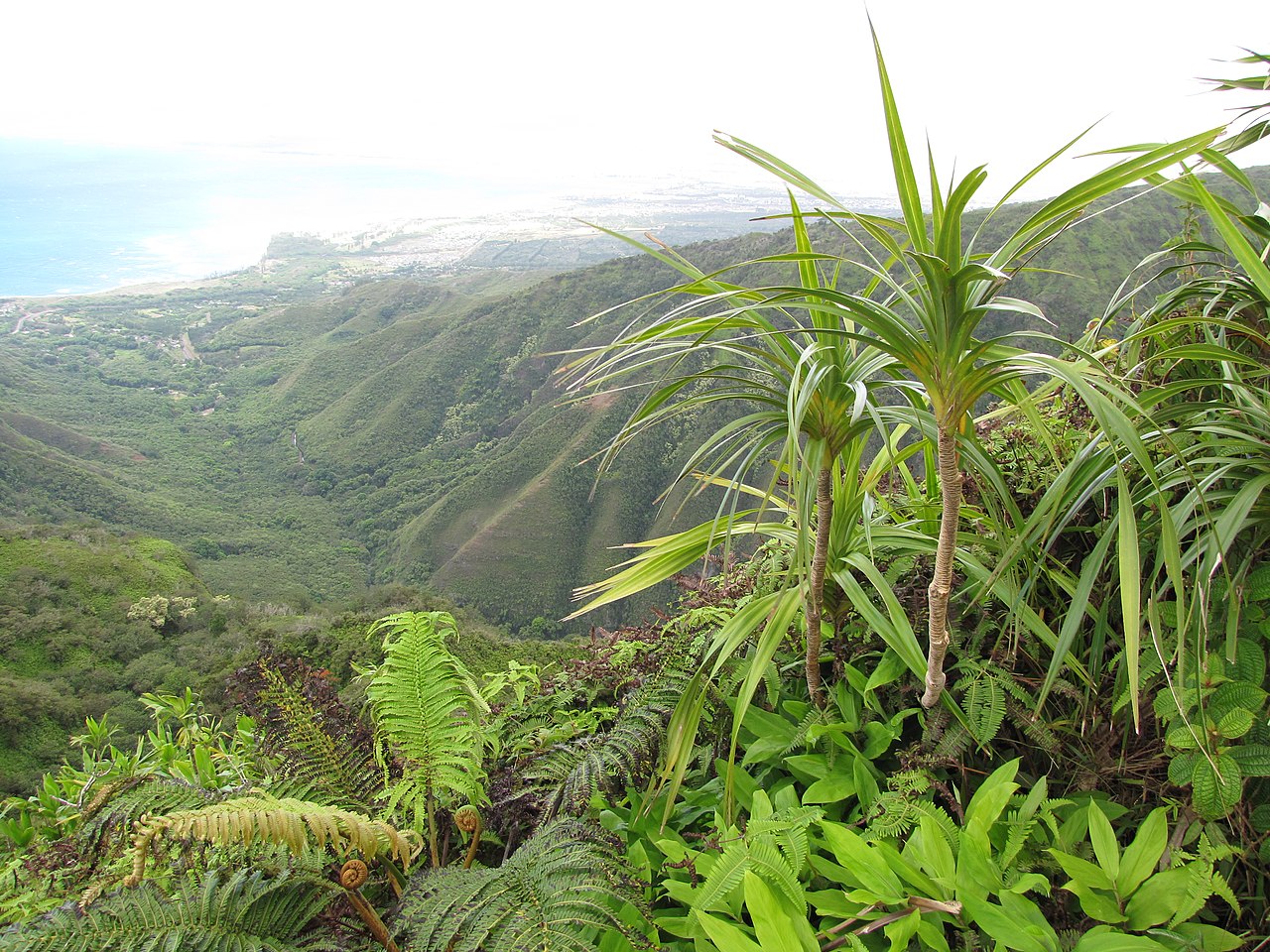
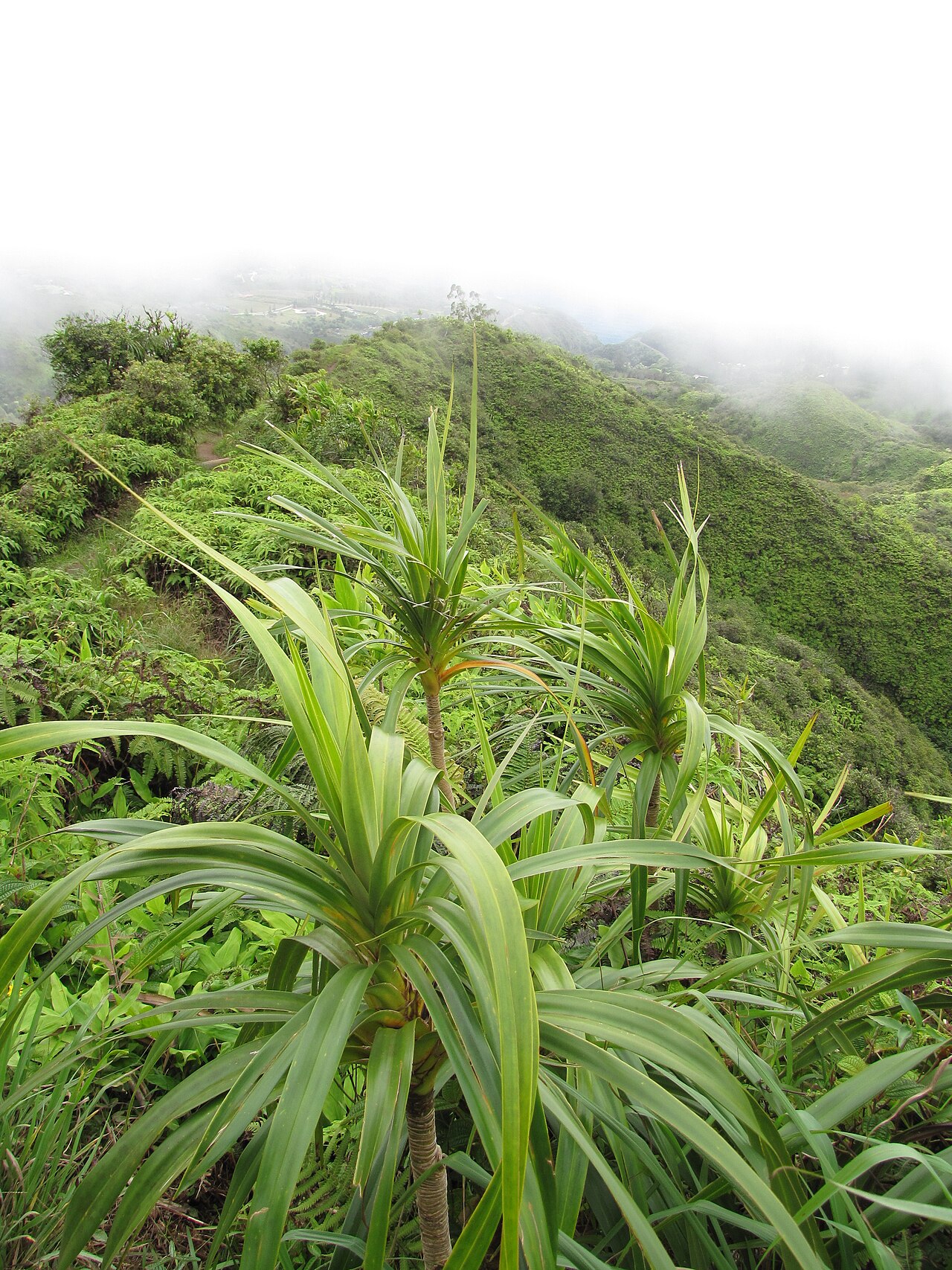
Freycinetia arborea, known in Hawaiian as ʻIeʻie, is a densely branched, woody climbing vine indigenous to the Hawaiian Islands and found nowhere else in the United States. A member of the screw pine family (Pandanaceae), it climbs into the forest canopy by gripping host trees with aerial roots, or sprawls in dense tangles across the forest floor and over rocks where no suitable support is available. Its long, spiny-edged, strap-like leaves spiral around the branch tips in a distinctive pinwheel pattern that makes it easy to recognize even from a distance.
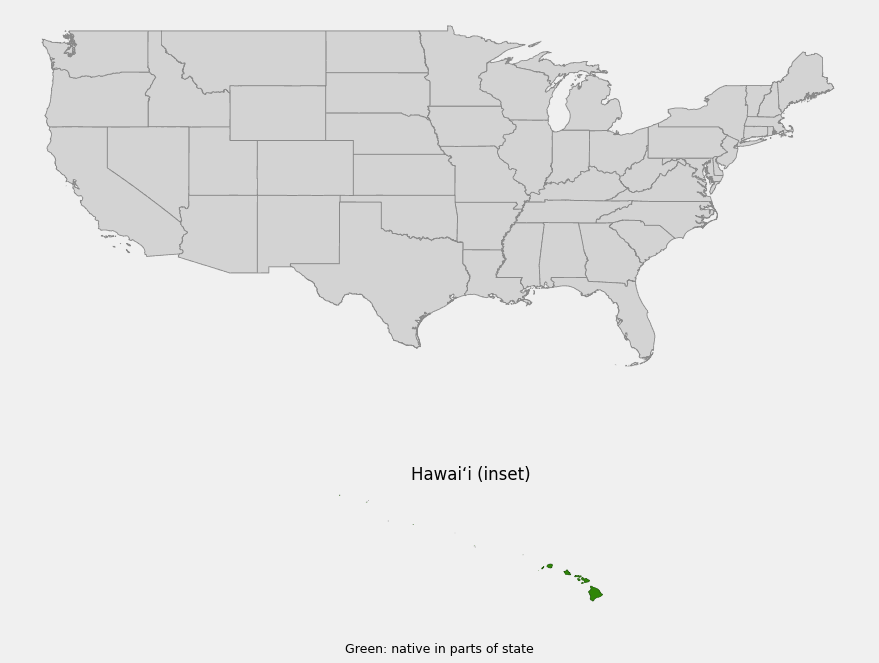
ʻIeʻie grows in mesic to wet native forest on exposed ridges and slopes across the main Hawaiian Islands — Kauaʻi, Oʻahu, Maui, Molokaʻi, Lānaʻi and Hawaiʻi Island — typically between about 1,000 and 4,900 feet elevation, climbing both native and introduced trees. Its striking orange-salmon flower bracts and spike-like inflorescences stand out against the surrounding greenery, and the plant holds deep cultural significance in Hawaiian history as a source of fiber for some of the most important traditional woven objects.
For gardeners in Hawaiʻi, ʻIeʻie is a distinctive native vine for a wet, shaded garden with a sturdy tree, trellis or rock pile to climb. It is not commonly offered outside specialty native-plant nurseries, but it rewards patient gardeners with a bold textural accent and a direct connection to Hawaiian cultural tradition.
Identification
ʻIeʻie is a woody, perennial vine with a brittle, densely branched habit. Rather than twining, it climbs by producing clusters of aerial roots along the stem that grip onto the bark of host trees as it ascends toward the canopy; where no host is available it forms sprawling, tangled mats on the ground or over boulders.
Stems
Stems are woody, much-branched, and brittle, with prominent leaf scars and clusters of wiry aerial roots arising at intervals along their length. These roots anchor the vine to its host and also help the plant take up moisture and nutrients directly from the humid forest air.
Leaves
The leaves are long and narrow, shiny green, and sharply pointed, typically 16 to 31 inches (40–80 cm) long but only about ½ to 1¼ inches (1–3 cm) wide. They are spirally arranged in dense whorls at the ends of the branches, and both the leaf margins and the underside of the midrib are lined with small spines, so the foliage should be handled carefully.
Flowers & Fruit
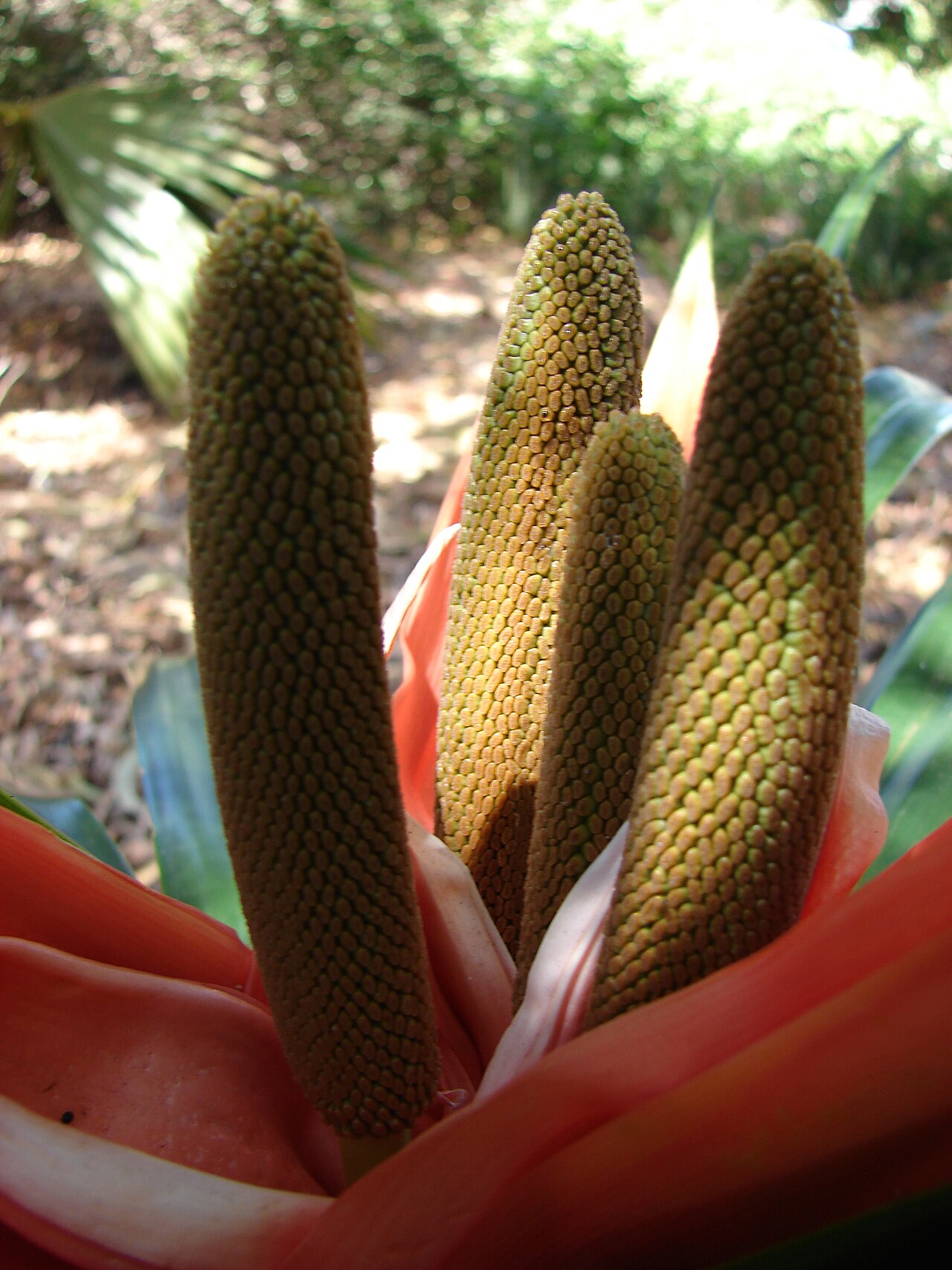
Flowers are borne in spike-like inflorescences at the branch tips and are either male or female, usually on separate spikes. Male (staminate) spikes are yellowish-white and up to about 4 inches long; female (pistillate) spikes start at 1 to 1½ inches and elongate to 3 to 3¾ inches as the fruit develops. Three or four spikes are typically clustered together, surrounded by showy orange-salmon bracts that are often mistaken for the flower itself. The fruit is a compact, pineapple-like fleshy spike about ⅜ inch long, packed with many tiny seeds.
Quick Facts
| Scientific Name | Freycinetia arborea |
| Family | Pandanaceae (Screw Pine) |
| Plant Type | Evergreen woody climbing vine |
| Mature Height | Climbs 20–30+ ft into host tree canopy, or sprawls as ground cover |
| Growth Rate | Slow to moderate |
| Sun Exposure | Part Shade to Shade |
| Water Needs | High; needs consistent moisture and humidity |
| Soil Type | Humus-rich forest soil; also grows epiphyte-like on host bark |
| Bloom Time | Variable; spikes seen through much of the year |
| Flower Color | Yellowish-white spikes with orange-salmon bracts |
| Fruit | Small fleshy multiple fruit, about ⅜ in, many tiny seeds |
| Conservation Status | Not rare (NatureServe G4 – Apparently Secure), but pressured locally by feral ungulates and rodents |
| USDA Hardiness Zones | 10–11 (Hawaiʻi only) |
Native Range
Within the United States, ʻIeʻie is native only to the Hawaiian Islands, where it is indigenous (native but not endemic — related species occur elsewhere in the Pacific). It grows on Kauaʻi, Oʻahu, Maui, Molokaʻi, Lānaʻi and Hawaiʻi Island, typically on exposed ridges and slopes in mesic to wet forest between roughly 1,000 and 4,900 feet elevation.
It is not native to the continental United States, Alaska, or any other U.S. state or territory outside Hawaiʻi. Beyond Hawaiʻi, closely related Freycinetia species occur across the Pacific — in the Marquesas, Austral, Society and Cook Islands, and Samoa — but these are distinct, locally native species rather than Freycinetia arborea itself.
In the wild, ʻIeʻie climbs into the canopy on both native trees, such as ʻōhiʻa lehua, and on introduced trees in disturbed forest, or forms dense ground-covering tangles where no host is available. It is considered important habitat for native tree snails, and historically its fruit and bracts were a favorite food of the ʻōʻū, an extinct Hawaiian honeycreeper that was an important seed disperser for small-seeded native fruiting plants.
📋 Regional plant lists featuring ʻIeʻie: Hawaiʻi
Growing & Care Guide
ʻIeʻie is grown in Hawaiʻi gardens mainly by enthusiasts of native plants and traditional Hawaiian crafts, since it needs fairly specific, humid, shaded conditions to thrive and is slower-growing and less widely available than common ornamental vines.
Light
Give ʻIeʻie part shade to shade, similar to the understory and edge conditions of its native wet and mesic forest habitat. Direct, hot, exposed sun combined with dry air tends to scorch the long leaves.
Soil & Water
Plant in humus-rich, consistently moist soil, and site the vine where humidity stays high — a shaded gully, streamside planting, or a spot shielded from drying wind works well. ʻIeʻie does not tolerate drought and should never be allowed to dry out for extended periods, reflecting its origin in Hawaiʻi’s wetter forest zones.
Planting Tips
Because ʻIeʻie climbs by producing aerial roots that grip onto bark, give it a sturdy living tree, rough wooden post, or rock pile to climb from the start. Plant at the base of the support and keep the root zone consistently moist and mulched while the vine establishes its climbing roots. It can also be allowed to sprawl as a dense, spiny ground cover where no vertical support is available, though it will not flower as freely in that form.
Pruning & Maintenance
ʻIeʻie needs little routine pruning beyond removing dead or damaged stems. Because the stems are brittle and the leaf margins are spiny, wear gloves and handle cut material carefully. Established plants are otherwise low-maintenance, though they benefit from protection against feral pigs and other browsing animals, which can damage plantings in garden and restoration settings alike.
Landscape Uses
- Native Hawaiian gardens, paired with ʻōhiʻa and native ferns for an authentic wet-forest look
- Climbing accent on an established tree, trellis, or rock feature in a shaded, humid spot
- Cultural and educational plantings highlighting traditional Hawaiian fiber and craft plants
- Wildlife habitat for native tree snails and forest insects in restoration plantings
- Ground cover in dense shade where a climbing support is not available
Wildlife & Ecological Value
ʻIeʻie is a structurally important plant in Hawaiian wet and mesic forests, providing habitat and, historically, food resources that supported some of Hawaiʻi’s now-rare native animals.
For Birds
Historically, the fleshy fruit and showy bracts of ʻIeʻie were a favorite food of the ʻōʻū, a Hawaiian honeycreeper now believed extinct, which played an important role dispersing the seeds of small-fruited native plants like ʻIeʻie through the forest. Surviving native forest birds and introduced birds may still visit the fruiting spikes today.
For Native Invertebrates
The dense, tangled growth of ʻIeʻie, both climbing and sprawling, provides important structural habitat for native Hawaiian tree snails and other forest invertebrates, offering shelter and foraging surfaces within an otherwise open forest canopy or floor.
Ecosystem Role
By climbing into the canopy and anchoring itself with aerial roots, ʻIeʻie adds structural complexity to native forest, creating microhabitats at multiple heights. Where it sprawls across the forest floor, its dense, spiny growth can also help protect understory plants from trampling by feral ungulates, though the vine itself is also browsed and damaged by these same animals, which is a recognized conservation threat.
Cultural & Historical Uses
ʻIeʻie holds a central place in Hawaiian material culture and remains one of the most storied native plants in the islands. Early Hawaiians stripped and split the long, flexible aerial roots and stems to weave hīnaʻi hoʻomoe iʻa (fish baskets) and hīnaʻi hoʻoluʻuluʻu (fish traps), prized for their strength and durability in the water.
ʻIeʻie fiber was also woven into mahiole, the feathered helmets worn by Hawaiian aliʻi (chiefs) as marks of rank and protection in battle, and the plant’s aerial roots were used more broadly in traditional cordage and basketry. Because of this deep association with high-status objects, ʻIeʻie was considered a culturally significant and sometimes sacred plant, connected in Hawaiian tradition to forest deities and to Laka, patroness of hula.
These traditional weaving practices are documented in Hawaiian ethnobotanical and cultural histories; this history of ʻIeʻie use is presented here for its cultural and historical importance and is not a guide to foraging the plant today. Because of ongoing threats from feral ungulates, rodents, and competition from invasive plants, wild ʻIeʻie populations should be left undisturbed, and plant material for cultural practice should come from cultivated or sustainably managed sources rather than wild collection.
Frequently Asked Questions
Is ʻIeʻie endemic to Hawaiʻi?
No — it is indigenous (native) to Hawaiʻi but not endemic, since closely related Freycinetia species occur on other Pacific islands such as the Marquesas, Society and Cook Islands, and Samoa. Within the United States, however, it is found only in Hawaiʻi.
Is ʻIeʻie rare or endangered?
No, it carries a NatureServe conservation rank of G4 (Apparently Secure) and is not listed as threatened or endangered. However, local populations face ongoing pressure from feral pigs and goats, rodents that eat its seeds, and competition from invasive plants.
What was ʻIeʻie traditionally used for?
Early Hawaiians wove its flexible aerial roots and stems into fish baskets, fish traps, and the feathered helmets (mahiole) worn by chiefs. It remains an important plant in Hawaiian cultural and craft traditions today.
How does ʻIeʻie climb?
It climbs by producing clusters of aerial roots along its woody stems that grip onto the bark of host trees as the vine ascends toward the forest canopy. Where no support is available, it sprawls in dense tangles across the ground instead.
Can I grow ʻIeʻie outside Hawaiʻi?
It is only native to Hawaiʻi within the United States and needs warm, humid, frost-free conditions similar to its native wet and mesic forest habitat, so it is not a practical garden plant for the continental United States.

Looking for a nursery that carries ʻIeʻie?
Browse our native plant nursery directory: Hawaiʻi