
Mountain Hemlock (Tsuga mertensiana)
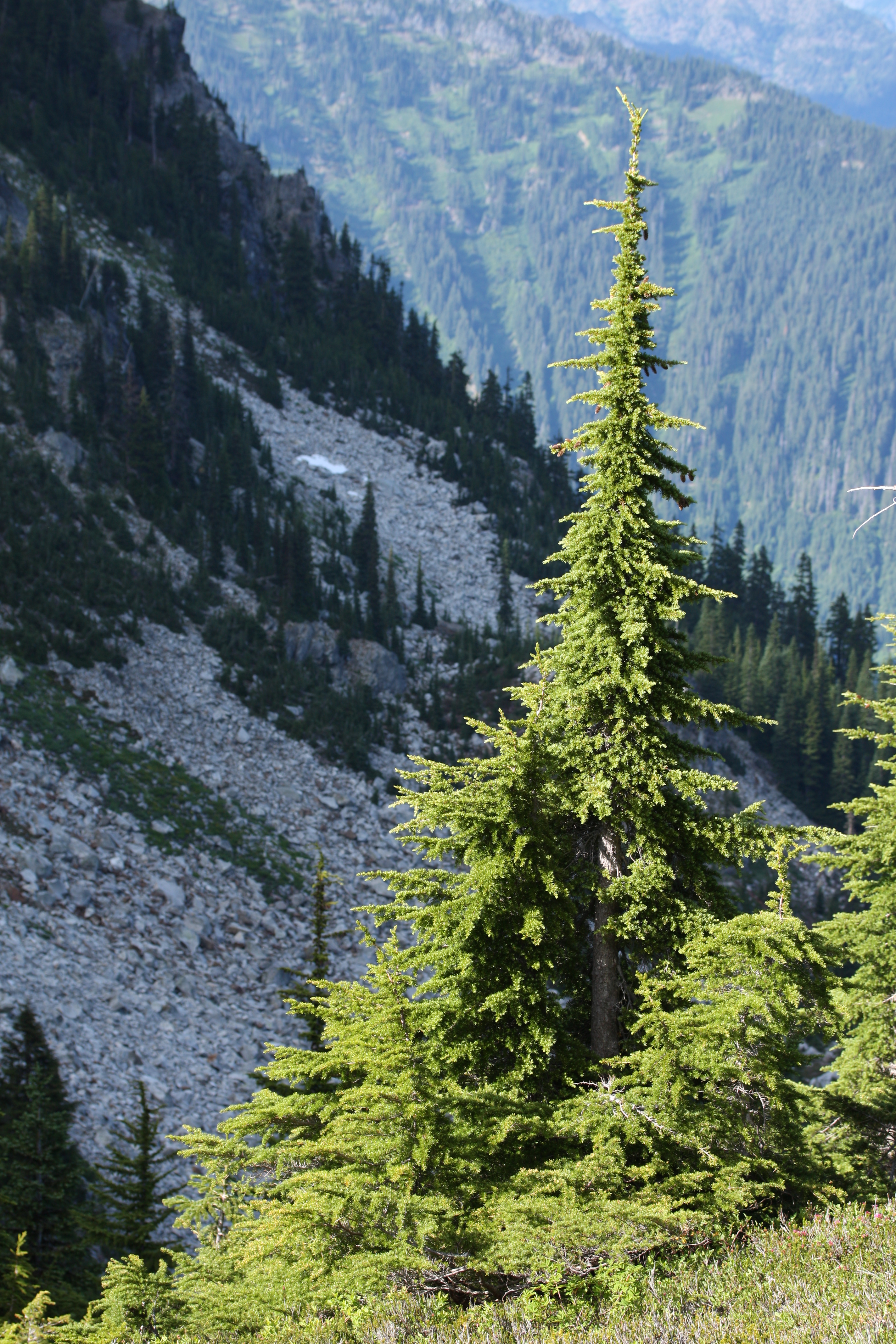
Tsuga mertensiana, commonly known as Mountain Hemlock, is one of the most graceful conifers of Alaska’s subalpine and montane forests. Named in honor of Karl Heinrich Mertens, a German botanist who collected specimens during the 1827 voyage of the Russian brig Senyavin, Mountain Hemlock is distinguished from its lowland relative Western Hemlock (Tsuga heterophylla) by its distinctly blue-green foliage, radially arranged needles, and preference for high-elevation, deep-snowpack environments. Its distinctive drooping leader — the topmost shoot that arches gracefully downward — is visible from a distance and makes it one of the most recognizable trees in the Pacific Coast mountain forests.
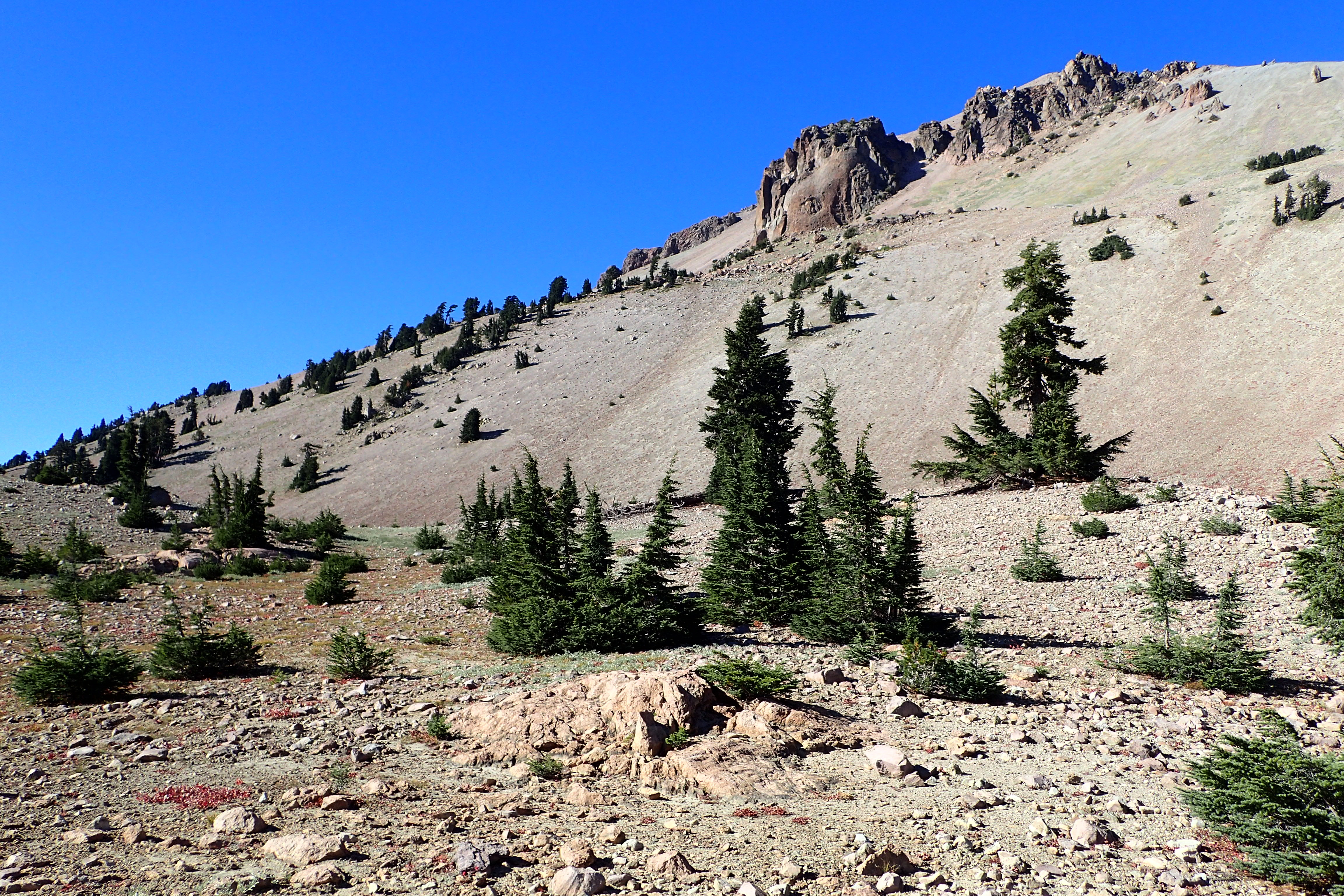
Mountain Hemlock is the dominant tree at or near timberline throughout much of its range, forming the characteristic subalpine forest of the Pacific Coast mountains from the Klamath Mountains of northern California north through the Cascades, Olympics, and Coast Ranges into Alaska. In Alaska, it is particularly prominent in the Southeast panhandle and along the Gulf Coast, where it occurs from near sea level on exposed, wind-blasted headlands to over 5,000 feet in the mountains. Its extraordinary tolerance for heavy snowpack — which may exceed 30 feet in some locations — is a critical ecological adaptation, allowing it to survive conditions that would crush most trees.
For wildlife, Mountain Hemlock provides essential year-round habitat. Its dense, layered canopy intercepts snow, creating thermal refugia for ground-dwelling animals during harsh winters. The seeds feed numerous bird and mammal species, while the complex old-growth structure supports extraordinary biodiversity. For gardeners and restoration practitioners, Mountain Hemlock is a refined, elegant conifer that thrives in partial to full shade — one of the few large trees that can succeed in the cool, shaded conditions of Pacific Northwest and Alaskan gardens.
Identification
Mountain Hemlock is a medium to large evergreen conifer, typically reaching 30 to 100 feet (9–30 m) tall at maturity, with a trunk diameter of 1 to 4 feet (0.3–1.2 m). At timberline and in exposed locations, trees may be considerably shorter and more stunted. The most instantly recognizable feature is the drooping leader — the topmost shoot arches or nods gracefully, a characteristic shared with Western Hemlock but more pronounced in Mountain Hemlock.
Needles
Mountain Hemlock’s needles are its most distinctive feature. Unlike Western Hemlock (whose needles are arranged in two flat ranks), Mountain Hemlock needles are arranged radially around the twig, pointing in all directions. Each needle is 0.5 to 1 inch (12–25 mm) long, rounded in cross-section (not flat), and blue-green to gray-green in color — a result of a whitish stomatal bloom on all surfaces. The needles are blunt-tipped (not sharp) and have two white bands on the underside. This blue-green, soft, radially-arranged foliage gives the branches a distinctive bottlebrush appearance — very different from the flat-spray appearance of Western Hemlock.
Cones
The cones are 1 to 3 inches (2.5–7.5 cm) long — notably larger than Western Hemlock’s tiny cones — and cylindrical to oblong. They are green when young, turning reddish-brown to dark purple at maturity. The cone scales are broad and rounded. Cones hang from branch tips and mature in their first year, releasing winged seeds in fall. The cones are often produced in abundance and are a reliable identification feature when present.
Bark & Form
The bark is gray-brown to reddish-brown, deeply furrowed and scaly on mature trees. Young bark is smoother and may be slightly grayish. The crown form is broadly conical to irregular, often with layered, drooping branches that give the tree a soft, feathery silhouette. In subalpine locations, trees at or near timberline may develop the windswept, krummholz form typical of high-elevation conifers exposed to prevailing winds.
Quick Facts
| Scientific Name | Tsuga mertensiana |
| Family | Pinaceae (Pine family) |
| Plant Type | Evergreen Conifer Tree |
| Mature Height | 30–100 ft (9–30 m) |
| Sun Exposure | Part Shade to Full Shade |
| Water Needs | High |
| Foliage Color | Blue-green to gray-green (year-round) |
| Bloom Time | May – June (pollen release) |
| Flower Color | Yellow (pollen cones); green-purple (seed cones) |
| Cone Size | 1–3 in. long (larger than Western Hemlock) |
| USDA Hardiness Zones | 5–9 (depending on provenance) |
Native Range
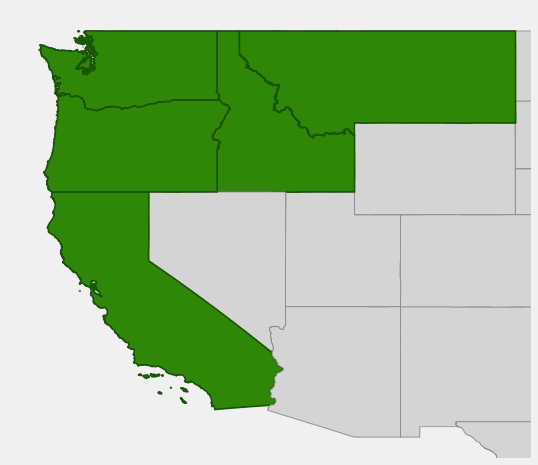
Mountain Hemlock has a linear distribution closely tracking the Pacific Coast mountain ranges from the Klamath Mountains of northwestern California north through the Oregon and Washington Cascades, Olympic Mountains, Coast Ranges, and British Columbia into Alaska. In Alaska, it is most prominent in the Southeast panhandle and along the Gulf Coast — the area encompassing the Alexander Archipelago, Kenai Peninsula, and Kodiak Island system. Northward, it grades into areas dominated by Sitka Spruce and White Spruce as the climate becomes less maritime and more continental.
The species is strongly associated with high-elevation, deep-snowpack environments. It often forms the treeline community in the Pacific Coast mountains — the last forest before open alpine terrain. In Alaska, Mountain Hemlock commonly grows at sea level in sheltered fjords and coastal bogs but is most characteristic at elevations of 1,500 to 5,000 feet, where heavy winter snowpack (20–30+ feet in some locations) and cool, moist summers create its ideal climate. It frequently grows alongside Western Hemlock at lower elevations and gradually replaces it at higher, snowier sites.
Ecologically, Mountain Hemlock old-growth forests are among the most complex and biologically rich forest ecosystems in North America. Ancient trees several hundred to over 1,000 years old develop massive, gnarled crowns, deep bark furrows, and extensive dead wood — providing structural complexity that supports extraordinary biodiversity. The conservation of old-growth Mountain Hemlock forest in Alaska and the Pacific Northwest is a major ecological priority, as these ancient stands cannot be quickly replaced once logged.
📋 Regional plant lists featuring Mountain Hemlock: Alaska
Growing & Care Guide
Mountain Hemlock is an elegant, refined conifer that thrives in the cool, moist, partly shaded conditions of Pacific Northwest and Alaskan gardens. While slower-growing than many conifers, it rewards patient gardeners with a graceful, long-lived specimen that adds year-round beauty and provides exceptional wildlife habitat.
Light
Mountain Hemlock is one of the most shade-tolerant conifers, naturally growing beneath the canopy of larger trees and thriving in partial to full shade. It performs best with dappled light to partial shade — mimicking the filtered light of its natural subalpine forest habitat. Unlike many shade-tolerant species, it also grows acceptably in full sun in cool, moist climates (such as coastal Alaska), but in warmer gardens, afternoon shade is important to prevent needle scorch. Avoid exposure to hot afternoon sun in warm, dry climates.
Soil & Water
Consistent high moisture is essential — Mountain Hemlock naturally grows in one of the wettest forest environments in North America. Plant in cool, moist, well-drained to moderately moist soils with good organic content. Acidic soils (pH 4.5–6.0) are preferred, similar to the naturally acidic forest soils of its native range. Mulch generously with 3–4 inches of organic material to retain moisture and maintain the cool root environment the tree needs. Regular irrigation during establishment (first 2–3 years) is important; established trees in rainy Pacific climates may need minimal supplemental water.
Planting Tips
Plant in fall or early spring in well-prepared, amended soil. Choose a sheltered site protected from harsh wind — particularly important for young trees. Mountain Hemlock is somewhat slow to establish from nursery stock but develops into a beautiful, long-lived tree. It is not easily available at most nurseries, so seek out Pacific Northwest or Alaskan native plant specialists. Container-grown stock from local seed sources is strongly preferred for Alaska plantings.
Pruning & Maintenance
Mountain Hemlock requires virtually no pruning. Allow it to develop its natural graceful form — including the characteristic drooping leader and layered branches. Remove only dead or damaged branches. The tree is susceptible to woolly adelgids in warmer parts of its range, but these pests are less problematic in cool Alaskan climates. Monitor for needle rots and fungal blights in very humid conditions, ensuring good air circulation around plantings.
Landscape Uses
- Woodland and shade garden specimen — the graceful drooping form is architecturally striking
- Understory planting beneath larger deciduous or coniferous trees
- Pacific Northwest and Alaskan native gardens emphasizing regional character
- Wildlife habitat trees providing dense cover and seed crops
- Screening and privacy planting in cool, moist, shaded garden settings
- Timberline garden plantings at high-elevation properties in SE Alaska
Wildlife & Ecological Value
Mountain Hemlock supports a rich and complex wildlife community, particularly in old-growth forest contexts where structural diversity is highest.
For Birds
Mountain Hemlock seeds are consumed by crossbills, Pine Siskins, Brown Creepers, and various chickadees and nuthatches. The dense, layered canopy provides outstanding nesting habitat for a wide range of birds — from Marbled Murrelets (which nest on the large moss-covered branches of old-growth hemlock trees) to Varied Thrushes and various warblers. The dense, snow-intercepting canopy creates thermal cover that is critical for birds surviving Alaskan winters. Ancient, cavity-rich old-growth Mountain Hemlock stands support Pileated Woodpeckers, owls, and other cavity-dependent species.
For Mammals
The deep, continuous canopy of Mountain Hemlock forests creates snow-free or low-snow zones beneath the trees, providing critical winter habitat for deer, elk, and other large mammals that depend on accessible forage under deep snowpack. Black-tailed Deer and Sitka Blacktail Deer in Alaska are heavily dependent on old-growth hemlock forest for winter survival. Squirrels and chipmunks cache hemlock seeds, while flying squirrels forage in the canopy year-round. The complex root systems and downed logs of old-growth hemlock forest support exceptional small mammal diversity.
For Pollinators
As a wind-pollinated conifer, Mountain Hemlock provides limited direct pollinator resources, but its pollen is an early-season food for pollen-collecting insects. The leaf litter and bark of old trees support diverse invertebrate communities — particularly saproxylic beetles and the soil invertebrates that underpin nutrient cycling in hemlock forest ecosystems.
Ecosystem Role
Mountain Hemlock is the dominant old-growth forest tree in much of Southeast Alaska and the northern Pacific Coast. Ancient Mountain Hemlock forests store vast quantities of carbon and support extraordinary biodiversity — from Marbled Murrelets nesting on moss-draped old-growth branches to rare lichens and bryophytes found only in ancient hemlock canopies. The species contributes massively to the salmon-forest nutrient cycle: marine-derived nutrients carried by spawning salmon are distributed by wildlife throughout hemlock forest watersheds, enriching soils and driving forest productivity in a remarkable loop connecting ocean and mountain.
Cultural & Historical Uses
Mountain Hemlock has been used by Indigenous peoples throughout its range for practical purposes, though it has generally played a secondary role to Western Hemlock and Sitka Spruce in Indigenous material culture. Coastal Alaskan groups — including the Tlingit, Haida, and Tsimshian — harvested the inner bark of hemlock trees in spring, when it is sweet and nutritious, as a food source. This inner bark (cambium) was eaten fresh, pressed into cakes, and dried for winter storage. In spring, the fresh green growth and the sweet cambium represented an important transitional food source after the lean winter months.
The bark of Mountain and Western Hemlock is extraordinarily rich in tannins — chemicals used to tan animal hides. Indigenous peoples throughout the Pacific Northwest used hemlock bark in the hide-tanning process, producing durable leather used for clothing, bags, and containers. The bark was also used as a red-brown dye for baskets and textiles. In some communities, hemlock twigs were burned and the ash mixed with other materials for medicinal purposes or used as a cleansing agent.
Structurally, Mountain Hemlock wood is used commercially for lumber, pulp, and paper production, though it is generally less valued than Western Hemlock or Sitka Spruce for timber. In Alaska, its primary commercial importance has been as pulp for paper production. Ecologically, the conservation of old-growth Mountain Hemlock forest in the Tongass National Forest and surrounding areas remains one of the most significant land management debates in Alaska’s history, as these ancient forests support both extraordinary biodiversity and the cultural values of Indigenous communities whose identities are inseparable from the hemlock forests of Southeast Alaska.
Frequently Asked Questions
How is Mountain Hemlock different from Western Hemlock?
Mountain Hemlock (Tsuga mertensiana) has blue-green, radially arranged needles (pointing in all directions around the twig), larger cones (1–3 in.), and a strong preference for high-elevation, deep-snowpack environments. Western Hemlock (Tsuga heterophylla) has darker green, flat-ranked needles, tiny cones (under 1 in.), and grows at lower elevations. In many areas of Southeast Alaska, both species occur together, with Mountain Hemlock dominating at higher elevations.
Why does Mountain Hemlock have a drooping leader?
The drooping leader — the flexible, arching topmost shoot — is characteristic of all hemlock species. It likely helps the tree shed heavy snow loads (the tip bends rather than breaking) and may reduce wind resistance at exposed subalpine sites. The drooping leader is so characteristic of hemlocks that it’s used as a field identification feature throughout their range.
Can Mountain Hemlock be grown in gardens outside Alaska?
Yes — it’s grown as an ornamental in the Pacific Northwest, the British Isles, and cool-temperate gardens worldwide. It requires cool, moist, acidic conditions and shelter from harsh wind and hot sun. Several cultivars have been selected for garden use, including compact and weeping forms.
Is Mountain Hemlock endangered in Alaska?
Mountain Hemlock itself is not endangered — it remains a dominant forest species throughout its range. However, old-growth Mountain Hemlock forests are under significant pressure from past and ongoing timber harvesting, particularly in the Tongass National Forest. Conservation of these ancient stands is important both ecologically and for the Indigenous communities whose cultures are deeply connected to them.
What wildlife depends most on Mountain Hemlock forests?
Marbled Murrelets — seabirds that fly inland to nest on the wide, moss-covered branches of old-growth conifers — are perhaps the most emblematic old-growth dependent species in Mountain Hemlock forests. Sitka Blacktail Deer depend on old-growth hemlock canopy for winter survival under deep snowpack. Spotted Owls, Pileated Woodpeckers, and many other species are closely tied to old-growth hemlock forest structure.

Looking for a nursery that carries Mountain Hemlock?
Browse our native plant nursery directory: Alaska