
Naio (Myoporum sandwicense)
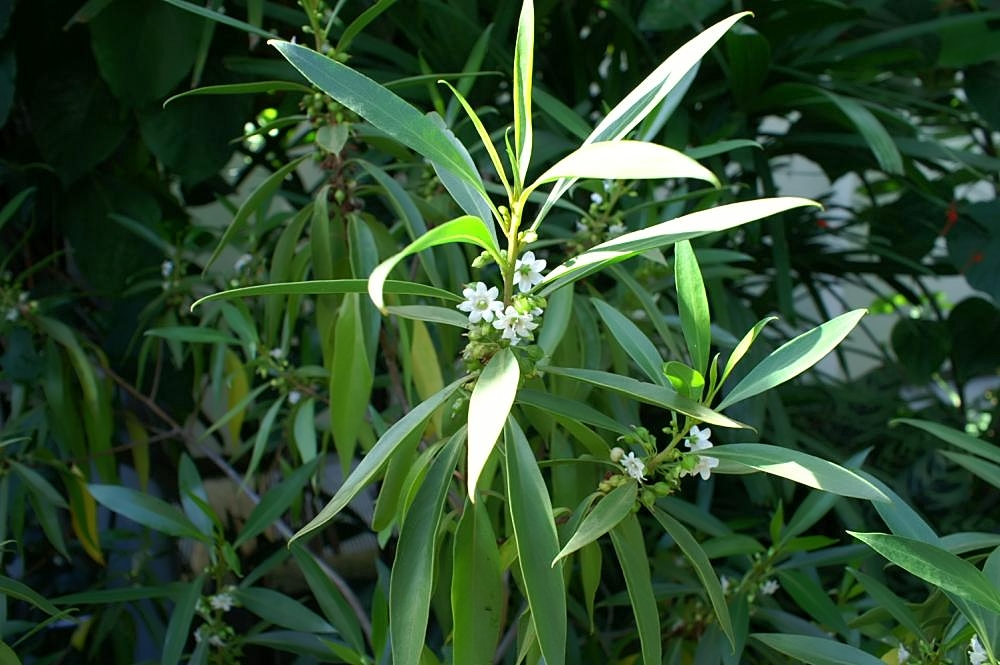
Myoporum sandwicense, known in Hawaiian as Naio and colloquially as Bastard Sandalwood or False Sandalwood, is one of Hawaii’s most ecologically important and culturally significant native woody plants. A member of the Scrophulariaceae family (or Myoporaceae in some classifications), Naio ranges from a low, spreading shrub to a substantial tree reaching 30 feet or more, depending on elevation, rainfall, and growing conditions. It is found across a wider range of Hawaiian habitats than almost any other native woody plant — from sea level coastal strand to subalpine zones above 8,000 feet elevation.
The name “Bastard Sandalwood” reflects Naio’s role in Hawaiian history: when Hawaiian sandalwood (Santalum spp.) was nearly harvested to extinction during the early 19th-century sandalwood trade, Naio wood was sometimes substituted for true sandalwood due to its similar fragrance. While not true sandalwood, Naio’s wood does carry a pleasant, sandalwood-like scent, and the plant produces conspicuous clusters of small white flowers with distinctive purple markings that make it recognizable in the field.
Naio is highly valued in Hawaiian native plant gardening and restoration for its adaptability, drought tolerance, and versatility across a wide range of landscape conditions. Its tolerance of dry, exposed sites — combined with its attractive flowers and wildlife value — makes it one of the most practically useful native Hawaiian trees for both restoration and ornamental landscape use.
Identification
Naio is a highly variable species. Growth form ranges from a low, spreading ground shrub in coastal and high-elevation environments to an erect multi-stemmed shrub or single-trunked tree reaching 15 to 30 feet in mesic forest settings. The plant’s appearance varies considerably by elevation and habitat, but several characteristics remain fairly consistent across populations.
Leaves
The leaves are simple, alternate, and narrowly elliptic to lanceolate — typically 2 to 5 inches (5–12 cm) long and 0.5 to 1.5 inches (1–3 cm) wide. They are thick, somewhat succulent in texture, and have a glossy, slightly waxy surface. The margins are entire to slightly toothed toward the tips. Leaves are a bright to medium green on the upper surface and paler below. Young growth may have a slightly reddish or bronze tinge. The leaves and wood carry a distinctive, pleasant scent reminiscent of sandalwood — a diagnostic feature of the species.
Flowers
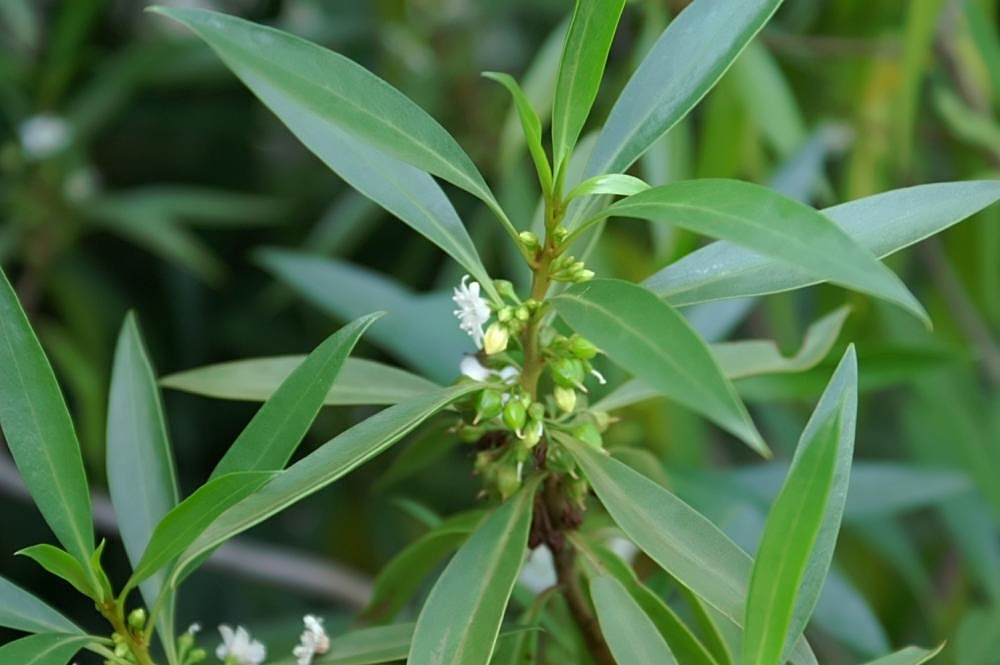
The flowers are small but conspicuous — as noted in the batch data description (“conspicuous flowers”). They are produced in clusters (cymose inflorescences) from the leaf axils, with each flower about ⅓ to ½ inch (8–12 mm) across. Individual flowers are white to pale pink, funnel-shaped, with five rounded petals that spread outward. The petals are typically marked with purple or lavender spots or streaks toward the center, creating a striking two-toned effect. Blooming can occur throughout the year in Hawaii’s mild climate, with heaviest flowering in spring and summer.
Fruit
The fruit is a small, fleshy drupe — about ¼ inch (6–8 mm) long — that turns from green to white, pink, or pale purple-red when ripe. The drupes are produced in clusters and are consumed by native Hawaiian birds. Each fruit contains a single hard seed. The fruit’s fleshy coating, though small, provides an important food resource for native birds that help distribute seeds throughout native forest habitats.
Quick Facts
| Scientific Name | Myoporum sandwicense |
| Family | Scrophulariaceae / Myoporaceae |
| Plant Type | Native Shrub to Tree (highly variable) |
| Mature Height | 3–30 ft (shrub to tree; varies by habitat) |
| Sun Exposure | Full Sun to Part Shade |
| Water Needs | Low (Drought Tolerant) |
| Bloom Time | Year-round; peak spring–summer (conspicuous flowers) |
| Flower Color | White with purple spots/streaks (smells of sandalwood) |
| Notable Feature | Sandalwood-scented wood and foliage |
| USDA Hardiness Zones | 10–13 (Hawaii) |
Native Range
Naio (Myoporum sandwicense) is endemic to the Hawaiian Islands, where it is one of the most widely distributed native woody plants in the archipelago. It is found on all the main Hawaiian Islands across an extraordinary elevation range — from sea level coastal areas up to approximately 9,000 feet on Maui and the Big Island. This exceptional altitudinal range — spanning sea-level coastal strand to high-elevation subalpine shrubland — makes Naio one of the most ecologically versatile native Hawaiian plants.
In its coastal and lowland habitats, Naio is typically a low to medium shrub growing in rocky, sandy, or volcanic soils in dry coastal scrubland and strand communities. As elevation increases and rainfall patterns change, Naio transitions through various scrubland and forest habitats, ultimately becoming a component of dry to mesic forest on mid-elevation slopes. At the upper end of its elevation range on Haleakala (Maui) and on the slopes of Mauna Kea and Mauna Loa (Big Island), Naio grows as a compact, wind-pruned shrub in subalpine dry shrubland communities at the limits of woody plant growth in Hawaii.
Naio’s remarkable adaptability has allowed it to persist across many of the habitat types that have been most affected by human activity, invasive species, and grazing in Hawaii. It is often one of the native plants most likely to be found in partially degraded habitats, providing important ecological continuity and serving as a framework species in restoration efforts. Its drought tolerance and tough constitution make it one of the most reliable native plants for difficult-to-restore sites.
📋 Regional plant lists featuring Naio: Hawaii
Growing & Care Guide
Naio is one of the most versatile and garden-tough native Hawaiian plants available. Its combination of drought tolerance, adaptability, attractive flowers, and pleasant fragrance makes it an excellent choice for a wide range of garden applications.
Light
Naio grows well in full sun to part shade, reflecting its natural occurrence across many habitat types in Hawaii. In full sun, it typically develops a more compact, shrubby form and produces flowers abundantly. In partial shade, it may grow more open and taller. Coastal plantings in full sun will produce the most robust plants; understory plantings in part shade can also succeed. Avoid deep shade.
Soil & Water
One of Naio’s great strengths is its outstanding drought tolerance. Once established, it requires minimal supplemental irrigation — a key attribute for low-water-use Hawaiian landscapes. It tolerates rocky, sandy, and nutrient-poor soils, as well as the shallow, well-drained volcanic soils common across Hawaii. Avoid waterlogged conditions, which the plant cannot tolerate. Naio also demonstrates good salt tolerance, making it suitable for coastal plantings where salt spray and wind are concerns.
Planting Tips
Plant in spring or fall. Container-grown specimens transplant readily. Space plants 4–8 feet apart for a naturalistic shrub planting; closer spacing creates a denser screen or hedge effect. Naio works well as a windbreak or screening plant along the makai (ocean) side of properties. It can also be trained as a small tree by removing lower branches to reveal the attractive trunk. Pair with other drought-tolerant Hawaiian natives such as Pohinahina (Vitex rotundifolia), Maʻo (Gossypium tomentosum), and native grasses.
Pruning & Maintenance
Naio requires minimal pruning and is generally a low-maintenance plant. Light shaping can be done at any time to maintain desired form or size. For a tree-like form, gradually remove lower branches over 2–3 years. Naio is relatively pest-resistant, though the introduced thrips (Klambothrips myopori) can cause galling damage on some plants — monitor and treat with appropriate organic insecticides if infestations become severe.
Landscape Uses
- Windbreak and screen planting in coastal and dry garden settings
- Specimen tree — trained to reveal attractive trunk and branch structure
- Coastal restoration in dry habitat zones
- Native Hawaiian garden — a foundation shrub-to-tree species
- Wildlife garden — flowers and fruit attract native birds and bees
- Erosion control on dry slopes and degraded sites
- Fragrant garden — the pleasant sandalwood-like scent from wood and foliage
Wildlife & Ecological Value
Naio provides significant food and habitat resources for native Hawaiian wildlife across its wide range of habitats.
For Birds
The small, fleshy drupes of Naio are consumed by several native Hawaiian birds, including the ʻomaʻo (Hawaiian thrush) and the ʻapapane (Himatione sanguinea). Various native honeycreepers visit the flowers for nectar. The shrub and tree structure provides nesting and shelter habitat for native forest and scrubland birds. In dry forest habitats where large trees are rare, Naio provides an important structural element for birds.
For Pollinators
Naio’s conspicuous white flowers with purple markings attract native Hawaiian yellow-faced bees (Hylaeus spp.) and other native pollinators. In dry coastal and lowland habitats where few native plants bloom, Naio’s year-round flowering provides an important and reliable source of nectar and pollen for native pollinators.
For Insects
Like many native Hawaiian plants, Naio supports native insect communities that have co-evolved with it over millennia. The plant’s bark and decaying wood provide habitat for native wood-boring beetles and other invertebrates that are part of the native forest food web.
Ecosystem Role
In Hawaii’s dry coastal and lowland habitats — among the most threatened and degraded ecosystems in the islands — Naio plays a critical role as one of the few native trees that can establish and persist in these challenging conditions. As a framework species in dry habitat restoration, Naio creates shade and litter that helps suppress invasive grasses and creates microhabitat for other native plants to establish. Its nitrogen-fixing root associations in some habitats contribute to soil development on volcanic substrates.
Cultural & Historical Uses
Naio has a fascinating and somewhat ironic place in Hawaiian history, earning its common name “Bastard Sandalwood” or “False Sandalwood” from events of the early 19th century. During the height of the Pacific sandalwood trade (approximately 1810–1830), Hawaiian sandalwood (Santalum freycinetianum, S. haleakalae, and related species) was harvested almost to extinction to meet the voracious demand of Chinese merchants who prized it for incense and medicinal use. As true sandalwood supplies dwindled, Naio wood — which carries a similar, though less intense, aromatic scent — was reportedly substituted by some traders, either inadvertently or as a deliberate fraud. The Chinese buyers noticed the difference, hence the “bastard” (meaning false or inferior substitute) designation.
Despite this nickname, Naio was valued in its own right in traditional Hawaiian culture. Its hard, durable wood was used for construction, tool handles, and fuel. The pleasant fragrance of the wood was appreciated, and Naio branches and leaves were used in certain ceremonial contexts. In traditional Hawaiian medicine, preparations from Naio were used for skin conditions and as a general tonic.
Today, Naio is being rediscovered as a valuable native plant for both restoration and ornamental use. Nurseries across Hawaii propagate it regularly, and it is featured in native plant gardens, botanical parks, and restoration sites throughout the islands. Its resilience, fragrance, and beautiful flowers make it a plant that Hawaiian cultural practitioners and ecologists alike are working to restore to the many habitats from which it has been displaced.
Frequently Asked Questions
Why is Naio called Bastard Sandalwood?
The name refers to the 19th-century Pacific sandalwood trade, during which Naio wood was reportedly substituted for true Hawaiian sandalwood (Santalum spp.) because of its similar aromatic scent. “Bastard” in this context means “false” or “inferior substitute” — not a derogatory term but a botanical naming convention common in the 18th and 19th centuries for plants that resemble more valuable species.
Is Naio the same as sandalwood?
No — Naio (Myoporum sandwicense) and Hawaiian sandalwood (Santalum spp.) are unrelated plants from different plant families. They share a similar fragrance in their wood but are botanically distinct. True Hawaiian sandalwood is a hemiparasite that attaches to the roots of other plants; Naio is an independent shrub or tree that does not parasitize other plants.
How fast does Naio grow?
Growth rate varies considerably by habitat and water availability. In suitable conditions (full sun, well-drained soil, moderate moisture during establishment), Naio can grow 1–2 feet per year and reach shrub or small tree stature within 5–10 years. In dry coastal conditions with minimal water, growth is slower. Naio is a relatively long-lived plant and can develop into a substantial tree over decades.
Can I prune Naio into a hedge?
Yes — Naio responds well to pruning and can be maintained as a formal or informal hedge. It tolerates regular trimming and will produce dense new growth when cut back. For a wildlife-friendly informal hedge, allow it to grow more naturally with only occasional shaping. For a formal hedge, shear 2–3 times per year during the growing season.
Is Naio affected by pests?
The main pest concern for Naio in Hawaii is the introduced thrips species (Klambothrips myopori), which causes characteristic galling of leaves and shoots. This pest was introduced from Australia (where it attacks other Myoporum species) and has caused significant damage in some Naio populations. Monitor plants regularly and consult with local nurseries or extension services for current management recommendations.
Looking for a nursery that carries Naio?
Browse our native plant nursery directory: Hawaii