
‘Ulei (Osteomeles anthyllidifolia)
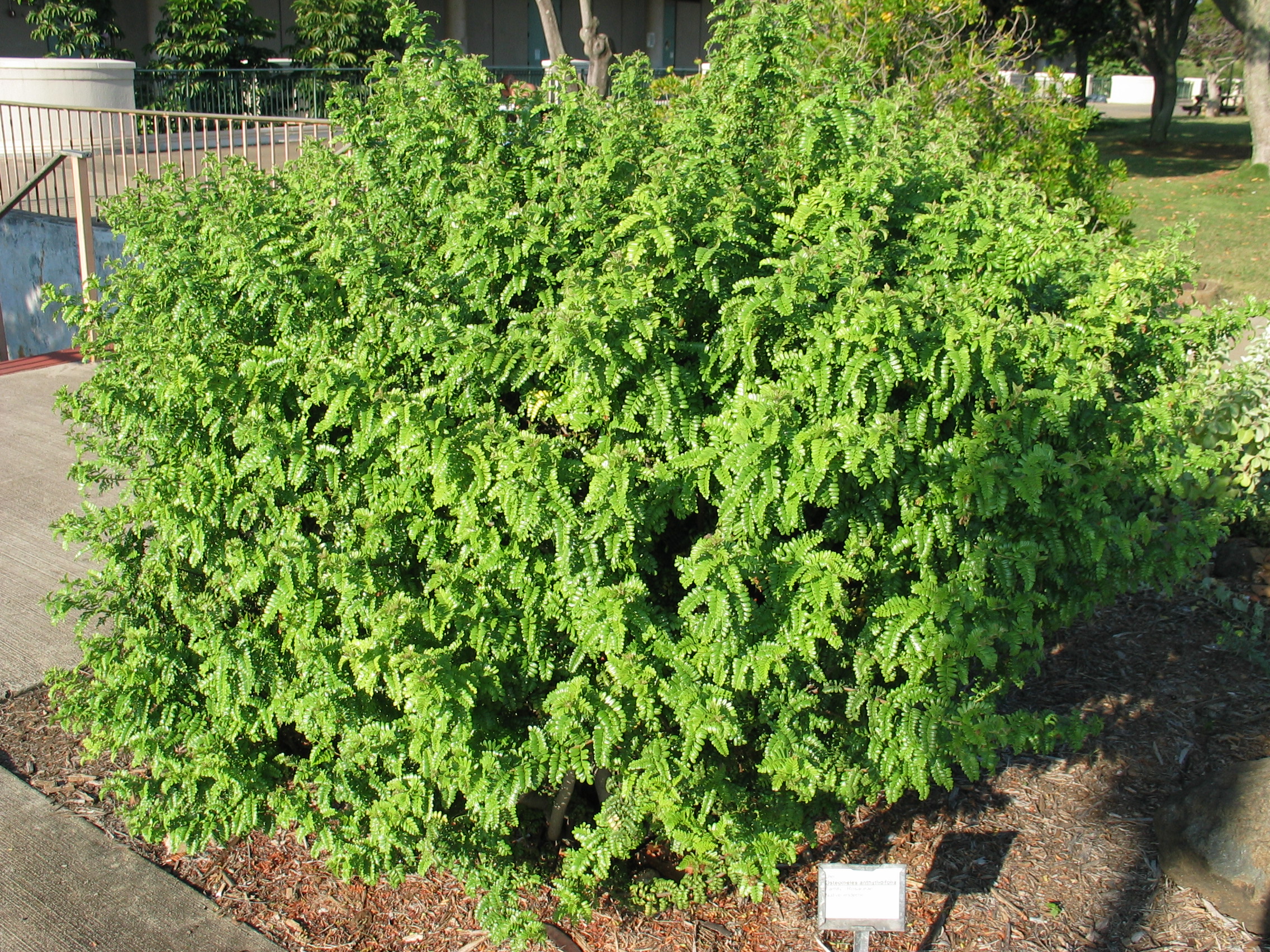
Osteomeles anthyllidifolia, known in Hawaiian as ‘Ulei, is a thorny, evergreen native shrub endemic to the Hawaiian Islands and among the most instantly recognizable plants in the Hawaiian flora. A member of the Rosaceae (rose) family, ‘Ulei produces beautiful clusters of small, fragrant white flowers that resemble miniature apple blossoms — not surprising given the plant’s close relationship with other rose-family members such as apples, pears, and hawthorns. The name ‘Ulei likely refers to the plant’s wiry, tough stems, which were one of the most important plant materials in traditional Hawaiian culture.
‘Ulei grows in a remarkably wide range of Hawaiian habitats, from coastal strand environments near sea level to subalpine shrubland above 6,000 feet elevation on Mauna Kea and Haleakalā. This extraordinary ecological amplitude — spanning from beach margins to high-elevation volcanic landscapes — is one of the broadest of any Hawaiian native plant, and it reflects the species’ remarkable adaptability. Across this range, ‘Ulei forms dense, impenetrable thickets of arching, thorny stems that provide critical habitat structure and wildlife resources.
Despite its resilience and wide distribution, ‘Ulei faces significant pressure from introduced ungulates (pigs, goats, deer) that browse on the plant, invasive grasses that compete with seedlings, and habitat loss in the lowland areas where it once formed extensive coastal thickets. Conservation fencing that excludes ungulates has been highly effective at allowing ‘Ulei populations to recover in protected areas, demonstrating that the plant’s underlying resilience is intact where threats are controlled. In the garden, ‘Ulei is a wonderful native choice for hedging, wildlife planting, and naturalistic landscapes.
Identification
‘Ulei is a dense, spreading to arching shrub typically 3 to 10 feet tall in most conditions, though it can reach 15 feet in favorable forest-edge habitats. The plant is immediately recognizable by its combination of thorny stems, small pinnate leaves, and clusters of white five-petaled flowers. Its growth form ranges from a low, sprawling ground cover in exposed, windswept sites to an upright, multi-stemmed shrub in more sheltered conditions.
Stems & Thorns
The stems of ‘Ulei are slender, wiry, and extremely tough — a combination that made them highly prized for cordage and other traditional uses. Young stems are greenish and flexible; older wood turns gray-brown and quite hard. Stout, curved thorns occur at the nodes along the stems, making established plants nearly impenetrable to humans and browsing animals. The thorns are sharp and persistent, remaining on the plant even as stems age.
Leaves
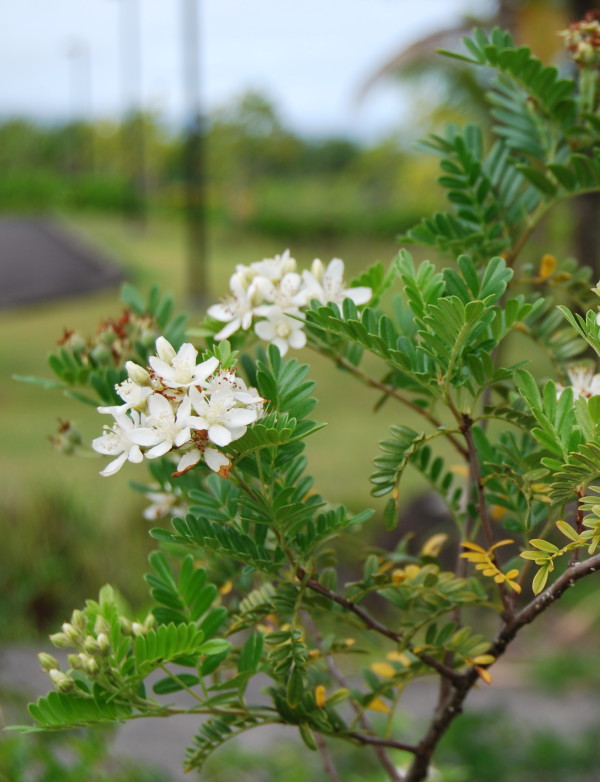
The leaves are pinnately compound (resembling small fern fronds), with 11 to 25 tiny ovate leaflets, each about ¼ to ½ inch (6–12 mm) long, arranged in opposite pairs along a slender central leaf stalk. The leaflets are bright green and slightly hairy, with entire (smooth) margins. The overall effect is a finely textured, fern-like appearance that is quite distinctive and beautiful. Leaves are evergreen, persisting year-round in Hawaiian conditions.
Flowers & Fruit
The flowers are the showpiece of ‘Ulei — clusters of 5 to 15 small white blossoms, each about ½ inch (12 mm) across with five rounded petals, five sepals, and numerous yellow stamens at the center. The flowers have a light, sweet, somewhat apple-like fragrance that is most noticeable in the early morning. Flowering occurs primarily in spring through summer but can continue sporadically throughout the year in warmer Hawaiian lowlands. The fruit is a small, round pome (like a miniature apple) about ¼ inch (6 mm) in diameter, ripening from white to cream-white to bluish-white or purplish at full maturity. The fruits are sweet-tasting and edible, though small.
Quick Facts
| Scientific Name | Osteomeles anthyllidifolia |
| Family | Rosaceae (Rose) |
| Plant Type | Evergreen Thorny Shrub |
| Mature Height | 3–15 ft (habitat-dependent) |
| Sun Exposure | Full Sun to Part Shade |
| Water Needs | Low to Moderate |
| Bloom Time | Spring – Summer (sporadic year-round) |
| Flower Color | White (fragrant) |
| USDA Hardiness Zones | 9–12 |
Native Range
‘Ulei is endemic to the Hawaiian Islands — meaning it is found naturally nowhere else on Earth. However, within Hawaii, it is one of the most widespread native shrubs, occurring on all the main islands from near sea level to above 7,000 feet (2,130 m) elevation. This extraordinary elevational range — spanning tropical coastal habitats to cool, subalpine shrublands on the flanks of Mauna Kea and Haleakalā — is matched by few other Hawaiian native plants and speaks to the species’ exceptional ecological flexibility.
In lowland areas, ‘Ulei was historically common in coastal strand communities, dry shrublands, and the margins of lowland dry forests, forming dense thickets on rocky lava flows and coastal bluffs. In mesic (moderate moisture) environments at mid-elevations, it grows as a larger, more vigorous shrub in mixed native shrubland communities. At high elevations on Mauna Kea and Haleakalā, ‘Ulei forms a prostrate, compact growth form adapted to the harsh, cold, windswept subalpine environment — demonstrating remarkable phenotypic plasticity across its range.
Today, lowland populations of ‘Ulei have declined significantly due to habitat loss, browsing by ungulates, and competition from invasive grasses and shrubs. High-elevation populations are generally better protected within national park and forest reserve boundaries. ‘Ulei is not currently listed as threatened or endangered at the species level, but many local populations are of conservation concern, particularly in lowland areas on the most developed islands of Oahu and Maui.
📋 Regional plant lists featuring ‘Ulei: Hawaii
Growing & Care Guide
‘Ulei is an excellent garden shrub that rewards its grower with seasonal floral displays, year-round attractive foliage, and remarkable resilience once established. It is appropriate for a wide range of garden settings in Hawaii, from coastal gardens to mid-elevation landscapes.
Light
‘Ulei performs best in full sun, where it develops its characteristic dense, compact form and produces the most abundant flowers. It tolerates part shade but may become more open and less floriferous in shadier conditions. In coastal gardens, full-sun exposure is ideal. In hotter, drier inland settings, light afternoon shade can be beneficial during the hottest months.
Soil & Water
‘Ulei grows in an extraordinarily wide range of soils in the wild, from well-drained sandy coastal soils to rocky lava substrates to clay-influenced mesic forest soils. In the garden, it performs best in well-draining soils with moderate fertility. Once established — typically after the first year — ‘Ulei is quite drought-tolerant and requires little supplemental irrigation in most Hawaiian climates. In the drier leeward areas, occasional deep watering during prolonged dry spells helps maintain the plant’s appearance. Avoid waterlogged soils, which can lead to root rot.
Planting Tips
Plant ‘Ulei in spring or fall. It transplants well from container stock available at Hawaiian native plant nurseries. Space plants 4 to 6 feet apart for a dense hedge or screen, or 6 to 10 feet apart for a more naturalistic shrubland planting. Wear gloves when handling — the thorns are quite sharp. A light layer of mulch around the base (keeping it away from the stem) will help retain moisture and suppress weeds during establishment.
Pruning & Maintenance
‘Ulei naturally forms a dense, arching mound and generally does not require heavy pruning. Light shaping can be done after the main flowering period (late summer) to maintain a desired size or form. Pruning also stimulates fresh new growth and can encourage repeat flowering. When pruning, use heavy gloves and long-handled loppers to avoid the thorns. Dead stems can be removed at any time. ‘Ulei is virtually pest- and disease-free in native Hawaiian conditions.
Landscape Uses
- Wildlife hedge or barrier — thorny stems make an impenetrable native hedge and excellent deterrent
- Coastal restoration planting on leeward Hawaiian shorelines
- Dry garden specimen with seasonal floral interest
- Bird and pollinator garden — flowers and fruit attract native species
- Naturalized native shrubland for low-maintenance sloped areas
- Erosion control on rocky slopes and lava fields
Wildlife & Ecological Value
‘Ulei is a keystone plant in Hawaiian native plant communities, providing multi-season wildlife resources and critical habitat structure.
For Birds
The small, sweet fruits of ‘Ulei are consumed by a variety of native and introduced birds in Hawaii. The dense, thorny thickets provide exceptional nesting habitat — the sharp thorns exclude predatory mammals from nesting sites, offering protection to birds raising young. The nesting success of native birds in ‘Ulei thickets is notably higher than in open or less defended vegetation, making ‘Ulei planting an important conservation tool for Hawaiian bird recovery.
For Pollinators
The fragrant white flowers of ‘Ulei are among the most important nectar sources for native Hawaiian yellow-faced bees (Hylaeus species), which are endemic to Hawaii and listed as federally threatened. These tiny native bees depend on native flowering plants for both nectar and pollen, and ‘Ulei’s extended blooming season provides critical resources. The flowers are also visited by native Hawaiian moths and various beneficial insects.
For Mammals
While introduced mammals (pigs, goats, deer) unfortunately browse on ‘Ulei to the point of seriously damaging populations in unprotected areas, the fruits are also consumed by native Hawaiian hoary bats (Lasiurus cinereus semotus), Hawaii’s only endemic land mammal. The hoary bat forages over ‘Ulei thickets for insects attracted to the flowers, particularly at dusk.
Ecosystem Role
‘Ulei is a foundational species in Hawaiian coastal and dryland plant communities. Its dense thickets create microhabitats of reduced wind, increased humidity, and accumulated leaf litter that enable other, less resilient native plants to establish. On bare lava flows and degraded coastal areas, ‘Ulei is often one of the first native shrubs to colonize, acting as a nurse plant for the recovery of the broader native plant community. Its extensive root system helps stabilize volcanic soils and reduces erosion on sloped terrain.
Cultural & Historical Uses
Few native Hawaiian plants have as rich a cultural history as ‘Ulei. The plant’s tough, flexible stems — which are among the strongest of any Hawaiian native plant relative to their diameter — were the primary material for a wide variety of traditional implements. They were used to make ‘ō’ō (digging sticks), handles for kō’i (adzes), and small tools and implements for farming and food preparation. ‘Ulei wood does not crack or split easily, making it ideal for these demanding uses.
Perhaps most famously, ‘Ulei stems were used to make pā’ū (or ukeke) — the Hawaiian musical bow, a traditional stringed instrument that was one of the few stringed instruments in pre-contact Hawaiian music. The bow-shaped stems, when strung with plant fiber and held near the mouth, produced a subtle, buzzing musical sound controlled by the shape of the player’s lips. Skilled musicians could produce a surprisingly complex melodic range. The ukeke was considered a personal instrument and was sometimes used in courtship, with a skilled player using the instrument to communicate privately with a potential partner.
‘Ulei fruits were eaten fresh by Hawaiians, and the plant was used medicinally for a variety of purposes. The inner bark was prepared as a remedy for urinary tract problems, and the plant was incorporated into various compound herbal formulas used by Hawaiian healers (kahuna lā’au lapa’au). The thorny stems were also used as fish hooks in some areas, bent and shaped while fresh and then dried to retain the desired curve. Today, ‘Ulei is increasingly recognized not only as a beautiful garden plant but as a living connection to centuries of Hawaiian cultural practice and ecological knowledge.
Frequently Asked Questions
Is ‘Ulei safe to grow around children and pets?
The thorns on ‘Ulei stems are sharp and can cause injury, so placement in areas frequented by young children should be thoughtful — it’s best planted away from play areas or used as a boundary or barrier planting. The fruit is edible, so there is no toxicity concern. Pets that brush against the plant may catch their fur on the thorns, but this is not a serious health concern.
How fast does ‘Ulei grow?
‘Ulei is a moderate grower, typically adding 1 to 2 feet of growth per year under good conditions. It reaches flowering size (usually 3 to 4 feet) within 2 to 3 years from planting. Growth is fastest in full sun with adequate moisture during establishment.
Can I use ‘Ulei as a hedge?
Yes — ‘Ulei makes an excellent, impenetrable native hedge. Its thorny stems, dense growth habit, and attractive flowers make it functional and beautiful as a boundary planting. Space plants 3 to 4 feet apart for a hedge that fills in within 3 to 5 years. Light trimming after flowering maintains a neat appearance.
Where can I buy ‘Ulei plants?
‘Ulei is available from Hawaiian native plant nurseries, particularly those specializing in dryland and coastal native species. See our nursery directory for sources in Hawaii.
What is the difference between ‘Ulei at the coast and at high elevation?
‘Ulei shows remarkable variation across its elevational range. Coastal plants tend to be larger, more open, and more vigorous, with larger leaves. High-elevation plants on Mauna Kea and Haleakalā are prostrate, compact, and smaller-leaved — adaptations to cold, wind, and UV exposure at high altitude. When selecting plants for your garden, ideally source plants from a population at a similar elevation and climate zone to your planting site.

Looking for a nursery that carries ‘Ulei?
Browse our native plant nursery directory: Hawaii