Ohio Buckeye (Aesculus glabra)
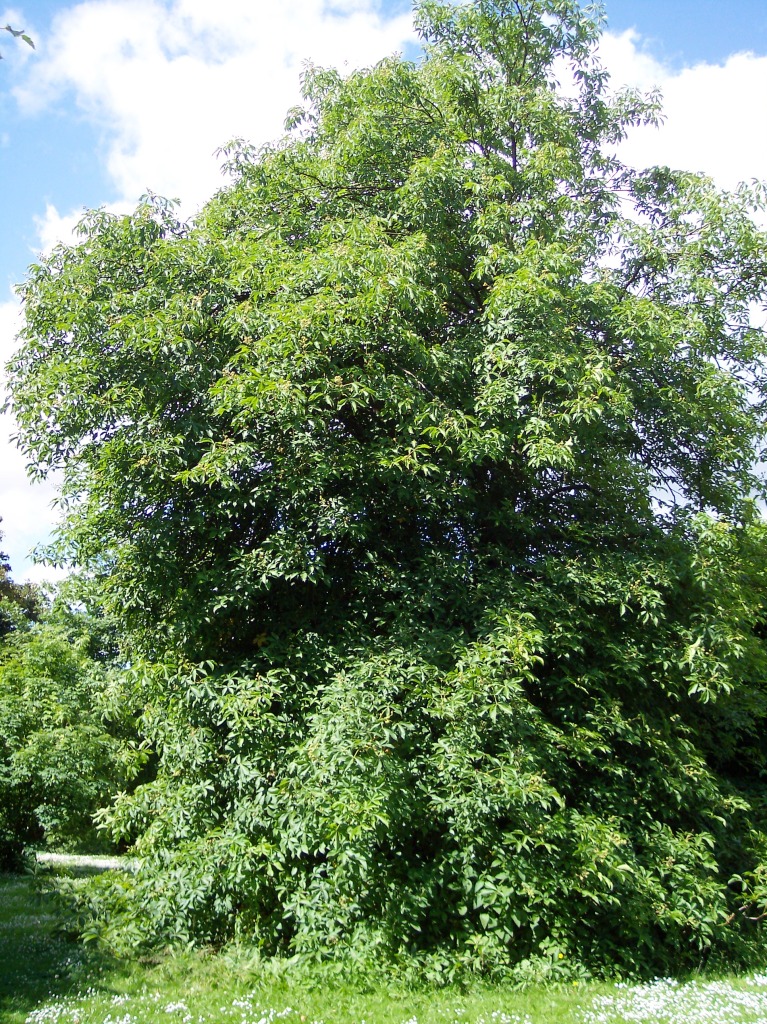
Aesculus glabra, commonly known as the Ohio Buckeye, is the iconic state tree of Ohio and one of the most distinctive deciduous trees native to the central and eastern United States. A member of the Sapindaceae family (soapberry family, which also includes maples), the Ohio Buckeye is recognized immediately by its bold, palmately compound leaves with five large leaflets, its upright panicles of creamy greenish-yellow flowers in spring, and its leathery husked fruits containing the shiny mahogany-brown “buckeye” nut — the source of the tree’s name, which alludes to the nut’s resemblance to the eye of a male deer.
Growing 50 to 75 feet tall (occasionally to 90 feet) with a broad, rounded crown, Ohio Buckeye is a medium to large shade tree of considerable ornamental merit across all four seasons. Its deeply textured, compound leaves emerge early in spring, creating a bold, tropical appearance that is unique among Midwest native trees. In spring, showy clusters of pale yellow flowers attract hummingbirds and native bees. In autumn, the foliage turns brilliant orange and yellow in a display that ranks among the most spectacular of any native tree. In winter, the corky, gray-brown bark and persistent fruit husks provide visual interest. For Ohio and Indiana landowners seeking a large native shade tree with year-round appeal and strong regional identity, the Ohio Buckeye is an outstanding and historically meaningful choice.
The tree is found in rich, moist bottomland forests, stream corridors, and lower slopes throughout much of the Midwest and into the Appalachians, growing in association with Sugar Maple, American Beech, and other mesic forest species. It is the state tree of Ohio, where it holds deep cultural significance — Ohio State University’s athletic teams are the Buckeyes, and carrying a buckeye nut in one’s pocket is a widespread Ohio folk tradition said to bring good luck.
Identification
Ohio Buckeye is readily identified at any season by the combination of its palmately compound leaves, its distinctive fruit, and — up close — the strong, disagreeable odor of its crushed leaves, bark, and wood, which has been variously described as resembling skunk spray, putrid rubber, or peanut butter gone terribly wrong.
Bark
The bark of mature Ohio Buckeye is distinctive: thick, gray-brown, and deeply furrowed into irregular, somewhat corky, interlacing ridges and scaly plates. On young trees and branches, the bark is gray and relatively smooth. The bark’s surface exfoliates in irregular patches on older trunks, giving a somewhat rough, broken appearance. When any part of the bark is cut or scratched, it produces the characteristic disagreeable odor that identifies the tree even in winter.
Leaves
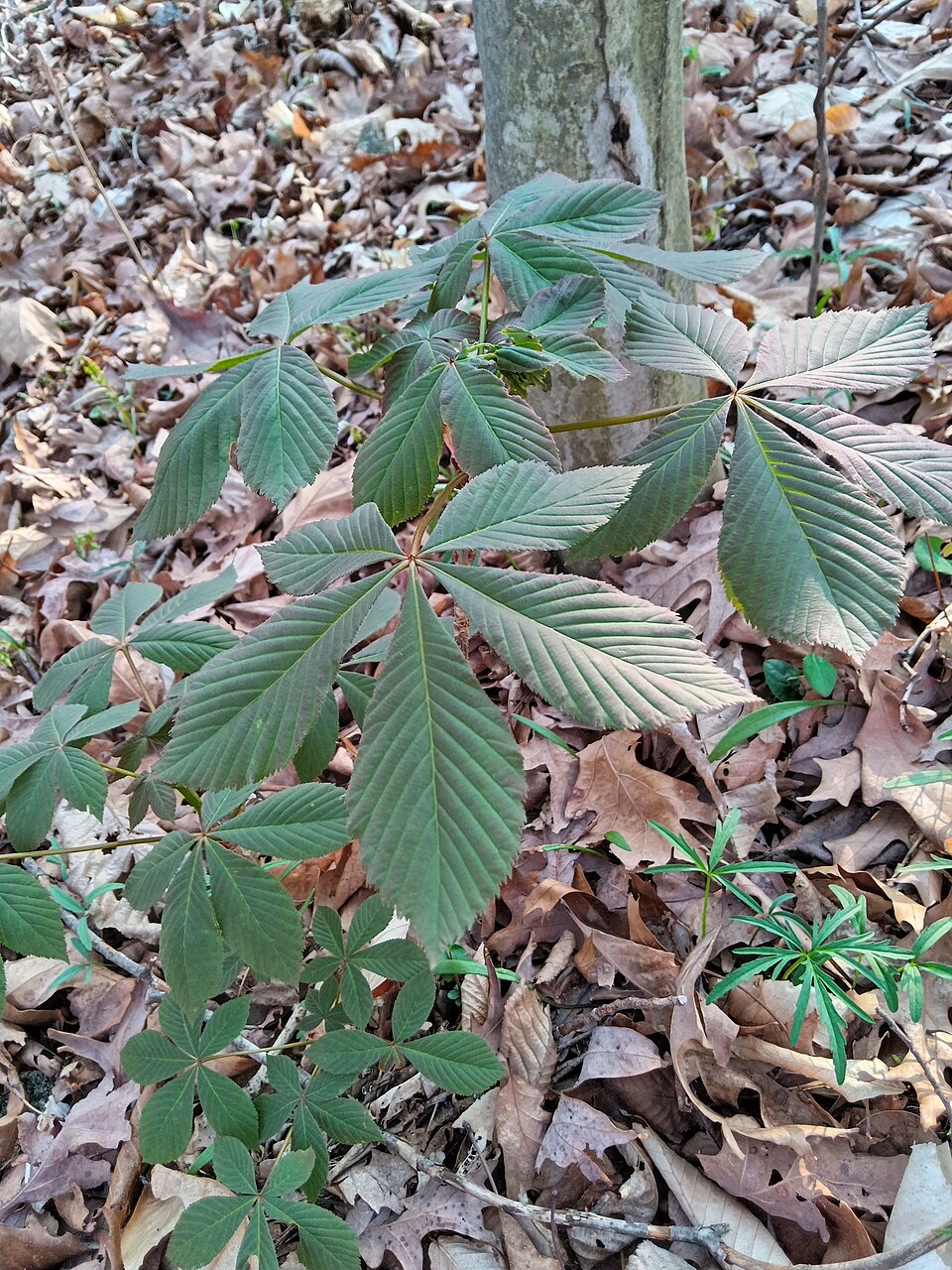
The leaves are the most distinctive feature of the tree. Each leaf is palmately compound with 5 leaflets (rarely 7) radiating from a central point at the end of a long petiole (leaf stalk). Individual leaflets are elliptic to obovate, 3–6 inches (7–15 cm) long, with a pointed tip, finely toothed margin, and smooth surfaces. The leaflets are sessile (lacking individual stalks) or nearly so, meeting at the central petiole attachment point. Leaves are among the first of any native deciduous tree to emerge in spring (often by late March or early April in Ohio), creating an early-season spectacle. In autumn, the foliage turns orange, brilliant yellow, or sometimes reddish-orange before dropping — one of the earliest trees to show fall color, typically by late September.
Flowers & Fruit
Flowers appear in April and May, just as the leaves are expanding — an upright, pyramidal panicle 5–7 inches (12–18 cm) tall, bearing numerous pale yellowish-green flowers with protruding stamens. The flowers attract early-emerging native bees, hummingbirds, and various insects. Most flowers are either staminate (pollen-producing) or pistillate (seed-producing), with only a fraction of flowers producing fruit.
The fruit is the most instantly recognizable feature of the tree: a thick-husked capsule 1.5–2.5 inches (3–6 cm) in diameter with a prickly or slightly warty surface, splitting into 3 sections in September to reveal 1–3 shiny, dark mahogany-brown nuts with a large, lighter circular scar (the “buck’s eye”). The nuts are highly toxic and must not be consumed by humans or animals, though squirrels cache them in large quantities despite their toxicity.
Quick Facts
| Scientific Name | Aesculus glabra |
| Family | Sapindaceae (Soapberry) |
| Plant Type | Native deciduous tree (State Tree of Ohio) |
| Mature Height | 50–75 ft |
| Sun Exposure | Full Sun to Part Shade |
| Water Needs | Moderate |
| Bloom Time | April – May |
| Flower Color | Greenish-yellow (spring); orange to yellow (fall foliage) |
| Fall Color | Brilliant orange-yellow; among earliest trees to color in fall |
| Toxicity | Nuts, leaves, bark, and sap are toxic to humans and most animals |
| USDA Hardiness Zones | 3–7 |
Native Range
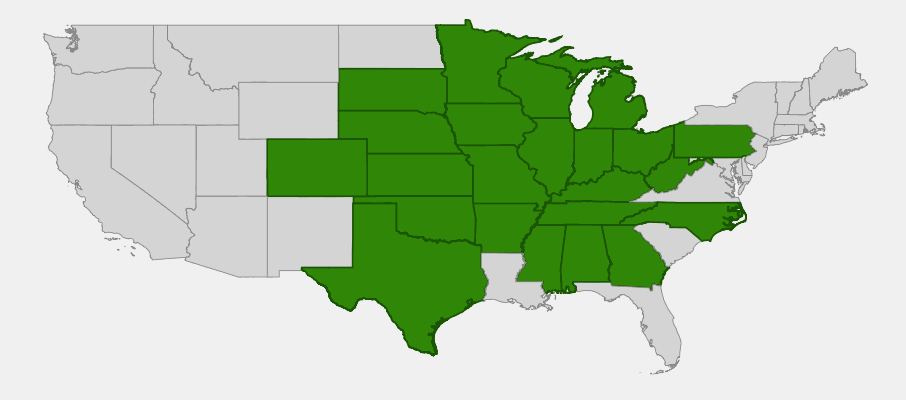
Ohio Buckeye is native to the central United States, with its core range encompassing Ohio, Indiana, Illinois, Missouri, Iowa, Kansas, Nebraska, Oklahoma, and extending into adjacent states. It is most common in the Midwest, particularly in the Ohio River valley region, where it is a characteristic tree of rich mesic forests on lower slopes, stream terraces, and floodplain margins. The species ranges from Nebraska and South Dakota in the west to western Pennsylvania and West Virginia in the east, and from Michigan in the north to Alabama, Mississippi, and Arkansas in the south.
In Ohio, the state tree is found in virtually every county, most often in rich, moist woodlands along rivers, streams, and ravines. It grows in association with Sugar Maple (Acer saccharum), American Beech (Fagus grandifolia), Shagbark Hickory (Carya ovata), White Ash (Fraxinus americana), and other mesic forest species. In Indiana, Ohio Buckeye is similarly common in the southern two-thirds of the state, less common in the northern glaciated portion where it approaches the northern edge of its range.
The species has also been planted widely outside its native range as an ornamental tree, particularly on college campuses and public grounds in the Northeast. It is also found on the Appalachian Plateau, extending into western Pennsylvania and West Virginia, where populations may represent natural range extensions along river corridors. The tree is very site-sensitive and tends to perform best in moist, well-drained soils in partial shade; it struggles in compacted urban soils and in drought conditions.
📋 Regional plant lists featuring Ohio Buckeye: Indiana & Ohio
Growing & Care Guide
Ohio Buckeye is a rewarding but somewhat demanding tree in cultivation. It thrives in the right conditions but can struggle in typical urban or suburban landscapes with compacted, dry soils. Understanding its natural habitat preferences is key to success.
Light
Ohio Buckeye grows best in full sun to part shade. Young trees are notably shade-tolerant — in the forest, they grow as understory trees for many years before canopy gaps allow them to reach the upper canopy. In landscape settings, full sun to light afternoon shade is ideal, producing a full, symmetrical crown. Full shade will result in a sparse, open crown and reduced flowering.
Soil & Water
This is the most important consideration for Ohio Buckeye in the landscape: it requires moist, well-drained, fertile soil — the kind found along stream terraces and in rich valley forests. It does not tolerate drought, compacted soils, or poorly drained wet soils. In dry summer conditions, the tree commonly shows premature leaf scorch and drop by late summer — a stress response that can be chronic in dry, exposed sites. Choose a site with access to groundwater or consistent soil moisture, and mulch generously to maintain soil moisture and temperature. Avoid planting in clay subsoil or in areas with significant summer drought.
Planting Tips
Plant Ohio Buckeye in fall for best establishment, or in early spring before bud break. Select a site with deep, moist, fertile soil and protection from drying winds and afternoon summer sun, if possible. Planting near a building’s north or east face, or in the partial shade of larger trees, can moderate summer heat and moisture stress. Space trees at least 30 feet from structures to accommodate the mature spread. Buckeyes transplant reasonably well from B&B (balled and burlapped) stock when young; avoid planting large specimens.
Pruning & Maintenance
Ohio Buckeye requires minimal pruning beyond standard structural work. Remove dead, damaged, or crossing branches in late winter while dormant. The tree has a naturally rounded crown and rarely requires corrective pruning. Be aware that fallen leaves, nuts, and husks can create maintenance work in lawn areas; the nuts are quite messy and can be slippery. Squirrels will bury many of the nuts throughout the landscape, leading to Buckeye seedlings in unexpected locations.
Landscape Uses
- Large shade tree for spacious yards, parks, and campus landscapes
- Riparian and stream corridor plantings — highly appropriate for streamside restoration
- Native woodland gardens as a large canopy species
- Historical and heritage plantings — Ohio’s iconic state tree
- Wildlife gardens for squirrels, birds, and pollinators
Wildlife & Ecological Value
Ohio Buckeye provides diverse wildlife value across seasons, from its early spring flowers to its fall fruits and persistent winter buds.
For Pollinators
The spring flower panicles are an excellent early-season nectar source. Ruby-throated Hummingbirds visit the flowers regularly for nectar. Native bumble bees and larger solitary bees, including bumble bee queens newly emerged from winter dormancy, visit in numbers when the tree is in full bloom in April–May. The flowers’ timing — when few other large trees are in bloom — makes them particularly valuable for early pollinators.
For Mammals
Eastern Gray Squirrels, Fox Squirrels, and chipmunks harvest buckeye nuts intensively in autumn, caching large quantities for winter food reserves. Despite the toxicity of the nuts to most animals (and humans), these squirrel species appear to have some physiological tolerance for the toxic compounds and can consume limited quantities without apparent harm — though most caches are likely never retrieved, effectively planting new trees throughout the landscape. White-tailed Deer browse the foliage and young shoots.
For Birds
While buckeye nuts are generally toxic to birds, the dense canopy provides excellent nesting habitat for many songbird species. The flowers attract nectar-feeding insects that in turn are harvested by warblers, vireos, and other insectivorous birds during spring migration. Rose-breasted Grosbeaks are particularly fond of the flower buds.
Ecosystem Role
As a dominant tree of the central hardwood forest, Ohio Buckeye contributes significantly to the forest structure and nutrient cycling of its native ecosystems. Its large, palmately compound leaves create a distinctive microclimate beneath the canopy, and decompose to contribute organic matter to the rich forest floor soils. The tree’s early leaf emergence creates a significant spring canopy layer that intercepts light and moderates temperatures beneath the crown.
Cultural & Historical Uses
The Ohio Buckeye has deep cultural significance to the people of Ohio, where it has been the official state tree since 1953. The “Buckeye State” nickname for Ohio predates the official designation by well over a century — it appeared in political contexts by the early 19th century and is associated with Colonel Ebenezer Sproat, who earned the nickname “Hetuck” (the Delaware word for buckeye nut) from local Indigenous people for his tall, imposing presence. William Henry Harrison’s successful 1840 presidential campaign (“Tippecanoe and Tyler Too”) featured the Buckeye heavily as an Ohio symbol, and the nickname has been inseparable from Ohio identity ever since.
Indigenous peoples used the Ohio Buckeye medicinally and in limited food applications. The Iroquois used the seeds (after extensive processing to remove toxins) as a food source in times of scarcity — the nuts can be made edible by prolonged roasting and leaching in water, a process similar to that used for acorns. The bark was used in infusions to treat various ailments, including as an external treatment for skin conditions and as an ingredient in veterinary medicine for horse disorders. The toxic compounds (primarily aesculin and saponins) have been investigated for various medicinal applications in modern phytochemistry.
Carrying a buckeye nut in one’s pocket as a good luck charm remains a widespread folk tradition in Ohio, particularly prevalent among Ohio State University fans and alumni. The “buckeye” amulet tradition is said to ward off rheumatism, bring good luck, and ensure prosperity — a folk belief that likely originated with Indigenous use of the nut as a medicine and trade good. Buckeye nuts are also carved, polished, and sold as ornamental objects and gifts throughout Ohio.
Frequently Asked Questions
Is the Ohio Buckeye the same as the Horse Chestnut?
They are closely related — both are in the genus Aesculus — but they are different species. Horse Chestnut (Aesculus hippocastanum) is a European species that is larger, has white flowers, and is widely planted as an ornamental. Ohio Buckeye is the native North American species with pale yellow-green flowers. The nuts of both are toxic.
Are Buckeye nuts really toxic?
Yes — the nuts, leaves, bark, and sap of Ohio Buckeye all contain toxic compounds including aesculin (a glucoside) and saponins. Consumption can cause severe gastrointestinal distress, muscle weakness, and in large amounts, more serious poisoning. Keep children and pets away from the nuts. Despite this, squirrels eat them regularly without apparent harm.
Why do Buckeye leaves turn brown and fall off in late summer?
Ohio Buckeye is known for “early leaf scorch” — a stress response to summer heat and drought in which the leaf margins turn brown and the tree drops its leaves in late July through August, well before normal fall color. This is a normal adaptive response and not a sign of disease. The tree typically remains healthy and produces normal fall color on any leaves that persist. Providing adequate soil moisture helps reduce this phenomenon.
How long does it take an Ohio Buckeye to produce nuts?
Typically 5–8 years from seed or transplant. Trees begin producing nuts once they reach sufficient maturity, usually when they are 8–12 feet tall. Annual nut production can be quite prolific in mature trees.
Can I grow an Ohio Buckeye from a nut?
Yes — buckeye nuts are large and germinate readily if planted fresh in fall. Plant them 2–3 inches deep in a pot or in the ground immediately after collecting them in September, before they dry out. Refrigerating them through winter in moist peat also works. Germination typically occurs in March or April. Seedlings grow several inches in their first year.