Pacific Silver Fir (Abies amabilis)
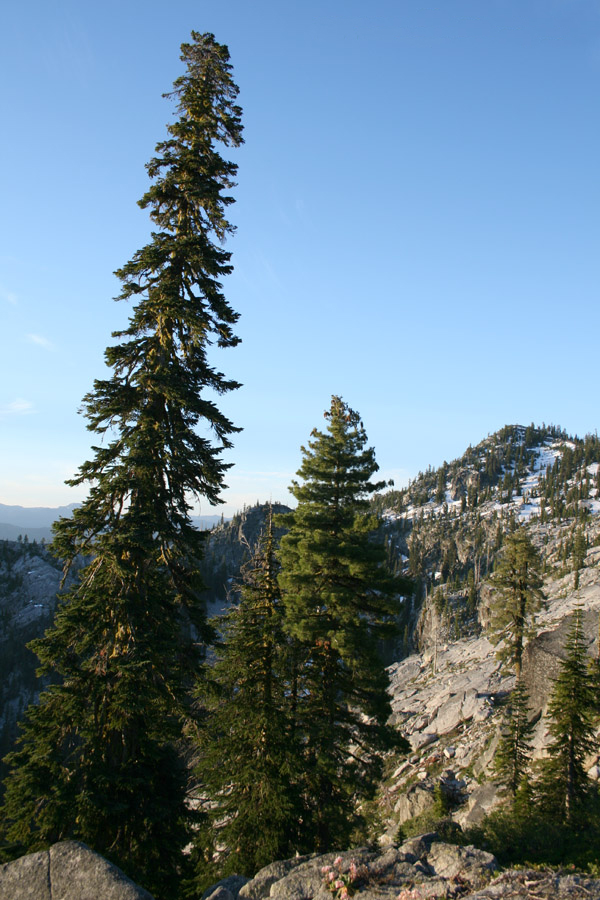
Abies amabilis, commonly called Pacific Silver Fir, is a tall, shade-tolerant conifer of the cool, wet mountains and coastal forests of the Pacific Northwest. Its narrow, spire-like crown, flattened silvery-white needles and barrel-shaped, upright cones make it one of the most elegant firs in North America. In old growth it can tower well over 150 feet, with a few recorded giants exceeding 200 feet, but it is just as often seen as a small, patient seedling waiting in deep shade for its turn in the canopy.
Pacific Silver Fir is a true maritime species, found only where winters are long, snowy and mild and summers stay cool and moist. Its range runs from the coastal mountains of southeast Alaska and British Columbia south through the west side of the Washington and Oregon Cascades and Coast Ranges, reaching its southern limit as a scattered, high-elevation relict in the Klamath and Siskiyou Mountains of far northwestern California.
Because it demands a cool, humid, high-rainfall climate, Pacific Silver Fir is not a plant for the ordinary home garden outside the Pacific Northwest, and even within the region it is rarely planted, since it is slow-growing and needs specific site conditions to thrive. Its real value is ecological and silvicultural: as a long-lived, deeply shade-tolerant tree that defines the character of the Pacific Northwest’s subalpine and montane old-growth forests.
Identification
Pacific Silver Fir is a large, single-trunked evergreen conifer with a narrow, spire-like crown when young that becomes flatter and more cylindrical with age. Mature trees typically reach 100 to 150 feet, occasionally more than 200 feet in favorable old-growth stands, with trunks 2 to 4 feet in diameter, exceptionally larger.
Bark & Stems
Young bark is smooth, light gray, and dotted with resin blisters, much like other true firs. With age it thickens and breaks into reddish-gray scaly plates, though it typically stays smoother than the deeply furrowed bark of Douglas-fir. Branches come off the trunk at right angles and are short and stiff, giving older trees a distinctive flat-topped, architectural silhouette.
Leaves
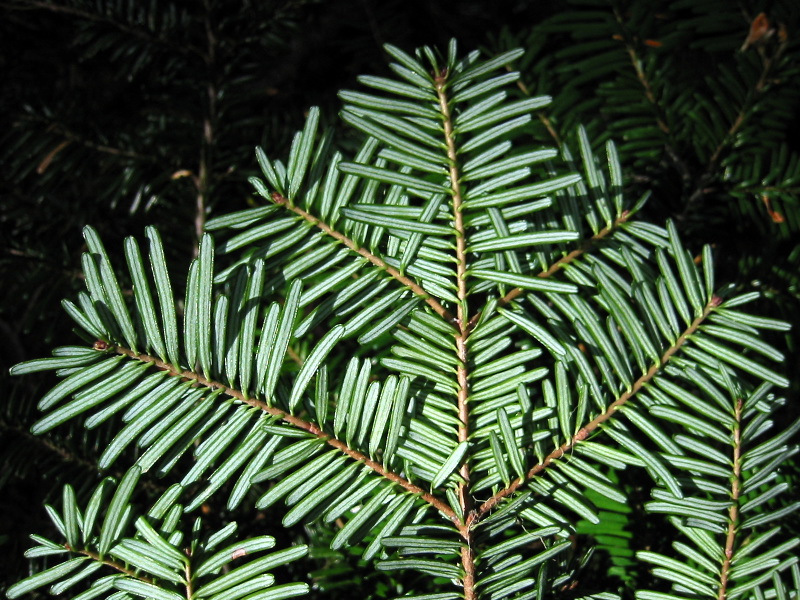
The needles are flattened, 0.5 to 1.5 inches long, blunt or notched at the tip, dark glossy green above with a distinct groove, and strikingly silvery white below from two broad bands of stomata. Needles are densely crowded and curve upward and forward on the twig, often nearly covering it from view, especially in shade. This dense, upward-sweeping, silvery-backed foliage is the clearest field mark separating Pacific Silver Fir from other Northwest conifers.
Flowers & Fruit
Like other firs, Pacific Silver Fir is wind-pollinated and produces separate male and female cones on the same tree. Male cones are small and reddish, releasing pollen in late spring. Female cones are the real spectacle: upright, barrel-shaped, resinous, purple-gray ripening to brown, 3 to 7 inches long, held high in the upper crown like candles. As with all true firs, the cones never fall intact; instead, the scales disintegrate on the branch in late summer and fall, releasing winged seeds and leaving behind only a slender, spike-like central axis.
Quick Facts
| Scientific Name | Abies amabilis |
| Family | Pinaceae (Pine) |
| Plant Type | Large evergreen coniferous tree |
| Mature Height | 100–150 ft; exceptional old-growth trees over 200 ft |
| Mature Spread | 20–30 ft; narrow spire-like crown, flatter with age |
| Growth Rate | Slow, especially as shaded understory regeneration |
| Sun Exposure | Full Sun to Full Shade (exceptionally shade tolerant) |
| Water Needs | Moist to wet; needs consistently cool, humid conditions |
| Soil Type | Deep, moist, well-drained forest soils |
| Soil pH | Acidic (about 5.0–6.5) |
| Bloom Time | May – June (pollination; not a showy bloomer) |
| Flower Color | N/A (conifer); male cones reddish, female cones purple-gray |
| Fall Color | None (evergreen) |
| Fruit | Upright cones, 3–7 in, disintegrate on the tree in fall |
| Deer Resistant | Generally yes (resinous conifer foliage) |
| USDA Hardiness Zones | 5–7 |
Native Range
Pacific Silver Fir is native to the maritime mountains of the Pacific Northwest. Its range begins in southeast Alaska and coastal British Columbia, runs south through the Olympic Mountains and the west slope of the Washington and Oregon Cascades and Coast Ranges, and reaches its southern limit as isolated high-elevation stands in the Klamath, Marble and Siskiyou Mountains of far northwestern California.
Within this range it is a classic high-rainfall, cool-climate tree. Along the outer coast and in the Olympic Peninsula it descends nearly to sea level, but farther south and inland it is increasingly confined to higher elevations, typically growing in the montane and subalpine zones up to about 1,000 to 2,300 meters. Typical habitat includes cool, moist old-growth and mature forest on deep, well-drained soils, often alongside mountain hemlock, western hemlock, Sitka spruce and other true firs, with a snowy, maritime winter climate and a long, cool growing season.
Because it requires such specific, cool, wet mountain conditions, Pacific Silver Fir has never become a widely planted ornamental and has not spread or naturalized outside this native range. Gardeners in drier or warmer climates, including most of the eastern and central United States, cannot grow this tree successfully; it belongs to the Pacific Northwest’s high country.
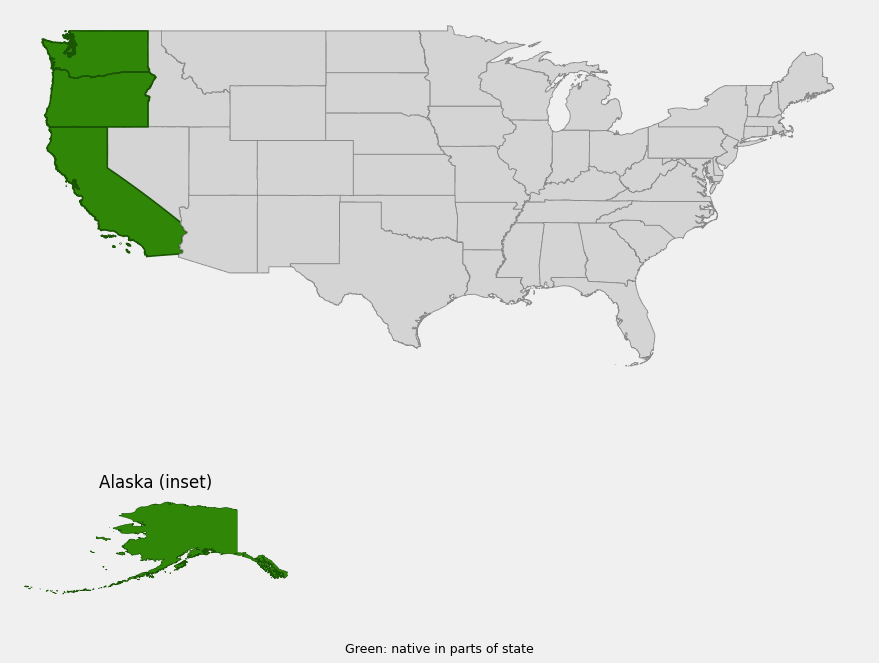
📋 Regional plant lists featuring Pacific Silver Fir: Alaska · Western Oregon & Western Washington
Growing & Care Guide
Pacific Silver Fir is not a landscape tree for most gardens; it is included here chiefly for restoration plantings, large rural properties and forestry use within its cool, wet native range. Where conditions suit it, however, it needs very little intervention once established.
Light
Pacific Silver Fir is among the most shade-tolerant conifers in North America, able to germinate and persist for decades as understory regeneration beneath a closed canopy. It also grows well in full sun once established, particularly at higher elevations, but it is this extreme shade tolerance that lets it dominate as the eventual climax species in many Pacific Northwest forests.
Soil & Water
Give it deep, well-drained, consistently moist soil and a cool, humid climate; this is not a tree for dry, hot or low-rainfall sites. It tolerates acidic forest soils well but struggles in heavy clay, poorly drained ground or anywhere summers are hot and dry. Supplemental irrigation can help young trees establish outside the foggy coastal belt, but ultimately the tree needs the Pacific Northwest’s natural rainfall pattern to thrive long term.
Planting Tips
Plant small container or bare-root stock in fall or early spring, in a site that mimics forest conditions: cool, sheltered, and with reliable moisture. Because wild seedlings commonly spend decades suppressed beneath a canopy before becoming full co-dominant trees, gardeners should expect very slow early growth and plan accordingly, siting it where its eventual large size will not crowd buildings or power lines.
Pruning & Maintenance
Established trees need essentially no regular pruning beyond removing dead or damaged lower branches. Watch for balsam woolly adelgid, an introduced insect pest that can seriously damage true firs in some areas, and for bark beetles, which more often attack already stressed or drought-weakened trees.
Propagation
Pacific Silver Fir is propagated from seed collected from cones just as the scales begin to loosen in late summer or early fall; because cones disintegrate quickly on the tree, timing collection is important. Seed often benefits from a period of cold, moist stratification before sowing. Natural regeneration in the wild is abundant under a parent canopy, which is part of why it is such a persistent, long-lived component of old-growth Pacific Northwest forests.
Landscape Uses
- Restoration and reforestation plantings within its native Pacific Northwest mountain range
- Large naturalistic woodland plantings alongside mountain hemlock and western hemlock
- Specimen conifer on large, cool, moist rural properties within its climate range
- Wildlife and old-growth habitat restoration, where its long lifespan and dense canopy add structural diversity
- Not recommended for typical home gardens outside its cool, high-rainfall native climate
Wildlife & Ecological Value
As a long-lived, shade-tolerant dominant of Pacific Northwest old growth, Pacific Silver Fir anchors a rich web of forest wildlife relationships that build up over centuries.
For Pollinators
Like other conifers, Pacific Silver Fir is wind-pollinated and does not rely on or particularly attract pollinating insects, though its pollen and foliage support a range of specialist insects that in turn feed birds and other wildlife through the forest food web.
For Birds
Dense old-growth stands provide important nesting and roosting habitat for forest birds, including species associated with structurally complex, multi-layered canopies. Seed-eating birds such as crossbills and nutcrackers forage on the seeds released as cones disintegrate each fall.
For Mammals
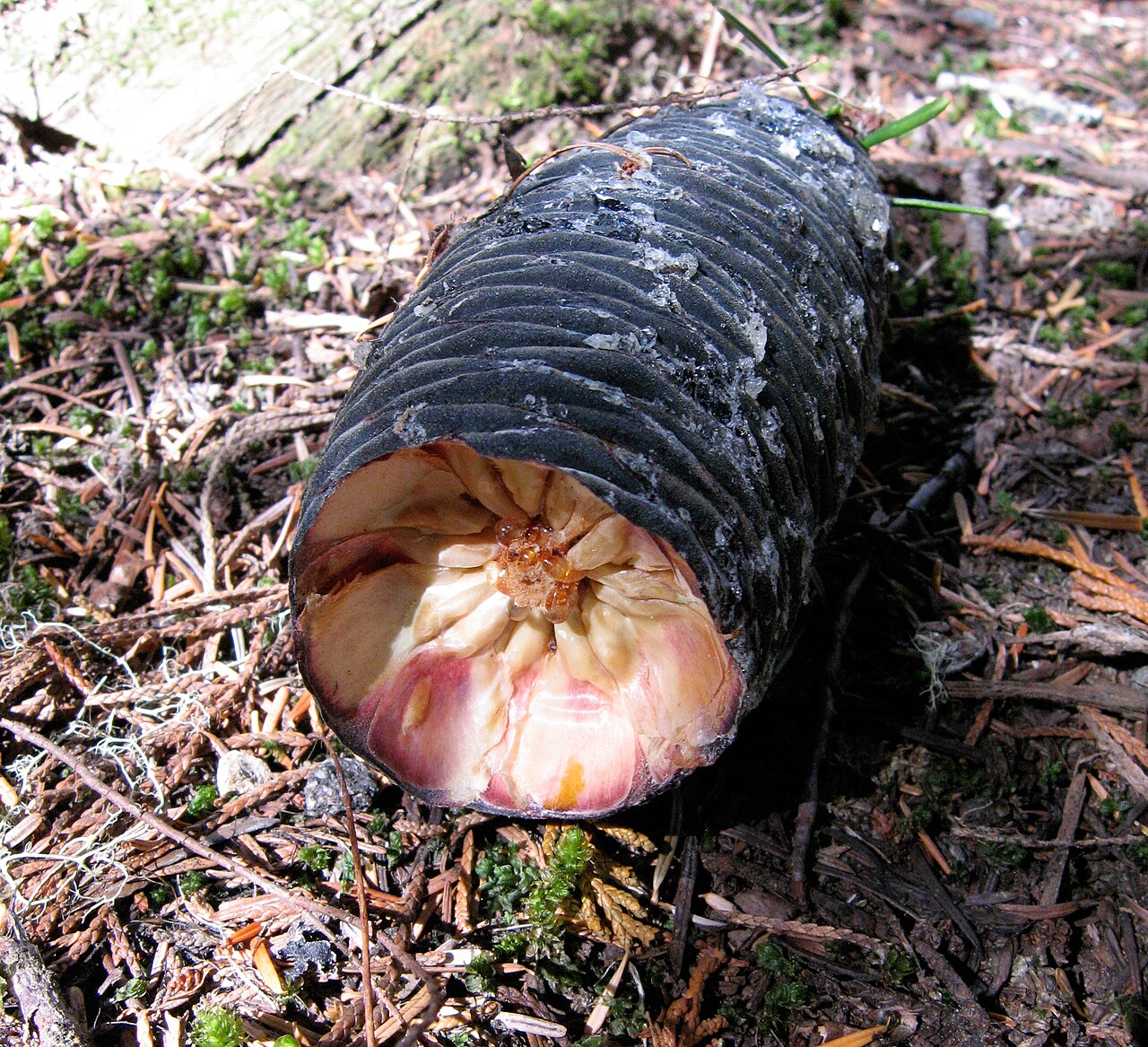
Douglas squirrels and other small mammals are major consumers of Pacific Silver Fir seed, often cutting whole cones from the tree to cache and process them on the ground, exactly the kind of foraging sign visible on a cut cone found at the forest floor. Black bears, deer and elk use dense fir stands for cover, and the deep, persistent snowpack beneath old-growth canopies can moderate winter conditions for wildlife.
Ecosystem Role
Pacific Silver Fir is a defining climax species across large areas of the Pacific Northwest’s montane and subalpine forest, able to regenerate in deep shade for centuries before finally reaching the canopy. Its long needle retention, slow decomposition and massive old-growth structure make it a key contributor to the carbon storage, snow retention and habitat complexity of these forests.
Cultural & Historical Uses
Indigenous peoples of the Pacific Northwest coast historically used Pacific Silver Fir in a variety of practical ways: the aromatic boughs were favored as bedding and floor coverings, and the pitch was chewed as a kind of natural gum. The soft, relatively brittle wood was used mainly as firewood rather than for structural purposes, since harder, straighter-grained woods such as western redcedar and Douglas-fir were generally preferred for building and carving.
In the 20th century, Pacific Silver Fir became economically important as a pulpwood and general timber species across its range, valued for its wide distribution, relatively fast growth where conditions are favorable, and large stem volumes in old growth. Foresters and ecologists have also used it extensively in dendrochronology, since its growth rings record climate patterns, old-growth forest dynamics and the effects of events like volcanic ash fall.
The species has had a few moments in the cultural spotlight as well: a Pacific Silver Fir was selected as the U.S. Capitol Christmas Tree in 2006, bringing a tree usually seen only deep in Pacific Northwest old growth into the public eye for a season.
Frequently Asked Questions
Can I grow Pacific Silver Fir outside the Pacific Northwest?
Generally no. This species needs a cool, humid, high-rainfall maritime climate and struggles with heat, drought or continental winters, so it is rarely successful or available outside its native coastal mountain range.
How tall does Pacific Silver Fir get?
Mature trees commonly reach 100 to 150 feet, and exceptional old-growth individuals in Washington’s Olympic Peninsula have measured more than 190 feet tall, making it one of the tallest true firs in the world.
Why don’t I see whole fir cones on the ground?
True firs, including Pacific Silver Fir, hold their cones upright and the scales shatter apart on the branch as seeds ripen, so intact cones are not normally found on the forest floor. Fallen cone fragments or cut cones, like the one shown here, are usually the work of squirrels harvesting seed.
Is Pacific Silver Fir the same as the Christmas tree species sold as “silver fir”?
Not necessarily. Several different firs are sold under similar common names, and Pacific Silver Fir is only one regional source; always check the scientific name, Abies amabilis, to be sure which species you have.
How shade tolerant is Pacific Silver Fir compared to other conifers?
It is among the most shade-tolerant conifers in North America, capable of surviving as a suppressed seedling or sapling under a closed canopy for a century or more before finally growing into the main canopy when a gap opens.

Looking for a nursery that carries Pacific Silver Fir?
Browse our native plant nursery directory: Washington · Oregon · California · Alaska