Red Buckeye (Aesculus pavia)
Aesculus pavia, commonly known as Red Buckeye, is one of the most spectacular and garden-worthy native shrubs of the southeastern and south-central United States. This deciduous shrub or small tree — a member of the Sapindaceae (soapberry) family — produces showy, 8- to 10-inch upright clusters of brilliant red to salmon-red tubular flowers in March through May, making it one of the earliest and most dramatic floral displays of the native spring woodland. The timing of Red Buckeye's bloom is perfectly synchronized with the spring migration of Ruby-throated Hummingbirds, making it the premier native plant for attracting these energetic visitors to the spring garden.
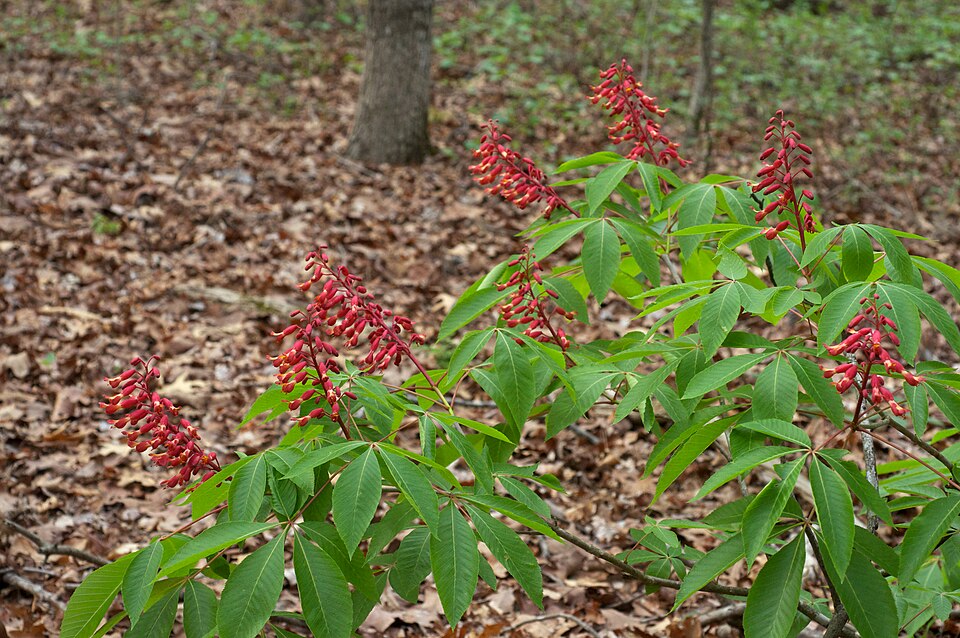
Growing 10 to 15 feet tall with a similar spread, Red Buckeye develops a rounded, multi-stemmed form that is attractive in all seasons. The large, palmate compound leaves — typically with 5 leaflets fanning out from a central point — unfurl early in spring, creating a lush tropical effect before most other shrubs have begun to leaf out. The leaves are followed in late April or May by erect panicles of tubular, red flowers, and then by the distinctive round, smooth, brown seed capsules containing the polished mahogany-brown “buckeye” seeds. While the seeds are toxic to humans and most animals, they are collected and cached by squirrels.
Red Buckeye is an ideal garden plant for partially shaded locations throughout the Midwest and South. Its early bloom, shade tolerance, modest size, beautiful foliage, and exceptional hummingbird value make it one of the most versatile and rewarding native shrubs available. For Iowa, Illinois, and Missouri gardeners — especially those in the southern portions of these states — Red Buckeye is an outstanding choice for woodland gardens, shade borders, and wildlife plantings.
Identification
Red Buckeye is a deciduous shrub to small tree typically growing 10 to 15 feet tall, though it can occasionally reach 20 to 25 feet in ideal conditions. The plant develops an irregular, rounded form with multiple stems and a low, broad crown. It is most reliably identified in spring by its brilliant red flower panicles, and in fall by its smooth, brown seed capsules containing the glossy buckeye seeds.
Bark & Stems
The bark on young stems is smooth, light grayish-brown, becoming slightly rougher on older trunks. The buds are large, opposite, and distinctively sticky — a character shared across the Aesculus genus. The large, resinous terminal buds are visible through winter and early spring, swelling dramatically before bud break. The leaves emerge very early in spring, often before the last frost has passed — this can lead to frost damage on young foliage in late-freezing years, though the plant typically recovers.
Leaves
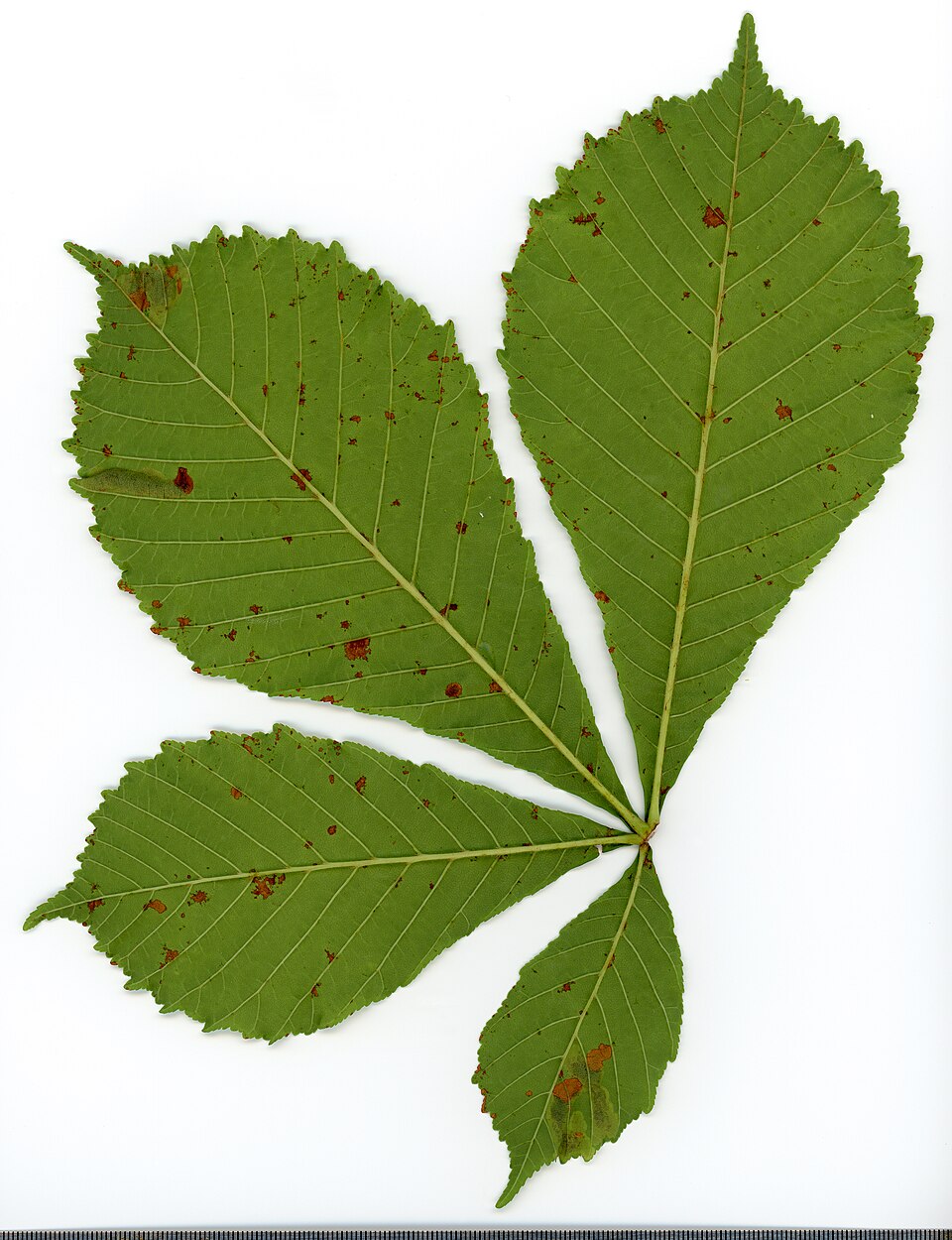
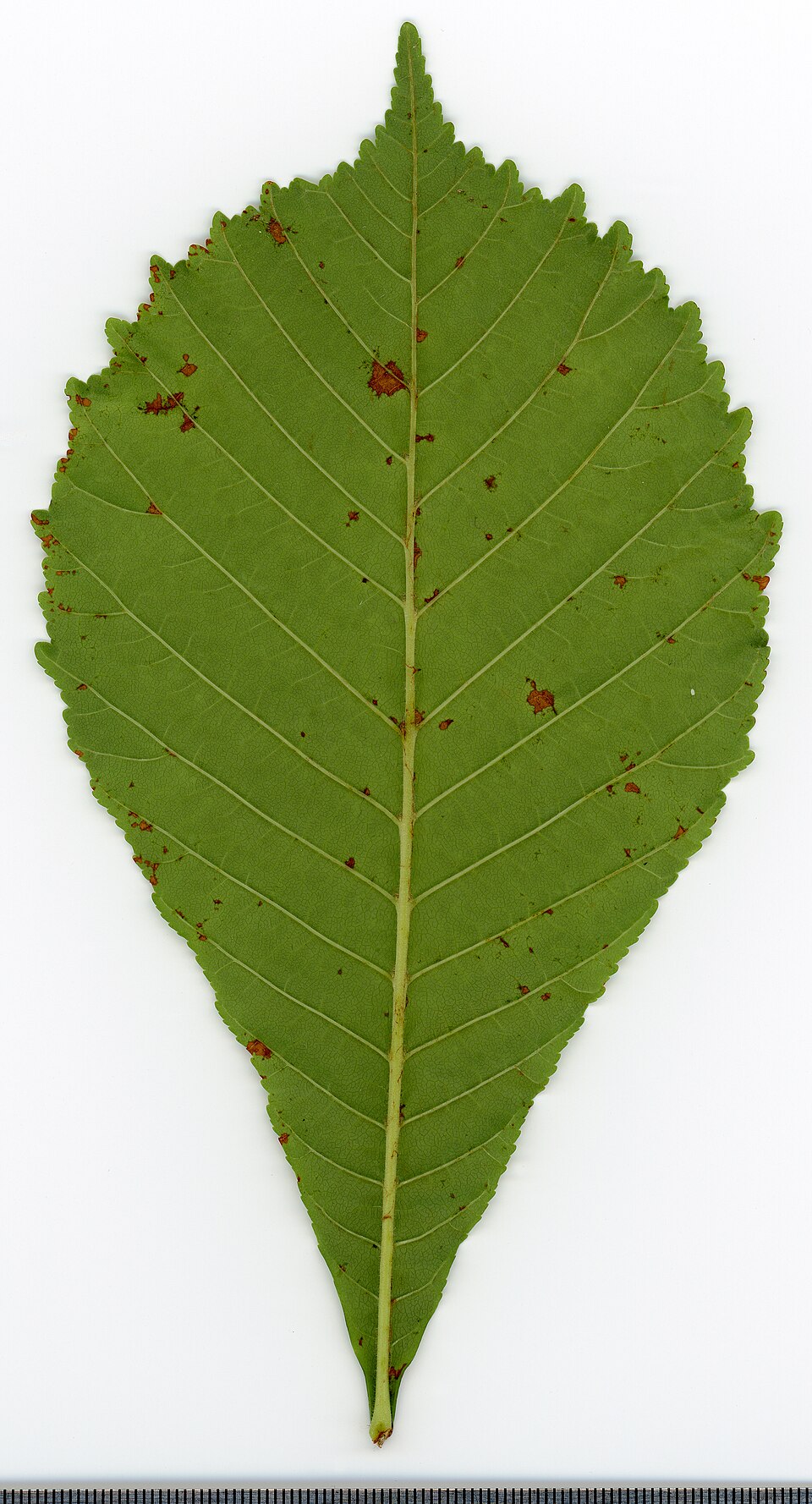
The leaves are palmately compound with typically 5 leaflets (occasionally 7) arranged like the fingers of a hand, each leaflet 3 to 6 inches long and 1 to 2½ inches wide. Leaflets are oblong to obovate with serrated margins and a pointed tip. The upper surface is dark green and smooth to slightly pubescent; the undersurface is paler and often hairy along the veins. Leaves drop early in the season — often by midsummer during hot, dry years — a normal characteristic of many Aesculus species.
Flowers & Fruit
The flowers are spectacular: erect, terminal panicles 4 to 8 inches (10–20 cm) tall composed of 20 to 50 individual tubular flowers. Each flower is about 1 to 1½ inches (2.5–4 cm) long with 4 petals fused into an elongated tube — bright red to salmon-red, sometimes with yellow markings in the throat. The long, curved stamens protrude noticeably beyond the petals. The red color, tubular shape, and timing all suit hummingbird pollination perfectly. Bloom occurs March through May.
The fruit is a smooth, light brown capsule, 1 to 2 inches (2.5–5 cm) in diameter, containing 1 to 3 large, shiny, chestnut-brown seeds with a distinctive circular pale scar (the “buck's eye”). The seeds are poisonous to humans and most animals. The capsule has a thin, leathery (not spiny) husk — distinguishing it from the related Ohio Buckeye (Aesculus glabra), whose husk is spiny.
Quick Facts
| Scientific Name | Aesculus pavia |
| Family | Sapindaceae (Soapberry) |
| Plant Type | Deciduous Shrub / Small Tree |
| Mature Height | 10–15 ft |
| Sun Exposure | Full Sun to Full Shade |
| Water Needs | Moderate to High |
| Bloom Time | March – May |
| Flower Color | Red to salmon-red |
| USDA Hardiness Zones | 4–8 |
Native Range
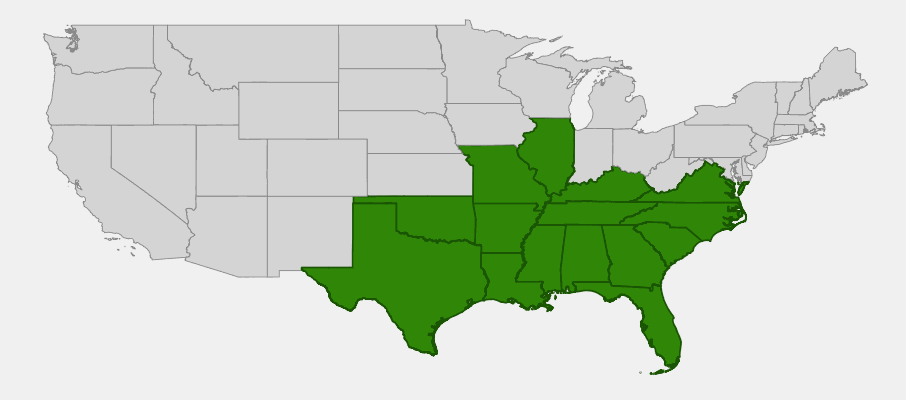
Aesculus pavia is native to the southeastern United States, ranging from Virginia and North Carolina south through South Carolina, Georgia, and Florida, west through the Gulf Coast states to Texas, and north through Arkansas, Missouri, and Kentucky into southern Illinois. The species reaches its northern range limits in the Midwest.
In the rpl-iailmo region, Red Buckeye is primarily a Missouri and southern Illinois species. In Missouri, it is found throughout the Ozarks and in bottomland forests along the major river systems, where it grows as an understory tree or large shrub. In southern Illinois, it occurs in the Shawnee Hills region in ravine forests and moist, protected slopes. The plant is at the northern edge of its hardiness in the upper Midwest and performs best in USDA Zones 5–8.
Red Buckeye favors rich, moist woodlands, ravines, and floodplain forests, growing as an understory plant beneath a canopy of oaks, maples, tulip poplar, and other hardwoods. It is also common along stream banks and moist, sheltered slopes where its moisture needs are naturally met. The species is associated with the rich mixed mesophytic forest communities of the Appalachian region and Ozarks.
📋 Regional plant lists featuring Red Buckeye: Iowa, Illinois & Missouri
Growing & Care Guide
Red Buckeye is a surprisingly low-maintenance native shrub once properly sited. Its primary needs are adequate moisture, some shade protection from harsh afternoon sun, and rich, organic soil.
Light
Red Buckeye thrives in full sun to full shade, but performs best in partial shade — morning sun with afternoon shade, or dappled light beneath deciduous trees. In the Midwest, protection from intense afternoon sun is important. Deep shade reduces bloom significantly. The species is quite shade tolerant, making it valuable for shaded garden situations where flowering shrubs are challenging to establish.
Soil & Water
For best performance, provide rich, moist, well-drained soil with good organic content. Red Buckeye naturally grows in the rich, moisture-retentive soils of ravines and bottomland forests. It is more tolerant of brief drought than its cousin Ohio Buckeye but benefits from supplemental watering during extended dry spells, particularly in the first few years after planting. Maintain a 3-inch mulch layer to conserve moisture and keep roots cool.
Planting Tips
Plant in early spring or fall in a location with partial shade and moist, organic-rich soil. Container-grown plants transplant readily. The large seeds can also be sown directly outdoors in fall — plant at 1 to 2 inch depth and protect from squirrels. Space plants 10 to 15 feet apart for mass plantings. Because the leaves drop early in summer, site the plant where early summer bare stems won't detract from the overall garden appearance.
Pruning & Maintenance
Red Buckeye needs minimal pruning. Remove dead or crossing branches in late winter while the plant is fully dormant. Avoid major pruning after early spring, as flower buds are set the previous year. Early summer leaf drop is normal — do not mistake it for disease. Buckeye scorch (leaf browning and early drop in hot, dry weather) is cosmetic and not damaging to the plant's long-term health.
Landscape Uses
Red Buckeye's exceptional hummingbird value and spring bloom make it a standout native garden plant:
- Hummingbird garden anchor — the premier native plant for attracting Ruby-throated Hummingbirds in spring
- Woodland garden — thrives in dappled shade beneath deciduous trees
- Shade border specimen — dramatic spring flowering in challenging shaded conditions
- Native shrub border — combines beautifully with Spicebush, Wild Hydrangea, and Buttonbush
- Foundation planting — attractive, manageable size suits many home landscapes
- Stream bank stabilization — root system holds moist, sloping sites effectively
Wildlife & Ecological Value
Red Buckeye's primary wildlife value is its extraordinary attraction to Ruby-throated Hummingbirds, but its ecological contributions extend well beyond this single relationship.
For Birds
The tubular red flowers of Red Buckeye are among the most important early-season nectar sources for Ruby-throated Hummingbirds as they arrive in the Midwest in late April and May. In many years, the flowering of Red Buckeye coincides almost perfectly with the first hummingbird arrivals, providing crucial refueling energy after their trans-Gulf migration. Baltimore Orioles also regularly visit the flowers for nectar. The relationship between this plant and hummingbirds is one of the best-documented coevolved plant-animal interactions in eastern North American ecology.
For Mammals
Eastern Gray Squirrels are the primary mammalian consumer of Red Buckeye seeds. Squirrels possess a unique physiological ability to detoxify the aesculin that makes the seeds poisonous to humans and most other animals. White-tailed Deer avoid Red Buckeye — the foliage, bark, and seeds are all toxic, making it genuinely deer resistant.
For Pollinators
While hummingbirds are the primary pollinators, native bumblebees are also documented visitors and can partially pollinate the flowers by “robbing” nectar through holes bitten in the base of the floral tube. The early bloom time (March–May) is particularly important for queen bumblebees emerging from overwintering and seeking early nectar and pollen resources.
Ecosystem Role
Red Buckeye occupies an important niche as a spring understory shrub in the rich deciduous forests of the eastern United States. Its early emergence allows it to capture spring sunlight in the brief window before the forest canopy closes. The early flowers provide crucial early-season resources for hummingbirds during spring migration. The large seeds, distributed by squirrels, contribute to forest regeneration.
Cultural & Historical Uses
Red Buckeye and related Aesculus species were well-known to Indigenous peoples throughout their range. Multiple nations used buckeye nuts — despite their toxicity — as a fish-stunning agent. Crushed seeds or bark were thrown into pools or slow-moving water, where the saponin compounds (primarily aesculin) stupefied fish, making them easy to collect by hand. This practice was widespread among Cherokees, Creeks, Choctaws, and other southeastern and midwestern nations.
Cherokee healers used Red Buckeye root preparations to treat fever, inflammation, and rheumatism. However, all parts of the plant — seeds, bark, leaves, and flowers — contain toxic saponins and glycosides (primarily aesculin and fraxin) that cause significant poisoning in humans, horses, cattle, and pets if ingested. Symptoms include muscle weakness, paralysis, vomiting, and in severe cases, death. The seeds should be kept away from children and animals.
The common name “buckeye” refers to the resemblance of the polished, dark brown seed with its circular pale scar to the eye of a deer (buck). The buckeye seed has long been carried as a good-luck charm in Ohio and the broader Midwest — the Ohio state tree is the related Ohio Buckeye (Aesculus glabra), and Ohioans are nicknamed “Buckeyes.” Red Buckeye seeds were historically carried in pockets for luck and to ward off rheumatism — a folk medicine practice that persists in some communities today.
Frequently Asked Questions
Are Red Buckeye seeds poisonous?
Yes — all parts of Red Buckeye contain toxic compounds (primarily aesculin and saponins) that are poisonous to humans, horses, cattle, dogs, and cats. The seeds should not be eaten. Keep children away from fallen seeds. Despite this, the plant is safe to grow in most residential landscapes as long as seed ingestion by children or pets is unlikely.
Will Red Buckeye survive in Iowa?
Red Buckeye is borderline hardy in Iowa. It is reliably hardy to USDA Zone 5 (which includes most of Iowa) but performs best in Zones 6–8. In Iowa, plant in a sheltered location with protection from prevailing winds, ideally on a south-facing slope or near a south-facing wall. Southern Iowa gardeners have the best chance of success.
When do the hummingbirds visit?
In the Midwest, Ruby-throated Hummingbirds typically arrive in late April to early May, and Red Buckeye blooms in April through May — making the timing nearly perfect. In a good year, you may observe hummingbirds visiting the flowers within days of their arrival.
Why are the leaves dropping in June/July?
Early summer leaf drop is completely normal for Red Buckeye and most other buckeyes. The species naturally enters summer dormancy when hot, dry conditions prevail. This is not a disease — the plant is simply following its natural phenology. It will remain dormant through summer and resume normal activity in fall and the following spring.
Can Red Buckeye grow in a container?
Red Buckeye can be grown in a large container (15+ gallon) but requires frequent watering and fertilizing. Container culture is practical for short-term use. The plant eventually needs to go in the ground where it can develop its natural root system.