Sand Cherry (Prunus besseyi)
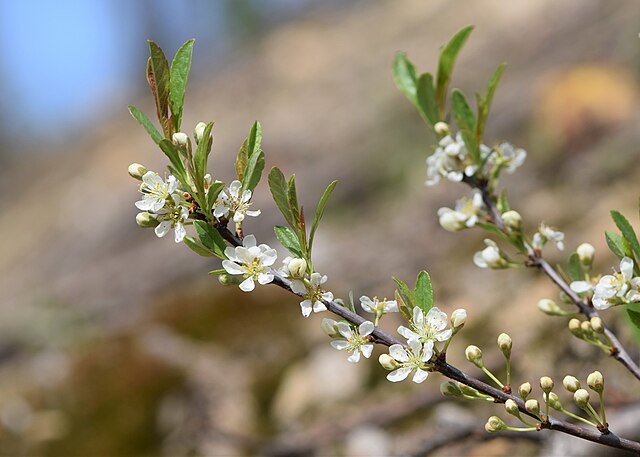
Prunus besseyi, commonly known as Western Sand Cherry or Sand Cherry, is one of the toughest and most adaptable native shrubs of the Great Plains and northern prairies. A low-growing, spreading deciduous shrub rarely exceeding 4 to 6 feet tall, Western Sand Cherry is adapted to some of the harshest environmental conditions in North America — surviving temperatures to -40°F, prolonged summer drought, and the poor, sandy, or rocky soils that characterize the loess hills, sandhills, and rocky bluffs of the central Great Plains from Nebraska and Kansas north through the Dakotas and Montana to the Canadian border.
Despite its unassuming size, Western Sand Cherry packs a remarkable combination of ornamental features, ecological value, and historical significance into its compact form. In spring, the shrub covers itself with abundant clusters of white flowers that attract bees and other early pollinators. In summer, the dark purple to black edible cherries provide food for wildlife and humans alike — Indigenous peoples of the Great Plains used the fruit extensively in pemmican and dried preparations. In fall, the foliage transforms to brilliant shades of purple and burgundy, rivaling the fall color of many trees. And in winter, the dense, twiggy branching provides important thermal cover and escape habitat for grassland birds and small mammals.
Western Sand Cherry has also played a significant role in horticultural history. Its extraordinary cold hardiness — it thrives in climates where most cherry and plum species cannot survive — made it an invaluable parent in breeding programs aimed at developing hardy fruit trees for the northern Great Plains and Canadian prairies. Crosses between Prunus besseyi and various plum and cherry species produced a range of hybrid varieties, including the famous ‘Hansen’s Bush Cherry’ developed by N.E. Hansen of South Dakota State University in the early 20th century. These hardy fruiting shrubs extended fruit production into northern regions where it had previously been impossible, making a lasting contribution to agricultural self-sufficiency on the Great Plains.
Identification
Western Sand Cherry is a low, spreading to mounding deciduous shrub with multiple stems arising from the base, often forming small colonies through root suckering. It can be distinguished from other native Prunus species by its low growth habit, Great Plains distribution, and sandy habitat preference.
Leaves
The leaves are simple, alternate, elliptic to oblong-lanceolate, 1 to 3 inches long and ½ to 1 inch wide, with finely serrated (toothed) margins. The upper surface is dark, lustrous green; the lower surface is paler and may be slightly hairy. Two tiny glands are typically present near the base of each leaf blade — a feature common to many Prunus species. In autumn, the leaves turn brilliant shades of purple-red to burgundy, creating one of the most striking fall color displays of any native Great Plains shrub. The fall foliage often remains colorful for two to three weeks before dropping.
Flowers
The flowers are small, white, and 5-petaled, approximately ½ inch across, appearing in small clusters of 2 to 4 blooms. They emerge in April and May — typically before or simultaneously with the leaves — in the classic early-spring pattern of the Prunus genus. The flowers are pleasantly fragrant, attracting bees on warm spring days. The flowering period typically lasts one to two weeks and coincides with early pollinator emergence, making Sand Cherry a valuable early-season nectar source in prairie habitats.
Fruit
The fruit is a small drupe (true cherry), ½ to ¾ inch in diameter, ripening from green to deep purple to nearly black in July and August. The flesh is astringent and somewhat sour when fresh — especially before full ripeness — but becomes more palatable after frost or cooking. The single large pit (stone) inside is typical of the cherry genus. Fruit set requires cross-pollination (two or more plants) for best production. The fruit is rich in anthocyanins (the pigments that give cherries their color), which have significant antioxidant properties.
Habit
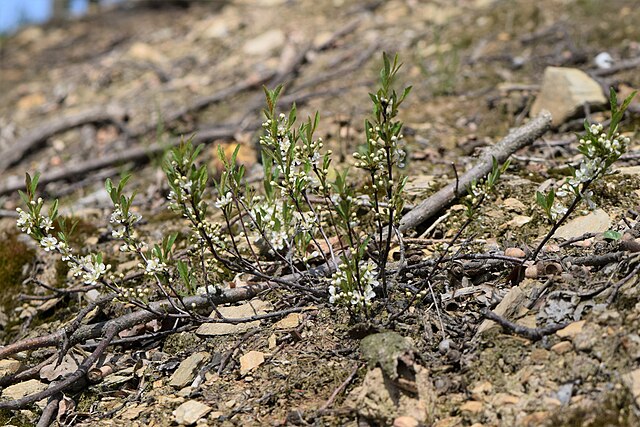
Western Sand Cherry grows as a low-spreading to mounding shrub, 4 to 6 feet tall and often wider than tall, with arching to spreading branches. Plants commonly sucker from roots to form small colonies, particularly in sandy soils where root systems spread widely. The dense branching habit makes Sand Cherry an effective erosion control plant on sandy banks and hillsides.
Quick Facts
| Scientific Name | Prunus besseyi |
| Family | Rosaceae (Rose) |
| Plant Type | Deciduous Shrub |
| Mature Height | 4–6 ft |
| Sun Exposure | Full Sun to Part Shade |
| Water Needs | Low (Drought Tolerant) |
| Bloom Time | April – May |
| Flower Color | White |
| Fall Color | Purple-red to burgundy (outstanding) |
| USDA Hardiness Zones | 3–6 |
Native Range
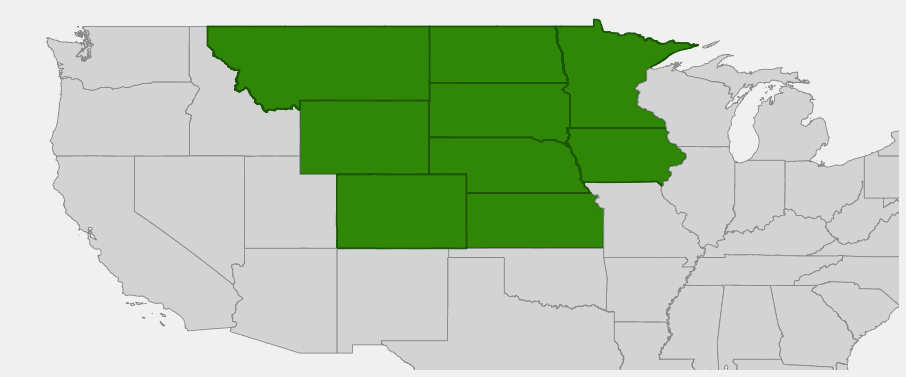
Western Sand Cherry is native to the northern Great Plains and central prairies of the United States, with a range extending from North Dakota and Montana in the north through South Dakota, Nebraska, Kansas, Colorado, and Wyoming. Its distribution closely tracks the occurrence of sandy and rocky soils in the Great Plains region — sandhills, loess bluffs, rocky hillsides, and dry sandy prairie margins. The species is most abundant in the Nebraska Sandhills, the loess hills of Nebraska and Iowa, and the sandy grasslands of South Dakota and the Dakotas.
In its typical habitat, Western Sand Cherry is a pioneer and stabilizing species on eroding sandy banks and hillsides. Its spreading root system binds loose, sandy soil, preventing erosion and creating conditions that allow other prairie plants to establish. It frequently grows in association with other sand-adapted species including Sand Bluestem (Andropogon hallii), Prairie Sandreed (Calamovilfa longifolia), and various prickly pear cacti (Opuntia spp.) — companions that reflect the harsh, dry, well-drained conditions of the native sandhills ecosystem.
The species reaches the eastern edge of its range in Minnesota, Iowa, and the eastern portions of Nebraska and Kansas, where sandier soils and open prairie habitats still occur. It extends into Canada (Saskatchewan and Manitoba) where it inhabits similar sandy grassland habitats on the northern Great Plains. Its extraordinary cold hardiness makes it one of the northernmost native Prunus species in North America, surviving winters that would kill most other cherries and plums.
📋 Regional plant lists featuring Sand Cherry: Nebraska & Kansas
Growing & Care Guide
Western Sand Cherry is one of the most drought-tolerant and cold-hardy native shrubs available for Great Plains landscapes. Its ease of cultivation, attractive four-season features, and wildlife value make it an excellent choice for naturalistic plantings, erosion control, and prairie-style gardens across Nebraska, Kansas, and the surrounding region.
Light
Sand Cherry performs best in full sun, which promotes the most prolific flowering, best fruit set, and most intense fall color. It tolerates light partial shade (3–4 hours of direct sun) but will produce fewer flowers and fruit in shadier conditions. In full sun on well-drained soils, plants develop a naturally compact, mounding form; in shadier or more moist conditions, they tend to grow taller and more open.
Soil & Water
This species thrives in well-drained to dry soils — sandy, loamy, rocky, or gravelly — and strongly dislikes poorly drained or waterlogged conditions. It is one of the most drought-tolerant native shrubs of the Great Plains, requiring no supplemental water once established in appropriate soil. In heavy clay soils, amend with coarse sand or grit to improve drainage, or plant on raised berms. Avoid planting in low spots where water collects after rain. No fertilization is needed; overly rich soils produce rank growth with reduced flowering.
Planting Tips
Plant in spring or fall in full sun with well-drained soil. Space plants 4 to 6 feet apart for a mass planting or hedgerow. For fruit production, plant two or more individuals to ensure cross-pollination. The plant establishes quickly and may bloom in its second year from transplant. For best erosion control on sandy slopes, plant 3 to 5 feet apart and allow suckering to fill gaps between plants. Sand Cherry also works well planted in combination with other Great Plains natives such as Leadplant, Prairie Rose, and native grasses.
Pruning & Maintenance
Minimal pruning is required. Remove dead or damaged branches in early spring. If plants become overly large or spreading, rejuvenate by cutting one-third of the oldest stems to the ground each year over three years. This encourages vigorous new growth without disrupting the plant’s overall structure. Annual pruning of the oldest stems maintains productivity and prevents the center of the shrub from becoming a tangle of dead wood. Sand Cherry is generally pest- and disease-resistant, though it may be affected by black knot fungus (Apiosporina morbosa) in some areas — remove and destroy any infected stems immediately.
Landscape Uses
- Erosion control on sandy or gravelly slopes and banks
- Prairie and xeriscape plantings — extremely drought tolerant
- Hedgerow — dense suckering habit creates effective wildlife hedges
- Four-season interest — white spring flowers, summer fruit, brilliant fall color, winter structure
- Wildlife planting — birds and pollinators value this shrub throughout the year
- Wind breaks — tough enough for exposed, windswept Great Plains sites
Wildlife & Ecological Value
Western Sand Cherry provides exceptional wildlife value across all four seasons in the Great Plains landscape, making it a keystone shrub for prairie wildlife gardens and restoration projects.
For Birds
The fruit of Sand Cherry is consumed by a wide range of bird species including Cedar Waxwings, American Robins, Swainson’s Thrush, Gray Catbird, Brown Thrasher, Ring-necked Pheasant, and Sharp-tailed Grouse. The berries ripen in July and August — earlier than many other native fruits — providing a critical summer food source. The dense, low-growing habit of Sand Cherry thickets also provides excellent nesting cover and escape habitat for ground-nesting birds including Grasshopper Sparrows, Dickcissels, and Brown Thrashers. In winter, the dense branching intercepts snow and creates thermal refugia that allow small birds to survive extreme cold snaps on the open prairie.
For Pollinators
The white flowers of Sand Cherry bloom in April and May — among the earliest blooms on the Great Plains — providing critical nectar and pollen for bumblebee queens, mining bees, mason bees, and native flies that are active on warm spring days. The flowers are particularly important in the northern Great Plains where alternative early-season nectar sources are limited. Several specialist native bee species in the genus Andrena (mining bees) are known to collect pollen primarily from Prunus species during spring, making Sand Cherry an essential component of early pollinator support in prairie landscapes.
For Mammals
The fruit is consumed by red foxes, coyotes, raccoons, and various small mammals. The dense thicket habit provides essential escape and denning cover for cottontail rabbits, which are a critical prey base for Great Plains raptors and carnivores. White-tailed deer and Pronghorn browse the foliage and fruit. The root system of Sand Cherry provides important erosion control that protects the sandy-soil habitats on which many specialized Great Plains wildlife species depend.
Ecosystem Role
As a pioneer and stabilizing species on sandy soils, Western Sand Cherry plays a critical role in maintaining the integrity of sandhills and sandy grassland ecosystems. By binding loose soil and reducing wind and water erosion, it creates conditions that allow other native plants to establish. Its early spring bloom, summer fruit, and dense structure create a cascade of ecological benefits that support the full food web of Great Plains prairie habitats — from pollinators to songbirds to raptors and carnivores.
Cultural & Historical Uses
Western Sand Cherry was one of the most important native fruits for Plains Indian peoples. The Lakota (Sioux), Cheyenne, Arapaho, Omaha, and numerous other Great Plains nations gathered the fruit in summer for immediate consumption and for preparation into preserved foods. The cherries were mixed with dried buffalo meat and fat to make pemmican — the portable, high-calorie food that sustained warriors, hunters, and travelers across the Great Plains for centuries. The fruit was also dried whole or as a mashed paste on flat rocks in the summer sun, creating fruit leather or “fruit jerky” that could be stored for winter and reconstituted in water or stew.
The plant’s medicinal applications were also documented among several Great Plains nations. The Lakota used a decoction of the inner bark to treat coughs and stomach ailments — a use consistent with the astringent and mildly antioxidant compounds found in cherry bark. The Cheyenne used the dried fruit as a laxative. Various nations used the bark and roots in ceremonial contexts, though the specific protocols and meanings were not always shared with outside observers. The cherries were also fermented into a mildly alcoholic beverage in some communities, particularly in late summer when abundant fruit was available.
The horticultural legacy of Western Sand Cherry is substantial. N.E. Hansen, the legendary plant breeder at South Dakota State University who worked in the early 20th century to develop cold-hardy crops for the northern Great Plains, used Prunus besseyi extensively in his breeding program. His ‘Hansen’s Bush Cherry’ and related selections introduced edible cherry-plum hybrids to northern gardeners who had no access to tender cherry varieties. These crosses between Sand Cherry and various plum species combined fruit quality improvements from the plum parent with the extraordinary winter hardiness of Sand Cherry, making small-scale fruit production feasible at latitudes and elevations where it had been impossible before. This work represents one of the great contributions of North American native plant breeding to agricultural self-sufficiency.
Frequently Asked Questions
Are Sand Cherry fruits good to eat?
The fruit is edible but astringent and tart when raw. They improve significantly after frost or cooking. For fresh eating, wait until fully ripe (deep purple-black) and frost-kissed. For jams, jellies, or sauces, no need to wait for frost — the heat of cooking and added sugar balance the tartness. The fruit is high in anthocyanins (the same compounds that give blueberries their health benefits) and has a deep, rich cherry flavor.
How cold hardy is Sand Cherry?
Extremely cold hardy — USDA Zone 3 (to -40°F). It is one of the hardiest native Prunus species in North America, naturally adapted to the brutal winters of the northern Great Plains and Canadian prairies. This cold hardiness makes it one of the few fruiting shrubs that reliably survives and flowers in the harshest climates of Nebraska and Kansas.
Will Sand Cherry grow in clay soil?
Sand Cherry strongly prefers well-drained soil and will struggle in heavy clay that stays wet. If you have clay soil, either plant it on a raised berm or heavily amend the planting area with coarse sand and compost to improve drainage. Better yet, site it on a slope where water drains naturally away.
Does Sand Cherry need cross-pollination?
For best fruit production, yes. Plant at least two individuals within a reasonable distance (20–30 feet) to ensure good cross-pollination. Single plants may produce some fruit but yields will be reduced. When ordering from a native plant nursery, ask for multiple seedlings grown from open-pollinated seed to ensure genetic diversity among your plants.
Is Western Sand Cherry the same as Eastern Sand Cherry (Prunus pumila)?
No, they are closely related but distinct species. Prunus besseyi (Western Sand Cherry) is native to the Great Plains and tends to be a more upright shrub reaching 4–6 feet. Prunus pumila (Eastern Sand Cherry) is native to the Great Lakes region and tends to be more prostrate. Both are excellent native plants for their respective regions.