Prairie Crabapple (Malus ioensis)
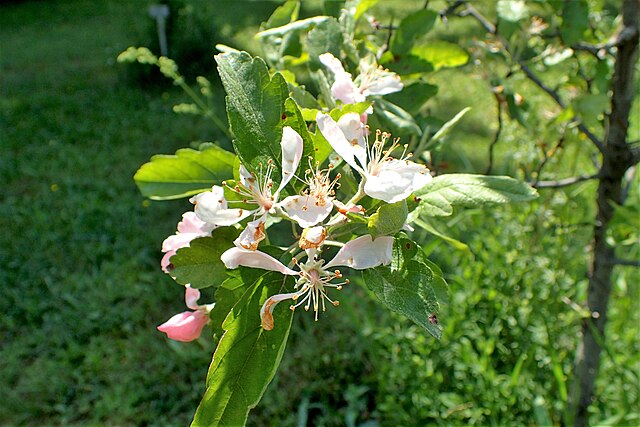
Malus ioensis, commonly known as Prairie Crabapple, Iowa Crabapple, or Wild Crabapple, is a beautiful and ecologically valuable native small tree of the Midwest prairies and woodlands. Growing 20 to 30 feet tall with a broad, irregular crown and arching branches, Prairie Crabapple produces some of the most intensely fragrant spring flowers of any native North American tree — deep pink buds that open to delicate pale pink blossoms with a rich, intoxicating scent that perfumes the surrounding landscape for weeks in April and May. Few native trees combine ornamental beauty, wildlife value, and ecological significance as effectively as this under-appreciated Midwestern native.
The Prairie Crabapple occupies an interesting position in both North American botanical history and horticulture. It is the parent species of the celebrated ‘Bechtel’ crabapple cultivar (Malus ioensis ‘Plena’), a stunning double-flowered form discovered in Illinois in the 1850s that became one of the most popular ornamental trees in American gardens during the Victorian and Edwardian eras. Nurseries across the country grew and sold ‘Bechtel’ crabapple by the tens of thousands in the late 1800s and early 1900s, and it remains available today — yet the wild parent species from which it sprang is rarely planted and little known outside of native plant circles. This represents a significant missed opportunity, as the straight species offers nearly equivalent ornamental value plus ecological benefits that the cultivar cannot provide.
Beyond its spring flowers, Prairie Crabapple provides year-round interest and ecological value. Its small, tart yellow-green to russet fruits — technically pomes, not true crabapples of introduced species — persist well into winter and are consumed by dozens of bird species and mammals. The dense, suckering growth habit creates valuable thicket structure that serves as critical nesting cover and shelter for wildlife across the Midwest. As a member of the rose family (Rosaceae), the tree is also a host plant for numerous native moth and butterfly larvae, adding to its value in wildlife gardens and prairie restorations.
Identification
Prairie Crabapple is a small, irregularly-shaped tree or large shrub that often develops a leaning, multi-stemmed form. It can be distinguished from other crabapples — including introduced Asian species widely planted in American landscapes — by its native range, the hairiness of its leaf undersides, and the modest size of its fruit.
Bark & Branches
The bark is grayish-brown, developing shallow, scaly furrows with age. Young branches are smooth and gray-green; older wood becomes rougher with a somewhat shaggy, flaking surface. A distinctive feature is the presence of short, spur-like lateral shoots on older branches that can develop pointed tips and appear somewhat thorny — particularly on branches in full sun. These “thorns” (actually short spur shoots) are not as sharp or prominent as those of hawthorn species but contribute to the plant’s value as a protective thicket for wildlife. Prairie Crabapple commonly suckers from the roots, forming multi-stemmed clumps or small thickets over time — a habit that contributes to its wildlife value but may require management in formal landscape settings.
Leaves
The leaves are simple, alternate, and variable in shape — typically ovate to elliptic, 2 to 4 inches long, with coarsely toothed margins. On vigorous new growth, the leaves are often shallowly lobed (3 to 5 lobes), while leaves on older growth may be unlobed. The upper surface is dark green and smooth; the lower surface is distinctly hairy (pubescent) throughout the growing season, a key distinguishing feature from many introduced ornamental crabapples whose leaf undersides lose their hairiness by summer. In autumn, the leaves turn yellow, occasionally with orange tints, before dropping.
Flowers & Fruit
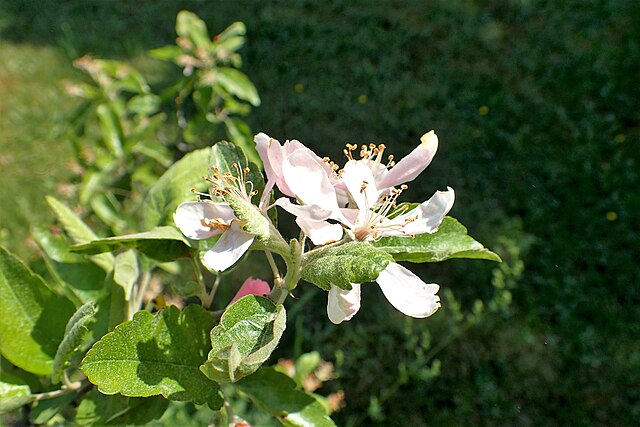
The flowers are among the most beautiful of any native North American tree. They open from deep rose-pink buds to 5-petaled blossoms 1 to 1½ inches across, pale pink to nearly white when fully open, with a powerful sweet fragrance that is often described as reminiscent of roses or apple blossoms but distinctly richer and more complex. Flowers appear in April and May — typically with or just after the leaves emerge — in clusters of 3 to 6 blooms. The bloom period typically lasts 2 to 3 weeks. The fruit is a small pome (miniature apple), ½ to 1½ inches in diameter, yellowish-green to waxy yellow or russet, extremely tart and astringent when fresh but softening and becoming more palatable after the first fall frost. Fruits mature in September and October and often persist through winter if not consumed by wildlife.
Quick Facts
| Scientific Name | Malus ioensis |
| Family | Rosaceae (Rose) |
| Plant Type | Deciduous Tree / Large Shrub |
| Mature Height | 20–30 ft |
| Sun Exposure | Full Sun |
| Water Needs | Low to Moderate (Drought Tolerant when established) |
| Bloom Time | April – May |
| Flower Color | Deep pink (bud) to pale pink/white (open); intensely fragrant |
| Fruit Color | Yellowish-green to russet; ½–1½ in diameter |
| USDA Hardiness Zones | 2–6 |
Native Range
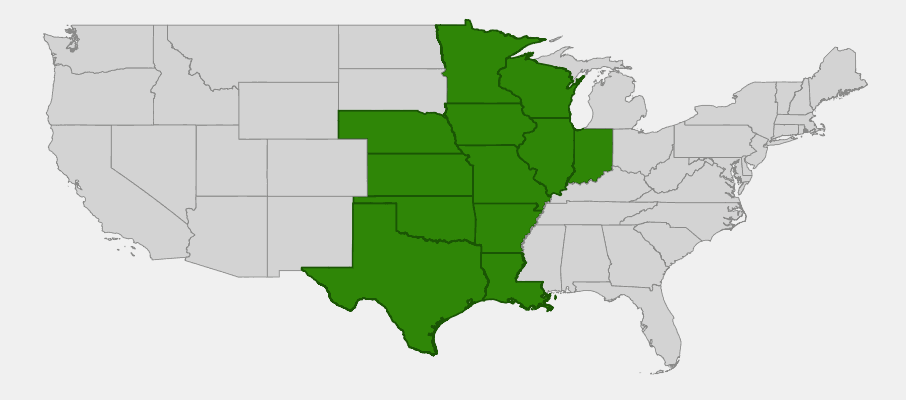
Prairie Crabapple is a Midwestern native with a relatively restricted natural range centered on Iowa, Missouri, and Illinois — the heart of the American prairie. Its range extends from Nebraska and Kansas in the west to Indiana and Wisconsin in the east, and from Minnesota in the north to Texas, Arkansas, and Louisiana in the south. Within this range, it is most frequently found at the edges of prairies, in open woodlands, along stream banks and woodland margins, and in disturbed upland areas — habitats where it receives full sun or light partial shade and can establish its suckering clonal growth.
Despite the species epithet ioensis (meaning “of Iowa”), Prairie Crabapple is widespread throughout much of the Midwest and is not restricted to Iowa. The name was applied because the original specimen used to formally describe the species was collected in Iowa. The species is most commonly found in the transition zones between prairie and forest — what ecologists call the forest-prairie ecotone — where fire historically maintained open conditions and prevented the complete closure of the forest canopy. With the suppression of prairie fires across the Midwest over the past two centuries, Prairie Crabapple has in many areas expanded into formerly open prairie as woody vegetation encroaches on grassland habitats.
Prairie Crabapple’s tolerance for both dry and moderately moist soils allows it to colonize a range of habitats from dry upland prairie edges to moist stream margins. In Nebraska and Kansas, it is found primarily in the eastern portions of both states where the climate is more humid and woodland habitats are more common. Its range in the western Great Plains is limited by the transition to a more arid climate that favors grasses over woody species.
📋 Regional plant lists featuring Prairie Crabapple: Nebraska & Kansas
Growing & Care Guide
Prairie Crabapple is an adaptable, relatively easy-to-grow native tree that rewards the gardener with spectacular spring blooms, wildlife-attracting fruit, and year-round structural interest. While it does not quite match the disease resistance of some modern crabapple cultivars, it is reasonably robust and becomes increasingly self-sufficient once established in a suitable site.
Light
Prairie Crabapple requires full sun to produce its best spring flower display and maximum fruit set. Plants in partial shade (3–5 hours of direct sun) will grow and bloom, but with fewer flowers and reduced fruit production. Ensure adequate sunlight to promote good air circulation through the canopy — this also reduces susceptibility to fungal diseases including apple scab (Venturia inaequalis), the most common disease issue affecting crabapples.
Soil & Water
This species demonstrates impressive soil adaptability. It grows well in both dry, well-drained soils and moderately moist conditions, making it suitable for a wide range of garden situations. Avoid poorly drained, waterlogged soils, which promote root rot and fungal diseases. While it tolerates drought after establishment, consistent moisture during the first two growing seasons helps the plant establish quickly. Average garden soil without excessive fertilization produces the best results — overly rich, nitrogen-heavy soils promote succulent growth that is more susceptible to disease.
Planting Tips
Plant in full sun in spring or fall. Container-grown trees transplant easily; balled-and-burlapped specimens also perform well. Incorporate a 2–3 inch layer of wood chip mulch around the base (keeping mulch away from the trunk) to conserve moisture and moderate soil temperature. If you prefer to prevent suckering, monitor the root zone and remove suckers as they emerge — though allowing some suckering creates the natural thicket form that is most valuable for wildlife.
Pruning & Maintenance
Prune in early spring before bud break to remove dead or crossing branches and maintain desired form. Avoid heavy pruning in summer, which can invite disease. If managing as a single-trunked tree, remove suckers regularly. To identify and remove any apple scab-infected leaves, rake and dispose of fallen leaves in autumn rather than leaving them to overwinter on the ground beneath the tree. In most years and well-sited plantings, disease pressure is manageable and does not significantly affect the tree’s long-term health.
Landscape Uses
- Spring flowering specimen tree — perhaps the most fragrant native spring tree in the Midwest
- Wildlife thicket — allow suckering to create dense cover for birds
- Prairie edge planting — natural companion to native grasses and prairie wildflowers
- Hedgerow — excellent when planted in rows for property screening and wildlife corridors
- Native fruit garden — fruit can be used for jams, jellies, and cider
- Pollinator garden — early-season bee magnet
Wildlife & Ecological Value
Prairie Crabapple is one of the highest-value wildlife trees of the Midwest. Few native trees provide so many different types of ecological benefit — from early spring nectar for pollinators to late-winter fruit for overwintering birds.
For Birds
The fruit of Prairie Crabapple is consumed by an extraordinary diversity of birds. Cedar Waxwings, American Robins, and Eastern Bluebirds feed heavily on the fruit in fall and winter; Ruffed Grouse, Ring-necked Pheasants, and Bobwhite Quail feed on fallen fruit; and small songbirds including American Goldfinches and various sparrows pick at overwintered fruits that have softened and fermented on the tree. The fruit that persists through winter — especially after hard freezes that soften the astringent flesh — can be a lifesaving food source for birds during extended cold spells when other food sources are exhausted. The dense, branching structure of Prairie Crabapple thickets also provides excellent nesting sites for Gray Catbirds, Brown Thrashers, and Yellow Warblers.
For Pollinators
Prairie Crabapple is one of the best early-season bee plants in the Midwest. Its flowers open in April and May, providing abundant nectar and pollen at a time when many native bees have recently emerged and food sources are still limited. Bumblebee queens (Bombus spp.), Orchard Mason Bees (Osmia lignaria), mining bees (Andrena spp.), and numerous other native bee species visit the flowers intensively. Managed honeybee colonies also benefit substantially from crabapple bloom. Prairie Crabapple is considered one of the best apple-family trees for supporting early-season native bee populations in Midwestern landscapes.
For Insects & Host Plant Value
As a member of the apple tribe (Maleae), Prairie Crabapple is a host plant for the larvae of numerous native moths and butterflies. The Cecropia Silk Moth (Hyalophora cecropia) — the largest moth in North America — regularly uses crabapple species as a larval host. Tiger Swallowtail (Papilio glaucus) and several species of hairstreak butterflies also use apple-family plants. Native plant ecologist Doug Tallamy has documented over 300 insect species associated with apple-genus plants in North America, making Prairie Crabapple one of the highest-value native trees for supporting insect biodiversity.
Cultural & Historical Uses
Prairie Crabapple was an important food plant for Indigenous peoples of the Midwest, particularly the Potawatomi, Sauk, Meskwaki, Omaha, and Ponca nations. The small, tart fruits were consumed fresh after frost (when astringency diminishes), dried for winter storage, cooked into sauces and preserves, and mixed with other foods in pemmican-like preparations. The Cherokee used the bark medicinally to treat fevers and as a tonic. Several Great Plains nations used the hard, dense wood for tool handles, bows, and other implements where a strong, flexible wood was needed.
European settlers quickly recognized the Prairie Crabapple’s ornamental potential. The tree’s spectacular fragrant flowers made it a natural candidate for orchard cultivation and garden use, and the discovery of the double-flowered ‘Bechtel’ crabapple form in Illinois in the 1850s launched an era of enthusiastic cultivation that placed Malus ioensis at the center of American ornamental horticulture for several decades. By the late 19th century, ‘Bechtel’ crabapple was being shipped across the country by nurseries, and it remains one of the most widely recognized native plant cultivars in American horticultural history. The wild species was also used as rootstock for apple cultivars grown in the harsh winters of the northern Great Plains, where it provided superior cold hardiness and disease resistance compared to European apple rootstocks.
Today, Prairie Crabapple is experiencing renewed interest as part of the broader native plant movement. Its ornamental qualities — fragrant spring flowers, persistent fruit, and wildlife value — compare favorably with introduced ornamental crabapples from China, Japan, and Europe that dominate contemporary nursery offerings. For gardeners in Nebraska, Kansas, Iowa, and the surrounding region who want the most beautiful spring-flowering tree possible while also supporting native wildlife, Prairie Crabapple represents an excellent choice that honors both ecological values and horticultural traditions of the American Midwest.
Frequently Asked Questions
Are Prairie Crabapple fruits edible?
Yes, but the raw fruit is very tart and astringent — most people find it unpleasant to eat directly off the tree. However, after frost softens the fruit (a process called “bletting”), the flavor improves considerably. The fruit is excellent for making jams, jellies, cider vinegar, and fruit leather. Native peoples and early settlers used them extensively in preserved and cooked forms. If you want sweeter, larger fruit, look for named cultivars of Prairie Crabapple such as ‘Klehm’s Improved Bechtel.’
How is Prairie Crabapple different from ornamental crabapples sold at garden centers?
Most ornamental crabapples sold at garden centers are cultivated varieties of Asian species (Malus spp. from China and Japan) or complex hybrids. Prairie Crabapple (Malus ioensis) is a North American native species. Key differences include: native origin (supports local insects and food webs), hairy leaf undersides, extremely fragrant flowers (many ornamental crabapples have little fragrance), and tolerance for the extreme cold winters of the northern Great Plains.
Does Prairie Crabapple get apple scab?
Yes, Malus ioensis is susceptible to apple scab (Venturia inaequalis), a fungal disease that causes spotted leaves and premature leaf drop in humid years. Selecting the ‘Klehm’s Improved Bechtel’ cultivar, providing excellent air circulation, avoiding overhead watering, and raking fallen leaves in autumn can significantly reduce disease pressure. In most years, scab causes cosmetic damage but does not seriously harm the tree’s long-term health.
Will Prairie Crabapple grow in Kansas or Nebraska?
Absolutely. Prairie Crabapple is hardy to Zone 2 and thrives throughout Nebraska and Kansas. It is adapted to the cold winters, hot summers, and variable precipitation of the region. In eastern Nebraska and Kansas it is a native species; in western parts of these states it can be planted as a hardy ornamental though it may not be found naturally occurring there.
How do I prevent suckering?
Regular mowing around the base and manual removal of suckers as they emerge will keep the plant to a single-trunked tree form. For thicket-form plantings, allow the suckers to grow — the resulting multi-stemmed clump is actually more valuable for wildlife. Note that many small birds specifically prefer dense, thorny thickets for nesting and escape cover.